
How to Start a Nonprofit Organization That Lasts
This article was assisted with AI. We may include links to partners.
You have an idea that could change your community. That passion is the spark, but turning it into a lasting nonprofit organization requires a solid plan. This guide provides actionable steps to test your idea, navigate the legal requirements, and build a foundation that can truly make an impact.
Laying the Groundwork for Your Mission

A successful nonprofit starts with a clear purpose. Before filing paperwork or choosing a name, you must confirm your idea is needed. This validation is what will convince your first supporters, board members, and funders to join you.
This early phase is about moving past assumptions to find out if the need you see is real and unaddressed in the community you want to serve.
Validate Your Idea with a Needs Assessment
A common mistake is creating a solution for a problem that doesn't exist—or one another organization already handles well. A needs assessment is your reality check, providing evidence that your nonprofit is genuinely necessary.
Here’s an actionable plan to conduct one:
- Talk to people. Go into the community you want to help and have real conversations. Conduct interviews or small focus groups. Ask about their biggest challenges, what support they lack, and what solutions they believe would work.
- Dig into the data. Find local government reports, community health studies, or university research related to your cause. These documents provide statistics that quantify the problem you want to solve.
- Map the landscape. Research every other organization in your space. Are they serving the same people? Look for gaps. Perhaps their waitlists are long, or they don’t serve a specific neighborhood. Finding that gap is where your nonprofit can fit.
This research gives you the data and compelling stories you'll need for every grant application and donor pitch.
Define Your Guiding Principles
Once you've confirmed the need, put your purpose into words with two key statements. These will act as the compass for every decision your organization makes.
Your mission statement is your "what" and "how." It’s a short, clear sentence explaining what your organization does. For example: "To provide hot meals and shelter placement services for homeless individuals in downtown Springfield."
Your vision statement is your "why." It describes the ideal future you're working toward. For the same organization, the vision might be: "A future where every person in Springfield has a safe place to call home."
Getting these right is foundational. For more help, explore this resource on crafting a strong nonprofit organization mission statement. These statements are the heart of your brand. To go deeper, check out our guide on how to create a brand for your new organization.
The good news is that a proven model for success exists. The IRS recognizes around 1.5 million 501(c)(3) organizations in the U.S. This ecosystem offers best practices to follow, proving that nonprofits are a powerful way to meet community needs, whether in human services (which makes up 29.25% of all registered nonprofits), education, or health.
Navigating the Legal and Governance Maze
With a powerful mission, it’s time to build the formal structure that will bring it to life. This is where your idea becomes a legal entity. These technical steps are manageable and essential for creating a framework for your operations and accountability.
Your first major step is incorporation. This process establishes your nonprofit as a legal corporation in your state. It's critical because it creates a legal shield between the organization and you, the founder. This means your personal assets are protected from the nonprofit's debts and legal actions.
Incorporation makes your nonprofit "real" in the eyes of the law, the IRS, and major donors.
Assembling Your Founding Board of Directors
Before you file paperwork, you need a founding board of directors. This is not just a list of names; this group is your initial brain trust, your first champions, and the backbone of your governance. A strong, engaged board is one of the most reliable predictors of a nonprofit's long-term success.
Your board members are legally responsible for the organization. They have a fiduciary duty—a legal obligation to act in the nonprofit's best interests. This breaks down into three core responsibilities:
- Duty of Care: They must be informed and actively participate in decision-making.
- Duty of Loyalty: The organization's interests must always come before their personal or professional gain.
- Duty of Obedience: They are responsible for ensuring the organization sticks to its mission, follows its bylaws, and obeys all laws.
Actionable Tip: Don't just recruit passionate friends. Assemble a board with a strategic mix of skills. Aim for a diverse group including people with experience in finance, law, marketing, fundraising, and, crucially, someone with deep connections to the community you serve.
Filing Your Articles of Incorporation
Once your board is assembled, you will file your Articles of Incorporation with your state's Secretary of State office. This document officially creates your nonprofit corporation. While specifics vary by state, it will almost always include:
- Your Nonprofit's Name: It must be unique in your state. Check availability on your Secretary of State's website.
- A Statement of Purpose: This section is critical. It must contain specific language required by the IRS to qualify for 501(c)(3) status, stating your organization is formed for charitable, educational, or similar purposes.
- Registered Agent Information: You must name a registered agent—a person or service designated to receive official legal mail for your nonprofit.
- Board of Directors Information: The names and addresses of your initial board members are typically required.
While most nonprofits are corporations, there are other structures. To learn more, see our guide on understanding business structure types and their pros and cons.
Drafting Your Bylaws
If the Articles of Incorporation are your nonprofit's birth certificate, your bylaws are its operating manual. This internal document is the rulebook for how your organization will be governed. Getting this right prevents future conflicts and ensures smooth operations.
Your bylaws must clearly define:
- Roles, responsibilities, and term limits for board members.
- Procedures for electing board members and officers.
- Rules for board meetings (e.g., how often they occur, how many people must be present to vote).
- The process for handling potential conflicts of interest.
- How the bylaws themselves can be amended.
Well-crafted bylaws provide the clarity and structure your board needs to govern effectively.
To help map out this legal journey, here’s a look at the key steps and estimated timelines.
Key Legal Milestones and Estimated Timelines
| Milestone | Purpose | Estimated Timeline |
|---|---|---|
| Recruit Founding Board | Assemble the initial leadership team required for incorporation. | 2-8 weeks |
| File Articles of Incorporation | Officially create the nonprofit as a legal corporation in your state. | 1-4 weeks |
| Draft and Adopt Bylaws | Establish the internal rules and procedures for governance. | 1-3 weeks |
| Obtain EIN | Get a federal tax ID number, necessary for banking and IRS filings. | Minutes (online) |
| Open a Bank Account | Establish a dedicated account for all nonprofit funds. | 1-2 days |
These timelines are estimates and can vary based on your state's processing times.
Securing Your Employer Identification Number
The last piece of the initial legal puzzle is getting an Employer Identification Number (EIN) from the IRS. An EIN is like a Social Security Number for your organization.
You absolutely need an EIN to:
- Apply for 501(c)(3) tax-exempt status.
- Open a bank account in the nonprofit's name.
- Hire any employees.
Actionable Tip: Applying for an EIN is free and can be done online in minutes through the IRS website. Complete this step as soon as you are incorporated to keep your momentum going.
Securing Your 501(c)(3) Tax-Exempt Status
You’ve built the legal framework for your nonprofit. Now comes the most important step: getting official 501(c)(3) status from the IRS.
This designation makes your organization tax-exempt and, crucially, allows your donors to make tax-deductible contributions. For most nonprofits, this is the key that unlocks serious fundraising, from individual gifts to major foundation grants.
The application process is detailed but manageable if you break it down. Your goal is to tell the IRS a clear story proving your organization exists for the public good.
Before you start this application, you need your Employer Identification Number (EIN).
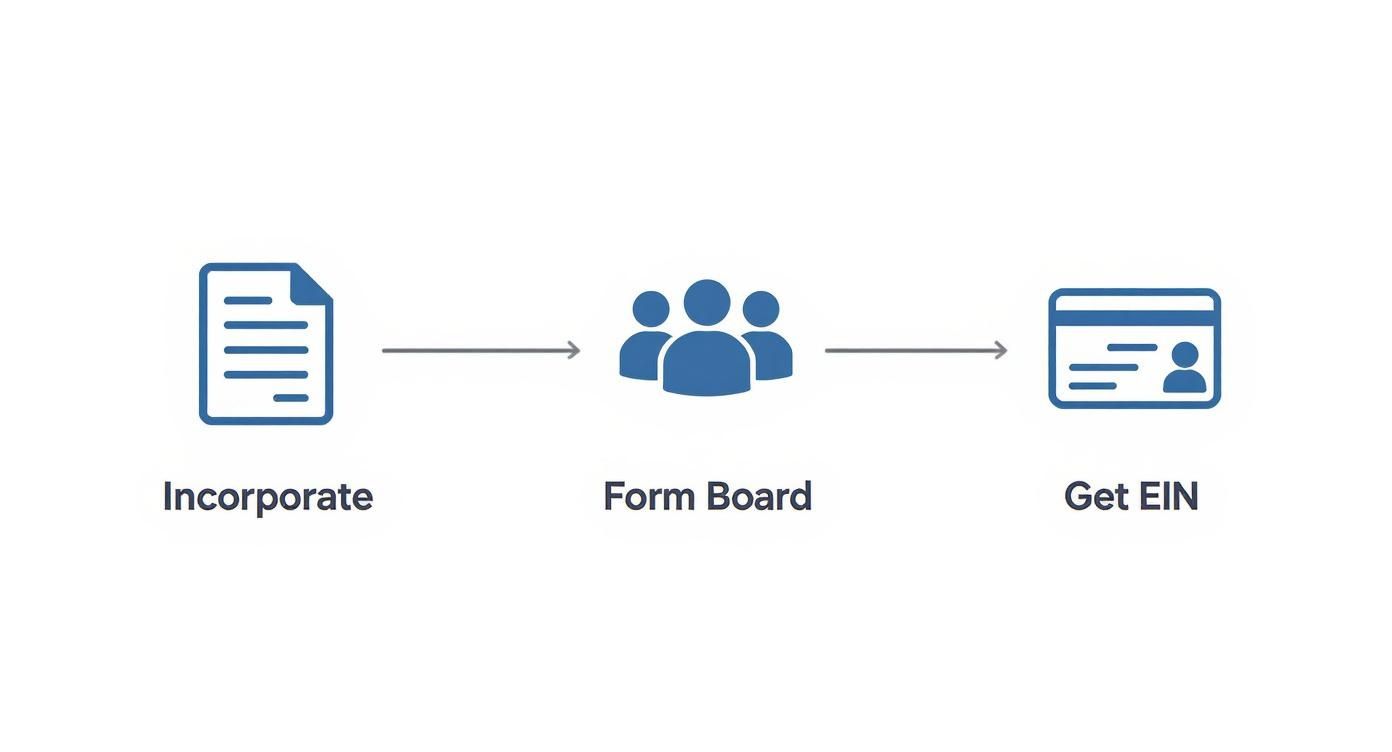
As the diagram shows, obtaining your EIN is the final step after incorporating and forming your board, right before you start the 501(c)(3) paperwork.
Choosing the Right Application Form
The IRS offers two paths to 501(c)(3) status. Choosing the right one saves time and money. The choice depends on your organization's projected finances.
- Form 1023-EZ: A shorter, online application for smaller organizations. You may be eligible if you project your annual gross receipts will be under $50,000 for the next three years and your total assets are under $250,000. The filing fee is $275, and approval is often faster (a few months).
- Form 1023: The full application for all other organizations. It requires a detailed narrative about your programs and finances. The fee is $600, and the wait time can be 6 to 12 months.
Actionable Tip: Be honest with your projections. Choosing the 1023-EZ when you don't qualify will lead to delays or rejection.
Public Charity vs. Private Foundation
During the application, you must classify your organization as either a public charity or a private foundation. This distinction dictates your funding rules.
Almost every new nonprofit founder aims to be a public charity.
Public charities get support from a broad base: the public, government grants, and other charities. Private foundations are typically funded by a small group, like a single family, and operate under stricter rules.
To qualify as a public charity, you must pass the "public support test." This simply means proving that at least one-third of your financial support over five years will come from a diverse mix of public sources.
Crafting a Compelling Narrative for the IRS
The core of your Form 1023 application is the narrative describing your organization's activities. This is your chance to connect your programs directly to your charitable mission. Avoid vague language.
Don't just say, "We will help at-risk youth."
Instead, be specific: "We will run an after-school tutoring program for 50 middle schoolers in the Lincoln Park neighborhood. The program will operate three days a week, focusing on improving math and literacy skills with the help of volunteer tutors."
Your application needs to include:
- Detailed Program Descriptions: Explain what you will do, who you will serve, and how each activity advances your tax-exempt purpose.
- Financial Projections: Submit a realistic three-year budget based on your research. Detail expected revenue (donations, grants) and expenses (salaries, rent, supplies).
- Fundraising Plans: Explain how you will raise money. Will you use online campaigns, apply for grants, or host events? The IRS needs to see a viable plan.
Actionable Tip: Gather your Articles of Incorporation, bylaws, and financial data before you start the application. A well-prepared, thorough application is your best strategy for a smooth approval.
Building Your First Financial and Fundraising Plan
Your mission is the heart of your nonprofit, but a smart financial plan is the engine. With your legal paperwork in motion, it’s time to get serious about money. This is about building a sustainable financial strategy to launch strong and thrive for years.
First, get brutally honest about your startup costs. A detailed budget is non-negotiable. Think of it as your financial roadmap for year one.
Crafting Your Initial Startup Budget
This budget is your launch-day shopping list. Track every anticipated expense, no matter how small, so you aren't blindsided later. This detail is what potential funders want to see.
A realistic startup budget covers these key areas:
- One-Time Legal & Filing Fees: List your state incorporation fee and the IRS Form 1023 filing fee ($275 for the EZ or $600 for the full form).
- Essential Software & Tools: Include accounting software (like QuickBooks for Nonprofits) and a donor management system.
- Website & Marketing: Budget for a domain name, website hosting, and simple launch materials.
- Program Supplies: List everything you physically need to run your first program, from office supplies to specialized equipment.
- Insurance: You may need General Liability or Directors & Officers (D&O) insurance from the start.
Actionable Tip: A detailed, well-researched budget isn't just a spreadsheet. It’s a signal to donors that you are a serious leader they can trust with their investment.
Diversifying Your Revenue Streams
Now, map out where the money will come from. Relying on a single income source is risky. The organizations that last build a diverse mix of revenue streams for stability.
While individuals gave 67% of the $557.16 billion donated to charity in 2023, the full picture is bigger. Nonprofits actually earn over 80% of their total revenue from program service fees (49%) and government grants (32%). This data, highlighted in these nonprofit fundraising statistics on doublethedonation.com, shows why a mixed strategy is critical.
Start exploring these funding avenues:
- Individual Donations: The lifeblood for most new organizations. Your first campaign should target your "inner circle"—friends, family, and colleagues.
- Grant Funding: Start by researching local community foundations and smaller family foundations. They are often more open to providing seed money to new, local organizations.
- Corporate Sponsorships: Approach local businesses whose values align with yours to sponsor a program or event in return for brand visibility.
- Earned Income: Can you charge a fee for any part of your service? An animal rescue could offer paid dog training classes, or an environmental group could host paid workshops.
Hosting family-friendly charity activities is a fantastic way to build awareness and attract new supporters.
Mastering Financial Management Basics
Finally, you need a system to manage money. In the nonprofit world, transparency and accountability are everything.
Your first two financial tasks are simple but critical.
- Open a Dedicated Nonprofit Bank Account: As soon as you have your EIN, open a business checking account in your nonprofit's legal name. Never mix personal and nonprofit funds. This protects you from personal liability and keeps your records clean.
- Set Up Basic Bookkeeping: You don't need to be an accountant, but you must track every dollar in and out. Simple accounting software can help you categorize income and expenses from day one. This habit is essential for creating financial reports, applying for grants, and filing your annual IRS Form 990.
Launching and Building Your Online Presence

With legal and financial foundations in place, it's time to shift from planning to doing. Before you announce your mission, there's one last crucial compliance step.
This is charitable solicitation registration. It's the law in about 40 states. Before you can legally ask for donations, you must register with the state’s charity official (usually the Attorney General's office).
Ignoring this can lead to fines. Since most nonprofits raise money online, this applies in every state where you actively ask for donations.
Your Essential Launch Checklist
A great launch is a coordinated effort to build momentum and bring your first supporters into the fold. Use a focused checklist to make a strong first impression.
- Announce Your Founding Board: Introduce the leaders guiding your mission to build credibility.
- Launch Your Website: Your digital headquarters must be live, professional, and ready to accept donations from day one.
- Stake Your Claim on Social Media: Get your organization’s name on relevant platforms and start telling your story.
- Send Your First Email Newsletter: Let your early contacts know you are officially open and how they can get involved.
- Kick Off Your First Program or Event: Nothing proves your worth like action. Start with a small-scale service or host a simple launch event to engage the community.
Actionable Tip: Your launch sets the tone for everything that follows. Use this chance to turn initial excitement into a foundation of donors, volunteers, and advocates.
Creating Your Digital Hub
Your website is your most critical asset for telling your story, building trust, and driving action. It must look professional, be clear, and be easy to use.
This doesn't mean you need an expensive web developer. Modern tools make it possible for anyone to build a powerful online presence without code.
An all-in-one platform like the Solo AI Website Creator is a game-changer for new nonprofits. It handles the essentials in one place, so you can focus on your mission.
Specifically, you can:
- Secure Your Domain Name: Instantly find and register a professional
.orgor.com. - Set Up Donation Forms: Seamlessly add secure, easy-to-use forms for online giving.
- Create Volunteer and Event Signups: Build simple forms or booking pages to manage volunteers, event registrations, or client appointments.
Getting Found from Day One
A great website is useless if no one can find it. This is where Search Engine Optimization (SEO) comes in. SEO is the practice of helping your site show up when people search for your cause on Google.
You don't need to be an expert to get the basics right. Think about what your supporters would type into Google. For an animal rescue, it might be "dog adoption in [Your City]" or "volunteer at an animal shelter."
Weave these key phrases naturally into the text on your main pages, like your homepage and "About Us" page. This simple step helps search engines understand what you do and show your site to the right people. For a deeper dive, our guide on nonprofit website best practices has more advanced tips.
Answering Your Top Questions About Starting a Nonprofit
As you get closer to launch, questions pile up. This is normal. The path to starting a nonprofit has common hurdles with straightforward answers. Let’s tackle the biggest questions new founders ask.
How Much Does It Really Cost to Get Started?
While the exact number varies by state, you can plan for a few core expenses.
The state incorporation fee typically runs between $50 and $200. Your biggest mandatory expense is the IRS filing fee for tax-exempt status: $275 for Form 1023-EZ or $600 for the standard Form 1023.
Actionable Tip: Beyond government fees, set aside a few hundred dollars for initial operations like your website domain, basic accounting software, and any state-level charitable registration fees.
Can I Actually Get Paid for My Work?
Yes, you can draw a salary as the founder or an employee. The key IRS rule is "reasonable compensation."
This means your salary must be comparable to what others earn in similar roles at nonprofits of a similar size, mission, and location.
Important: Your board of directors is legally responsible for setting and approving your salary. It's not a decision you can make yourself. This must be a formal, documented process to avoid any conflict of interest.
How Long Does It Take to Get IRS Approval?
The wait time for your 501(c)(3) determination letter depends on which application you file.
If you use the streamlined Form 1023-EZ, you could get approval in as little as 2-4 months.
If you file the long-form 1023, be prepared to wait 6 to 12 months. The timeline can be longer if the IRS has follow-up questions, which is why a thorough and clear application is your best strategy.
What's the Difference Between a Board Member and Staff?
Understanding this is fundamental to running a healthy nonprofit. They are two distinct roles.
- Board members are unpaid, volunteer leaders who provide strategic oversight. They are the guardians of the mission and have a legal duty to protect the organization's assets and ensure compliance. They govern; they do not manage day-to-day operations.
- Staff members are the paid employees doing the daily work. They run the programs, manage operations, and execute the board's strategic vision.
As a founder, you can also be a staff member, like the Executive Director. But even in that role, you are still accountable to the board of directors.
Ready to build your nonprofit's online home? The Solo AI Website Creator makes it easy to secure a domain, create donation forms, and launch a professional website in minutes. Start building for free at https://soloist.ai.
