Discover what is a custom domain: A quick guide
This article was assisted with AI. We may include links to partners.
A custom domain is a unique, branded address for your website, like yourcompany.com. Think of it as your own digital street address. It replaces generic, platform-provided URLs (e.g., yourcompany.platform.com) with a clean, professional name that you own and control. This simple change is crucial for building trust, making your brand memorable, and helping customers find you online.
What Is a Custom Domain
Imagine the internet is a massive city. A website is a building—a shop, an office, or a home. To find any of these places, you need an address. A custom domain is that unique, easy-to-remember address for your business online.
Without one, your website essentially uses a borrowed address. This is called a subdomain, and it looks something like apartment-2b.bigcomplex.com. While it works, it's long, hard to remember, and doesn't communicate professionalism. It makes it clear that your website is just a small part of a larger platform, not a standalone brand.
The Anatomy of a Custom Domain
Every custom domain has two main parts that work together to create your web address:
- Second-Level Domain (SLD): This is the unique, brandable part you choose. For
soloist.ai, our SLD is "soloist." - Top-Level Domain (TLD): This is the extension at the end, like .com, .org, or .ai. The TLD often suggests the website's purpose; for example, .com is the most common for commercial businesses.
This infographic clearly shows the difference between renting a digital space (a subdomain) and owning your own (a custom domain).
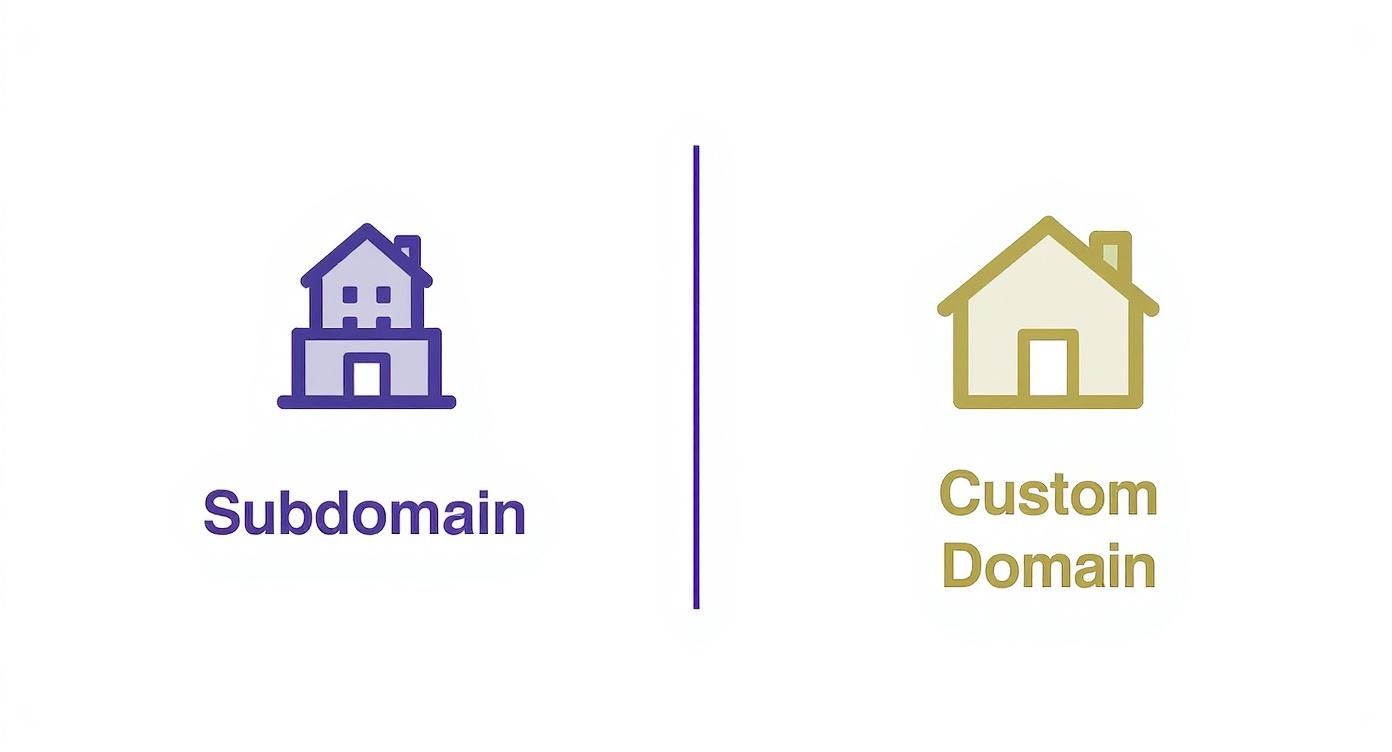
As you can see, a custom domain gives you a distinct, standalone identity. A subdomain, on the other hand, makes it clear you're just one small part of a larger, shared platform.
If you want to dig a bit deeper, understanding the difference between a domain name vs URL is a great next step. The key takeaway is that owning yourbrand.com puts you in the driver's seat of your digital identity, making your business instantly recognizable and building credibility from the very first click.
Subdomain vs Custom Domain At a Glance
To make it even clearer, let's break down the practical differences. This table gives you a quick side-by-side look at what you get with a free subdomain versus what you get when you invest in your own custom domain.
| Feature | Subdomain (e.g., yourname.platform.com) | Custom Domain (e.g., yourname.com) |
|---|---|---|
| Cost | Usually free with the platform | Annual registration fee (typically low) |
| Branding | Limited; platform's name is prominent | Full control; your brand is the focus |
| Credibility | Lower; can look amateur or temporary | Higher; appears professional and permanent |
| Memorability | Harder to remember and communicate | Easy for customers to recall and type |
| SEO | Less authority; tied to parent domain | Builds its own authority and ranking power |
| Cannot create a branded email address | Can create professional email ([email protected]) | |
| Ownership | You don't own it; tied to the platform | You own and control the asset |
Ultimately, while a subdomain is a decent starting point, a custom domain is a non-negotiable for any serious business looking to build a lasting, credible brand online.
The Real Benefits of Owning Your Digital Address
Getting a custom domain is like moving your business from a rented space to a prime piece of real estate you own. It's one of the most effective steps you can take to establish a serious, trustworthy online presence. This small annual investment immediately signals to customers that you are established and professional, unlike a free subdomain that can appear temporary or less credible.
Build Unforgettable Brand Recognition
Your domain is more than an address; it's a powerful marketing tool. A short, memorable domain reinforces your brand every time it's seen, shared, or typed into a browser.
For example, a local bakery called "Sweet Treats" benefits more from sweettreats.com than a long, clunky subdomain. The custom domain is simple, direct, and easy for customers to share with friends.
Actionable Tip: Use your custom domain everywhere. Put it on your business cards, social media profiles, and email signature. This consistency builds a professional and cohesive brand identity across all your marketing channels.
As of early 2025, there are roughly 368 million registered domain names across the globe, with 4.4 million new ones added in 2024 alone. That growth shows just how essential a unique domain has become for standing out and building credibility online.
Gain a Crucial SEO Advantage
Search engines like Google view websites with custom domains as more authoritative. Owning your domain allows you to build domain authority over time, a key factor that helps your content rank higher in search results. This means that as you add valuable content, your custom domain accumulates credibility, making it easier for new customers to find you through search.
Understanding what white label software is shows how owning your digital address empowers your brand even further, letting you put your own stamp on third-party solutions.
Ultimately, a custom domain gives you:
- Complete Control: This is your digital asset. You can move your website to any hosting provider or platform, like the Solo AI Website Creator, without losing your brand identity.
- Professional Email: You can create branded email addresses like
[email protected]. This looks far more professional to clients than a generic Gmail or Yahoo address. - Future Flexibility: Your domain is ready to grow with your business. Whether you add a blog, an online store, or new services, it all lives under your consistent, branded address.
How to Choose the Perfect Domain Name

Choosing a custom domain is a critical first step for your brand. A great name sticks in your customers' minds, while a confusing one can send them to a competitor.
The best domains are short, simple, and easy to spell. Avoid hyphens, numbers, or complex words that are difficult to type or say. For example, freshbakes.com is clean and clear. An alternative like fresh-bakes-4u.com creates unnecessary confusion and is harder to share via word-of-mouth.
Make It Brandable and Relevant
Your domain should instantly communicate what your business does. Including a relevant keyword can improve your SEO and tell visitors what you offer. For example, a plumber in Oakville could use a name like oakvilleplumbingpros.com.
If you're stuck for ideas, try using a domain name ideas generator to spark inspiration. The goal is a name that is both unique to your brand and descriptive of your services.
Actionable Tip: Say your potential domain name out loud. Is it easy to pronounce? Could it be misunderstood? A strong domain name is intuitive—people should be able to guess the spelling after hearing it, which is a huge asset for word-of-mouth marketing.
Choose the Right Domain Extension
The part at the end of your domain, like .com or .store, is the Top-Level Domain (TLD). While .com is the most recognized and often the best choice for businesses, it's not your only option.
Different extensions can be used strategically:
- .com: The gold standard. It's trusted, familiar, and ideal for most commercial businesses.
- Country-Code TLDs (e.g., .ca, .uk): Perfect for targeting a specific country. They build local trust and show you're part of the community. With 142.9 million country-code domains registered worldwide, it's clear people love a local web address. You can dive deeper into these trends with domain name statistics on Hostinger.com.
- Newer TLDs (e.g., .tech, .store): These can help your brand stand out and instantly define your niche. A name like
byteflow.techfor a software company is modern and descriptive.
Getting Your Domain with Solo AI Website Creator
So, you understand what a custom domain is and have an idea for a name. What's next? In the past, you would need to go to a separate company called a domain registrar, which could be a confusing and technical process.
Fortunately, modern platforms like the Solo AI Website Creator integrate domain registration directly into the website creation process. This eliminates the technical hurdles, allowing you to secure your professional online address in just a few minutes, all in one place. You can go from brainstorming a name to owning yourbrand.com without needing to open another browser tab.
It's a Simple Three-Step Process
Getting your custom domain with the Solo AI Website Creator is straightforward. The platform handles all the technical details for you.
Here’s how it works:
- Brainstorm and Search: Inside the creator, type your desired domain name into the search bar. The system will immediately check its availability and suggest smart alternatives if it's taken.
- Choose Your Perfect Match: Review the list of available domains. Your ideal
.commight be available, or a more creative option like.storeor.photomight be a better fit for your brand. Select the one that best represents you. - Finalize and Own It: Follow the simple prompts to complete the registration and purchase. That’s it! The domain is now yours and will be automatically connected to your new website.
This integrated approach is designed to be efficient. By combining website creation and domain registration, you can launch your professional site faster, confident that everything is set up and working correctly from the start.
If you want to see the platform in action, you can learn more about how to meet the Solo AI Website Creator and discover how it simplifies the entire journey of getting online.
Looking Beyond Dot Com Domain Extensions

While .com is the most popular domain extension, it's far from the only choice. When your first-choice .com is unavailable, exploring other extensions is a smart branding move, not just a backup plan. Alternative Top-Level Domains (TLDs) can tell visitors what your website is about before they even click, turning your domain into a strategic marketing tool.
Find Your Niche With a Modern TLD
Newer extensions are a great way to secure a short, memorable, and highly relevant domain name. A .photo domain is a clear choice for a photographer, while .io or .app immediately signals a business in the tech industry. This helps you stand out and instantly communicate your specialty. A domain like brilliantdesigns.art is more descriptive and memorable than a longer, compromised .com alternative.
The
.comextension still dominates with around 156 million registered domains, but its market share is definitely feeling the pressure. New TLDs authorized since 2012 are booming, showing an average 16% growth in 2024 alone. You can find more details in the latest domain industry data from Strategic Revenue.
For businesses targeting specific regions, a country-code TLD like .de for Germany or .ca for Canada is a powerful signal that builds instant local trust. With the Solo AI Website Creator, you can easily explore all these options and find the perfect fit.
Popular Domain Extensions and Their Uses
This table breaks down common TLDs to help you pick the right one for your website's purpose.
| Domain Extension (TLD) | Primary Use Case | Example |
|---|---|---|
| .com | The universal standard for commercial businesses. | yourbrand.com |
| .org | Primarily for non-profits and organizations. | charitywater.org |
| .store | Perfect for e-commerce and retail websites. | mystylish.store |
| .io | Popular with tech startups and SaaS companies. | analytics.io |
| .photo | Ideal for photographers and creative portfolios. | jane-doe.photo |
| .ca (ccTLD) | For businesses targeting a Canadian audience. | torontobikes.ca |
Choosing the right extension is a small detail that can make a big difference in how your audience perceives your brand right from the start.
Common Questions About Custom Domains
To wrap things up, here are answers to the most common questions about custom domains. These should clear up any remaining confusion and help you move forward with confidence.
Can I Get a Custom Domain for Free?
Yes and no. The domain itself requires an annual registration fee, but many website platforms include this as a promotion. For instance, when you subscribe to a plan with a tool like the Solo AI Website Creator, you often receive a free custom domain for the first year. This is a great perk that removes the initial cost of securing a professional domain.
How Long Does My Domain Registration Last?
Domain registration is typically managed on an annual subscription basis. You can register a domain for one year or lock it in for multiple years at a time.
Actionable Tip: Set your domain to auto-renew. If you let it expire, your website and any associated custom email addresses will stop working, making your business unreachable online. Most registrars offer an auto-renewal feature to prevent this.
What Happens If the Domain I Want Is Already Taken?
This is a common issue, but don't worry. If your first choice is unavailable, you have several practical options.
Here are a few actionable strategies:
- Try a Variation: Add a simple action word, like
getyourbrand.comoryourbrandhq.com. - Add Your Location: For local businesses, adding a city or state can work well (e.g.,
yourbrandnyc.com). - Explore New Extensions: A different TLD like
.co,.store, or.photomight be a perfect fit and even more descriptive for your business.
Can I Move My Custom Domain to Another Provider?
Yes. You own your custom domain name, meaning it is not permanently tied to one company. You can transfer it from one registrar or website platform to another at any time. The process typically involves unlocking your domain at your current provider and using an authorization code to initiate the transfer with your new one.
Ready to claim your own piece of the internet and get a professional website live in minutes? The Solo AI Website Creator makes it ridiculously simple. Get started for free and build the online presence your business deserves.
