 Let’s cut to the chase: Search Engine Optimization (SEO) is how you get your website found on Google. It's the process of making your site more appealing to search engines, so they show it to people who are actively looking for what you sell.
Think of it as the ultimate online word-of-mouth—without paying for ads.
Your Introduction to Search Engine Optimization
Imagine your bar's website is a brand-new, hidden gem of a speakeasy. You’ve got the best cocktails and a killer atmosphere, but if the front door is unmarked and down a back alley, nobody will find you.
SEO is the art of putting up a neon sign, listing your address in every local guide, and getting fantastic reviews.
So when someone pulls out their phone and searches for "best cocktail bar near me" or "local craft gin," Google acts as the bouncer, pointing them straight to your front door. It’s not about cheating the system. It’s about making it dead simple for Google to see what you’re all about and trust that you're the best answer for its users.
Why SEO Is Your Digital Megaphone
At the end of the day, SEO matters because it connects you with customers at the exact moment they’re ready to buy. It’s a powerful, sustainable way to drive a steady stream of the right kind of people to your website.
This all breaks down into a few key goals:
- Get Noticed: You want to show up on the first page of Google, not buried on page ten.
- Drive "Free" Traffic: Attract visitors who are already searching for you, which is far more effective thaninterrupting them with ads.
- Build Street Cred: A high ranking signals trust. People naturally assume the top results are the best and most reliable.
The numbers don't lie. SEO is responsible for over 53% of all website traffic—that’s more than any other source. And since 75% of users never even click to the second page of search results, being on top isn’t just a nice-to-have. It’s everything.
By getting these fundamentals right, you stop being a digital secret and start becoming a landmark. This guide will walk you through exactly how to build that foundation.
To get a better idea of what a strong digital storefront looks like, check out our insights on what makes a great website.
SEO at a Glance The Core Principles
To make this crystal clear, here’s a quick breakdown of what SEO really boils down to. Think of these as the three pillars holding up your online visibility.
| Principle | What It Means for Your Site | Why It Matters for Your Business |
|---|---|---|
| Technical Health | Is your website fast, secure, and easy for Google to "crawl" or read? This is the foundation. | A slow or broken site frustrates users and gets penalized by Google, making you invisible. |
| Content Quality | Are you creating useful, relevant content (like menus, event pages, blog posts) that answers your customers' questions? | This proves your expertise and gives people a reason to visit your site—and your establishment. |
| Authority & Trust | Are other reputable websites linking back to you? Do you have positive online reviews? | Links and reviews act like votes of confidence, telling Google that you're a legitimate and trusted business. |
Getting these three things right is the core of any successful SEO strategy. It’s a marathon, not a sprint, but the payoff is a steady stream of new customers finding their way to your door.
How Search Engines Find and Rank Your Content
Before you can get customers flocking to your website, you need to understand how search engines like Google even find it in the first place.
Think of Google as the world’s most organized, data-obsessed librarian. Its only job is to find, catalog, and then recommend the absolute best book (your webpage) to answer someone's question. This all happens in three key steps: Crawling, Indexing, and Ranking. Getting your head around these is the first real step in understanding what SEO is all about.
Stage One: Crawling
First up, Google sends out an army of little automated bots, known as "spiders" or "crawlers," to explore the entire internet. They jump from link to link, discovering new pages and checking for updates on old ones, 24/7.
Their mission is simple: find everything out there. For your bar or liquor brand, that means they’ll eventually crawl your homepage, your drinks menu, that "About Us" page, and any blog posts you write—as long as there’s a link pointing to it from somewhere.
Stage Two: Indexing
Once a crawler finds your page, it tries to figure out what it’s actually about. It scans your text, looks at your images, and analyzes everything it can to categorize it. All this info gets stored in a gigantic digital library called an index.
The index is Google’s master catalog of the internet. If your page isn’t in the index, it's invisible. Period. As far as a searcher is concerned, it doesn't exist.
This is exactly why having a clean, well-organized website is so critical. You have to make it dead simple for Google’s crawlers to read your content and file it away correctly. A messy, confusing site is like a book with a torn-off cover; the librarian has no idea where to shelve it, so it just gets lost.
Stage Three: Ranking
This is where the real action is. When someone types "whiskey bar downtown" into Google, the search engine instantly digs through its massive index to find every page that might be a good fit. Then, it uses a seriously complex algorithm to "rank" them, deciding the exact order you see them in.
This algorithm looks at hundreds of different signals to pick the winner. The entire point of SEO is to send all the right signals so that Google picks your content. The big ones are:
- Relevance: How well does your page match what the person is looking for? This comes down to the keywords you use and the topics you cover. It has to be a direct hit.
- Authority: How trustworthy is your site? Google figures this out by seeing how many other reputable websites link back to yours. Think of these links as votes of confidence from trusted sources.
- User Experience: Is your site a pain to use? Things like fast load times, being mobile-friendly, and having a clear layout tell Google that visitors will have a good time on your page, which it loves.
If you can get a handle on this three-step process, you can build a website that doesn't just get found by Google, but one that Google actively wants to recommend to your future customers.
The Three Core Pillars of a Strong SEO Strategy
Search engine optimization can feel like a beast with a million moving parts and a rulebook that changes every other Tuesday. But once you cut through the noise, you’ll find that every solid SEO strategy is built on just three core pillars.
Think of it like building a house: you need a solid foundation, strong walls, and a protective roof. You can’t skip one and expect the thing to stay standing.
This framework—On-Page, Off-Page, and Technical SEO—is your roadmap. It tells you exactly where to focus your time and money. Each part sends a different signal to search engines, and getting all three right tells Google that your website is the real deal—a trustworthy spot for its users.
On-Page SEO: Your Content and Keywords
On-Page SEO is everything you can directly control on your website. This is your menu, your event calendar, your "About Us" story. It’s the stuff your customers actually see and read. The goal here is simple: show Google exactly what each page is about and prove it’s the best answer for what someone is searching for.
You wouldn't just scribble "Drinks" on a chalkboard, right? You’d list "Craft Cocktails," "Local IPAs," and "Single Malt Scotch." On-page SEO is the same idea. It’s all about being specific.
Key activities include:
- Keyword Research: Figuring out the exact phrases your ideal customers are typing into the search bar.
- High-Quality Content: Writing genuinely helpful blog posts, detailed spirit descriptions, or event guides that solve a problem or answer a question.
- Title Tags & Meta Descriptions: Crafting the headlines and short summaries that show up in Google results. Make them punchy enough to earn the click.
- Header Tags (H1, H2, H3): Using headers to break up your text. This makes it scannable for humans and easy for search engine bots to understand the structure.
Off-Page SEO: Building Your Reputation
While On-Page SEO is what you say about yourself, Off-Page SEO is what the rest of the internet says about you. It's the digital version of word-of-mouth.
If a popular local food blogger writes a rave review and links to your bar’s website, that's a massive signal to Google. It's a vote of confidence from a trusted source, telling the search engine you're legit. These "votes" are called backlinks, and they are the heart and soul of Off-Page SEO.
A strong backlink profile is one of the most powerful ranking factors out there. Search engines see links from other credible, relevant websites as endorsements that boost your own authority.
This pillar isn’t just about links, though. It also covers things like managing your Google Business Profile reviews, social media buzz, and getting your brand mentioned in online articles.
Technical SEO: The Foundation of Your Site
Finally, there’s Technical SEO. This is all the behind-the-scenes stuff that makes your website work properly. Think of it as the plumbing and electrical wiring in your building. If your site is slow, buggy, or a nightmare for Google to navigate, it doesn't matter how great your content is.
This diagram shows how Technical SEO is the base that everything else sits on.
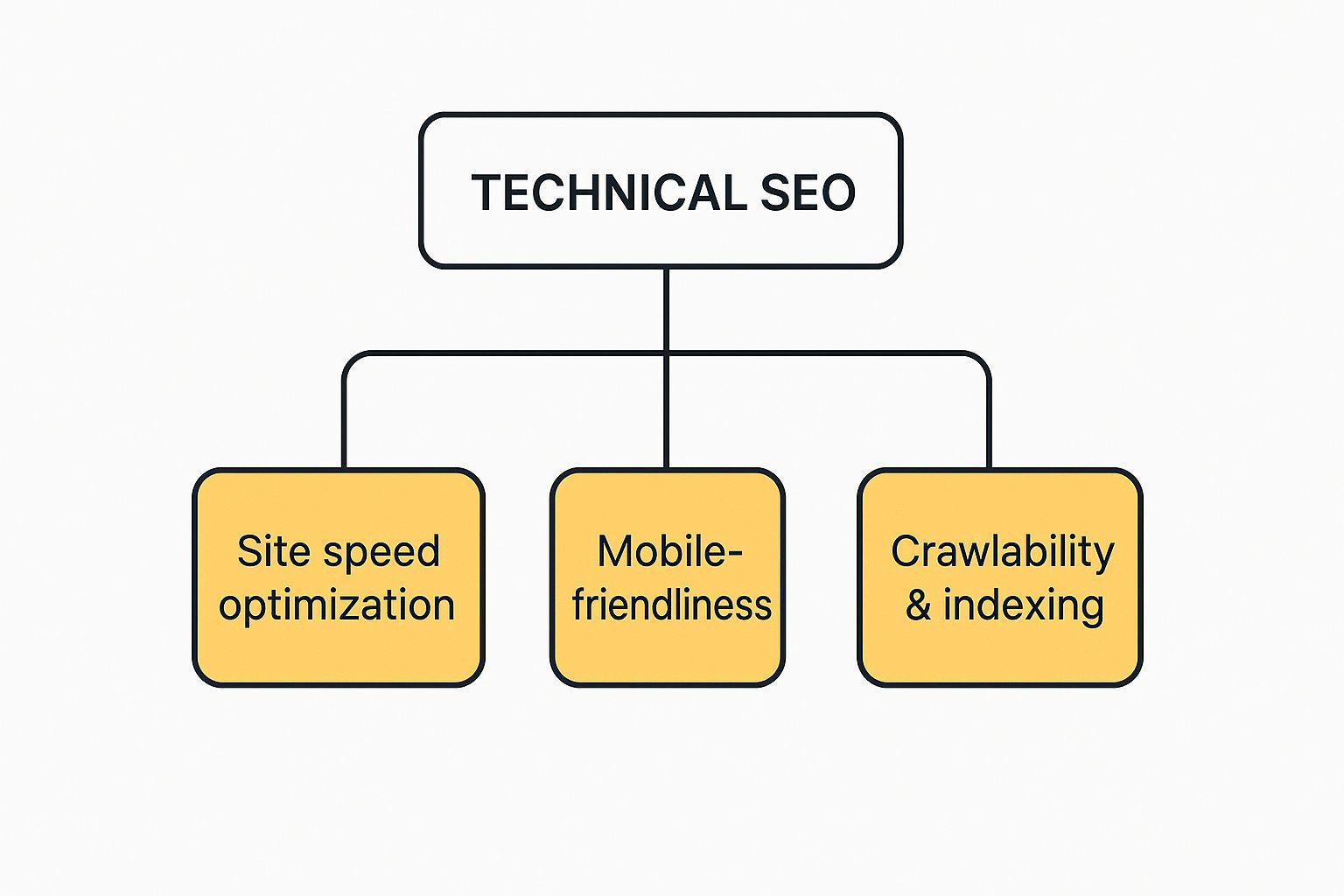
As you can see, things like site speed, being mobile-friendly, and having a clean structure aren't just nice-to-haves—they're the absolute foundation. If you want to make sure your site's foundation is rock-solid, it’s worth exploring some quality web development resources to get it right.
Nailing the technical side gives both your visitors and search engine crawlers a smooth ride, and that’s a non-negotiable for getting to the top of the search results.
To make it even clearer, let's break down how these three pillars compare.
On-Page vs Off-Page vs Technical SEO
| SEO Pillar | Primary Goal | Example Activities |
|---|---|---|
| On-Page SEO | Show search engines what your content is about. | Keyword research, writing blog posts, optimizing title tags, internal linking. |
| Off-Page SEO | Build your site's authority and trust. | Earning backlinks from other sites, managing online reviews, social media marketing. |
| Technical SEO | Make your site easy for search engines to crawl and index. | Improving site speed, ensuring mobile-friendliness, creating an XML sitemap. |
Each pillar has its own job, but they all work toward the same outcome: convincing search engines that your bar or brand deserves to be the top result.
Why SEO Is an Essential Investment for Growth
It’s one thing to know what SEO stands for. It’s another thing entirely to see it as the business-building powerhouse it is. SEO isn't just some techie task to check off a list; it’s one of the best, most sustainable marketing investments you can make.
Think about it. Old-school advertising interrupts people. SEO, on the other hand, puts you in front of people who are already looking for you.
When someone types "local craft distillery" or "best whiskey sour recipe" into Google, they have a mission. By showing up for those searches, you place your brand squarely in their path right when they're ready to act. It's a game-changer because you're not trying to convince someone they need you—you're just being the best answer when they've already decided they do.
Building Credibility and Trust on Autopilot
Showing up at the top of Google does more than just get you clicks. It builds instant credibility. People just trust Google’s organic results more than they trust the paid ads. A high ranking is like a nod from Google itself, telling searchers your business is a legit, go-to spot.
When you’re the first name that pops up, you become the default choice. This digital authority translates into real-world trust, making it way more likely that someone will visit your bar, buy your bottles, or book your space for an event.
SEO is the modern-day version of being the most recommended spot in town. It creates a cycle of visibility and trust that continuously feeds your business with qualified, high-intent customers, turning your website into a reliable revenue-generating asset.
This trust gets a huge boost from a good user experience. With over 60% of all searches now happening on mobile, Google switched to mobile-first indexing way back in 2017. Ever since, things like how fast your site loads have become huge ranking factors. Google rewards businesses that give people a smooth, fast online experience. You can learn more about the history of SEO and user experience from Landingi.
From Clicks to Customers: A Real-World Example
Let's ground this in reality. Picture a plumber who’s nailed their SEO for "emergency plumbing services" in their city. A homeowner’s pipe bursts at 2 AM. Are they casually browsing? Heck no. They're frantically searching for someone to fix it, right now.
By ranking on that first page, the plumber's website becomes a digital lifeline. Every single click from that search is a red-hot lead—someone with a massive problem who needs to hire a pro immediately. That’s how a smart SEO strategy goes beyond just traffic and starts driving real, measurable money into a business. That’s what search engine optimization is all about.
The Journey from Keywords to User Experience
To really get what SEO is today, you have to know where it started. Back in the day, the internet was basically the Wild West, and SEO was right there with it. The entire game was about outsmarting search engines, not actually helping people.
One of the go-to tricks was something called keyword stuffing. You’d just cram your target keyword onto a page over and over again. Sometimes it was hidden in text the same color as the background. It was a mess. The goal was to fool the algorithm into thinking your page was super relevant, even if it was complete garbage to a real person.
The Great Google Shake-Up
Then Google decided to clean house. It started rolling out massive algorithm updates designed to penalize all the sneaky tactics and reward websites that gave users what they actually wanted. This was the moment everything changed for good.
These updates forced the entire industry to grow up. The focus shifted from cheap tricks to creating quality, user-friendly experiences. Two of the most legendary updates were:
- Panda (2011): This one went after sites with low-quality, thin, or copied content. If your page offered little to no real value, you got hammered.
- Penguin (2012): This update targeted shady link-building schemes, like buying thousands of spammy links to fake your site's authority.
The lesson here is dead simple: Google’s number one job is to keep its users happy. Any strategy built to trick the system instead of helping a customer is destined to fail.
The history of SEO goes way back to the mid-90s, but things got serious in 1998 when Google launched its PageRank algorithm. Still, it was the Panda and Penguin updates that truly forced everyone to focus on quality content and user experience above all else. You can dig into a more detailed timeline of SEO's evolution at Opositive if you're curious.
Why This History Matters for Your Bar
Look, understanding this backstory is actually important. It proves that modern SEO isn't about finding secret loopholes or "hacking" your way to the top. It’s about earning your rank by being the best possible resource for your customers.
For a bar or liquor brand, that means building a website people actually want to use—one with great photos, a clear menu, and useful info.
Focus on building a site that people love. The search engines will follow. That user-first approach is the only way to build something that lasts.
Common SEO Questions Answered
Alright, let's get into the nitty-gritty. Once you start dipping your toes into SEO, the practical questions start popping up fast. You get the "what" and the "why," but now you need to know about the "how long" and the "what if."
This is where we clear the air. We'll tackle the most common questions every bar or brand owner asks when they're just starting out. No fluff, just straight answers to set your expectations and give you the confidence to make your next move.
How Long Does SEO Take to Show Results?
This is the big one, isn't it? The honest answer: SEO is a marathon, not a sprint. It’s a lot like aging a good whiskey—it takes time, but the payoff is more than worth it.
While you might see a few little wins in the first couple of weeks, you're typically looking at 4 to 12 months before you see the kind of results that really move the needle. We're talking about ranking on the first page for the keywords that bring paying customers through your door.
That timeline can speed up or slow down based on a few key things:
- Industry Competition: A neighborhood bar in a small town will see results way faster than a new gin brand trying to compete on a national level.
- Website History: Is your website brand new? You're starting from a dead stop. If it's been around for a while and has some history, you've got a running start.
- Dedicated Resources: The more time and effort you consistently invest in creating great content and fine-tuning your site, the faster you’ll see progress.
Can I Do SEO Myself or Should I Hire Someone?
You absolutely can! In fact, most small business owners can get fantastic results just by handling the SEO basics themselves. Learning this stuff is an invaluable skill, and there’s no better way to start than by just diving in. You don't need to be a coding genius to make a real impact.
Here are a few foundational tasks you can tackle right now:
- Create Valuable Content: Write blog posts about your best cocktail recipes. Create pages for upcoming events. Tell the story behind your spirit.
- Optimize Page Titles: Make sure the titles of your web pages are crystal clear. Something like "Craft Cocktail Menu - Your Bar Name in Downtown" works perfectly.
- Ensure Mobile-Friendliness: Grab your phone and pull up your website. Does it look good? Is it easy to use? Most of your customers will find you on their phones, so this is critical.
Down the road, as your business grows or the competition gets tougher, bringing in an SEO pro can be a game-changer. An expert has the deep knowledge and advanced tools to really put the pedal to the metal and accelerate your growth.
What Is the Difference Between SEO and SEM?
This one trips a lot of people up, but it's actually pretty simple. Think of Search Engine Marketing (SEM) as the whole pie. SEO is just a big slice of that pie.
Search Engine Marketing (SEM) is the umbrella term for everything you do to market your business on a search engine. It covers both organic efforts (SEO) and paid ads (PPC).
Here's the breakdown:
- SEO (Search Engine Optimization): This is all about earning organic (unpaid) traffic. You do it by building up your website's authority and relevance over time. It's the long game for sustainable, free traffic.
- PPC (Pay-Per-Click): This is where you pay for ad placements at the very top of the search results. It gets you traffic immediately, but that traffic disappears the second you stop paying.
A solid digital strategy almost always uses both. SEO builds that strong, credible foundation, while PPC is perfect for short-term promotions or targeting super-specific campaigns.
What Are the Best SEO Tools for a Beginner?
You don't need to drop a ton of cash on a bunch of complicated tools to get going. In fact, Google gives you two of the most powerful platforms on the planet for free.
- Google Analytics: This is your website’s command center. It tells you who's visiting, what pages they're looking at, and where they came from.
- Google Search Console: This is your direct line to Google. It shows you how your site is performing in search, which keywords are driving traffic, and alerts you if there are any technical problems.
When it comes to figuring out what your customers are actually searching for, Google Keyword Planner is another fantastic (and free) tool to kick off your research. These three tools are more than enough to build a rock-solid SEO foundation. For even more tips and strategies, you can always check out our digital marketing blog.
