Does every photo have multiple compositions?
Every photo has a single composition. Everything contained within the frame is part of the composition of the photo. The photo is a totality of all that it contains.
I believe what you are actually trying to ask is can a photo have multiple compositional elements. The answer to that depends entirely upon the photo.
Does every photo naturally contain multiple compositions, or is one composition usually dominant?
Many photos have multiple compositional elements: Leading lines, contrasting tones (brightness levels), contrasting colors (hues), shapes of objects within the frame, shapes created by the positional relationships between various objects in the frame, etc.
Other photos can have simpler compositional elements: A single subject against a uniform background or a simple subject that completely fills the frame. Monochrome instead of "full color'. Diffuse shapes with no distinct lines.
If a dominant composition exists, how do we identify which one is truly leading the visual experience of the photo?
That will depend upon the specific photo, the specific viewer, and what experiences and perceptive abilities that specific viewer brings to the photo. There may or may not be a dominant compositional element.
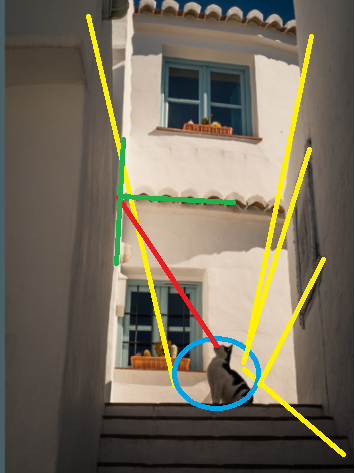
Take this image, for instance.

You can say it's all about leading lines.
Or you can say it's a bit more about various shapes.
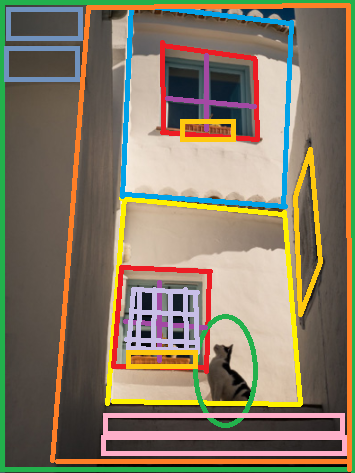
Neither is an obvious intent of the photographer to the exclusion of the other.
In the end, it's probably as much about the tendency of the human vision system to place priority on things perceived as animals over inanimate objects. Most people's eye will be drawn to the cat, then they'll search for what has the cat's attention.
Combining simple geometric shapes next to or inside another is an oft used compositional technique. Some have suggested that the "secret" to the golden ratio (as if there really is such a "secret") is that it allows a rectangle to be endlessly redacted into proportional squares. Circles inside squares or triangles, five pointed stars within circles, etc. are all common compositional combinations of regular geometric shapes.

We cropped this image to approximate the golden ratio of φ and drew in lines that reduced the first five rectangles to squares.
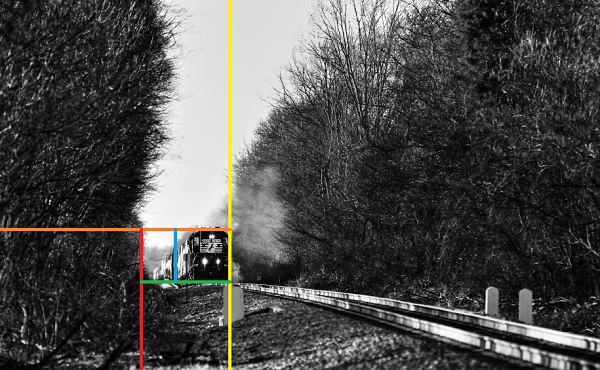
Notice that we were able to place elements of the scene along each of these five successive compositional lines. Sometimes the element is shorter than the compositional line, sometimes vice-versa. But each line has a corresponding element in the scene approximately along at least part of its length. We also have a very strong diagonal and a strong curve traversing the largest square that also lead the viewer's eye to the locomotive that occupies the fifth redactive square. If one were to draw the tangential arcs in each square to create a near-Fibonacci spiral, the fifth arc would cross the nose of the locomotive from lower right to upper left, the sixth would arc above the train and then the seventh and all successive ones would fall in the space occupied by the freight cars being pulled by the locomotive.
But sometimes even when an image may "fit" into such a "golden spiral" figure, the actual composition perceived by the viewer may be something entirely different.
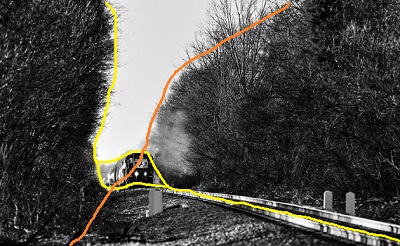
Even though this image has elements that match up to lines from five golden rectangles, I think the strength of the composition is probably more due to the two diagonal lines and curves that intersect at the face of the locomotive.
Does the perceived dominant composition change from viewer to viewer? For example, some viewers may notice leading lines first, while others may see balance, shapes, or framing. Is composition dominance subjective?
Please see above. Everything the viewer brings with them before they view a photo can affect their perception of a photo. One only needs to study the history of the visual arts before photography to see that different eyes see the same world differently. Compare Picasso to van Gogh to van Eyck. Different eyes can also see the same photo differently.
Life experiences also come into play.
This photo, for example, will be seen differently by those who live in areas where there are four seasons from someone who has spent their entire life in a tropical or desert environment.

For those who have experienced a climate where leaves change colors and fall with the seasons the image might evoke memories of a particular place and time where a similar scene was experienced. At the very least for those viewers the image does tell a more generalized story of sorts: It reminds them that when the days become shorter and the temperatures become cooler the green of summer gives way to the colors of autumn. But for someone who has spent their entire life in a desert or tropical climate that does not experience the four seasons and who has not learned about the four seasons that occur in other parts of the world the image doesn't tell that story.
When analyzing a photo, how can we practically determine which composition technique is being used?
Your question assumes there is an intentional compositional technique used when every photo is taken. This can be a false assumption. Many photos are basic snapshots where someone pointed a camera and pressed the shutter without any intentional use of compositional technique.
Among those that are taken with more attention to composition, sometimes the photographer and the subject matter make it fairly obvious what the intent is. At other times it can be a bit more ambiguous, either due to what Adams once called a "sharp image of a fuzzy concept"¹, or maybe because the photographer chose to make the intent ambiguous and force the viewer to "fill in the blanks" from their own experience. Such photos can be the still image equivalent of the endings of most Stanly Kubrick films: intentionally ambiguous that leaves each viewer to decide for themselves what the meaning is of what has been revealed.
Should we look at where the eye travels first?
Should we identify the strongest lines or shapes?
Should we look at how visual weight is distributed?
Or is there a standard method to detect the primary composition in an image?
Yes (to all of the above)? No (to all of the above)? Maybe so (to all of the above)?
There are no hard and fast "rules" of composition, nor are there any hard and fast rules of interpreting the compositional intent of another photographer. They're, at best, "rules of thumb" which can be useful tools for helping each photographer compose with intentional purpose. They can help the photographer decide what they want to communicate, how to communicate that, or give the photographer a means to tell the story they wish to tell.
¹ "There is nothing worse than a sharp image of a fuzzy concept." - Ansel Adams


