-
-
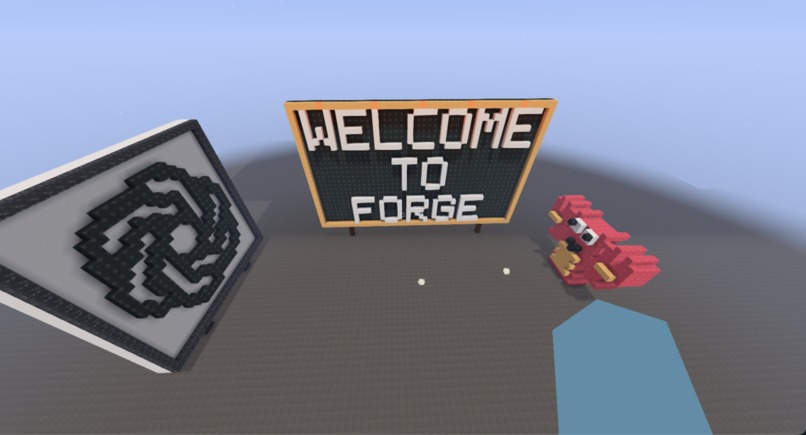
Welcome to Forge
-
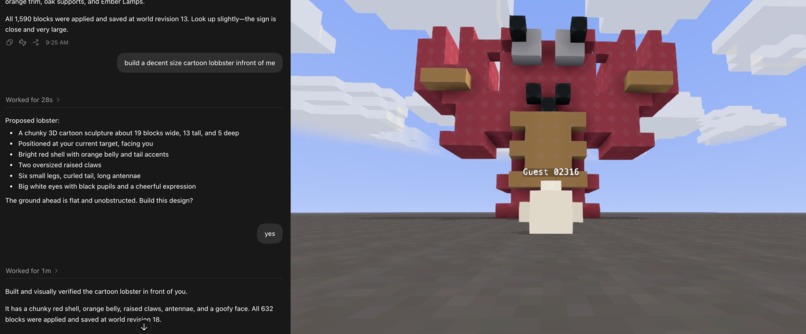
Molty
-
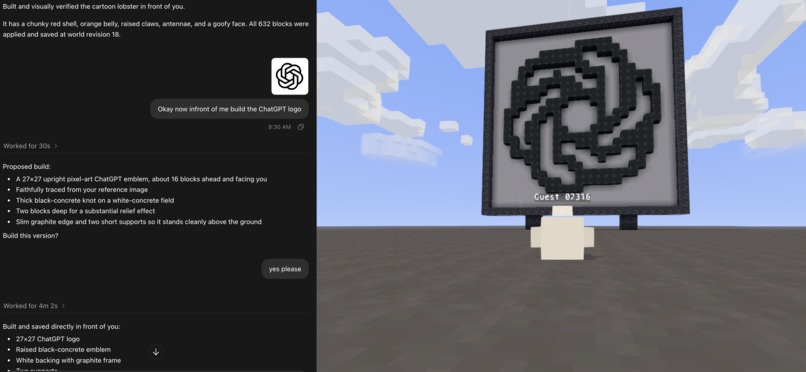
Our favourite logo
-
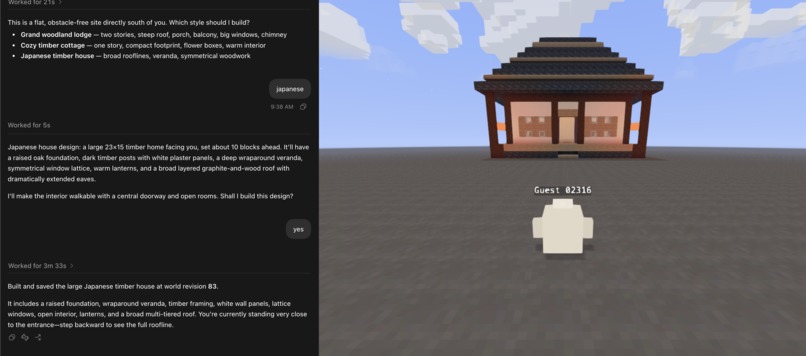
Home sweet home


Inspiration
Building a 3D world is fun, but it can take hours of planning and placing blocks. We wanted to make creating a world as simple as walking to a location and describing what you imagine.
Forge started with one question: What if you could point somewhere and ask your agent to build there with whatever you imagined?
Instead of replacing the player, the agent works alongside them. The player decides where to go, what to create, and how it should feel. ChatGPT and your agent helps turn that vision into something real.
How we built it
- Hosted on ChatGPT Sites + Render
- Built on top of Voxelize
What it does
Forge is a browser-based voxel world that multiple players can build through conversation.
Multiple players can explore the world, look at a clearing, and say, "Build a lobster here." ChatGPT and your agent understands the location, designs the structure, and builds it directly in the world.
The players can then continue the conversation:
Replace the wooden roof with glass.
Build a wall around this area.
Make the lobster taller.
Each request changes the same live world, allowing the players and your agent to build and refine ideas together.
1. Why is your use case a strong fit for WebMCP?
Before WebMCP, an agent could suggest what to build, but it could not understand where the player was standing, what they were looking at, or what existed nearby.
Building in 3D depends on this spatial context. WebMCP connects your agent to the live world, giving it the context and actions needed to understand what the player means by "build it here" and turn their idea into something they can immediately see and explore.
2. How does it create a better user experience?
Players do not need to enter coordinates, learn a complex editor, or place every block manually.
They can explore naturally, point at a location, and describe what they want. Your agent handles the design and construction while the player stays focused on the creative idea.
3. What can people and agents do together that was difficult or impossible before?
The player's movement and attention become part of the conversation.
The player chooses where to build and provides the creative direction. ChatGPT and your agent understands the surrounding world, plans the structure, and places hundreds of blocks. Together, they can create and refine a world through simple conversation.
4. How did you implement WebMCP?
I registered two WebMCP tools in Forge.
get_player_contextgives your agent the player's position, target, and nearby terrain.build_structureapplies your agent's building instructions to the live world.
Challenges we ran into
The hardest challenge was helping ChatGPT and the agent understand words like "here" and "there." We needed to give it enough information about the player's location and surroundings without overwhelming it.
We also had to make sure that completed buildings appeared correctly, remained responsive during construction, and stayed in the world after a reload.
Accomplishments that we're proud of
We created a complete experience where multiple players can point at a location, ask ChatGPT to build something, and watch it appear.
What we learned
We learned that agents are most helpful when they understand what the person is currently doing.
Players are good at imagination, exploration, and deciding what feels right. Agents are good at planning and carrying out repetitive work. Forge brings those strengths together.
What's next for Forge
Next, we want multiple people and their agents to build in the same persistent world.
We also want players to point at existing creations and ask Forge to expand, repair, restyle, or remove them.
Our goal is to make creating digital worlds accessible to players and agents who can describe what they imagine.
Built With
- chatgpt
- codex
- javascript
- render
- rust
- voxelize


Log in or sign up for Devpost to join the conversation.