-
-
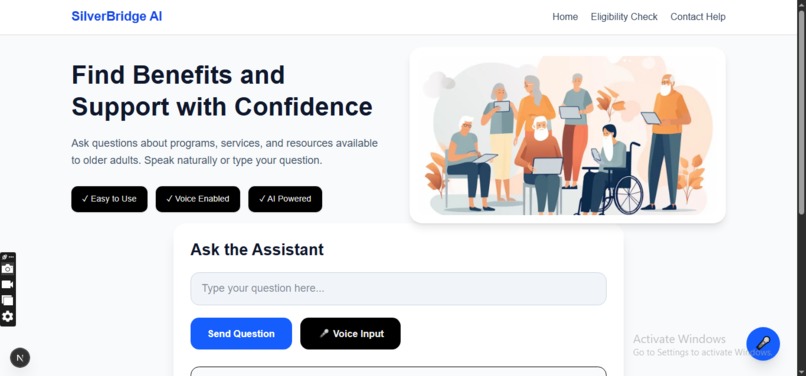
Landing page + Chat
-
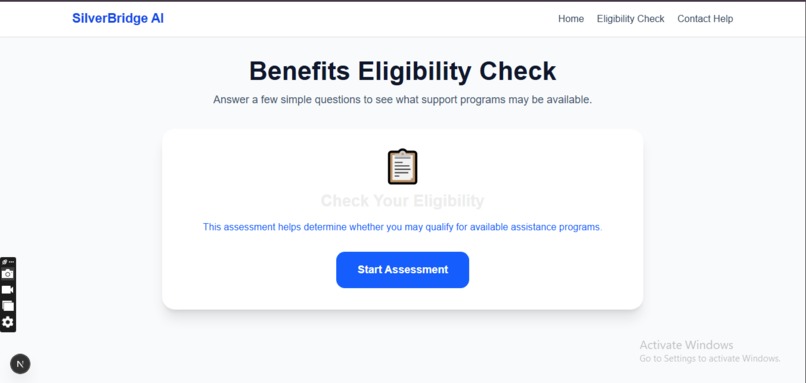
Benefits Eligibility Check
-
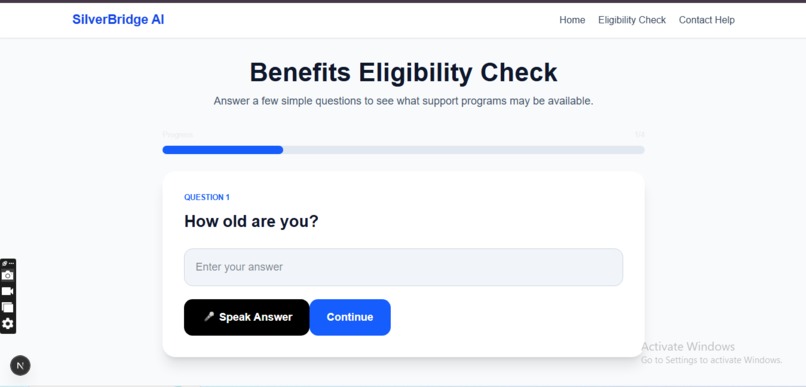
Eligibility Checker Questions
-
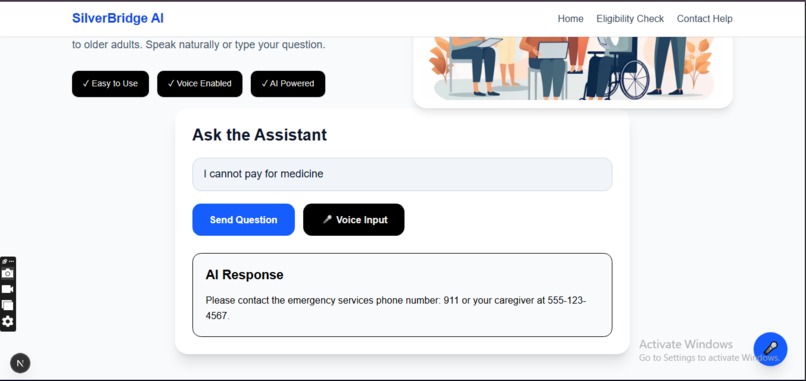
Emergency Detection and Contact finding


Inspiration
Elderly citizens living alone and having limited digital literacy often struggle with accessing support programs they are eligible for. Benefits, healthcare assistance and community services are often fragmented, difficult to understand and increasingly digital. For seniors living alone, these challenges are amplified by memory difficulties, limited digital literacy and the stress of managing essential needs independently.
We built SilverBridge AI to act as a senior-oriented AI-assistant and memory companion, helping seniors understand their options, remember important next steps and easily connect with the help they need through simple conversation.
What it does
SilverBridge AI helps older adults discover and navigate support services through a voice-first, senior-friendly interface. Users can simply speak naturally and the AI will:
• Understand their situation and identify support programs they may qualify for
• Explain complex eligibility requirements in clear, senior-friendly language
• Provide personalized next steps instead of overwhelming users with websites and forms
• Connect users with relevant healthcare, emergency and community support services
• Automatically surface hotline numbers and support contacts during urgent situations
• Help draft and send emails to support organizations without requiring digital literacy
• Remember previous conversations, applications, documents, and deadlines using ChromaDB vector database for long-term memory.
• Answer follow-up questions such as "What was I supposed to do next?" or "Which documents do I still need?"
By combining voice interaction, eligibility reasoning, crisis support and memory recall, SilverBridge AI turns confusing support systems into a simple conversation tailored to each user's needs.
Before SilverBridge AI
A senior living alone must search multiple websites, understand complex eligibility requirements, remember application steps and keep track of different agencies and contacts.
After SilverBridge AI
The senior simply asks questions in natural language or through voice. SilverBridge identifies relevant support programs, explains requirements clearly, remembers previous interactions and guides them toward the next action they should take.
How we built it
We built SilverBridge AI using FastAPI, SQLite, ChromaDB, and a local Gemma language model. The system combines: • Conversational AI for natural interaction
• Eligibility reasoning for interpreting benefit requirements
• Semantic memory retrieval using ChromaDB embeddings
• Voice-first interaction designed for older adults
• Personalized memory storage that remembers previous conversations and recommendations
Why AI?
Search engines & directories require users to know where to search and which service they need.
AI can understand spoken descriptions (eg:“I don’t have money for food”), assess urgency using natural language understanding and find relevant support services nearby all without requiring technical knowledge from the user.
Moreover, search engines can provide information, but they cannot understand a user's unique circumstances, explain eligibility in simple language, remember previous conversations, or guide someone through a multi-step support journey like AI can.
Challenges we ran into
One of our biggest challenges was designing a system that goes beyond being a simple resource directory.
We needed the AI to reason about eligibility, explain requirements clearly and provide actionable next steps rather than just listing programs.
Another challenge was creating an experience suitable for seniors, which required simplifying language, reducing complexity and incorporating voice-based interaction and memory-support features.
Accomplishments that we're proud of
We are proud that SilverBridge AI is not just another chatbot.
It acts as an AI caseworker that understands a user's situation, provides personalized guidance, and remembers important information over time.
We are also proud of building a solution specifically for older adults through voice interaction, simple explanations, memory recall, and direct connections to support services.
What we learned
We learned that accessibility is about much more than interface design. Many people struggle not because information is unavailable, but because systems are difficult to understand and navigate.
We also learned how retrieval-augmented memory systems can make AI more useful by helping users continue long-term journeys instead of treating every interaction as a new conversation. This is especially helpful for seniors, so they do not have to input all of their eligibility each time they use the AI assistant.
What's next for SilverBridge AI
Future versions of SilverBridge AI could integrate caregiver portals, multilingual support and an option for the AI to directly call a caregiver/support program in emergencies.


Log in or sign up for Devpost to join the conversation.