-
-
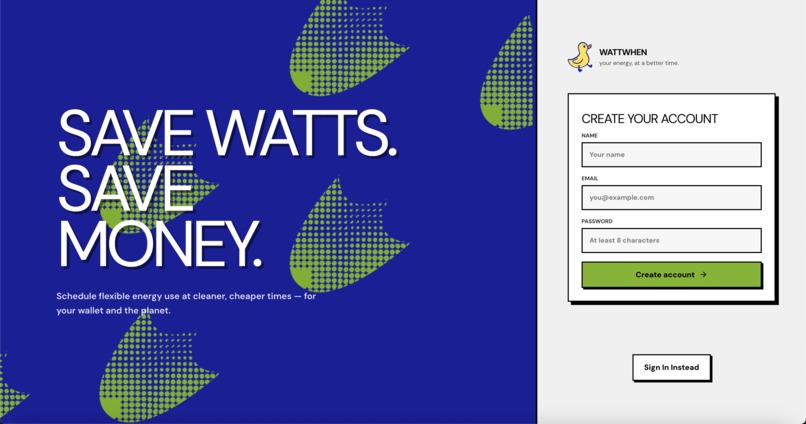
-
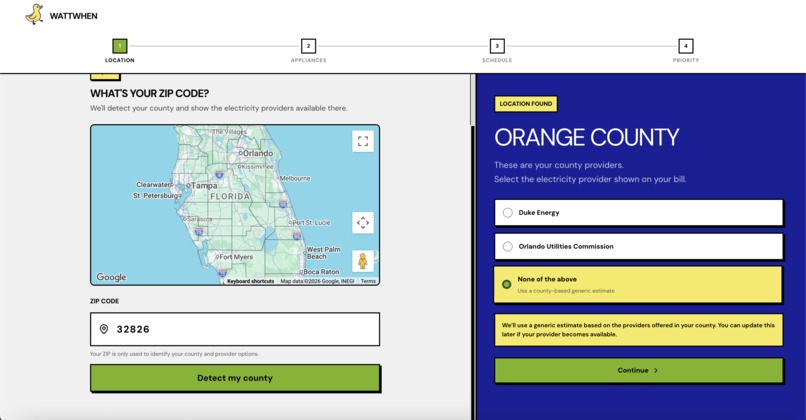
Locating you and pinpointing your county!
-
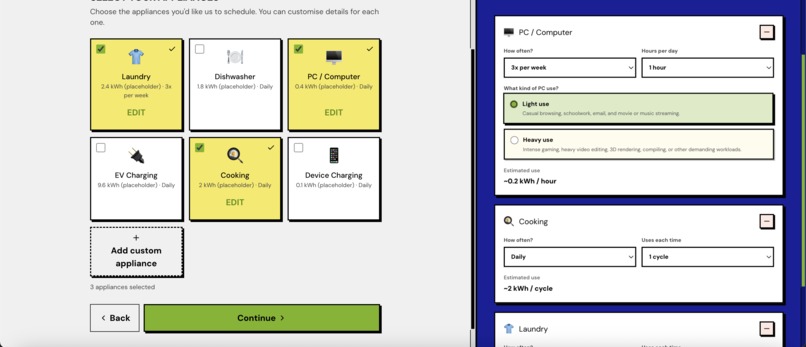
Selecting appliances for energy expenditure!
-
-
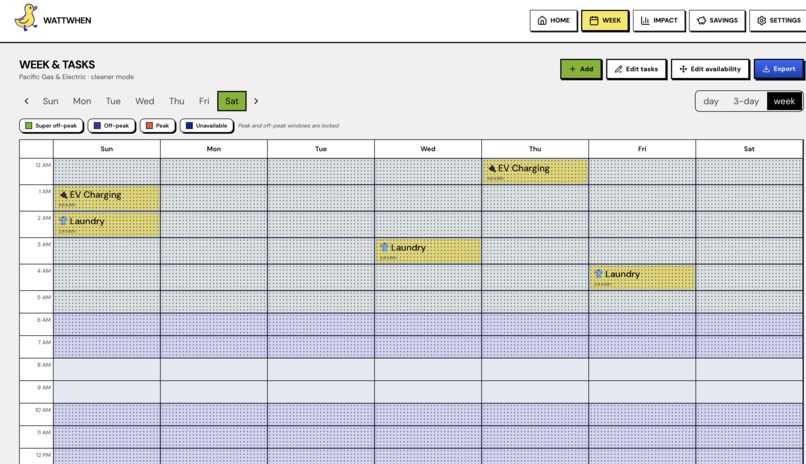
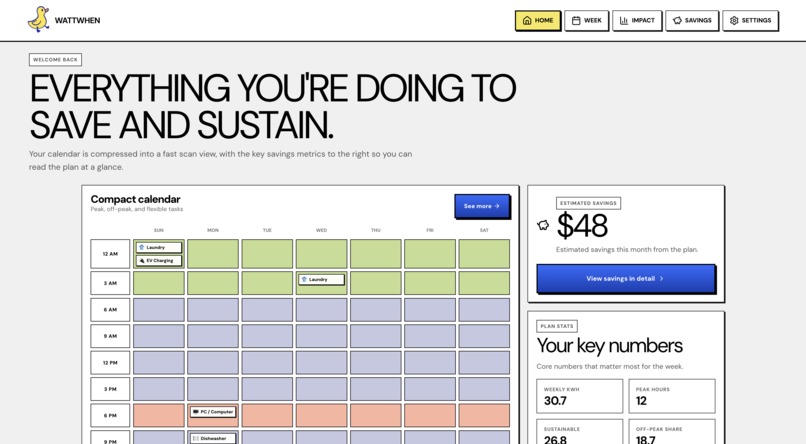
Optimized scheduling!
-
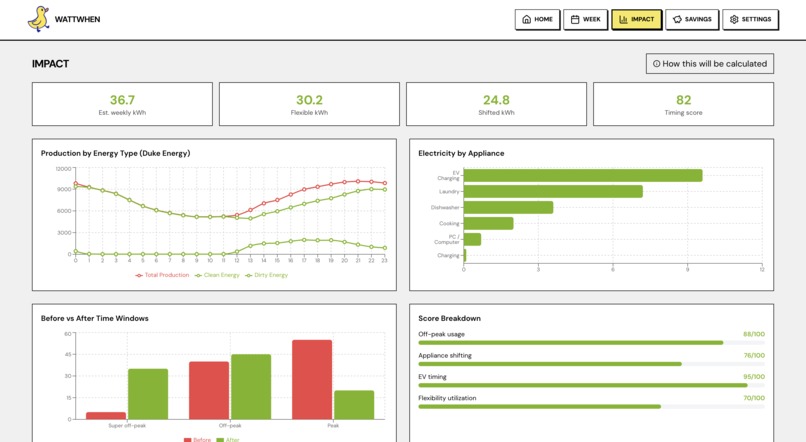
Our duck curve!
-

Our mascot, Wattle!


🦆 Inspiration
WattaSave started with a simple question: What if saving energy felt rewarding, easy, and realistic enough to fit into your everyday life?
A lot of people want to lower their environmental impact and electricity bill, but energy data is often confusing, overly technical, or difficult to act on. We wanted to turn that information into clear, personalized recommendations that people could actually use.
Our visual direction was inspired by the bold, playful personality of neo-brutalist design. We also took inspiration from the energy industry’s famous “duck curve,” which influenced our branding and, naturally, gave us the perfect excuse to create a duck mascot.
Together, these ideas helped us build an app that makes energy conservation feel less intimidating and more engaging, approachable, and financially rewarding.
⚡ What it does
WattaSave is a Florida-based energy optimization app that helps users understand when, where, and how they consume electricity.
During onboarding, users provide their location, household appliances, typical appliance usage, and their main priority: saving money, using energy more sustainably, or finding a balance between the two.
WattaSave uses the user’s location to identify their county and electricity provider. It then analyzes provider-specific peak and off-peak energy periods to recommend better times for energy-intensive activities, such as washing clothes, running the dishwasher, or adjusting the thermostat.
The app can also work alongside the user’s calendar, allowing recommendations to fit around their real schedule. Rather than suggesting that someone run their dishwasher at an impossible time, WattaSave looks for efficient time windows that are both energy-conscious and realistic for the user.
WattaSave also highlights which appliances may be responsible for the largest portions of household energy consumption. Based on the user’s habits and provider information, it estimates how much energy and money could be saved by changing when or how those appliances are used.
Those estimated savings are added to the Watt Wallet, our digital energy-saving piggy bank. As users make more efficient choices, they can watch their savings grow while tracking the environmental impact of their decisions.
🦆 How we built it
WattaSave was built as a full-stack web application using React, Vite, TypeScript, PostgreSQL, Prisma ORM, Better Auth, and Turborepo.
On the frontend, we used React to build a responsive and interactive user experience. Vite gave us a fast development environment with hot module replacement, which was especially valuable during a 12-hour hackathon where every second counted.
We used TypeScript throughout the project to improve type safety and create more reliable boundaries between the frontend, backend, and database. This helped us catch potential errors earlier and made it easier for multiple team members to work across the codebase simultaneously.
Our project was organized using Turborepo, which streamlined our development workflow and allowed us to manage shared packages, frontend code, backend logic, and configuration within a single monorepo. This made collaboration faster and kept the project organized as it grew.
For authentication, we implemented Better Auth. Its straightforward setup allowed us to create a secure account system without spending the majority of the hackathon rebuilding authentication from scratch. That gave us more time to focus on the features that made WattaSave unique.
We selected PostgreSQL because our application needed to represent complex relationships between users, appliances, household activities, counties, energy providers, schedules, and usage periods. We paired PostgreSQL with Prisma ORM, allowing us to work with strongly typed database models instead of writing and maintaining large amounts of raw SQL.
We also incorporated the Google Maps API into the frontend to support location-based interactions and help connect users with information relevant to their region and electricity provider.
At the center of WattaSave is our scheduling system. We developed a complex, minimax-inspired optimization algorithm that evaluates different combinations of household activities, available time windows, appliance energy consumption, provider demand periods, and user preferences.
Instead of simply choosing the lowest-demand hour, the algorithm works through competing priorities and scheduling constraints to produce a recommendation that is both energy-efficient and practical. Because every household has different routines, appliances, and priorities, the system was designed to remain flexible rather than relying on one fixed schedule.
⚡ Challenges we ran into
One of our biggest challenges was determining how to algorithmically create the most optimized energy schedule while accounting for several different variables at once.
The lowest-energy time is not automatically the best recommendation. Our algorithm also needed to consider the user’s availability, household activities, appliance energy consumption, task duration, provider information, peak-usage periods, and the amount of flexibility each activity allowed.
We also had to collect, organize, and parse real information across Florida counties and electricity providers. Because we wanted WattaSave to be grounded in real-world data, we needed to develop calculations that could translate provider-specific information into personalized scheduling recommendations and estimated financial savings.
Another major challenge was balancing technical accuracy with usability. Energy data can become overwhelming very quickly, especially when it involves rates, kilowatt-hours, schedules, providers, and multiple household appliances.
We had to decide which information users genuinely needed to see and how to present it without making the app feel like a utility company spreadsheet. Our dashboard, mascot, visual statistics, and Watt Wallet helped us communicate that data in a way that felt more intuitive and rewarding.
🦆 Accomplishments that we're proud of
We are incredibly proud of what our team accomplished in only 12 hours.
Within a single fast-paced sprint, we developed a strong product concept, a full-stack technical foundation, real data-driven features, a scheduling optimization system, and a complete visual identity.
We are especially proud of the personality we were able to give the application. Our neo-brutalist design system, duck-inspired branding, energy dashboard, and Watt Wallet helped turn a highly technical sustainability tool into something playful and approachable.
We are also proud of how successfully our dataset, database structure, and backend components came together. Working with real provider and regional data required constant communication between our designers and developers.
The final result demonstrated our team’s ability to divide responsibilities, trust one another’s expertise, solve problems quickly, and adapt when something inevitably broke five minutes before the next demo.
Most importantly, we built something that feels useful. WattaSave does not just show users how much energy they consume; it gives them realistic actions they can take to improve it.
⚡ What we learned
We learned that creating a truly optimized schedule is much more difficult than simply identifying the lowest-demand time of day.
A useful recommendation must also consider the user’s personal schedule, the duration and flexibility of each task, appliance energy consumption, local provider data, competing household activities, and whether the suggestion is realistic enough for someone to follow.
We also gained a much stronger understanding of how frontend design, backend architecture, database modeling, and algorithmic decision-making depend on one another.
A recommendation is only helpful if the data behind it is accurate. Accurate data is only useful if the interface communicates it clearly. And even the best interface will not matter if the recommendation does not fit into the user’s life.
With only 12 hours to build the project, efficient task delegation became essential. Each team member had to communicate clearly, work independently when necessary, trust the rest of the team, and remain flexible as the project evolved.
Most importantly, we learned how much can be accomplished when thoughtful design, real-world data, technical problem-solving, and a shared vision all come together.
🦆 What's next for WattaSave ⚡
Our next goal is to expand WattaSave beyond Florida by incorporating electricity provider, rate, and energy-demand information from additional states across the United States.
We would also like to continue improving our scheduling algorithm so it can make even more personalized recommendations based on changing energy rates, weather conditions, appliance efficiency, household routines, and live grid demand.
Another feature we hope to introduce is a roommate or household challenge mode. Multiple people within the same household could compete to reduce their energy consumption, complete weekly goals, and contribute the most money to the shared Watt Wallet.
Future versions could also include achievements, streaks, weekly challenges, household leaderboards, more detailed environmental-impact statistics, smart-home integrations, and rewards for maintaining consistent energy-saving habits.
We would also like to make the Watt Wallet more interactive by allowing users to set financial goals and visualize what their accumulated savings could help them afford over time.
Ultimately, we hope WattaSave can make sustainability feel less like a sacrifice and more like a rewarding part of everyday life.
Save watts. Save money. WattaSave.


Log in or sign up for Devpost to join the conversation.