

Ruby vs PHP comes down to the work you need to do. Ruby is a sensible choice when you want to build with Rails. PHP is the direct choice for writing WordPress plugins, and it also supports custom applications through frameworks such as Laravel. For an existing product, the codebase and the people maintaining it deserve more weight than a language popularity contest.
Both languages can handle a database-backed website. The useful differences show up when you read code, validate a value, install dependencies, or put an application into production. Start with those tasks.
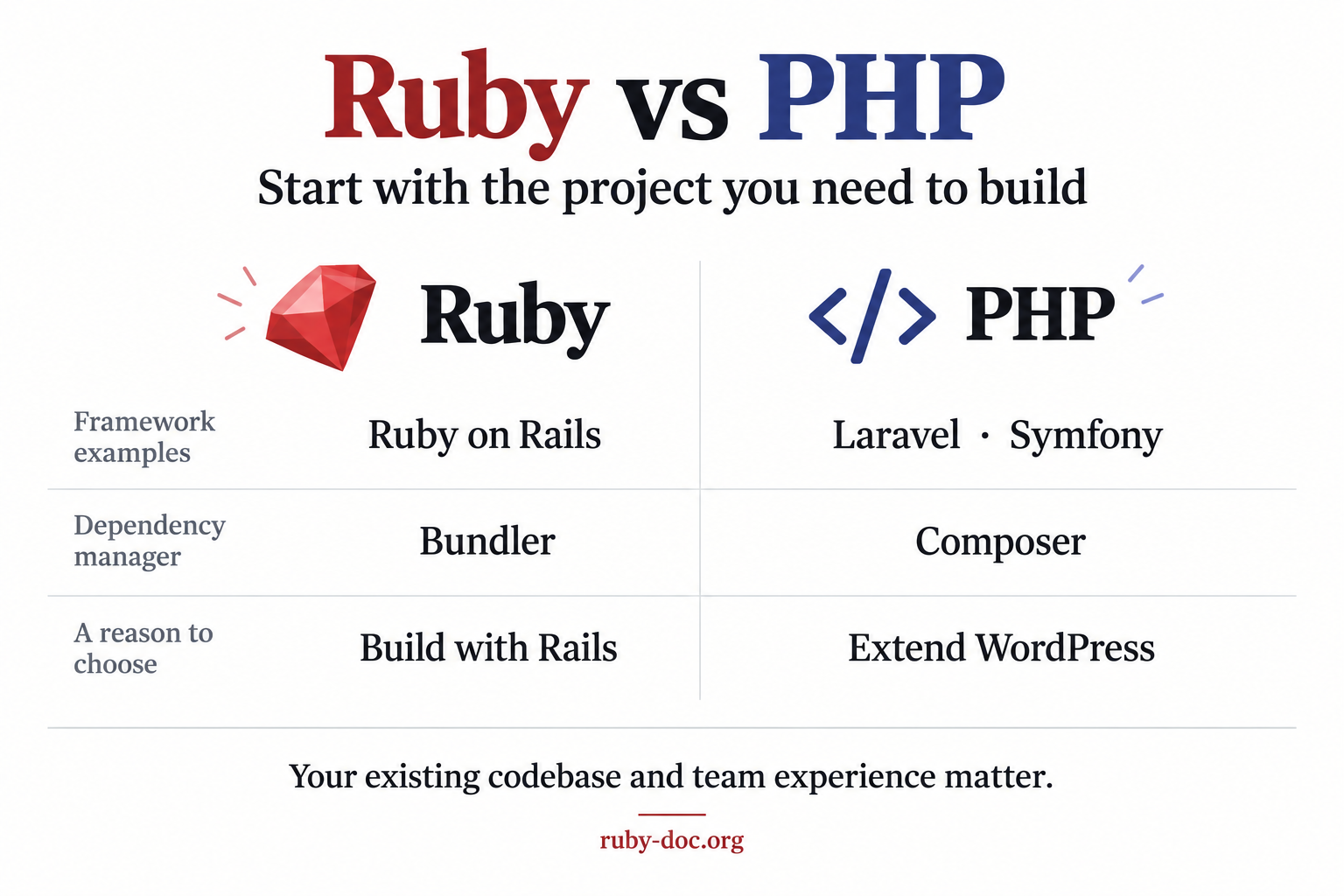
Ruby vs PHP: the main differences
| Question | Ruby | PHP |
|---|---|---|
| What is it? | A general-purpose programming language | A programming language widely used for server-side web development |
| Web framework examples | Ruby on Rails | Laravel and Symfony |
| Lists and key-value data | Separate Array and Hash classes | The array type is an ordered map |
| Dependency tools | RubyGems and Bundler | Composer |
| Does zero count as true? | Yes | No |
| A practical reason to choose it | You want Rails, or already maintain Ruby applications | You need WordPress plugin development, or already maintain PHP applications |
Rails is a framework written in Ruby; it is not another name for the language. The same distinction applies to PHP and Laravel. Our Ruby vs Ruby on Rails guide explains that separation before you start comparing frameworks.
Read the same small program in both languages
Suppose a price list includes a negative value that should be removed. A price of zero is valid: a free item still belongs in the list. These examples keep every non-negative integer.
Ruby: pass a block to select
prices = [-1, 0, 12, 25]
valid = prices.select { |price| price >= 0 }
p valid
Output: [0, 12, 25].
The block between the braces supplies the test. Ruby calls it for each element, and select builds an array of the elements that pass. The method call reads from left to right: take the prices, then select the valid ones.
PHP: give array_filter an explicit test
<?php
$prices = [-1, 0, 12, 25];
$valid = array_filter($prices, fn(int $price): bool => $price >= 0);
echo json_encode(array_values($valid)), PHP_EOL;
Output: [0,12,25].
Here, the arrow function supplies the same test. PHP preserves the original keys when filtering. After removing the first element, array_values gives the result consecutive keys starting at zero, so JSON represents it as a list.
Neither example needs a web framework. They also make a better starting point than judging a language by how few characters it uses. Follow the data through each statement and ask which version your team will understand six months later.
PREDICT · REVEAL · COMPARE
Try it: Ruby vs PHP truthiness
Would an if statement enter its true branch? Pick a value, make your prediction, then open the row to compare the results.
0Integer zero
Ruby → true
puts(0 ? "true" : "false")PHP → false
<?php
echo 0 ? "true" : "false";
A free item can have a valid price of zero. Test the price rule explicitly; a truthiness test changes meaning between these languages.
"0"A string containing zero
Ruby → true
puts("0" ? "true" : "false")PHP → false
<?php
echo "0" ? "true" : "false";
Form inputs often arrive as strings. PHP treats this exact string as false, while Ruby treats it as true.
""An empty string
Ruby → true
puts("" ? "true" : "false")PHP → false
<?php
echo "" ? "true" : "false";
If text is required, check for an empty string directly. Ruby still takes the true branch for this value.
[]An empty array
Ruby → true
puts([] ? "true" : "false")PHP → false
<?php
echo [] ? "true" : "false";
An empty array counts as true in Ruby. Check whether the collection is empty when that is what you mean.
nil / nullNo value
Ruby → false
puts(nil ? "true" : "false")PHP → false
<?php
echo null ? "true" : "false";
The names differ, but both values take the false branch.
falseBoolean false
Ruby → false
puts(false ? "true" : "false")PHP → false
<?php
echo false ? "true" : "false";
The Boolean false takes the false branch in both languages.
Results checked with Ruby 3.2.3 and PHP 8.3.6. Open a row with a click, a tap, or the keyboard.
Watch zero, empty strings, and array keys
Sometimes a direct translation seems accurate yet produces a different outcome. Ruby treats only false and nil as false in a condition. Zero, an empty string, and an empty array all count as true. The official Ruby guide for PHP developers highlights this difference.
PHP has more false-like values, including zero, "", "0", an empty array, and null. Its Boolean conversion rules list the cases. That matters for a form field: a submitted quantity of "0" is not necessarily missing data.
For the price example, calling PHP’s array_filter without a callback would remove zero while keeping the negative number. By providing an explicit test, you define the rule you really want. See the array_filter reference for both filtering behavior and key preservation.
There is a second translation issue. Ruby separates an ordered list, Array, from a key-value collection, Hash. PHP’s array type is an ordered map, used for both jobs. Check the keys when porting code that prepares a JSON response; visually similar collections do not guarantee the same JSON structure.
Types help, but they do not replace validation
Both Ruby and PHP are dynamically typed. Ruby code often depends on which methods an object supports. In PHP, you can also declare parameter and return types. The example uses an integer parameter and a Boolean return type.
PHP’s declare(strict_types=1) changes scalar type coercion for calls made from that file. It does not turn PHP into a statically typed language, and the caller’s setting matters. The type declaration documentation explains that boundary.
A price’s type cannot tell you whether negative prices are allowed. Your application has to make that decision. Make the rule explicit, then test it in either language.
Rails, Laravel, and WordPress lead to different choices
If your goal is a Rails application, learn enough Ruby to understand methods, blocks, classes, and collections first. Rails then adds conventions for routes, database models, controllers, and views. The Rails getting-started guide walks through a store application and shows how those pieces fit together.
For a new custom PHP application, evaluate Laravel alongside Rails. List the features your application needs: authentication, background jobs, file uploads, testing, and deployment. A team that knows Laravel starts in a different place from a team that knows Rails.
WordPress presents a more specific decision. Its plugin handbook starts with a PHP file and a plugin header. If the job is to extend WordPress from inside a plugin, PHP belongs in the learning plan. Ruby can communicate with a site through an API, but that is a different task from writing its PHP plugin code.
Dependencies, hosting, and maintenance
In Ruby applications, Bundler manages gem dependencies using a Gemfile and records resolved versions in Gemfile.lock. PHP applications commonly use Composer, with composer.json and composer.lock. Composer’s basic usage guide explains why an application’s lock file belongs in version control.
Before choosing a hosting plan, list the services the application needs. That could include web processes, a database, scheduled tasks, and background workers. Check whether the plan allows all of them. Running a simple PHP page is a smaller requirement than running a Laravel application with persistent queue workers.
Add up the cost of those services, then include backups and the time spent updating software. You cannot calculate the monthly bill from the language name alone.
Ruby vs PHP performance: what to measure
This article does not establish a performance winner. The small examples above check behavior; they are not benchmarks. They say nothing about a checkout page waiting on database queries or an API calling another service.
Before making a performance-led choice, build one representative endpoint. Give both implementations the same workload and data, then measure response times, memory use, and errors under expected traffic. Record the runtime versions and caching settings too. Without that context, a requests-per-second number is hard to use for your own project.
Which should you learn or use?
Choose Ruby when Rails is the framework you want to work with, or when the application you need to maintain is already Ruby. Choose PHP for WordPress plugin work or a PHP codebase your team understands.
If neither restriction applies, build a small feature using each language. Accept input, validate it, save a record, and return an error if something fails. Include a test and try deploying it. The problems you encounter will give you something tangible to compare.
Ruby vs PHP questions
Is Ruby easier than PHP for beginners?
There is no single answer for every learner. Try variables, collections, methods or functions, and a small file-processing task before adding a framework. Then choose the language connected to the project you want to finish.
Can PHP do the same web-development jobs as Ruby?
Both can power websites and APIs. They do not share the same libraries or framework code, though. Moving an application between them means rewriting and testing behavior, not just changing file extensions.
Should an existing PHP site be rewritten in Ruby?
First, identify the problem you need to solve. Switching languages does not automatically make database queries faster. Compare a targeted fix with the full cost of rewriting, testing, and maintaining a replacement.
