
- Module 1: Intro to platform engineering
-
Sep 15 - Live: Intro to platform engineering
-
Recording: Intro to Platform Engineering
-
Quiz - Module 1: Intro to platform engineering
-
The problems platform engineering exists to solve
-
What well-designed and built platforms deliver
-
Adoption is the mechanism, maturity is the goal
-
Defining platform engineering
-
Defining platforms
-
Current trends shaping platform engineering
-
Reading
-
Homework
- Module 2: Thinking in platforms
-
Module 2: Thinking in platforms
-
The pressures that shaped platform engineering
-
Measuring the pressures
-
How the discipline emerged
-
Anatomy of platforms
-
Platform teams
-
Demo - Module 2: Thinking in platforms
-
Reading
-
Quiz - Module 2: Thinking in platforms
-
Homework
- Module 3: Platforms as products
-
Module 3: Platforms as products
-
Platforms as products
-
Mindset shifts
-
The platform lifecycle
-
User research
-
Misconception: creativity requires unlimited freedom
-
Reading
-
Quiz - Module 3: Platforms as products
-
Homework
- Live Q&A session
-
Sep 22 - Live Q&A
-
Recording: Live Q&A Sep 22nd
- Module 4: The paths to outcome model
-
Module 4: The paths to outcome model
-
The anatomy of a path
-
Golden paths, not golden cages
-
Escape hatches
-
Abstractions vs illusions
-
Paths as value streams
-
Choosing and building the first paths
-
Common objections
-
Reading
-
Demo - Module 4: The paths to outcome model
-
Quiz - Module 4: The paths to outcome model
-
Homework
- Module 5: Starting a platform engineering practice
-
Sep 29 - Live: Starting a platform engineering practice
-
Recording - Starting a platform engineering practice
-
Foundational steps
-
The four types of production systems
-
Conway’s Law for platform engineering
-
Misconceptions
-
Pain to impact mapping
-
Reading
-
Quiz - Module 5: Starting a platform engineering practice
-
Homework
- Module 6: The platform engineering playbook
-
Module 6: The platform engineering playbook
-
Starting small, at every stage
-
Discovery interviews
-
From pain points to path candidates
-
What makes a good first path candidate?
-
The 3x3x3 rule for proposing an MVP
-
The Platform Engineering Playbook in detail
-
Reading
-
Quiz - Module 6: The platform engineering playbook
-
Homework
- Live Q&A session
-
Oct 6 - Live Q&A
-
Recording: Q&A - June 9
- Module 7: Driving adoption, value, and scale
-
Module 7: Driving adoption, value, and scale
-
The translation challenge
-
ROI as a loop
-
Translating DevEx into business language
-
What does leadership care about?
-
AI-specific metrics
-
Choosing metrics that matter
-
Leading and lagging indicators
-
Two roadmaps
-
Internal advocacy
-
Reading
-
Quiz - Module 7: Driving adoption, value, and scale
-
Homework
- Module 8: Platform engineering in the age of AI
-
Module 8: Platform engineering in the age of AI
-
How did we get here?
-
Extending the evolution
-
The trust gap
-
The Agentic Engineering Platform (AEP)
-
AI as capability and interface
-
From IDP to AEP
-
The four levels of agentic software development
-
The organizational readiness gate
-
Organizational archaeology
-
Core course takeaway
-
Reading
-
Quiz - Module 8: Platform engineering in the age of AI
-
Homework
- Conclusion & Final Q&A
-
Oct 13 - Live: Conclusion & Final Q&A
-
Recording: Conclusion & Final Q&A - Jun 16
-
Course Feedback Survey
-
Exam info
This video is still being processed. Please check back later and refresh the page.
Uh oh! Something went wrong, please try again.
Platform Engineering Certified Practitioner (September 2026)
Hands-on certification for platform engineers, DevOps engineers, SREs, and engineering managers, grounded in the Thinking in Platforms framework and covering the shift from IDPs to AEPs, platform-as-a-product thinking, golden path design, and how to sell platform initiatives internally.
What you'll learn
By the end of this certification, you'll be able to:
 Diagnose your organization's platform engineering archetype and identify where value is leaking across the six value vectors. Apply the Platform as a Product mindset to shift from project thinking to enduring ownership and adoption. Design golden paths that reduce cognitive load without collapsing into golden cages. Translate platform pain points into a build lifecycle, from MVP through production readiness to scale. Build the internal case for a platform initiative, with framing that lands for engineering, leadership, and stakeholders alike.
Who's it for?

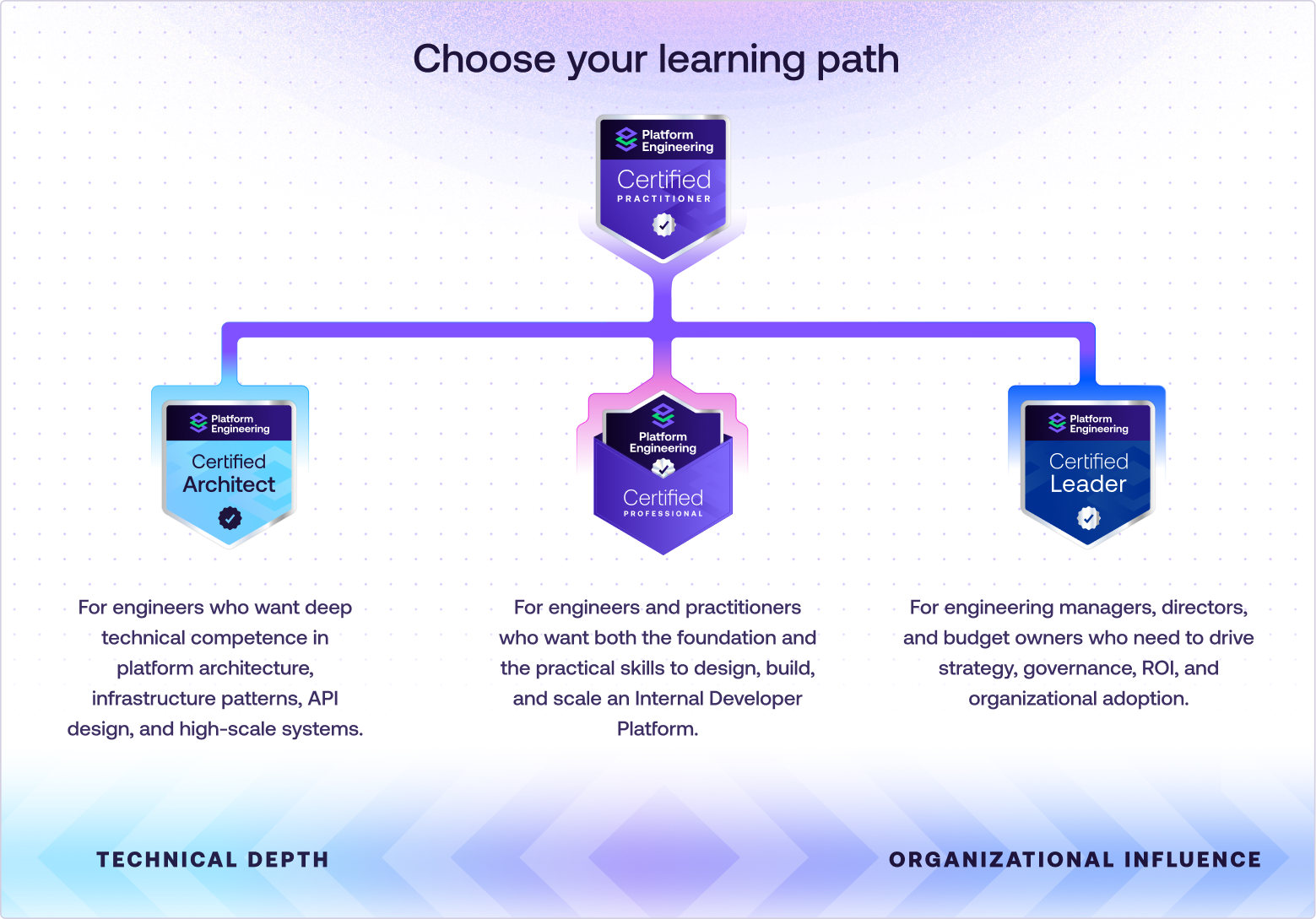
Practitioners
DevOps and SREs who want to upskill, sharpen their platform chops, and boost their earning potential (salaries run up to 42% higher 🚀).
Platform Engineers
ICs and Heads of Platform who want proven frameworks, golden paths, and best practices to drive adoption across their org.
Leaders
Engineering managers, directors, and platform leaders who want to align teams, show ROI, and navigate the shift to Platform as a Product.
Curriculum
8 MODULES · 8 QUIZZESMODULE 1 SEP 15 • 18:30 CET
Introduction to platform engineering

 Course outline and intro PE.org, and the community + research landscape Why platform engineering, why this course Where platform engineering came from Engineering as deliberate design, not just code Current trends, including ADPs
MODULE 2 ON-DEMAND
Thinking in platforms
The evolutionary tree of platform engineering Reference architectures The tooling landscape Hands on: what a platform actually looks like Roles, specializations, and team structure Governance models, and platform maturityMODULE 3 ON-DEMAND
Platforms as products
The three shifts to think of platforms as products The platform as a product lifecycle Golden rules of platform-as-a-product thinking User research and how to conduct it Misconception: creativity requires unlimited freedomQ&A SEP 22 • 18:30 CET
Live Q&A
MODULE 4 ON-DEMAND
The paths to outcome model
Golden paths vs golden cages Abstractions vs illusions Anatomy of a path Paths as value streams Misconception: we're too complex to standardize The Inverse Conway Maneuver as a design toolMODULE 5 SEP 29 • 18:30 CET
Starting your platform engineering practice
Two dimensions, four archetypes Why organizations shift between archetypes Conway's Law applied to platform engineering The six value vectors Misconceptions: hiring or reorganizing fixes structure + silos vs specialization Pain-to-impact mappingMODULE 6 ON-DEMAND
The platform engineering playbook
Starting small is the answer to any iteration Discovery interviews, and finding path candidates through friction points The build lifecycle: MVP → production readiness → adoption From prototype to production; scaling in productionQ&A OCT 6 • 18:30 CET
Live Q&A
MODULE 7 ON-DEMAND
Driving adoption, value, and scale
DevEx as a strategic metric, and what leadership cares about The three-layer baseline and metrics frameworks Leading vs lagging metrics Internal vs external roadmaps as a translation problem Formulating stakeholder arguments Internal marketing tacticsMODULE 8 ON-DEMAND
Platform engineering in the age of AI
The agentic shift: IDPs evolving to ADPs The four levels of human involvement The organizational readiness gate Conclusion + course wrap-upCONCLUSION OCT 13 • 18:30 CET
Exam overview + next steps
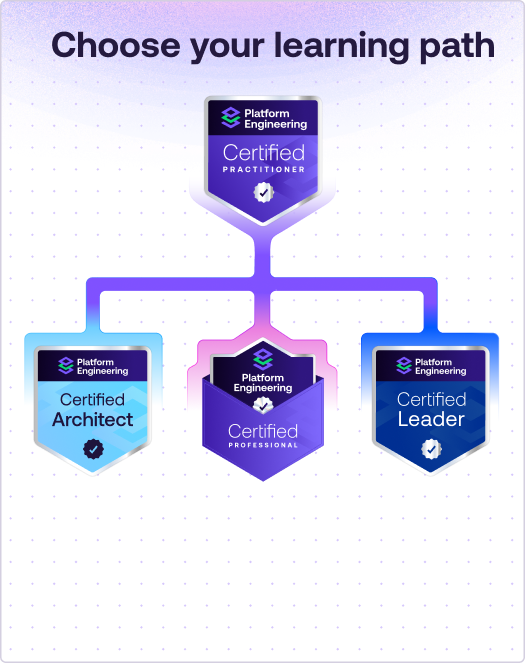
Exam procedures, attempts, validity and recertification Course feedback survey Further courses: Professional, Leadership, Architect, ADP, etc. Community, events, and the Ambassador programMeet your Instructor
Mallory Haigh
Course instructor and Platform Engineering SME
- Full-stack engineer by background (LAMP stack veteran + PHP lifer)
- Also experienced in: Engineering management, customer success, product development
- Platform Engineering SME, course instructor, trainer, and coach
- #horsegirl, farmer, cat+dog mom
|
Desktop
|
Mobile |
 |
|
Alumni stories
| Testimonials | |||||
| Name | Image | Position | Text | LinkedinPost | |
| Jay Moran |  |
SVP of Platform Engineering & Distinguished Engineer at Fiserv | I don’t often feel certifications are too useful, but in this case beyond being not vendor specific, I think this is one certification that really helps define a “Platform Engineer” versus someone who does some of the many components of what goes into platform engineering… | https://www.linkedin.com/in/jaycmoran/ | https://www.linkedin.com/posts/jaycmoran_platformasaproduct-idp-platformengineering-activity-7364777833262448641-ku7Z/?utm_source=share&utm_medium=member_desktop&rcm=ACoAAB7W6ucBwi1gPqF5QCBe36ipfkH_n4Cityo |
| Daniel Palermi |  |
Senior Cloud Engineer at Serko | The Platform Engineering Practitioner certification helped me understand the evolution of DevOps and engineering practices over the years. It clarified the concept of platform engineering and its true purpose. In my opinion, everyone working in an IT company should take this course, as it offers valuable lessons that span across all roles. |
https://www.linkedin.com/in/daniel-palermi-4a5b881b/ | |
| Brittany Lebel |  |
Senior Product Owner, Kinsale Insurance | The Platform Engineering course was a transformative addition to my career. The content was well-structured, covering everything from designing Platform Engineering Maturity Models to developing reference architectures that drive standardization and empower developers with seamless self-service capabilities. The hands-on lectures on Pocket IDP provided an in-depth exploration of the entire implementation process, diving into technical details and real-case scenarios. This comprehensive approach offered invaluable insights into how an IDP functions as a product and how it can efficiently support production workloads.Thanks to this course, I now have the expertise to contribute meaningfully to the development and enhancement of our Internal Developer Platform, enabling us to accelerate application delivery cycles.I highly recommend this course to anyone eager to elevate their engineering expertise and make a tangible impact in platform engineering! | https://www.linkedin.com/in/brittany-lebel/ | |
| Marc Schnitzius |  |
Service Lead Platform Engineering at Codecentric AG | The Platform Engineering Certified Practitioner course is a great guide for better understanding that the success of an internal developer platform is not just about making developers happy and shifting all their problems to a platform team. | https://www.linkedin.com/in/marc-schnitzius/ | |
| Rafael de Araujo Pires |  |
Global Director of Architecture at AB InBev | The Platform Engineering Practitioner certification was more than concepts. It was a reflection on my own platform journey since 2022.The biggest lesson? Platforms are about people. It’s about listening, building trust, and reducing friction so teams can deliver value with autonomy. It’s about connecting culture, product, and technology, and showing that developer satisfaction can be as strategic as any infrastructure investment.Platform engineering isn’t just code: it’s people, trust, and real business impact. | https://www.linkedin.com/in/rafaeldearaujop/ |
| Desktop | Mobile |
 |
|
Certification & Exam
Show proof
Receive an official Platform Engineering Certified Practitioner certificate when you complete the course and pass the exam. Valid for 1 year.
Build your credentials
Use your certification to demonstrate verified skills in platform engineering and qualify for advanced programs.
Share your achievement
Add your certificate to your LinkedIn profile and share with your network!

| Desktop | Mobile |
 |
|
| Question | Answer |
|
Why this certification? |
Unlike other programs, this certification blends technical, product, and business frameworks so you can actually build and scale a successful platform initiative, not just understand the tech. |
|
What will I learn? |
You’ll master platform engineering fundamentals: how to design an Internal Developer Platform, build golden paths, and scale adoption across teams, all using proven frameworks from top platform teams. |
|
How is it delivered? |
Live weekly sessions (recorded if you can’t join), self-paced modules, guest lectures, and an active Slack community of 500+ platform engineers. |
|
How much time will it take? |
About 3 hours per week for 5 weeks, including optional homework. All sessions are recorded for flexible learning. |
|
When will the instructor-led live sessions take place? |
The sessions (unless stated otherwise) take place on Tuesdays at 6:30 pm CET/12:30 pm ET. But remember - all recordings are shared, so it’s easy to take the course asynchronously. |
|
Is this course for me? |
It’s for engineers, platform leads, and managers who want to align technical and business goals around platform engineering. No coding required. |
|
I’m not an engineer, will I still benefit? |
Absolutely. The course is designed for both technical and non-technical leaders. You’ll gain a shared framework for platform success across teams. |
|
Do I get a certificate? |
Yes. By doing an exam after the course, you’ll earn a verified digital certificate and LinkedIn badge recognized by leading platform teams. |
|
What if I can’t attend live? |
No problem, every session is recorded and available on demand. |
|
What’s the exam like? |
60 minutes, 50 multiple-choice questions. Passing score: 75%. You’ll have 2 attempts within 6 months of completing the course. |
|
Can I pay by invoice or installments? |
Yes, just contact us to arrange. |
|
Can I buy now and start later? |
Absolutely. Just contact us to arrange and join any future cohort. |
|
Do I need any specific tools or technologies? |
No special setup needed, just a laptop. A basic understanding of DevOps concepts (like Kubernetes or IaC) helps, but isn’t required. |
|
Is coding required? |
No. The course focuses on frameworks, adoption, and product thinking, not hands-on coding. |
|
What technologies are discussed? |
We reference tools like Terraform, Backstage or Kubernetes, but the focus is on best practices for platform design, not on tool-specific tutorials. |
|
Do you offer private training for teams? |
Yes, we run private team cohorts (virtual or in-person) tailored to your platform maturity and goals. Contact us for more information. |