-
-
zerocmo Logo
-
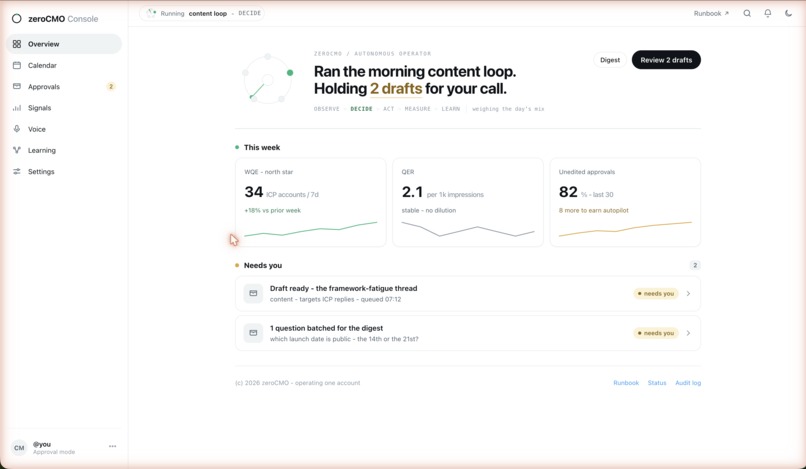
dashboard
-
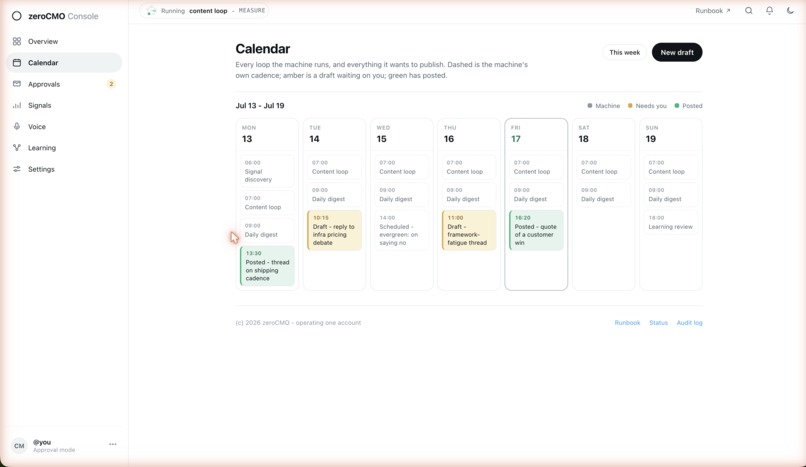
calendar - contents
-
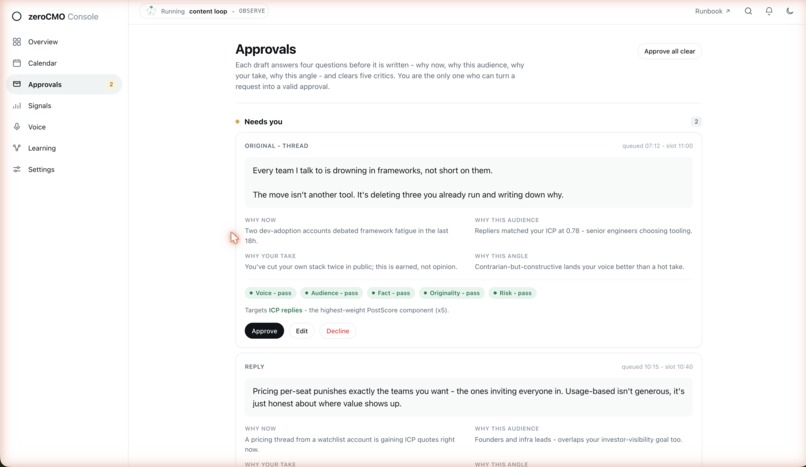
content posts
-
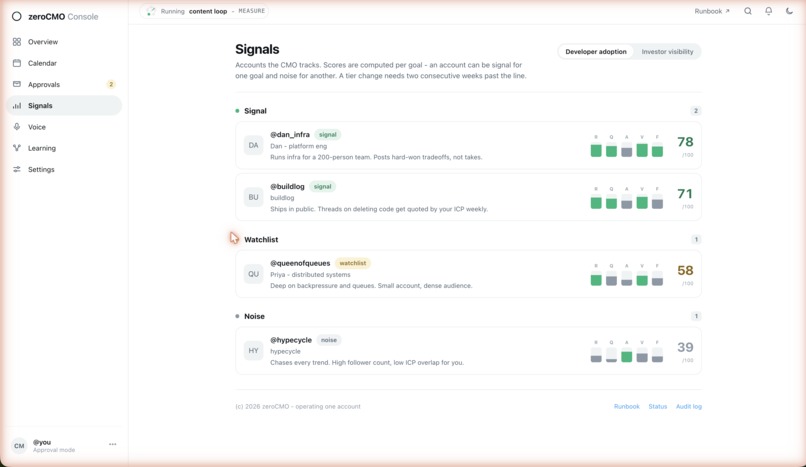
signals
-
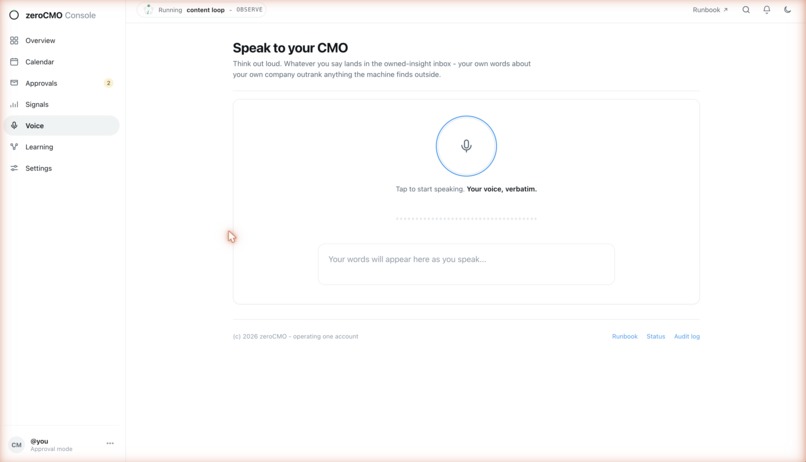
speaking - TBD
-
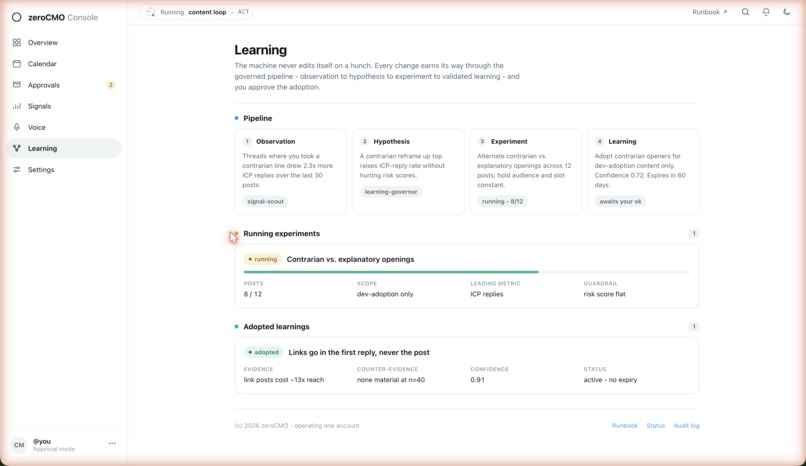
learning loops


Inspiration
zeroCMO starts with zero cold start: your X history is the onboarding. Then every edit, approval, and outcome becomes state no competitor can replay: your tone versions, your signal graph, your win patterns. Day 0: instant context. Day 90: a compounding playbook. We don't lock you in with your data. We keep you with the curve.
What it does
You bring your own keys (X, Notion, xAI). zeroCMO interviews you in 12 questions to build an Audience Profile and a Tone Skill, then starts its loops:
Signal Loop (weekly): scores every candidate account into Signal / Watchlist / Noise with a falsifiable formula, not vibes:
SignalScore=100(0.40R+0.20Q+0.15A+0.10V+0.15F)
How we built it
Claude Agent SDK is the brain: an orchestrator plus six subagents with strict output contracts, per-run turn and dollar budgets. Grok 4.5 with xAI Agent Tools (x_search) is the sensing layer, so we never pay X API read costs for research. The X API v2 (pay-per-use) is the act layer, own account only; links always go in the first reply because a link post costs 13x a plain one. Notion is the visible brain: eight databases the user can read and edit, written through the Markdown endpoints with an internal integration token. Telegram is the single human surface. Guardrails are PreToolUse hooks in code, not prompt suggestions: unapproved posts, duplicates, embargo topics, and daily limits are physically blocked.
Challenges we ran into
Making "signal" falsifiable instead of a vibe. X's February 2026 switch to pay-per-use pricing, which forced the read/write split (Grok reads, X API writes). Running Notion headless: the hosted MCP needs browser OAuth, so we went raw API plus token. And the autonomy dilemma: we wanted auto-posting without handing an AI the keys to a personal brand, which produced the earned-autopilot design.
What we learned
Closed loops beat clever prompts. A mediocre writer that measures itself outruns a brilliant writer that doesn't. Every important action must produce an artifact; our Learnings database is injected into every subsequent run, so the system literally gets a memory of what worked. And guardrails belong in hooks, not prose.
The moat
Self-learning is an architecture, and architectures get copied. What cannot be replayed is the state the loops accumulate: tone skill versions distilled from your edit diffs, the signal graph's score history, weeks of Learnings about what actually works on your audience. Day 0: instant context, because your X history is the onboarding. Day 90: a compounding playbook, because the same product is measurably better for you than it was on day 1. We hold users honestly, too: all of that state lives in their own Notion, fully portable. We don't lock you in with your data. We keep you with the curve.
What's next
Telegram Mini App for rich editing, Notion Workers as a zero-infra deploy target, multi-tenant OAuth, and a newsletter loop built on the same Learnings. Then the third moat layer: opt-in, anonymized cross-user pattern learnings, where every new user makes the product smarter for everyone.
Built With
- anthropic
- claude
- claude-agent-sdk
- cron
- grok
- node.js
- notion-api
- sqlite
- telegram-bot-api
- typescript
- webhooks
- x
- x-api
- xai


Log in or sign up for Devpost to join the conversation.