-
-
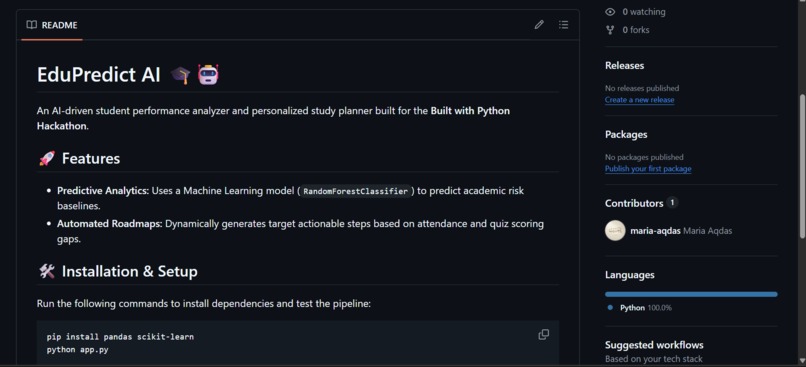
Detailed project documentation on GitHub outlining the application's core predictive features and setup instructions.
-
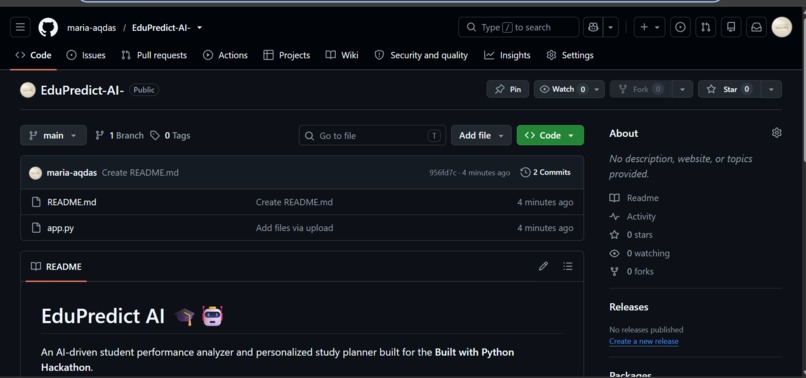
The official GitHub repository for EduPredict AI containing the core script implementation and a well-structured project overview.
-
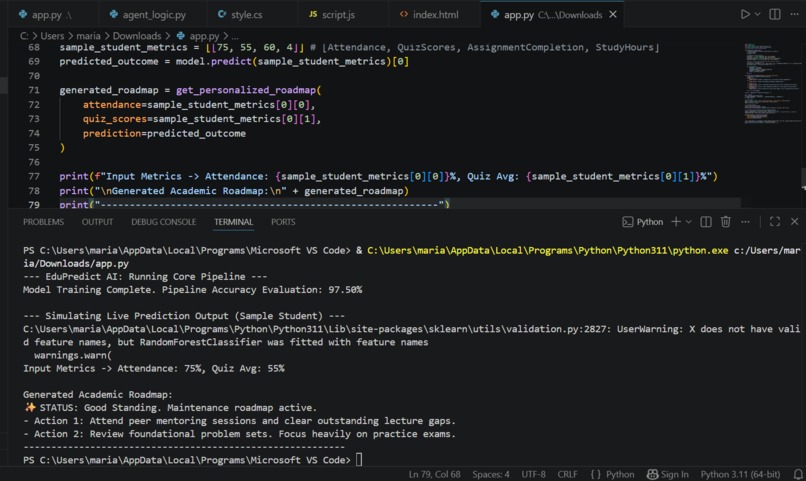
EduPredict AI machine learning pipeline running successfully in VS Code, achieving a 97.50% model accuracy.


💡 Inspiration
Many students struggle to pinpoint the exact subjects or methodologies causing their grades to slip until it is too late in the semester. Inspired by the need for actionable academic guidance, we wanted to build an intelligent, data-driven system that acts as an early-warning academic tool and a personalized study assistant.
⚙️ What it does
EduPredict AI is a predictive analytics application designed for students and educators. By securely processing historical academic metrics (such as quiz marks, assignment scores, and attendance rates), it predicts upcoming exam outcomes. Going a step further, it identifies specific weak areas and automatically generates a tailored study roadmap with targeted focus topics to help bridge the learning gap.
🛠️ How we built it
The core engine is built entirely using Python. We utilized Pandas and NumPy for data manipulation, cleaning, and preprocessing. The predictive capability is powered by a machine learning model implemented via Scikit-learn. For the user experience, we used clear data visualizations to track expected performance metrics over time.
🧠 Challenges we faced
Feature engineering from raw student performance metrics required balancing static historical context with dynamic current-semester progress. Fine-tuning the predictive models to avoid false positives—and ensuring the generated study suggestions felt practical rather than overwhelming—took significant logical adjustments.
🏅 Accomplishments that we're proud of
We successfully constructed an end-to-end Python workflow that moves cleanly from raw data entry to a predictive classification, concluding with an automated, customized student schedule generator.
📖 What we learned
We deepened our mastery of Scikit-learn classification workflows, learned how to structurally match algorithmic outputs to educational text recommendations, and gained hands-on experience deploying a cohesive ML tool within a tight hackathon deadline.


Log in or sign up for Devpost to join the conversation.