-
-
App is in testflight, Waiting for Apple and Android App store review.
-
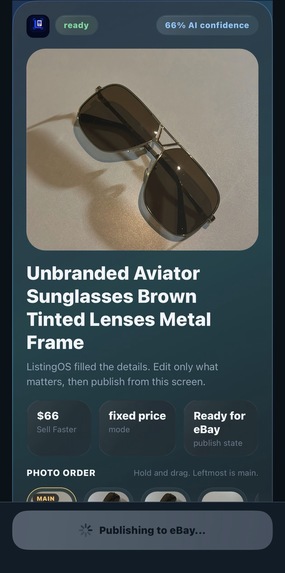
iOS Mobile App Listing Page
-
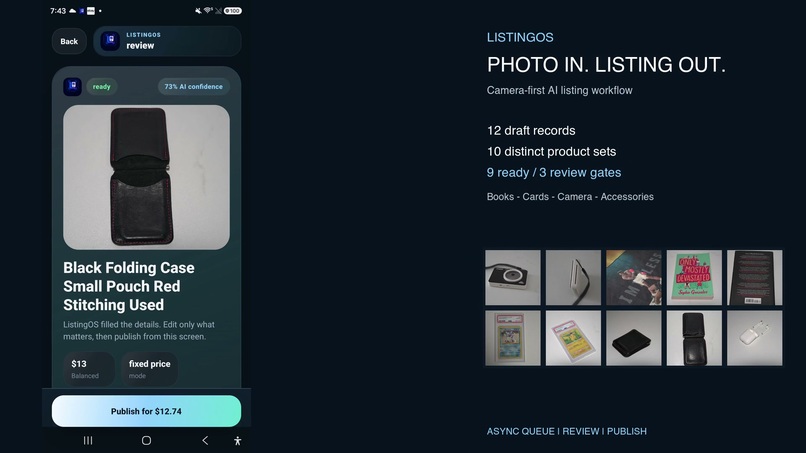
Thumbnail
-
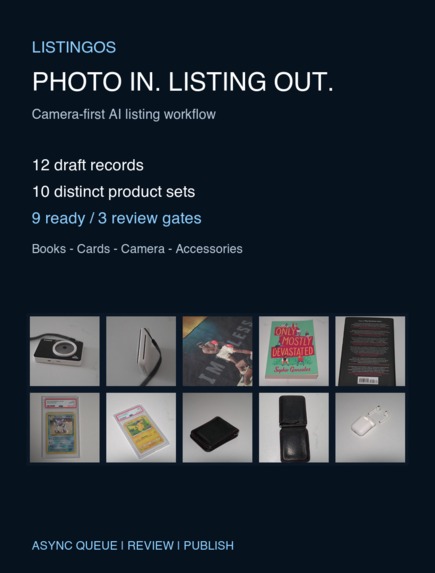
Demo Listings
-
Compatible with React Native for Web
-
How I used Codex
-

LIVE SONY PTP VIEWFINDER + IMAGE USAGE SUPPORT ON ANDROID


Inspiration
ListingOS began during one of the most stressful periods of my life.
I had recently lost my job, been in a car accident, and was struggling to get paid for work I had already completed. With rent approaching, I looked around my apartment and realized I might need to sell nearly everything I owned.
I turned to eBay and briefly found an AI-assisted listing experience that made the process remarkably fast. I could take a few photos, let the app identify the product, and move quickly from one item to the next. For a moment, it felt like I had found a practical way to turn the things I already owned into the money I urgently needed.
Then the feature disappeared.
From what I could determine, it had been a temporary beta. I was pushed back into the traditional workflow: researching each product, writing titles and descriptions, selecting categories, entering item specifics, setting a price, and repeating the process for every item.
The problem was larger than one platform. There are many places to sell something, but nearly all of them require sellers to repeatedly enter the same kinds of information.
That experience made two things clear:
- A listing is not a sale.
- Until an item sells, all listing-related work is unpaid.
Sellers already accept the risk that an item may never sell. They should not also have to spend several minutes manually entering data for every attempt—especially when they are listing dozens of one-off, secondhand items just to make ends meet.
At almost exactly that moment, the OpenAI Build Week hackathon appeared. I was already living the problem and had started thinking about the solution. Rather than wait for someone else to build it, I decided to build it myself.
ListingOS was created around one simple idea:
Listing an item should feel as fast as posting a story.
Take the photos. Let AI handle the repetitive work. Review only what requires human judgment. Publish, then move on to the next item.
Every item sitting in a closet, garage, or storage unit may hold value. Turning that value into cash is still surprisingly slow.
ListingOS is designed to change that.
What it does
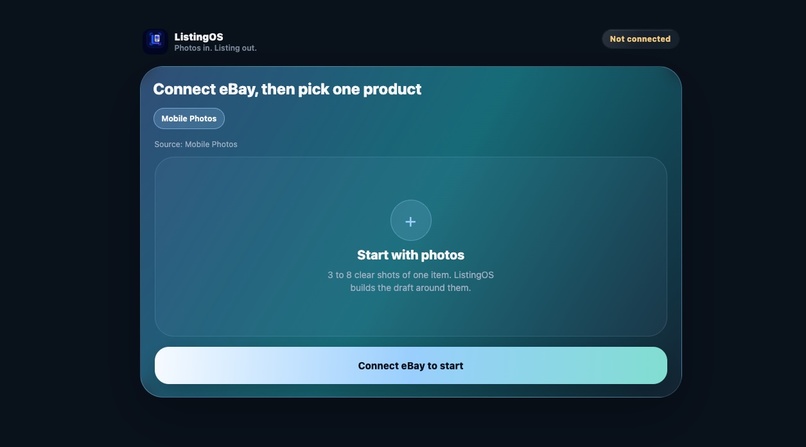
ListingOS is an AI-powered, camera-first mobile selling assistant that transforms product photos into marketplace-ready eBay listings.
A seller signs in to their eBay account, photographs an item, and chooses whether to prioritize a faster sale or stronger price potential. They can then immediately continue photographing the next product.
While the seller keeps capturing inventory, ListingOS processes each listing asynchronously.
Using GPT-5.6 together with live eBay marketplace data, ListingOS:
- Identifies the product
- Generates a search-optimized title
- Writes an accurate, buyer-focused description
- Suggests the most appropriate category
- Completes relevant item specifics
- Recommends evidence-based pricing
- Flags missing or uncertain information
- Explains exactly why manual review is needed
Instead of forcing sellers to wait for AI, ListingOS uses a visible production queue. Every item moves through the listing pipeline while the seller continues photographing inventory.
When processing finishes, the seller receives a focused review screen where they can approve the generated information, repair any remaining blockers, and publish directly to their own eBay account.
For graded trading cards, ListingOS uses a stricter verification pipeline. Rather than allowing the model to guess, it combines:
- OCR
- PSA certificate verification
- Pokémon catalog matching
- eBay image search
- Marketplace evidence
- Confidence scoring
Pricing recommendations are only shown when the available evidence clears the required confidence threshold. When confidence is too low, ListingOS refuses to invent information and explains what must be verified.
Capture is not limited to a phone. Photos from supported Sony cameras can be imported into ListingOS as a single capture session. On-device quality analysis also checks blur, exposure, and visible detail so sellers can identify poor photos before publishing a listing.
To make judging easier, ListingOS includes a dedicated Proof Mode. It allows judges to explore realistic workflows—including successful listings, trust-gated trading cards, and blocker repair—without connecting an eBay account or creating live marketplace listings.
Why it’s different
Most AI listing tools still expect sellers to stop and wait.
ListingOS was designed around momentum.
Instead of treating AI as another form to complete, ListingOS treats listing creation like an assembly line.
- Never wait for AI. Listings generate asynchronously while sellers continue photographing inventory.
- Camera-first, not form-first. Sellers capture products first and review only the exceptions that need attention.
- Evidence before automation. GPT-5.6 evaluates marketplace evidence before recommending prices or asserting product identities.
- Built for trust. When confidence is low, ListingOS surfaces uncertainty instead of inventing facts.
- Designed for real sellers. Every workflow is built to reduce friction rather than add another dashboard.
How I built it
ListingOS combines a React Native mobile application with a globally distributed serverless backend.
The mobile app is built with:
Expo SDK 57React NativeExpo RouterTanStack QuerySecureStoreZod
The backend runs on Cloudflare Workers and uses:
HonoD1R2KVQueues
Together, these services power an asynchronous listing pipeline without requiring traditional server infrastructure.
The core workflow is:
Capture → Queue → Analyze → Verify → Review → Publish
Authentication is handled through eBay OAuth. Listing creation integrates with eBay's Identity, Browse, Taxonomy, Account, Media, and Inventory APIs.
At the center of the system is the OpenAI Responses API with GPT-5.6.
Rather than producing unrestricted free-form text, GPT-5.6 receives seller photos, marketplace context, and structured instructions. It returns structured listing data that is validated before anything can be published.
The prompts and validation rules are intentionally conservative. The system is instructed not to:
Invent included accessories Exaggerate product condition Make unsupported authenticity claims Recommend pricing without sufficient evidence Hide uncertainty from the seller
The result is an AI system designed to help sellers make better decisions—not simply faster ones.
How I used Codex
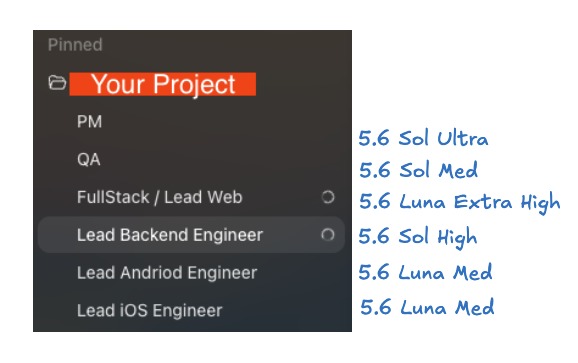
Codex became my primary engineering partner throughout development.
It helped me:
Architect the Cloudflare Worker backend Scaffold the React Native application Implement secure eBay authentication Build the asynchronous listing queue Debug native Android crashes Resolve production image-delivery issues Improve the trading-card verification pipeline Refine the mobile interface Generate technical documentation Test the application on physical devices
I retained responsibility for the product decisions: designing a seller-first workflow, minimizing manual input, determining when AI should refuse to guess, and ensuring that listings could be published directly from the mobile application to a real seller account.
Codex accelerated implementation, debugging, and iteration, while the product direction remained grounded in the problem I had personally experienced.
Challenges I ran into
The hardest problem was not generating listings.
It was knowing when AI should not answer.
Marketplace trust disappears quickly when AI confidently misidentifies a product, invents a detail, or recommends an unsupported price.
That led me to redesign much of the listing pipeline around evidence rather than model confidence alone.
For trading cards, AI-generated conclusions are checked against PSA data, catalog information, OCR results, and marketplace image matches before pricing is allowed.
I also spent significant time solving practical engineering problems, including:
Reliable media uploads to eBay Asynchronous queue processing OAuth reliability and token refresh Production image delivery Idempotent publishing Blocker recovery Native Android stability after major dependency updates
Building the listing generator was only one part of the challenge. Building a system that could fail safely, explain uncertainty, and recover cleanly was much harder.
What I learned
The biggest lesson was not technical.
It was behavioral.
Sellers do not want another dashboard. They want a machine that turns photos into trustworthy listings with as little effort as possible.
I also learned that production AI systems need more than impressive outputs.
They need guardrails.
Identity verification, confidence scoring, marketplace evidence, secure authentication, idempotent publishing, and transparent uncertainty are what make AI trustworthy enough to automate real commerce.
AI does not earn trust by sounding confident. It earns trust by knowing when not to guess.
What’s next
ListingOS is focused on eBay today, but the long-term vision is much broader.
Rather than becoming another marketplace, ListingOS aims to become the universal AI listing layer that sits above marketplaces.
Future work Unified multi-market publishing: Create one listing and distribute it across multiple marketplaces through a shared workflow. ListingOS Market: Build a lightweight first-party marketplace where sellers can instantly publish AI-generated listings alongside external channels. Desktop Seller Copilot: Give professional sellers an AI-assisted workspace for managing inventory, listings, blockers, pricing, and store operations. Deeper camera integrations: Add direct Sony tethered capture, remote shutter control, and advanced multi-item capture sessions. Expanded on-device intelligence: Use VisionCamera and React Native ExecuTorch to detect duplicates, poor framing, blur, and other capture issues before upload. Marketplace intelligence: Add sold-comparable pricing, time-to-sale prediction, vertical-specific models, and listing optimization based on real performance data.
ListingOS started as a faster way for me to sell something on eBay.
I believe it can become the operating system for selling anything, anywhere.
Built With
- cloudflare-d1
- cloudflare-kv
- cloudflare-queues
- cloudflare-r2
- cloudflare-workers
- codex
- ebay-api
- ebay-inventory-api
- ebay-oauth
- expo-router
- expo-ui
- expo.io
- gpt-5.6
- hono
- openai
- react-native
- responses-api
- tanstack-query
- typescript
- zod


