-
-

the problem
-

PREHAB
-

thank you
-

the problem
-

our team
-
value prop
-

pricing
-
system design


Inspiration
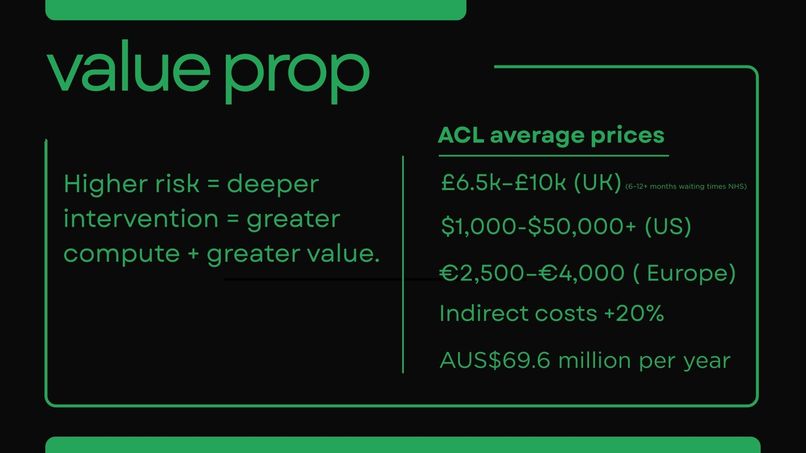
Female athletes are eight times more likely to suffer ACL injuries than their male counterparts, yet most training programs are still designed based on male physiology. Research shows that hormonal fluctuations during the menstrual cycle, specifically during ovulation and premenstrual phases, significantly impact ligament laxity and recovery. We built PREHAB to close this "gender data gap" by creating an AI agent that treats an athlete’s cycle as a critical performance metric, not a footnote.
What it does
PREHAB is an autonomous, cycle-aware injury prevention platform. It acts as a 24/7 sports physiologist for female athletes and a command centre for coaches.
For Athletes: A personalised dashboard that tracks cycle phases, soreness, and training load. It provides a daily "Risk Score" and an AI-adjusted training plan that lightens the load during high-risk windows.
For Coaches: A squad-level heatmap and escalation queue. The AI automatically flags high-risk athletes, allowing coaches to intervene only when necessary, saving hours of manual data analysis.
How we built it
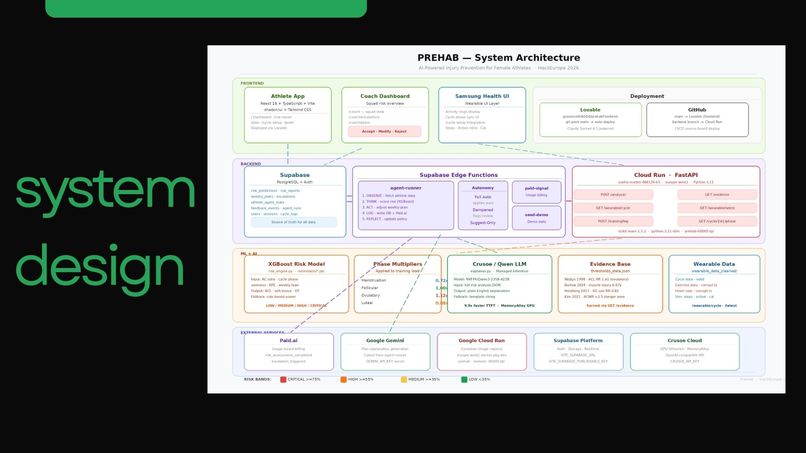
Frontend built entirely in Lovable (React + TypeScript + shadcn/ui), backend on Supabase with PostgreSQL and Edge Functions. XGBoost model predicts injury risk from training load, soreness, RPE, and cycle phase. Autonomous agent runs Observe-Think-Act-Log-Reflect loop: fetches athlete data, scores risk, adjusts training plans using cycle-phase multipliers (menstruation 0.72×, luteal 0.88×, ovulatory 1.12×), logs decisions to Supabase, and adapts autonomy based on coach feedback. Gemini generates evidence-based explanations citing peer-reviewed research. Every agent action emits usage signals to Paid.ai for outcome-based pricing. Samsung Health integration syncs cycle and activity data.
Challenges we ran into
Building an agent that coaches actually trust required solving the "black box" problem - we added evidence citations, coach escalation workflows, and adaptive autonomy modes. Balancing agent independence with coach oversight was critical: too autonomous and coaches reject it, too cautious and it adds no value. We also had to handle sparse menstrual cycle data, as not all athletes track consistently, requiring intelligent imputation and confidence scoring.
Accomplishments that we're proud of
Created a fully autonomous agent that adapts its own behavior based on real-world feedback, shifting between Full Autonomy, Dampened, and Suggest-Only modes. Integrated outcome-based pricing through Paid.ai, proving the economic value of each intervention. Built a production-ready platform in 48 hours using Lovable. Most importantly, we're addressing a real gap in women's sports medicine with evidence-based AI that could prevent thousands of injuries.
What we learned
Female athlete health is massively underserved by sports tech - most wearables and training platforms ignore the menstrual cycle entirely. We learned that building trustworthy AI for high-stakes decisions (athlete safety) requires transparency, adaptability, and human-in-the-loop design. We also discovered that outcome-based pricing fundamentally changes how you think about AI value: every agent action must justify its cost.
What's next for PREHAB
Partner with sports teams and physiotherapy clinics for pilot studies to validate injury reduction rates. Expand beyond ACL injuries to other cycle-sensitive conditions (stress fractures, overtraining syndrome). Integrate real wearable APIs (Garmin, Whoop, Oura) beyond Samsung Health simulation. Build a feedback loop where the XGBoost model retrains on actual injury outcomes, continuously improving predictions. Explore insurance partnerships where outcome-based pricing rewards injury prevention.


Log in or sign up for Devpost to join the conversation.