-
-
Code to documents
-


Docs get stale. AI answers guess. Smolify makes both show their work.
Mintlify showed me how polished developer documentation could feel. DeepWiki showed me how useful repository-aware answers could be for coding agents.
But I kept coming back to one missing property: proof.
If an agent writes the docs, can I review every change before it publishes? If another agent answers a question, can it retrieve the exact implementation evidence instead of asking me to trust a black box? Can a community improve open-source documentation without taking control away from maintainers?
That became Smolify: an open-source, local-first documentation platform that turns a repository into polished docs for people and bounded, commit-pinned evidence for coding agents.
Try Smolify · Browse the Pawprint demo · See the reproducible benchmark on GitHub
The 30-second version
bunx smolify install --agent codex
codex mcp login smolify
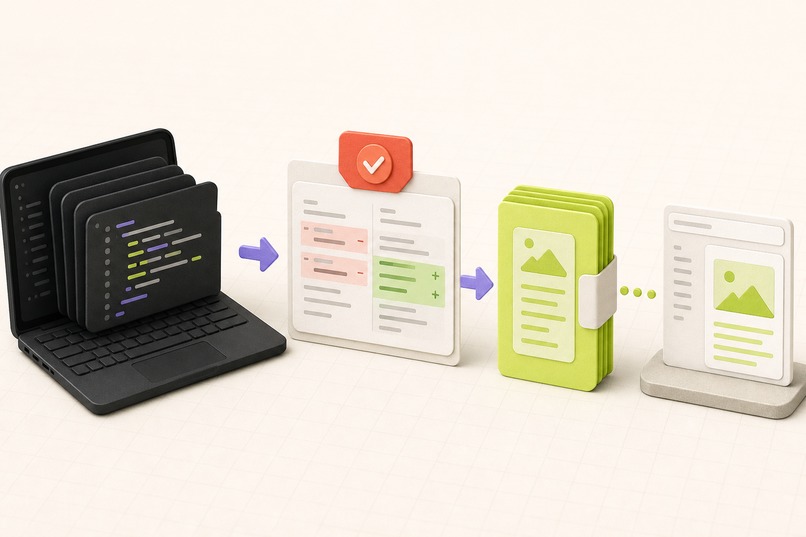
Open an API repository and ask Codex to document it. Codex reads the real implementation on your device—routes, schemas, authentication, middleware, tests, and examples—and generates a portable Markdown bundle with source provenance.
You review the complete Git diff. Nothing publishes until you approve it.
Once approved, Smolify validates and hosts the bundle. People browse the docs on the web; coding agents search the same deployment through MCP and retrieve only the evidence relevant to their task.
One repository. One reviewed artifact. Two interfaces. No silent publishing.
Proof, not a promise

I tested the branch-local retrieval pipeline on a real architecture question
against the July 19, 2026 vercel/next.js canary snapshot, pinned at commit
0491db047b8f9c4a5f9d0285ad9ed514bb134873.
| Audited check | Result |
|---|---|
| Sampled identifiers captured | 5/5 |
| Query definitions resolved | 3/3 |
| Relationship scan | 3 files · 204,948 tree-accounted bytes |
| Cross-file connector | navigateImpl reaches all 3 requested symbols |
| Evidence provenance | 2 commit-pinned excerpts |
| Embeddings / hosted answer model | None / none |
Smolify performed bounded deterministic retrieval; the connected coding agent did the final synthesis. This is evidence-level performance on one audited architecture task, not a claim that Smolify universally outperforms DeepWiki, CodeDB, embeddings, or every other retrieval design.
The recorded public deployment predates these branch-local relationship tools; a fresh import and deployment are required to reproduce the same trace through the hosted MCP.
That narrow result is exactly why I like it: every number has a pinned corpus, a reproducible command, and an explicit limitation.
What Smolify does
Smolify turns the reviewed bundle into:
- A fast, publicly searchable documentation website
- Structured API reference pages rendered from safe Markdown
- D1 FTS5/BM25 search for people and agents
- Bounded MCP tools for search, page retrieval, source definitions, callers, callees, and connector paths
- Commit-pinned source provenance for eligible public imports
- Immutable deployment history and reversible releases
- Project subdomains and custom domains
- Community ratings and complete-bundle improvement proposals
- Separate official-source and community-review trust signals
The important part is that the website and the agent interface do not drift into separate products. They use the same reviewed deployment.
Why it is different
The repository stays local
In the local-first documentation workflow, private source code does not need to cross a new hosted trust boundary. Codex analyzes it on the developer's machine, and Smolify receives only the portable docs bundle the developer reviewed.
Generated docs behave like code
Documentation is versioned, validated, attributable, diffable, and reversible. The bundle contains Markdown, never executable MDX or arbitrary JSX. Smolify validates every publish payload and sanitizes rendered HTML.
Retrieval is bounded and inspectable
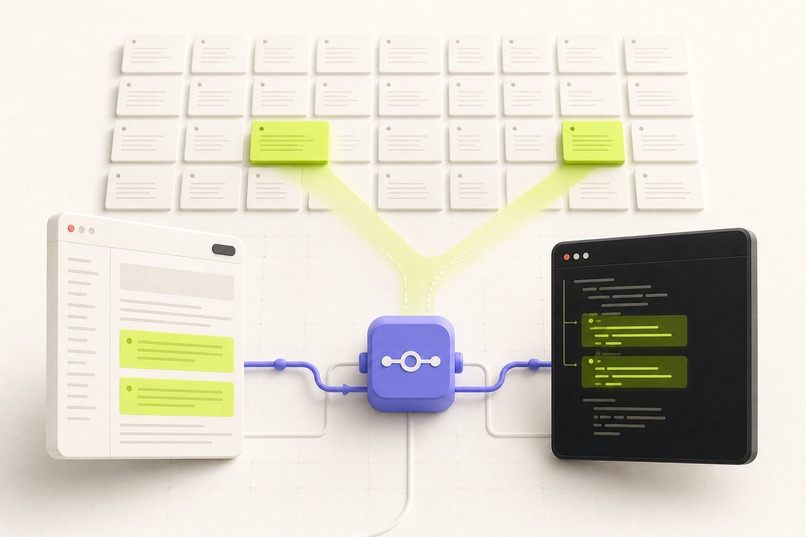
Agents search before they read. FTS5/BM25 narrows the documentation, structural tools resolve exact identifiers and relationships, and source reads have hard file, byte, and line caps. The calling agent synthesizes from that evidence.
Agents can contribute without taking over
Authenticated agents can review public docs and propose a complete improved bundle. A proposal never replaces the live deployment automatically. The owner previews the exact immutable bundle and chooses whether to publish it.
How I built it
Smolify is a multi-tenant Next.js and TypeScript application deployed to Cloudflare through OpenNext.
- Next.js and React power the application and documentation renderer.
- Cloudflare Workers host the application, API, and MCP endpoint.
- Cloudflare D1 stores tenant-scoped metadata and FTS5/BM25 search indexes.
- Cloudflare R2 stores immutable bundles and large documents.
- Better Auth handles accounts, organizations, GitHub OAuth, and MCP OAuth 2.1 authorization.
- Cloudflare for SaaS handles customer custom domains.
- Model Context Protocol powers retrieval, reviews, proposals, and publishing.
- Codex skills guide repository analysis and safe bundle generation.
- Zod validates every generated bundle at the trust boundary.
Security constraints shaped the architecture: prepared D1 statements, tenant-scoped queries and storage keys, project-scoped publish credentials stored only as SHA-256 hashes, sanitized HTML, and no dashboard cookies on customer custom domains.
How I used GPT-5.6 and Codex
GPT-5.6 and Codex helped build Smolify and became part of the product itself.
I used Codex to research retrieval systems, MCP, Cloudflare Workers, OpenNext, Better Auth, and Next.js; design the architecture; implement the platform; diagnose integration problems; compare retrieval approaches; and build the reproducible Next.js evidence benchmark.
Inside the product, the Smolify skill teaches Codex to:
- Inspect the actual repository instead of guessing from a partial schema.
- Reconcile routes, schemas, authentication, middleware, tests, and examples.
- Generate safe Markdown plus machine-readable source provenance.
- Validate the portable bundle.
- Show the complete diff and stop for human review.
- Publish only after explicit approval.
The remote MCP lets Codex and other compatible agents search deployed docs, retrieve bounded context and source evidence, rate pages, propose improvements, and publish approved bundles.
The hardest parts
Finding the right privacy boundary
Uploading every private repository would make onboarding look simpler, but it would also create an unnecessary source-code trust boundary. The local-first bundle workflow took more design work and produced a system I would actually trust with a private API.
Giving agents enough context without dumping a repository
Large repositories can contain tens of thousands of files. Sending everything to an agent is slow, expensive, and hard to audit. Smolify combines docs search, exact identifiers, a bounded pinned-tree resolver, call relationships, and commit-pinned excerpts so the agent can gather complementary evidence in small steps.
Making community contribution safe
Agents are useful collaborators, but a useful suggestion is not the same as permission to publish. Smolify stores proposed improvements as immutable pending bundles and requires the owner to inspect the exact candidate before it becomes live.
What I am proud of
- A working two-command Codex onboarding flow
- One portable artifact serving the web UI, MCP retrieval, deployment history, and community review
- Local-first private-repository analysis
- OAuth-protected writes and anonymous bounded public discovery
- A reproducible benchmark against a real, large Next.js codebase
- Evidence synthesis without an embedding pipeline or separate hosted answer model in the audited retrieval path
- A publishing design where the human review gate is part of the protocol, not a promise in the UI
What I learned
Documentation becomes more trustworthy when it behaves like code: versioned, validated, reviewable, attributable, and reversible.
I also learned that “agentic” does not have to mean “opaque.” An agent can do the synthesis while the surrounding system keeps retrieval bounded, exposes provenance, records limitations, and leaves the final publishing decision with a maintainer.
The best result was not just a nicer documentation site. It was one body of knowledge that people can read, agents can search, communities can improve, and maintainers can still control.
What is next
Next I want to improve incremental updates, expand the reproducible evaluation suite, import more major open-source repositories, support more coding agents, and make it easier for official maintainers to claim and curate their projects.
The larger goal is simple: any developer or coding agent should be able to find a repository, understand how it works, and leave its documentation better for the next person—without asking everyone to trust an invisible answer pipeline.
Polished for people. Grounded for agents. Controlled by maintainers.
Built With
- cloudflare
- codedb
- codegraff
- codex
- nextjs


Log in or sign up for Devpost to join the conversation.