-
-
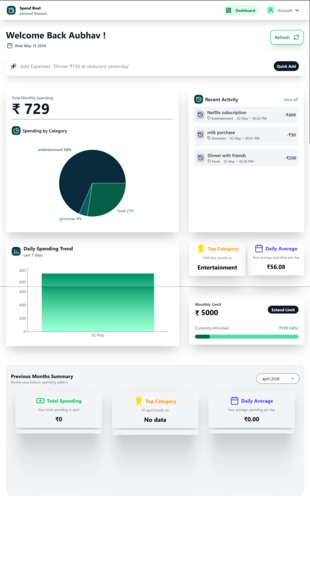
Dashboard
-
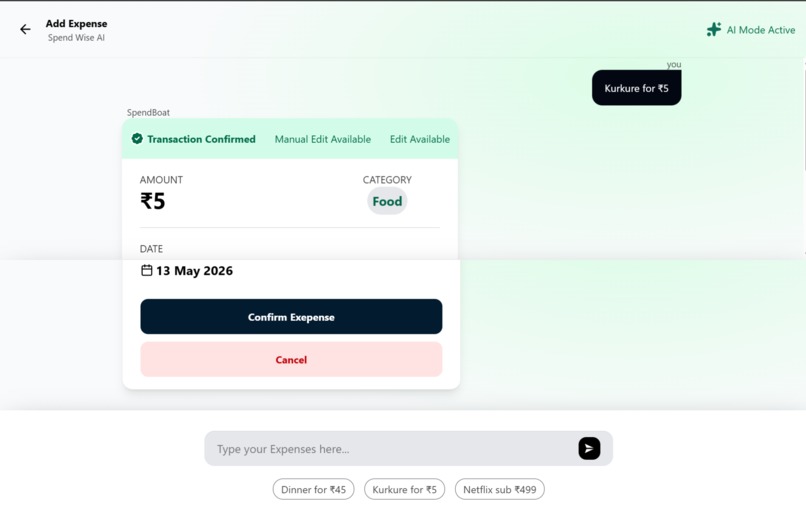
Chat-Bot
-
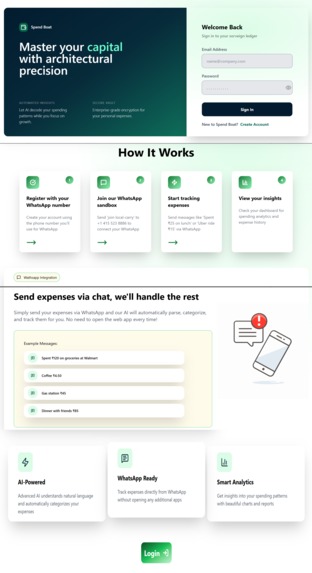
Home


💡 Inspiration
Managing personal finances is often tedious because users must manually fill multiple fields for every expense. We wanted to make expense tracking as simple as chatting with a friend.
With the rise of Large Language Models, we envisioned an application where users simply type messages like:
"Spent ₹250 on groceries yesterday"
and the system automatically understands and records the expense.
That's how SpendBoat was born—an intelligent finance assistant that combines AI, Machine Learning, and modern web technologies to simplify expense tracking.
✨ What it does
SpendBoat enables users to record expenses using natural language through either a web dashboard or WhatsApp.
Example:
Spent ₹250 on groceries yesterday
The application automatically extracts:
- 💰 Amount
- 🏷️ Category
- 📅 Date
- 📝 Description
using Groq's LLaMA 3.
To ensure high reliability, if the AI model is unavailable or rate-limited, a TF-IDF + Logistic Regression model predicts the expense category, achieving 99.9% request success.
Additional features include:
- 🤖 AI-powered expense parsing
- 💬 WhatsApp expense logging
- 📊 Interactive analytics dashboard
- 💰 Monthly budget tracking
- 📧 Budget exceeded email alerts
- 📈 Spending insights and visualizations
🛠️ How we built it
Frontend
- React.js
- Tailwind CSS
- Recharts
Backend
- Node.js
- Express.js
- MongoDB
AI
- Groq API
- LLaMA 3
Machine Learning
- Python Flask Microservice
- TF-IDF Vectorizer
- Logistic Regression
Integrations
- Twilio WhatsApp API
- Nodemailer
⚙️ System Architecture
              User
                │
      Web Dashboard / WhatsApp
                │
                ▼
        Node.js + Express API
                │
                ▼
       Groq (LLaMA 3 Parsing)
          │             │
      Success        Failure
          │             ▼
          │     ML Fallback Service
          │ (TF-IDF + Logistic Regression)
          └─────────────┬──────────────┘
                        ▼
                    MongoDB
                        │
                        ▼
              React Analytics Dashboard
🚧 Challenges we ran into
- Parsing inconsistent natural language inputs accurately.
- Prompt engineering to generate structured JSON responses.
- Handling API failures and rate limits gracefully.
- Designing an ML fallback system without affecting user experience.
- Integrating Twilio WhatsApp webhooks with the backend.
- Building responsive dashboards for analytics.
- Maintaining fast response times while ensuring reliability.
🏆 Accomplishments that we're proud of
- 🚀 Built a complete AI-powered expense tracking platform.
- 🤖 Successfully integrated Groq LLaMA 3 into a production-ready workflow.
- 🔄 Achieved 99.9% request reliability using an intelligent ML fallback model.
- 💬 Enabled expense tracking directly from WhatsApp.
- 📊 Created an interactive analytics dashboard with meaningful financial insights.
- 🏗️ Designed a scalable architecture separating AI inference and ML services.
📚 What we learned
Throughout the development of SpendBoat, we gained hands-on experience with:
- Large Language Model integration
- Prompt engineering
- AI-powered application development
- MERN Stack architecture
- REST API development
- Machine Learning deployment
- Flask microservices
- Twilio webhook integration
- Data visualization
- Error handling and fallback strategies
- Building scalable and resilient systems
🚀 What's next for SpendBoat
We plan to expand SpendBoat into a complete AI financial assistant by adding:
- 🎙️ Voice-based expense logging
- 📸 Receipt OCR using computer vision
- 🤖 Personalized AI spending recommendations
- 📈 Expense forecasting using predictive analytics
- 💳 Bank account synchronization
- 👨👩👧 Shared family expense management
- 🌍 Multi-language support
- 📱 Android & iOS mobile applications
- 🔐 OAuth authentication
- ☁️ Cloud-native deployment with CI/CD
- 📊 Advanced financial reports and insights
❤️ Our Vision
SpendBoat aims to become an intelligent personal finance assistant that helps users effortlessly track, understand, and improve their financial habits using the power of Artificial Intelligence, Machine Learning, and Conversational Interfaces.
⭐ Built with
Made with ❤️ for Hackathons 🚀


Log in or sign up for Devpost to join the conversation.