
Generative Agents
Open-source frameworks and systems that orchestrate teams of AI agents—from architecture to deployment at Microsoft scale.

AutoGen
Co-creatorA framework for building AI systems where multiple agents converse to solve a task—now the foundation of Microsoft Agent Framework.

Today agents mostly work in isolation with their users. What if instead they were all connected? This project highlights the potential benefits of that future—and its security implications.

Five specialized agents orchestrated to browse, code, and reason—state-of-the-art on GAIA and WebArena.

Imagine a marketplace like eBay, but where all the buying and selling is done by agents. We simulate these “two-sided markets” to understand the performance, biases, and vulnerabilities of LLM agents.

Converts PDFs, DOCX, images, and 20+ formats to Markdown. Originally a module built to support the FileSurfer sub-agent in Magentic-One.
Human-Centered GenAI
Agents fail in ways chatbots don't. I study where human-AI collaboration breaks down and build systems that fix it.

Magentic-UI
Co-leadA human-in-the-loop web agent: it browses, codes, and manipulates files, but co-plans the task with you and stops at action guards before risky steps.

We argue that, just as in human-human collaboration, people and agents can only collaborate efficiently once they achieve a shared understanding of each other’s beliefs and goals—and we lay out 12 challenges to reaching this common ground.

We ran observational studies with real programmers to understand how they use GitHub Copilot, yielding a richly labeled dataset of interactions. We found programmers spend about 22% of session time just verifying AI suggestions.

Despite a large literature on explainable AI, we showed that explanations rarely help people catch the AI’s mistakes—if anything, they make people more likely to accept its answer even when it’s wrong. The paper also popularized the term “complementary performance”.
Talks & Panels
I speak often about multi-agent systems and human-centered AI—at conferences, universities, and companies building with agents.
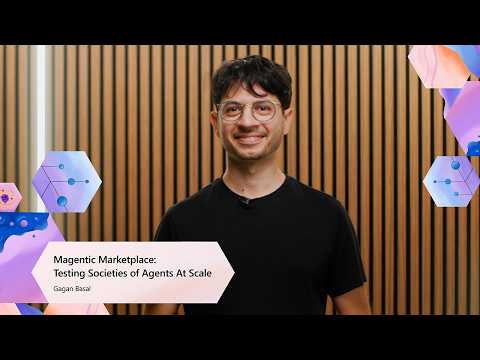 Magentic Marketplace: Societies of Agents at Scale
 AutoGen v0.4: A New Architecture for Agentic AI
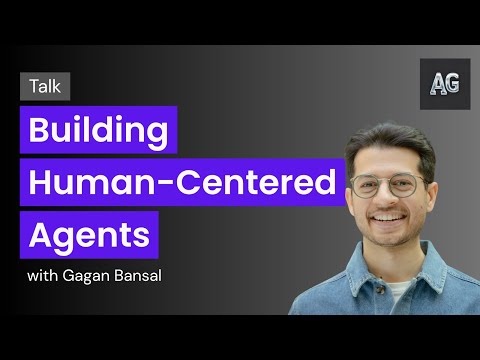 Challenges in Human-Agent Communication
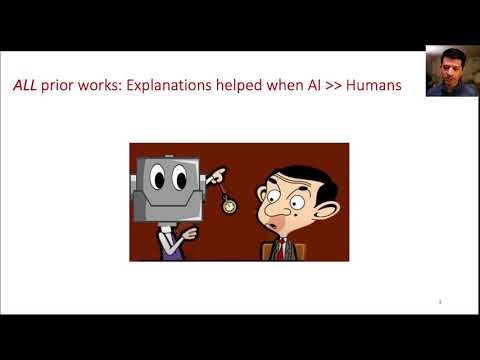 Does the Whole Exceed its Parts?
Open Source
I love open source and programming. Most of my research ships as code you can run. Find me on GitHub. Fun fact: in December 2024, I was a top trending developer on GitHub worldwide.
Bio
Gagan Bansal is a Principal Researcher at Microsoft Research AI Frontiers, where he co-created AutoGen, one of the most widely adopted open-source frameworks for multi-agent AI systems and now the foundation of Microsoft's Agent Framework. He has co-led the development of Magentic-One, a generalist multi-agent system achieving state-of-the-art on GAIA and WebArena benchmarks; Magentic-UI, a human-in-the-loop web agent with co-planning and guardrails; and Magentic Marketplace, a collaboration with economists studying agent behavior in two-sided markets. His research spans both building agentic AI systems and studying how humans interact with them—identifying fundamental challenges in human-agent communication and examining how AI explanations, uncertainty displays, and code completion tools affect human decision-making and performance. His work has received a Best Paper award at the ICLR 2024 LLM Agents Workshop and an Honorable Mention at CHI. He holds a Ph.D. in Computer Science from the University of Washington, where he was advised by Dan Weld, and a B.Tech from IIT Delhi.
