
HiAPI
HiAPI unifies image, video, and text generation models into one API with persistent artifact storage and production-grade routing for seamless.
Visit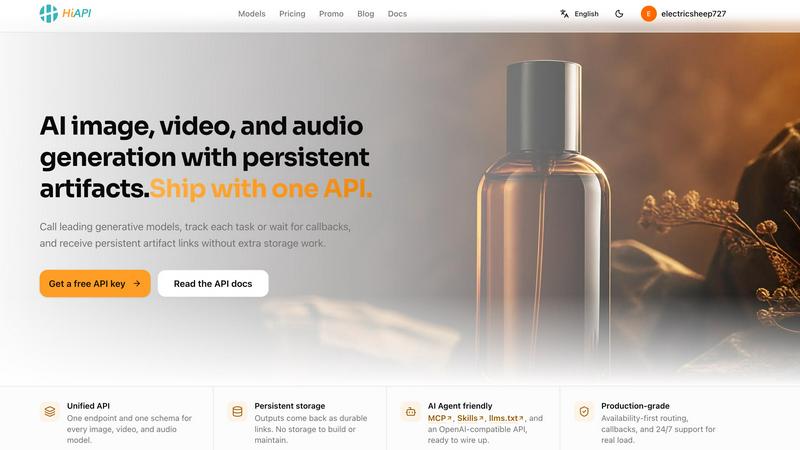
About HiAPI
HiAPI is a developer-first, unified AI API platform designed to streamline the integration of leading generative AI models for image, video, text, and audio generation. At its core, HiAPI eliminates the complexity of managing multiple vendor APIs by providing a single, OpenAI-compatible endpoint that grants access to a curated catalog of top-tier models from providers like OpenAI, ByteDance, Black Forest Labs, and MiniMax. The platform is purpose-built for developers and AI agents who need a production-grade, scalable solution without the overhead of managing individual model subscriptions, billing, or storage infrastructure. With HiAPI, every generation task is handled through a unified asynchronous lifecycle: you submit a job, track its status via polling or callbacks, and receive persistent artifact links that are stored at no extra effort. This approach removes the need to build and maintain custom storage solutions for generated outputs. The platform is also AI Agent friendly, supporting MCP (Model Context Protocol), Skills, and llms.txt for seamless integration into agentic workflows. Whether you are building a content creation tool, a dynamic marketing platform, or an autonomous agent, HiAPI offers a single integration point with transparent pay-as-you-go pricing, availability-first routing, and 24/7 support for real-world loads. With support for cutting-edge models like Seedream 5.0 Pro for text-to-image and image-to-image generation, HiAPI ensures developers can ship faster and scale confidently.
Features of HiAPI
Unified API and Single Schema
HiAPI provides one endpoint and one consistent JSON schema for every image, video, and audio model in its catalog. This means developers no longer need to learn and maintain separate API calls, authentication methods, and parameter structures for each AI provider. By simply passing a model name and the required input parameters, you can switch between models like GPT Image 2, FLUX 1.1 Pro, or MiniMax Music 2.6 without any code changes. This unified approach drastically reduces integration time and technical debt, allowing your team to focus on building product features rather than managing API sprawl.
Persistent Storage with No Extra Work
Every output generated through HiAPI is returned as a durable, persistent artifact link. This feature eliminates the need for developers to build, manage, or pay for additional cloud storage infrastructure. When you set the storage parameter to "persistent" in your API request, HiAPI automatically stores the generated image, video, or audio file and provides a stable URL that can be used directly in your application, shared with users, or referenced in downstream workflows. This is particularly valuable for applications that need to serve generated content at scale without worrying about file expiration or storage costs.
AI Agent Ready Integration
HiAPI is built from the ground up to be compatible with modern AI agent frameworks. It supports MCP (Model Context Protocol) for agent-accessible tools, Skills for reusable agent instructions, and llms.txt for automatic discovery and setup. Developers can paste a simple prompt into their agent (such as Claude, Cursor, or Codex) and the agent will understand HiAPI's models and APIs, then choose the best integration path. This makes HiAPI an ideal backend for autonomous agents that need to generate and retrieve media assets as part of complex, multi-step tasks.
Production-Grade Architecture with Callbacks
HiAPI is designed for reliability and performance under real-world loads. It features availability-first routing, which automatically directs requests to the most responsive model endpoints. The platform supports asynchronous task submission with idempotency keys to prevent duplicate tasks, and it offers callback URLs that notify your application upon task completion. This eliminates the need for constant polling and ensures your system can handle high-throughput generation workflows efficiently. Combined with 24/7 support, HiAPI provides the infrastructure confidence needed for production deployments.
Use Cases of HiAPI
Dynamic Content Creation for Marketing Teams
Marketing teams can use HiAPI to generate high-quality images and videos at scale for social media campaigns, ad creatives, and website assets. By integrating a single API, developers can build tools that allow marketers to input a product description and instantly receive multiple visual variations from models like GPT Image 2 or Seedream 5.0 Pro. The persistent storage feature ensures that all generated assets are immediately available with stable URLs, ready for use in email campaigns, landing pages, or programmatic ad buys. This workflow eliminates the bottleneck of manual design and accelerates campaign iteration cycles.
AI-Powered Music and Audio Production
Music producers and content creators can leverage HiAPI's audio generation models, such as MiniMax Music 2.6, to turn text prompts and lyrics into complete songs with optional instrumental mode. Developers can integrate this capability into music creation apps, video editing suites, or game development tools. The unified API allows users to generate background scores, sound effects, or full tracks without needing to understand the underlying model complexities. Callbacks ensure that long-running audio generation tasks can be managed asynchronously, freeing up the application for other user interactions.
Autonomous Social Media Management Agents
AI agents can use HiAPI to autonomously generate and post visual content to social media platforms. By using the llms.txt or MCP integration, an agent can be instructed to create a series of images based on trending topics, generate captions, and schedule posts. The agent can submit tasks to HiAPI, receive persistent artifact links, and then use those links directly in social media APIs. This use case demonstrates how HiAPI acts as a critical media generation layer in agentic workflows, enabling fully automated content pipelines that run 24/7.
E-commerce Product Visualization
E-commerce platforms can integrate HiAPI to generate product images from text descriptions or to edit existing product photos using image-to-image models like Seedream 5.0 Pro or Nano Banana 2. For example, a developer can build a feature that allows a seller to upload a photo of a plain t-shirt and describe a custom pattern, and the API will return a photorealistic image of the t-shirt with the pattern applied. The unified billing and pay-as-you-go pricing model makes it cost-effective to offer this feature to thousands of sellers without upfront commitments.
Frequently Asked Questions
How does HiAPI handle billing for multiple AI models?
HiAPI provides unified billing across all supported models. You use a single API key and pay-as-you-go pricing for every request. Each model has its own transparent price per generation, which is displayed on the model details page. Your usage is aggregated into a single invoice, eliminating the need to manage separate accounts and payment methods with each AI provider. This simplifies financial tracking and cost management for development teams.
What is the process for switching between different AI models?
Switching models is as simple as changing the model parameter in your API request. Because HiAPI uses a single endpoint and a unified JSON schema, you can swap from GPT Image 2 to FLUX 1.1 Pro or from Seedream 5.0 Pro to Nano Banana 2 without modifying any other part of your integration. The input structure remains consistent, though you may adjust model-specific parameters as needed. This flexibility allows you to A/B test different models or respond to changes in model performance and pricing.
How does persistent storage work, and what are the costs?
When you set the storage parameter to "persistent" in your task submission, HiAPI stores the generated output and returns a durable URL. There are no additional storage infrastructure costs to build or maintain on your end. The cost for persistent storage is included in the model's per-generation price, which is listed upfront. These artifact links are designed to be long-lived and suitable for production use, such as embedding in web pages or serving to end users.
Can I use HiAPI with AI agents like Claude or Cursor?
Yes, HiAPI is specifically designed to be AI Agent friendly. You can integrate it using MCP for agent-accessible tools, Skills for reusable agent instructions, or by pasting the llms.txt prompt into your agent's context. The agent will then understand the available models and APIs, and it can autonomously choose the best integration method. This makes HiAPI a powerful backend for autonomous agents that need to generate and retrieve media assets as part of complex tasks.
Similar to HiAPI

VideoAny is an AI studio for generating uncensored videos, images, and audio from text or photos with models like Seedance and Wan.

Picture Enhancer uses AI to deblur, upscale, and restore photos in your browser with no software install and three free guest tries.

Meme Picture uses AI to turn your selfies and pet photos into shareable memes with classic templates, free daily generations, and instant downloads.

Anime Maker turns text prompts into 1024x1024 anime images, photo-based illustrations, and 6-30 second videos using AI generation.

ComicsMaker transforms prompts into structured comic strips, manga, or storyboards with integrated panel planning and dialogue tools for export-ready.

EditTextImage seamlessly edits text in images online while preserving font, color, lighting, and perspective without Photoshop or font installs.

Anijam.ai is the all-in-one AI animation studio that generates anime and videos with consistent characters and automatic lip-syncing on one canvas.

HappyHorse is a cutting-edge AI platform that seamlessly converts text and images into high-quality cinematic videos with lifelike motion.
