◦ Comprehensive security
◦ 24/7 support
WordPress → Latest WordPress Version
Latest WordPress Version (and All the Previous Versions)

WordPress is the most popular tool for website creation in the world. Over 40 percent of websites on the internet are powered by WordPress, and over 100 WordPress versions have been released in the last 19 years since it’s been on the market.
Why so many? What’s new about the latest? Why does it matter? Let’s get into it.
What is the latest WordPress version?
The WordPress current version is 6.9. It was released on December 2, 2025. Named Gene, WordPress version 6.9 improves collaboration, performance, and editor tooling.
This WordPress update includes:
- Block-level commenting
- Anywhere-access to the Command Palette
- Automatic font size adjustments
- New Abilities API
- New Core blocks (Accordion, Time to Read, Math, Term Query)
- Upgraded Core blocks (Heading, Button, Query Loop)
- Performance improvements
- Improved editor workflows
- Accessibility improvements
What’s new in WordPress’ current version?
The latest WordPress is version 6.9. WordPress 6.9 “Gene” introduces a suite of features aimed at modernizing content creation, improving teamwork directly in the editor, and enhancing performance across both front and back ends.
This release focuses strongly on workflow, editing power, collaboration, responsive performance, and foundational platform updates that support future automation and AI integrations.
FUN FACT: WordPress 6.9 is named after Gene Harris, whose warm, soulful jazz performances echo the release’s objectives. Harris was celebrated for blending bebop technique with blues, gospel, and funk influences, creating music that was both technically sophisticated and deeply accessible.
A closer look at WordPress’ current version
Let’s do a short breakdown of WordPress version 6.9, the current WordPress version, below.
- Block Notes: Users can now leave comments directly on blocks within the editor, similar to Google Doc comments.
- Expanded Command Palette: Command Palette is available across the admin dashboard and editor, letting you navigate without exploring menus.
- Editor workflow enhancements: The Site Editor introduces more intuitive drag-and-drop controls, improved template and block management, and visibility toggles.
- New blocks: WordPress 6.9 introduces or updates Core blocks such as Accordion, Math, Time to Read, Term Query, and Comment Count/Comment Link without extra plugins.
- Abilities API: A new Abilities API standardizes permission logic across PHP, REST, and JS, making automation and next-gen workflows (including AI integrations) easier to build.
- Performance improvements: Smarter script loading, on-demand block CSS, optimized database queries, refined caching, improved WP-Cron handling, and rendering-path optimizations.
- Accessibility enhancements: Over 30 accessibility improvements refine UI clarity, focus handling, semantic HTML defaults, screen reader announcements, and assistive technology behavior.
To summarize, WordPress 6.9 focuses on making sites faster, editing workflows more efficient and day-to-day site management smoother. The result is a more polished and reliable experience for developers, designers, and site administrators alike.
Importance of using the latest WordPress version
Once you get started with site creation, you will notice that you can create countless types of WordPress websites. No matter what type of site you are running, it’s of huge importance that you always use the latest WordPress version.
Why?
The answer is pretty simple. WordPress is free to use and the fact that it’s so popular makes it a target for hackers. They can study the source code and find exploits in it which will let them proceed with their malicious intent.
Frequently updating your installation to the current WordPress version will make sure that overall security of your site is up to date, that all bugs are patched, and that you are not missing out on any new features that developers push out.
Why WordPress releases regularly
Just like we mentioned above, hackers look for holes in WordPress code. That is why developers have to stay on top of things all the time. In summary, a release of a minor WordPress version means that a bug or a glitch that could be exploited was patched.
Why?
Making sure you’re on the current WordPress version ensures you’re up to date with security for your site and you have access to all the current features.
What version of WordPress do I have? How to check your WordPress version
You may be wondering, What version of WordPress do I have?
It’s simple and there are a few different ways to go about it, which we outline below.
Keep reading to learn how to check your WordPress version.
How to check your WordPress version through WordPress dashboard
By far, the easiest and most commonly used method to check your WordPress version is through the WordPress dashboard. All in all, you just need a few clicks for this method.
Simply login to your dashboard with WordPress admin credentials and navigate to your main dashboard and click on updates.
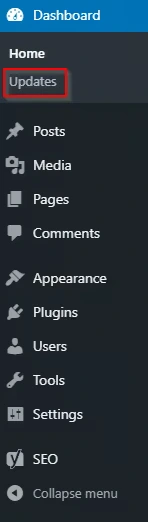
Once you are there, you will see a screen that will look just like the one below.
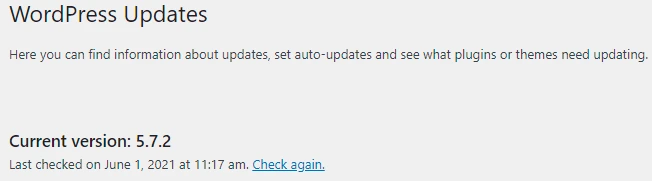
As you can see, the WordPress version will be written in bold letters accordingly. If your installation is not up to date, you will have an option to update it.
How to check your WordPress version through your website frontend
The second way to find out which version you are using is to open your site in the browser and then right click and select View page source. After you do that, another tab will appear and you will see the code of your site, similar to the image below.

While you are on that screen, press Ctrl+f on your keyboard to open a search bar. Type the word “generator” in the search bar and you will see this.

Your WordPress version will be highlighted and you will be able to easily spot it.
How to check your WordPress version through your terminal
This is a bit advanced, but if your site is running on Managed WordPress, managed WooCommerce, cloud, or a dedicated server, you will have access to your terminal. You will need to use the SSH creds to access your server. If this is the environment that you are using and you are able to login to your server use this command. It will show you which WordPress core version is being used on the site.
You will need to be in the WordPress install directory in order to use WP-CLI;
cd public_html
Once you are logged in, run the following WP-CLI command:
As a result, output will look like this:
6.9
In the hope that you’ll be able to find out your WordPress version more easily now, let’s check the version history of the latest releases.
Looking back on WordPress version history
WordPress is popular because its core is quite easy to work with. Additionally, it offers a huge variety of themes and plugins to extend the capability of your site.
Below you can find a short breakdown of WordPress version history and the key features in these WordPress versions.
WordPress versions comparison
| WordPress version | Release date | Key features |
|---|---|---|
| WordPress 6.8 | December 2, 2025 | Faster page loading, Block commenting, better style controls, new blocks, single-keystroke Command Palette |
| WordPress 6.8 | April 15, 2025 | Style Book enhancements, Editor improvements, Speculative loading, bcrypt password hashing, Accessibility improvements |
| WordPress 6.7 | November 12, 2024 | New default theme, automation improvements, new font styling capabilities, Zoom Out, HEIC images, new APIs |
| WordPress 6.6 | July 16, 2024 | Color palettes, font sets, quick previews, plugin rollbacks, pattern management, grid blocks |
| WordPress 6.5 | April 2, 2024 | Font Library, Block Bindings API, interactivity API, enhanced Site Editor, dependency management, improved link controls, refined preferences panel, performance optimizations |
| WordPress 6.4.2 | December 6, 2023 | Maintenance and security release |
| WordPress 6.4.1 | November 3, 2023 | Maintenance release |
| WordPress 6.4 | November 7, 2023 | Improved site editor, block hooks, ability to categorize patterns, improved design and writing experience, enhanced Command Palette, Lightbox, Twenty Twenty-Four theme |
| WordPress 6.3 | August 8, 2023 | Streamlined site editor, block theme previews, easier pattern creation and syncing, new command palette, enhanced design tools, style revisions, new footnotes block, new details block, and enhanced navigation |
| WordPress 6.2 | March 29, 2023 | New stable site editor, scaled block settings, color-coded labels for templates and reusable blocks, improved navigation experience, new style book, custom CSS support for specific blocks or whole site, Openverse integration, widgets now become template parts when switching from classic to block theme |
| WordPress 6.1.1 | November 15, 2022 | Maintenance release |
| WordPress 6.1 | November 1, 2022 | Full site editing, expanded templates and patterns extended to all post types, table of contents block, improved writing blocks, Twenty Twenty-Three theme, performance improvements, improved accessibility, new functions, and hooks to improve the development experience |
| WordPress 6.0.3 | October 17, 2022 | Security release |
| WordPress 6.0.2 | August 30, 2022 | Security and maintenance release, 12 fixes for core, 5 bug fixes for block editor |
| WordPress 6.0.1 | July 12, 2022 | Maintenance release, improved editor experience, 11 fixes for core, 18 bug fixes for block editor |
| WordPress 6.0 | May 24, 2022 | New Webfonts API, improved editor performance, extensive bug fixes, new design tools, expanded block editor functionality |
| WordPress 5.9.5 | October 7, 2022 | Security release |
| WordPress 5.9 | January 25, 2022 | Full site editing, site-wide blocks, navigation blocks, enhanced lazy loading, Twenty Twenty-Two theme, performance improvements |
| WordPress 5.8.6 | October 7, 2022 | Security release |
| WordPress 5.8 | July 20, 2021 | Improved functionality, power, and support for blocks, new blocks and patterns, improved template editing, improved image flow, improved design features like suggested patterns and duotone filters, Global Styles and Global Settings APIs, IE11 support dropped |
| WordPress 5.7.8 | October 7, 2022 | Security release |
| WordPress 5.7.2 | May 12, 2021 | Security update which patched vulnerability in PHP mailer |
| WordPress 5.7.1 | April 14, 2021 | Security release which fixed 26 bugs in total, data exposure vulnerability within REST API patched, PHP 8 vulnerability within media library patched |
| WordPress 5.7 | March 9, 2021 | Font size adjustment, full-height blocks, streamlined block inserter, one-click switch between HTTP and HTTPS, lazy loading for iframes, simpler color palette, social icons block, New Robots API |
| WordPress 5.6.4 | May 12, 2021 | Same date and same features as release 5.7.2 |
| WordPress 5.6.3 | April 14, 2021 | Same date and same features as release 5.7.1 |
| WordPress 5.6.2 | February 22, 2021 | Small maintenance update which fixed user reported issues discovered in version 5.6.1 |
| WordPress 5.6.1 | February 3, 2021 | Maintenance release |
WordPress version FAQs
What is the current version of WordPress?
The current WordPress version is 6.9 and was released on December 2, 2025.
How do I know my WordPress version?
You can check your WordPress dashboard to find your WordPress version. You can also find it in the front end of your WordPress website. WordPress versions update all the time. You should be checking regularly that you’re using the latest version of WordPress.
What is the latest WordPress version 2025?
Version 6.9 is the latest major WordPress release. It was released on December 2, 2025. Key updates include block-level editor notes for team collaboration, an expanded Command Palette for faster navigation, new and upgraded core blocks (such as Accordion and Time to Read), as well as significant performance improvements.
What versions of WordPress are there?
There are hundreds of versions of WordPress if you count every maintenance or security version. But major releases go from 1.0, 1.2, 1.5, 2.0, and all the way to the latest major WordPress version, 6.9.
Getting started with WordPress
That’s where fully managed WordPress hosting comes in. Fully managed hosting means you don’t have to worry about that — your website is in the hands of hosting experts.
Liquid Web offers WordPress hosting for every need and skill level. If managed hosting sounds like a weight off your shoulders, our WordPress experts can take care of the technical server work for you.
Additional resources
What is WordPress? →
A complete beginner’s guide to basic WordPress options
Is WordPress easy to use? →
Discover a user-friendly WordPress hosting solution designed for seamless website management and effortless customization.
A complete guide to WordPress shortcodes →
Shortcodes make life easier. Learn how to get started!
