Automated Test Assembly with TestAssembler
TestAssembler is easy-to-use software for automated test assembly. Specify your blueprints and psychometric targets as well as number of forms, and it will build parallel exams with a technical report.
What is automated test assembly?
Just what it sounds like – provide the software a list of items in your pool and relevant metadata, then tell it to assemble 4 forms of 100 items with content coverage that meets your blueprints, 20 items overlap, and an average P value of 0.72… DONE. It only takes seconds.

Automate the drudgery of form assembly
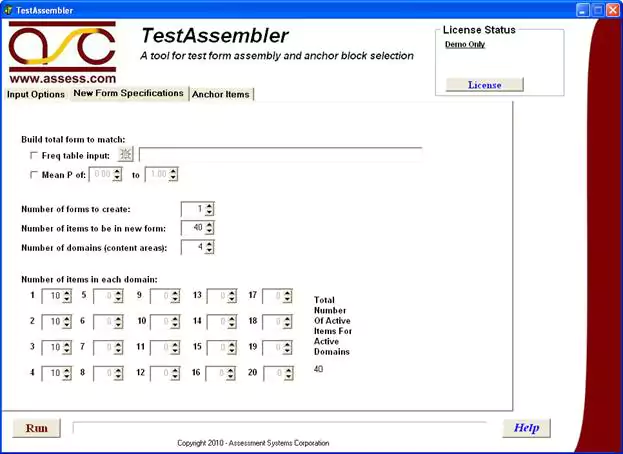
TestAssembler’s interface is straightforward and user-friendly. It is divided into three tabs:
- Input Options – Specify the input file, the output file, and the run title to appear in the output. In addition, you must specify the measurement model, either classical test theory (CTT) or item response theory (IRT) used for test assembly. You can also control the range of acceptable item statistics, such as classical difficulty values between 0.50 and 0.90; only items that meet your specifications will be available for selection.
- New Form Specifications – Specify the number of forms, number of items on each form, then number of content areas, the number of items in each content area, and the psychometric target for the final forms
- Anchor Items – Specify the percentage of the total form to be an internal anchor block, as well as its statistical characteristics
Then click “Run” and your new forms are created in just a few seconds!

Why Automated Test Assembly?
Consider the time that it would take to build 8 test forms from a bank of item statistics where each form
- is equivalent in terms of content distribution and psychometric statistics;
- has internal anchor blocks that are also equivalent in terms of content distribution and psychometric statistics;
- is constrained with additional bounds on the statistics of individual items.
To do this manually would take you hours or even days. TestAssembler can complete this process in seconds and do it more accurately, not to mention it automatically drafts a formal report for you – meaning that TestAssembler can literally pay for itself with a single use!
Automated test assembly (ATA) is widely regarded as a valid and efficient method to the practical problem of creating test forms that are parallel and/or linked via anchor items (Davey and Hendrickson, 2010). TestAssembler is the first publicly available program designed specifically to implement ATA, bringing the power of ATA to every testing organization. It can apply both CTT&IRT.
Download the free version of TestAssembler
Download the free version of TestAssembler with the form on the right, and evaluate to determine if it fits the needs of your organization. It is restricted to only one test form of up to 50 items. You must enter a valid email address and it will send you a link to download TestAssembler.
The demonstration version of TestAssembler is available for evaluation of the program with no cost and no obligation to purchase. While limited to 50 examinees, there is no limit on time. This makes it useful as a completely free student version.
Want to unlock the full power? Contact us to purchase a subscription.
More information about automated test assembly
A test form is a version of a test, for example, the set of 100 items used this year for a certification. If a different set is used next year, that is a new form. Often, an assessment program has multiple forms at once, so that if you retake you won’t see the same items. Test forms are often built to meet requirements; here are typical requirements with examples.
- Content: 40% items from Geometry, 30% from Algebra, 30% from Statistics
- Statistical targets: An average classical difficulty of 0.72-0.74
- Overlap targets: Two forms of 100 must overlap with 40 items
- Item statistic requirements: No difficulty below 0.50, no discrimination below 0.10
- Item types: 80% multiple choice, 10% multiple response, 10% drag and drop
ATA uses an algorithm to build test forms. There are several algorithmic approaches, from simple heuristics to integer programming. See van der Linden & Diao (2011).
The more complex the situation, the more essential ATA is. If you have a pool of 120 items and are building only two forms of 60 with only content area targets (no statistics), you could do this in Excel in only a few minutes. But if you have a pool of 3000 items and are building 8 test forms of 200 items to content and statistical targets with the requirement that they overlap by exactly 50 items? This would take a very long time to do manually.
LOFT is the same idea as ATA, but builds a unique form for each examinee as they start a test. This means the test is very secure, but also that the opportunity is fair for each examinee.
Yes, our FastTest platform has some ATA functionality, but is focused on one form at a time, or on the use of LOFT, which is more common.
Adaptive testing uses IRT to personalize the exam for every student, candidate, or examinee. It typically refers to tests that adapt after every item while multistage testing adapts in blocks of items. This personalized assessment paradigm makes tests more accurate, more engaging, and more secure.
Ready to start? Contact us to request a demo with one of our test construction experts.
Request a Consultation