YA Fiction: Football with Autism, Harmful Actions with Obliviousness, Threat without Reason, Friends with a Bully, Faith with Cynicism, Photography without Seeing What is Really Going on, a Love Story without a Happy Ending, Fantasy Role-Playing with Reality, a Novel without a Single Author, A Prefect Life with No One in it, and a Life

Davis, DeAndra (2025) All the Noise at Once. New York: Atheneum.

Image

Opening Lines:  Every summer, Brandon says it is hotter than the devil’s ass crack, and I have never quite understood what he means by that. NOTE: how hot is the devil’s ass crack, exactly? And how many degrees hotter is it outside than said ass crack? That is what I am concerned with.

Other Interesting Quote:  “ Sometimes you do not get an apology….Even if you deserve it.  Sometimes we do not get what we deserve.  And sometimes we just have to be okay with that.” p. 368

Genre and Format:  regular text young adult novel

What academic subject does this book connect to:  English Language Arts

Short Summary:  Brandon has always been the football star in the family, and Aiden has always been there with him—but because of the way his autism is perceived, he is never thought of in the same way as Brandon.  When Brandon is suspended from the team, Aiden gets thrust into the spotlight. He has to negotiate fellow team members who question the value of a player with autism, overcome his anxiety, and figure out what really happened when his brother was suspended. And he is running out of time.

Why should I read this book?  Not because of its remarkably accurate portrayal of a high school student with autism – though that is very interesting and valuable.  Not because it is an interesting blend of sports book, mystery novel, and young adult novel.  I think the most fascinating part of this book is how much the reader will identify with Aiden.  His disability aside, Aiden struggles with most everything that any other high school student struggles with. This book is amazingly universal.

Who is this book best for?  This book would be a great addtiioin ot any high school English classroom library – or a high school library as well.

Is this book likely to be challenged?  I don’t think so.

Lynch, Chris (2005) Inexcusable. New York: Atheneum.

Image

Opening Lines:  The way it looks is not the way it is.  Gigi Boudakian is screaming at me fo fearsomely.  I think I could just about cry.

Other Interesting Quote:  “I hate it when people I love let me down.  It’s like the worst thing there is.”  p. 128

Genre and Format:  regular text young adult novel

What academic subject does this book connect to:  English Language Arts

Short Summary:  Keir Sarafian knows he is a good guy.  He is popular.  On the football team.  He would never do anything to hurt the girl he loves, Gigi.  So why is everyone so upset?

Why should I read this book?   Because it is well-written.  But fair warning – it won’t be easy.  This is an interesting idea.  This novel looks at the inner justificaitons of a boy who has become inured to violence as a football player, in denial about an act of sexual violence, and unaware of how his partying has turned him from a nice guy into an insensitive jerk – but it is hard to read because he isn’t a sympathetic character.

Who is this book best for?  High school students. This is a good book for your classroom library, but it might be one that needs an explanation.  Same with the school library.  Strong readers who are up to the challenge might enjoy seeing how the book works.

Is this book likely to be challenged?  It is certainly possible.

Medina, Meg (2013) Yaqui Delgado Wants to Kick Your Ass. Somerville: Candlewick.

Image

Opening lines:  “Yaqui Delgado wants to kick your ass.”  A kid named Vanesa tells me this in the morning before school.  She springs out with no warning and blocks my way, her textbooks held at her chest like a shield.

Other Interesting Quote: “Use your brain.  Nobody is a match for that.”  p. 26

Genre and Format:  regular text young adult novel

What academic subject does this book connect to:  English Language Arts

Short Summary:  Piddy Sanchez has enough to worry about.  She is loaded down with honors courses, works after school in a hair salon, she is also trying to find information about her father, a man she has never even met. And now some girl she doesn’t even know is after her.  Piddy needs to figure out how to be who she is and not who others expect her to be.

Why should I read this book?  It is a well-told story – but it is really the ending that makes the book worth reading. It is magnificent.

Who is this book best for?  This book would work really well as a whole class novel – but the title may be problematic.  It would also be a good lit circle book, or just a book in your classroom or school library.

Is this book likely to be challenged?  Yes.  Likely on the basis of the title alone.  But the story also shows poverty and uncertainty which some people might be uncomfortable with.

Schmidt, Gary D. (2024)  Jupiter Rising. New York: Clarion.

Image

Opening Lines:  A few days after his thirty-fourth birthday, Quintus Sertorius decided he was as old as any horse should be—and told us so.

Other Interesting Quote:   “…you can’t keep losing what you love most in all the world.  You just can’t.  You just freaking can’t. “  p. 47

Genre and Format:  regular text young adult novel

What academic subject does this book connect to:  English Language Arts

Short Summary:  This sequel to Orbiting Jupiter is only a little over 200 pages, but there is so much going on.  Jack is taking seriously his responsibility to be a good uncle to Jupiter, his foster brother’s daughter.  His PE teacher and track coach teams him up with Jay Perkins, a kid who is kind of a bully and who Jack kind of doesn’t like, at all.  Gradually, though, as they run together, Jack finds out there is more to Jay than he thought.  And he comes to find out that he may need Jay’s help as much as Jay needs his help.

Why should I read this book?  Easy.  Any time I read a book by Gary Schmidt, I think to myself, this is what reading books is supposed to be.  This is a book you will get lost in immediately.  It is a book you will enjoy immensely.  The ending will be somehow both deeply satisfying, but at the same time unresolved.  And you will be left thinking about something that you can’t quite pin down. 

Who is this book best for?  I would say anyone seventh grade and up should read this.  Great choice for whole-lcass study, book clubs, lit circles, class and school libraries and, really, anyone.

Is this book likely to be challenged?  I shouldn’t be.  But if anyone does challenge this book, call me.  I will drive to your location, meet the person who is challenging, sit them down, read the whole book aloud to them, and then, then dear reader, I will have a conversation with that person for as long as it takes for them to see the error of their ways.

Paulsen, Gary (1995) The Tent.  Orlando: Harcourt.

Image

Opening lines:  In the eighth century B.C.E., in what is now Israel/Palestine, the birthplace and stipulations of a religious leader were prophesied.  He was to be born in the village called Bethleham, or a virgin.

Other interesting quote:  “I do not believe in hate – God is a God of love. “  p. 42

Genre and Format:  regular text realistic novel

What academic subject does this book connect to:  English Language Arts

Short Summary:  Steven and his dad have been struggling for money for as long as Steven can remember.  When his father decides that the best was to climb out of the financial hole they are in is by becoming a tent-preacher and travelling from town to town holding revivals, Steven isn’t sure what to think.  When the money his dad makes starts allowing them to stay in hotels, eat good food in restaurants, and buy things Steven has never had before, he decides that maybe his dad’s new job isn’t all bad.  But because Steven is part of the operation, seeing behind the scenes, he becomes more and more convinced that what they are doing is wrong.

Why should I read this book?  At 86 pages, it is one of the shortest novels I have ever read, but in an amazingly short time we sympathize with Steven, recognize the seriousness of his dilemma, and root for him in his fight to put things right.  There is a lot thematically and morally here and, since the author is Gary Paulsen of Hatchet fame, the readers are in good hands.

Who is this book best for?  This book is probably best for middle school, though I could imagine it working in high school too.  This would be an ideal book for lit circles.  Students might be drawn to it by its short length, but they will find that it is a book with remarkable thematic depth and potential for discussion.  This would also work for classroom and school libraries. It would be a good read-aloud except that it is so short, so there wouldn’t be much of a payoff in terms of students getting deeply into he world of the book.  I could imagine it as a supplemental text for the whole class to study, especially in a unit about ethics.

Is this book likely to be challenged?  It is possible.  Some parents might perceive the book as an attack on organized religion – but I would argue that is a misreading.  It would be more accurate to see it as an indictment of the power of greed to distort things that are good.

Ramos, James (2024) Daniel, Deconstructed.  Toronto: Inkyard Press.

Image

Opening lines:  Generally speaking, I don’t do crowds. Which means the Frederick Jones High School stadium is totally not my scene.

Other interesting quote:  “Friends are supposed to look out for one another, and best frieds are supposed to be, well, the best at doing that.”  p. 51

Genre and Format:  regular text young adult novel

What academic subject does this book connect to:  English Language Arts

Short Summary:  Daniel is a photography with autism who has a best friedns, Mona who is popular, beautiful, and the star of the soccer team.  When Daniel meets Gabe, a hansome, mysterious, and nonbinary new classmate, Daniel tries to set Gabe up with Mona – that way he can have both of his friends together.  Turns out, Gabe isn’t that interested in Mona, and Daniel may not be the disinterested matchmaker he things he is.

Why should I read this book? That is, for me, a complicated question.  On the one hnd, it is an interesting YA novel focused on a love triangle.  But I struggled with several parts of this story.  As a card-carryingnerd, I found the overemphasis on Gabe and Mona’s attractiveness to be deeply off-putting.  It made me think that their relationships with each other were shallower than I think the author meant thme to be.  Further, the humor, if you can call it that, is based on the awkwardness of the reader knowing that both Gabe and Mona are waiting for Daniel to ask them out, but he htinks he is setting them up.  That made the book, at times, less than enjoyable.  At times the narrative voice seemed overly didactic.  Finally, I found the ending unsatisfying.  It didn’t think it was fair that Mona, the loyal friend, got left out in the cold.  So, I am not sure you should read it.  I am an old, white, sis-gendered, straight, white man. And so it is quite possible that I can’t connect with he novel because of what I bring to it.

Who is this book best for?  High school students would appreciate it the most.  This would be a good choice for a classroom or school library.

Is this book likely to be challenged?  Sadly, yes.  It acknowledges the existence of persons who are bisexual.

Green, John (2008) Paper Towns.  New York: Dutton.

Image

Opening lines:  The way I figure it, everyone gets a miracle.  Like, I will probably never be struck by lightning, or win a Nobel Prize, or contract terminal ear cancer, or spontaneously combust.  But if you consider all the unlikely things together, at least one of them will probably happen to each of us.  I could have seen it rain frogs.

Other interesting quote:  “Nothing ever happens like you imagine it will….But then again, if you don’t imagine, nothing ever happens at all.”  p. 296

Genre and Format:  regular text realistic novel

What academic subject does this book connect to:  English Language Arts

Short Summary:  Quentin is deeply in love with Margo whom he has never much even talked to.  Then one night she climbs through his bedroom window and takes him on an all night adventure.  The next morning she isn’t in school.  Quentin begins trying to figure out what happened to her and the closer he gets to solving his personal mystery, the more he realizes how little he know her.

Why should I read this book?  The plot is fine.  The characters are certainly interesting, but the writing is exquisite.  This is the sort of book that has me copying down lines from it because they are so totally beautifully rendered.  Look at the quotes at the beginning of this review.  See?  That is what I maen.

Who is this book best for?  High school students would be the best fit.  This book would work well in classroom and school libraries, for lit circles and maybe for who class study – though I suspect that John Green’s writing creates deep appreciation from some students but not all.

Is this book likely to be challenged?  I wouldn’t think so, except that there is a fair amount of rebellion in it.  Some vulgarity too. 

Koops, Victoria (2024) Who We Are in Real Life. Toronto: Greenwood

Image

Opening lines:  Strength. Dexterity. Constitution. Intelligence. Wisdom. Charisma. I repeat the abilities in my head as the flat fields of wheat streak past.

Other interesting quote: “I like the way you talk nerdy to me.”  p. 168

Genre and Format:  regular text young adult novel

What academic subject does this book connect to:  English Language Arts

Short Summary: Darcy and her mom’s have just moved from the city to a small rural intolerant town.  With that move, Darcy has lost her friends she used to play role-playing games with, her boyfriend, and, it seems, everything that makes life worthwhile.  Then she meets Art who invites her into his Dungeons and Dragons game.  Darcy joins the game and finds acceptance and community again.  But when her boyfriend comes to visit, she finds herself contrasting her boyfriend’s possessiveness, rudeness, and selfishness to the way Art is kind, interested in who she is, and the way he cares for her. But what will her boyfriend do if she tries to break up?  And what will Art’s ultra-conservative father do if he finds out Art is spending time with the daughter of two lesbians?

Why should I read this book?  There is so much here that students could relate to.  The book also does a good job developing themes like how imagination is not just about escaping reality, but sometimes it is about changing it.  I also really valued how the story shows how Darcy makes wrong choices, along the way, but eventually makes the right ones.

Who is this book best for?  High school students would enjoy this the most, especially readers interested in Dungeons and Dragons or in an authentic romance with a lot more to offer than a boilerplate special.  This book would probably be best for a classroom library.  I could imagine it working as a lit circle choice, but only if there were sufficient numbers of students interested in this sort of book.  This book would also be a good bridge for students hooked on fantasy to try a realistic fiction book.

Is this book likely to be challenged?  While I would consider the book not only inoffensive but likely to be a positive influence on some students, the book does have two minor characters (Darcy’s moms) who are a same-sex couple.  There is also some intolerance shown toward them.  There might be challenges on that basis.

Lewis, Amanda West (2023) Focus. Click. Wind. Toronto: Greenwood.

Image

Opening Lines:  When they come, it’s the middle of the night.  When they come, the barricades are no match for axes and anger.  When they come, Billie is among the first to know.

Oher Interesting Quote:  “She thinks a perking coffee pot is probably the most optimistic noise in the world.”  p. 136

Genre and Format:  regular text young adult novel

What academic subject does this book connect to:  English Language Arts. Social Studies

Short Summary: Billie is a 17 year old photographer/activist and New York City in 1968 is an amazing place for her to be.  She attends and photographs Vietnam protests and feels like she is in the middle of everything.  And then her mother decides that Billie’s life is too dangerous, so he decides they are moving to Toronto.  Billie is crushed at first that she is moving away from the center of the world,  but she finds the anti-war effort is present in Toronto and before long she finds herself in the middle of it, with higher stakes than she ever had to deal with in New York.

Why should I read this book?  Not only does it make an interesting period of history come alive through a person who will remind many young adult readers of themselves, but also that particular moment in history – protests over the Vietnam war, students protesting US government actions, a deep divide between economic classes and political positions—probably sounds very familiar to the current situation in the United States.  This makes the book deeply engaging with students and easy to discuss.

Who is this book best for?  High school students with some interest in history or activism would be the easiest to connect this book to.  This would be a good book for a classroom or school library.  I could imagine it working as a lit circle for kids who are interested in activistm and stories.

Is this book likely to be challenged?  Perhaps.  The main character, Billie, is rebellious and gets herself into some adult situations.  Students would not be surprised or shocked by anything in this story, but some parents might react.

Almond, David; Colfer, Eoin; Doyle, Roddy; Ellis, Deborah; Hornby, Nick; Lanagan, Margo; Maguire, Gregory; Ozeki, Ruth; Park, Linda Sue; Wynne-Jones, Tim (2007) Click: One Novel Ten Authors New York: Arthur A Levine

Image

Opening Lines:  “I can’t believe you’re not going to open it!” Jason said.  “Don’t you want to know what it is?”

Other interesting quote:  “I’m happy when I’m [home]…but then I travel and I find so many places to be happy in.”  p. 35

Genre and Format:  regular text young adult realistic novel

What academic subject does this book connect to:  English Language Arts

Short Summary: Maggie and Jason’s grandpa leaves each of them with a mystery.  Maggie has a wooden box with seven shells in it.  Jason has his grandpa and a collection of photographs.  As they each explore their gifts, they gradually learn more about their grandpa (a world-reknowned photojournalist, and about the world he traveled through.

Why should I read this book?  I’ll admit, I was torn.  On the one hand, this book has some amazing authors – I mean, Eoin Colfer?  Deborah Ellis?  Nick Hornby?  Linda Sue Park?  Tim Wynne-Jones?  Who could resist?  But on the othe hand,. The idea of a single book written by 10 authros sounds like it would be about as much fun as a story told by a committee.  I gave it a shot.  And I am happy to say that what makes the book work is that the story is strong and interesting throughout.  Chapter transitions are a little bumpy as you get used ot each style – but the bottom line is, it works.

Who is this book best for?  This would be a good choice for high school students.  Because of the way it slowly unfolds I think it would have pretty broad appeal.  I could see it working as a read-aloud.  It would also be a good addition for a classroom or school library. I think it could work for lit circles, but I am not sure it would be ideal for whole class study unless a teacher read it and was particularly passionate about it.

Is this book likely to be challenged?  I don’t think so.

Lieberman, Leanne (2023) Cleaning Up. Toronto: Groundwood.

Image

Opening lines:  The house was bigger and shabbier than Jess had expected.

Other Interesting Quote:  “Your smiles are like rainbows. Rare, but amazing.”

Genre and Format:  regular text young adult realistic novel

What academic subject does this book connect to:  English Language Arts

Short Summary:  Jess and her dad are almost homeless.  They live in a trailor and tent  and her father struggles with alcohol addiction.  When Jess gets a job cleaning for a beautiful country house, she dares to hope that this might be a way out.  Along with the house comes a new set of friends as well. But then Jess discovers a bedroom in the house that belonged to Quinn, the family’s teenaged daughter.  The beautiful furnisihings and expensive clothes look like they were trashed.  Jess wonders how someone with a perfect life could have done this.  And then she finds Quinn’s diary.  It gives her some answers and a lot more answers.  Jess thinks of a way to end Quinn’s story in a positive way, but acting on her idea could mean she might lose the fragile stable life she has just started building for herself.

Why should I read this book?  It is a well-written and interesting story.  You will find yourself rooting for Jess and then worrying for her.  There is a lot to think about here.  And honestly, every time I read a YA book published outside of the United States, I am struck by the difference in voice and even in story structure.  It is a breath of fresh air.

Who is this book best for?  High school students who like realistic fiction will enjoy this one.  There is a bit of romance here, but it is not the main focus.  This is a great choice for a classroom or school library. 

Is this book likely to be challenged?  I wouldn’t think so unless someone objects to the depiction of poverty.

Lewis, Amanda West (2022) These are not the Words. Toronto: Greenwood.

Image

Opening Lines:  The living room is a foreign country at night.  I’m in my nightgoen, at the edge of the dark.  My feet are bare, still warm from the bed..

Other Interesting Quote:  “I want to be an angelheaded hipster forever.”  p. 57. 

Genre and Format:  regular text young adult realistic novel

What academic subject does this book connect to:  English Language Arts, History, Music

Short Summary:  Missy loves her life in New York city.  Her mom is an aspiring artist and her dad an aspiring musician.  Missy loves the late night trips to the East Village and Harlem with her Dad to listen to jazz.  When her dad’s dependence on alcohol and drugs gets worse, Missy’s mom decides they need to leave and start fresh, Missy has to leave her friends, her home, and her family. 

Why should I read this book?  It nicely captured the feeling of the art scene in 1960s New York.  It also captured the maelstrom of feelings that go along with being an adolescent, watching a parent self destruct, witnessing the end of a marriage, and the heartbreak of having to move.

Who is this book best for?  ?  This would be a good choice for high school students.  There are a lot of universal connections to adolescent experiences here.  It would be a good addition for a classroom or school library. I think it could work for lit circles, but I am not sure it would be ideal for whole class study unless a teacher read it and was particularly passionate about it.

Is it likely to be challenged?  Perhaps.  The references to alcohol and drug abuse and perceived neglect by the parents might cause some challenges.  I think, though, if the objectors read the whole book, they might feel different.

Amazing High-Interest Non-Fiction for Kids (Adopting Bears, The Cardiff Giant Hoax, A Kid finds a Skull, Weird Creatures in the Deep Ocean, Underground Railroad Story, and the First Tyrannosaurus Rex)

These are not new books, but they are good. The best non-ficiton, in my opinion, tells a good story. These all do that extremely well.

Murphy, Jim (2012) The Giant and How He Humbugged America.  New York:  Scholastic

.

Image

On Saturday, October 16, 1869, a farmer digging a well in Cardiff, New York, came upon an astounding discovery.  He found what appeared to be a giant petrified human being.  It was over 10 feet tall and very detailed, with ribs, toenails and muscles clearly visible.   The farmer, a man called Newell, called upon historians, experts, and reporters, and soon a crowd was gathered around the hole.  News spread like wildfire and soon Newell was charging admission to the huge crowds that came to see the giant.  As the Cardiff giant’s fame grew, he seemed to capture the imagination of the entire nation.

Too bad the whole thing was a hoax. 

I still remember when I first read about the Cardiff giant, in a SRA article (SRA was an ancient reading program — sort of the 1970s version of Accelerated Reader) and how fascinated I was by it.  Murphy (who apparently wrote and illustrated this book) does an amazing job with the story.  The amount of text and vocabulary mean this book is probably ideal for second or third grade an up — but it is fascinating stuff.  The illustrations are mostly pictures and illustrations from newspapers– but they really give a feel for the excitement of the time. 

Murphy chronicles the exciting rise of the giant and its equally fascinating downfall.  This is an especially good book for kids who are already pretty good readers.

Kvatum, Lia; Pokrovskaya, Liya (2012)  Saving Yasha:  The Incredible True Story of an Adopted Moon Bear.  Washington D.C.: National Geographic

Image

When she was in 4th grade, my daughter asked me why so many kids her age want to be veterinarians when they grow up.  I wasn’t sure of the answer to that question, but I think it probably has to do with the fact that a high proportion of animals seem eminently huggable.


Saving Yasha is the story of a profoundly huggable Moon Bear cub in Russia who was orphaned, cared for by scientists, and released into the wild.  Every page has a huge photo of an amazingly cute bear doing amazingly cute things.  Along the way, the text tells kids all sorts of interesting information about Moon Bears — but it is the pictures that will keep them turning the pages.  The book does give a pretty good explanation of what bear researchers do — which is bound to interest the child looking for an answer to the question of what they want to do when they grow up.
     This would be a great read aloud, but it is also the sort of book that second graders on up could read on their own. 

Berger, Lee R.; Aronson, Marc (2012)  The Skull in the Rock:  How a scientist, a boy, and Google Earth opened a new window on human origins.  Washington D. C.: National Geographic.

Image

So this kid, Matthew Berger, is out hunting fossils with his dad one day in 2008 and he sees this tiny fossil of a human clavicle sticking out of a rock and he calls to his paleontologist dad and finds out he has not only found a fossil that might be 2 million years old, but he has also made a really important discovery for that field of study. 

This book looks at three things:  first, the life’s story of that kid’s father, Lee, and how his childhood interest in saving the gopher tortoise led to an interest in science, which led to a lifelong interest in fossil hunting.  The second part of the book is the story of this one particular expedition and what tools and evidence led Lee and his son Matthew to be in the right place to find the human skull that Mathew’s find led to.  The third part de3als with what scientists have been able to learn from Lee and Matthew’s find.  What is excellent about this book for young readers is that the connection to kids draws them in and before they know it, they are reading about how science gets done. It is amazing writing.

The pictures, as in all National Geographic books, are illustrative, intriguing and utterly beautiful.  They get you inside of the hole in the rock where Lee found the rest of Matthew’s ancient skeleton. They let you see what it was in the Google Earth pictures that led Lee back to that site. 

 I would say for third through middle school, this is a good one (though the picture book format may be off-putting to older readers.

Hague, Bradley (2012) Alien Deep:  Revealing the Mysterious Living World at the Bottom of the Ocean.  Washington D.C.: National Geographic.

Image

I sometimes forget that after I learned things in school, scientists and discoverers kept adding to that body of knowledge.  Somehow, when I turned my back for a couple of decades, scientists found out that around volcanic vents in the super deep parts of the ocean are bizarre thriving ecosystems including giant clams, hairy-armed crabs, and ten foot long tube worms.  And they have discovered these world by using robot submarines. 

So not only is this an amazing alien world reached by strange space-ship looking vessels, but it is all new knowledge that most grown-ups do not know.  Some of the text is pretty small and tightly packed — but it is the kind of book where a younger student (say third grade) could read the captions are the first time through and maybe dig a little deeper the second time.  It is sort of episodic — with a lot of smaller sections rather than a single narrative through line. 

Oh, and the pictures are remarkably breathtaking. 

Cole, Henry (2012) Unspoken: A story from the underground railroad.  New York:  Scholastic.

Image

Okay, this isn’t exactly non-fiction — but it sort of is.  This is the story of a little girl who notices a runaway slave in her family’s corn field and she gives him a place to stay (actually, I am not sure it is a him — we see only the eye of the escapee.  The story is told solely through pictures and, for little ones, is perhaps best read first with an adult who can help make connections from page to page.  Soon, though, the child readers will be able to make connections on their own. 

It is a powerful story, and well worth reading (even though there aren’t any words).  Here is one more picture.  Enjoy it, then go get the book.

Fern, Tracey; Kulikov, Boris (2012)  Barnum’s Bones: How Barnum Brown Discovered the Most Famous Dinosaur in the World  New York:  Margaret Ferguson Books

Image

This is the amazing story of the dinosaur hunter, Barnum Brown — who first discovered Tyrannosaurus Rex bones.  The focus here is on Barnum who from a young age was interested in geology, and how he eventually travelled the world finding dinosaur bones.  The pictures are exciting (though I wish they showed more about the dinosaurs sometimes).  Still, this would be a great book for sparking children’s interest in paleontology. 

Though older kids might enjoy reading it, it seems best suited for kindergarten through second grade.


Pet Rabbits, Mysteries, Accidents, and Chronic Illness: Realistic Fiction for Upper Elementary

DeJong, Meinert (1953) Shadrach.  New York: Harper Trophy

Image

Opening lines:  There was this boy, Davie, and he was going to have a rabbit.  His grandfather had promised it.  A real, live rabbit!  A little black rabbit., if possible.  In a week, if possible.

Other Interesting Quote:  “Every morning you woke up it was a miracle all over again, that there in a barn across the village sat a little rabbit, and he was yours.  Something breathing, nibbling, hopping and it was yours!  It was alive and it was yours!”  p. 100

Genre and Format:  regular text realistic upper elementary novel.

What academic subject does this book connect to:  English Language Arts

Two-Sentence Summary:  Davie is overjoyed with his new pet, a little black rabbit named Shadrach, until Shadrach escapes from his hutch. Will Davie ever be able to find his rabbit again?

Why should I read this book?  This book won a Newbery Honor in 1954.  It is good, solid storytelling.  Students might find it a comforting low-stakes story – which might be wonderful in a time of local, national, and world tension.

Who is this book best for?  This book would be a great read-aloud for second and third grade, and a good classroom library addition for fourth through sixth.  Good choice for the school library too.

Is this book likely to be challenged?  I don’t think so. I suppose some people might object to the idea of a human owning an animal, but davie shows nothing but care for the rabbit.

Buyea, Rob (2010) because of mr. terrupt New York: Yearling

Image

Opening Lines:  It’s our bad luck to have teachers in this world, but since we’re stuck with them, the best we can do is hope to get a brand new one instead of a mean old fart.

Other Interesting Quote:  “If you let people get away with being mean, they’re going to keep being mean. You need to stick up for each other.” p. 82

Genre and Format:  regular text realistic upper elementary novel.

What academic subject does this book connect to:  English Language Arts

Two-Sentence Summary:  Fifth graders Jessica (who is smart but having trouble fitting in), Alexia (who is a manipulative bully), Peter (the class clown and troublemaker), Luke (the good, hardworking kid), Danielle (a pushover). Anna (shy and embarrassed by her home situation), and Jeffry (who wishes he were anywhere else but in school) are a lot to handle.  But thie new teacher Mr. Terupt seems to be up to it, until an accident calls everything into question.

Why should I read this book?  This is a powerful emotional story with a redemptive theme that kids will grab hold of.  The range of characters means more connectiosn to more students.  There is a lot here to discuss.

Who is this book best for?  This could work as a read aloud for fourth grade, but it seems best suited to fifth and sixth.  Good choice for classroom and school library, but it would also wrk for lit circles or even whole class study.

Is this book likely to be challenged?  I don’t think so.

Clements, Andrew (2002) A Week in the Woods. New York: Scholastic.

Image

Opening Lines: Mr. Maxwell looked a the long checklist, and then looked at the calendar, and then he shook his head.  It was February thirteenth, and was sitting at his desk in his classroom at quarter to seven on a Friday morning. And a question formed in his mind: Why on earth do I do this year after year?

Other Interesting Quote:  “He’d had this feeling many times during his life as a teacher.  Only not so much recently.  This feeling of quiet awe at the decency of people.  And especially children… about how people are given half a chance, they’ll do the right thing.” p. 180

Genre and Format:  regular text realistic upper elementary novel.

What academic subject does this book connect to:  English Language Arts

Three-Sentence Summary:  Mark, a rich kid, moves to a rural town.  Mark has always been a strong student with access to good schools.  He alienates himself on the first day and fights to get back into social interaction, wishing the teachers would help him, but none do, except Mr. Maxwell.

Why should I read this book?  There is a powerful theme in this book about how appearances and casual social interactions seldom show was is really going on inside a kids head and heart. It is a well-written book and a good story.

Who is this book best for?  It would make a good fourth grade read aloud.  Good choice for classroom and school library from fifth grade and us.  Would work well for literature circles.  I think it also might be able to sustain whole class study.

Is this book likely to be challenged?   I don’t think so.

Paulsen, Gary (2009) Mudshark. New York: Scholastic.

Image

Opening Lines:  This is the principal.  Would the custodian please reort to the faculty restroom with a plunger…no wait…a shovel and a plunger?  And has anybody seen the gerbil from room two oh six?

Other Interesting Quote:  “It makes me crazy, but the library somehow always comes in last.  I mean, really?  Is it necessary to have an Olympic-sized curling rink before the library gets anything? Does the library have to fight for every penny?” p. 73

Genre and Format:  regular text realistic upper elementary novel.

What academic subject does this book connect to:  English Language Arts

Three-Sentence Summary:  The Mudshark Detective Agency is out to solve the mystery of the disappearing erasers, the toxic issue in the faculty bathroom, and the mystery of the disappearing gerbil, and the allegedly psychic parrot isn’t making this any easier.

Why should I read this book?  At 93 pages it is very short; with Gary Paulsen as the aurhor, it is well-written,; and it is funny to boot.

Who is this book best for?   This book would be a great addition to a classroom library or a school library, particularly for struggling readers who have enver completed a book.  Seems like fifth or sixth grade to me.

Is this book likely to be challenged?  I don’t think so.

Erb, Calyssa (2024) Maya Plays the Part  Toronto: Annick Press

Image

Opening Lines:  Inside my head is a marquee.  A white background, so bright it makes my eyes hurt, with my name in huge letters.

Other Interesting Quote:   “If I had some popcorn right now, that would make  things a lot better.” p. 104

Genre and Format:  regular text realistic upper elementary novel.

What academic subject does this book connect to:  English Language Arts

Three-Sentence Summary:  Maya has been looking forward to summer drama camp all year because she knows tha she is going to get the lead.  Even when her best friend stops talking to her, Maya looks forward to making new friends in camp.  But when her newly-found friend gets the lead, Maya’s life seems like it is falling apart forever.

Why should I read this book?  Honestly, at first I found it hard to like Maya.  Her passion for drama is admirable, but that focus seemed to shut out her awareness of others.  As the story went on though, we begin to find our way into Maya’s personality and how autism changes they way she thinks.  When we understand how she wees the world and how she is trying to be thoughtful for those around her, it is much easier to like her.  By the end of the book, I found myself rooting for her.  And the ending was satisfying.

Who is this book best for?  This would be a good classroom or school library book for fourth through sixth graders.

Is this book likely to be challenged?  I don’t think so.

Van Wagenen, Maya (2024)  Chronically Dolores.  New York: Dutton

Opening Lines:  Uh,. Hi sir.  Father?  Is that right?  It sounds weird.  I’ve…um, I’ve never done this before, and I’m going to be honest.  I’m not totally sure how this works. 

Other interesting quote:  “Friends make one bold and foolish and happy.  They influence what direction one goes, what choices are made” p. 278

Genre and Format:  regular text realistic upper elementary novel.

What academic subject does this book connect to:  English Language Arts

Three-Sentence Summary:  During the final days of eighth grade Dolores, who has a chronic bladder condition, had an..accident…in public.  After that, her best friend wants nothing to do with her.  In fact, no one wants anything to do with her.  And that is when she meets Terpsichore Berkenbosch-Jones, a homeschooled kid with autism who needs Dolores’s help to convince her mother to let her go to high school, but Dolores sin’t sure she needs Tersichore.

Why should I read this book?   Because life is hard.  Popularity kills friendships.  But sometimes when misfits find each other the best kind of friendship can rise form the ashes.  One of the themes in this book is that even though people are so very different from each other, everybody has bvalue and everybody has something they can offer.

Who is this book best for?  This would be a good fit for sixth and up.  It would work for literature circles (especially when paired with Wonder and similar books), for whole-class instruction, and certainly for class and school libraries.

Is this book likely to be challenged?  I doubt it.  It does speak directly of disability and the embarrassment of uncontrolled urination, but it does so with care and grace.

Konigsburg, E.L. (2000) Silent to the Bone.  New York: Scholastic

Image

Opening Lines:  It is easy to pinpoint when my friend Branwell began his silence. 

Other Interesting Quote:  “I don’t think there’s a why for friendship.”  p. 13

Genre and Format:  regular text realistic upper elementary novel.

What academic subject does this book connect to:  English Language Arts

Three-Sentence Summary:  During a 911 call, a woman begs Branwell to tell what happened to the baby, but Branwell is silent.  The blame for the severe injury of his baby sister settles on Branwell.  His friend Connor must figure out why Branwell is silent in order to save him and find the true facts of the case.

Why should I read this book?  It is a rip-roaring mystery, filled with clues, twists and turns, and exciting revelations along the way.  There are some interesting themes too – about the intersection of love, protection, justice, duty, and more.  Good, well-written book.

Who is this book best for?  This could be a good fourth or fifth grade read-aloud.  It might work as a literature circle option if your students are hooked on mysteries.  Great for a class or school library.

Is this book likely to be challenged?  I suppose it is possible.  It isn’t overly violent nor anxiety producing, but there is a baby injured from the start of the book.

Hamza, Nina (2024) Samora’s Worst (Best) Summer Ever. New York: HarperCollins

Image

Opening lines:  “Are you sure you’re goingto be okay?” Mom asked for the hundredth time.

“Definitely.” I reassured her for the hundredth time.

Even though I was not sure.

Other Interesting quote:  “…we are happiest when we are helping others.” p. 264

Genre and Format:  regular text realistic upper elementary novel.

What academic subject does this book connect to:  English Language Arts

Three-Sentence Summary:  Samira’s best friend suddenly doesn’t want to hang out any more.  She has a new group of friends, but Sammy is left high and dry.  When Sammy’s folks leave on vacation, they leave her in the care of her grandmother.  After the house gets TPed, Sammy has to figure out if her suspicions about the culprits are correct and how she can rescue her worst summer ever.

Why should I read this book?  It is a good story, full of surprises, but the ending is what makes it worth it.  When friendships disappear, finding new ones is hard, but also deeply satisfying.  There is a lot in this book to talk about.

Who is this book best for?  This could be a good read-aloud for fourth and fifth grades.  It would be a great addition to the classroom or school library.  It might not work as well for use in class or in literature circles.

Is this book likely to be challenged?   I wouldn’t think so.  The main character is a person of color, so I suppose it might be accused of being a woke book.  But that is, of course, nonsense.

Clements, Andrew (2024) The Frindle Files, New York: Random House

Image

Opening Lines:  The only thing Josh Willett liked about homework was how quickly he could access his assignments.  All he had to do was turn on his laptop, then click the Sixth Grade Homework portal he’d bookmarked on his browser a that start of the school year.

Other interesting quote:  “Beign able to help another person, especially ayoung person, to take forward steps in life?  One cannot askfor a higher urpose than that.  It can be exhausting, but it is remarkably satisfying.”  p. 185

Genre and Format:  regular text realistic upper elementary novel.

What academic subject does this book connect to:  English Language Arts

Three-Sentence Summary:  Josh doesn’t think much of his teacher, Mr. N. who forbids his class form using technology.  That is until he find sout that Mr. N. was actually a famous tech innovator.  And then he finds out Mr. N.’s other secret which has to do with the word Frindle.

Why should I read this book?  Have you read Frindle?  This is the rest of that sorty!  What/  you haven’t read Frindle?  Well, what are you waiting for?

Who is this book best for?  Third grade and up.  It would be a great read-aloud for a class that read Frindle in an earlier grade.  It would be good for a class library, but maybe add a note on the cover that readers will enjoy this book more if they read Frindle first.

Is this book likely to be challenged?  If anyone challenges this book, it is time to leave the planet because there is no hope left.

Classic Reviews: Shakespeare, Star Wars, and Sherlock

Doescher, Ian  (2013) William Shakespeare’s Star Wars: Verily, A New Hope  Philadelphia: Lucas Books

Image

It starts like this:

C-3PO:  Now is the summer of our happiness
              Made winter by this sudden, fierce attack!
              Our ship is under siege, I know not how.
              O hast thou heard?  The main reactor fails!
              We shall surely be destroy’d by this.
              I’ll warrant madness lies herein.
R2-D2:  –Beep, beep.  Beep, beep, meep, squeak, beep, beep, beep, whee!
C-3PO:  We’re doomed. 
              The princess shall have no escape this time!
              I fear this battle doth portent the end
              Of the rebellion.  O!  What misery!

Now I am certain that not everyone reading this is either a Star Wars nut or a Shakespeare nut.  And I suppose even fewer of you are both.  So let me break this down for you:

If you are a Star Wars Nut but not a Shakespeare nut:  Buy this book immediately.  You will find it hilarious and you will discover that the once-impenetrable Shakespearean language is suddenly clear as a bell and funny as well.  I am not sure why I find it so delightful when Biggs says, “But Luke, at that quick pace shalt thou escape/ Before thy speedy ship is blown in twain?” and Luke replies “‘Twill be like Beggar’s Canyon back at home.” 

If you are a Shakespeare nut but don’t care so much about Star Wars:  Buy this book immediately.  This book may be your one chance to be able to absorb the details of Star Wars without having to watch the movie.  Besides, you will be the sort of person who will get the joke when Artoo speaks directly to the audience and explains that he speaks in beeps and whistles because he has been ensorcelled, and explains how he really feels about Threepio and the others.

If you don’t really like either one, but you teach students who like one or the other, buy this book for them. Your students and their parents will love you for it.

If you like both, you probably aren’t reading this any more, you are probably riding your bike to your favorite independent bookstore or taking public transportation to your local library.  Good.  When you get back and finish reading it, let me know how much you liked it.

Naslund, Sena Jeter (1995) Sherlock in Love.  Boston:  David R. Godine.

Image

It has been a few years now, but out of 30 college students, a handful of students will be rabid fans of the BBC Masterpiece Theater show Sherlock starring Benedict Cumberbatch as the title character (Cumberbatch is also the voice of Smaug the Dragon in the Peter Jackson Hobbit movies) and Martin Freeman as Dr. John Watson (Freeman plays Bilbo in the same movies and also a Shield agent in the marvel universe).  Another handful of your students will be familiar with Sherlock Holmes through the movies starring Robert Downey Jr (who also plays, of course, Iron Man in the Marvel movies).  So if there was ever a time to get your students interested in reading Sir Arthur Conan Doyle’s original Sherlock stories, this is it (you can get an electronic copy of the stories for free on Kindle and other e-readers.)

But what do you do when your eager readers devour the two volume set of Doyle’s work and still want more.  Well, happily there is a long tradition of pastiches, with excellent Holmes novels written by the likes of Nicholas Meyer (director of Star Trek Wrath of Kahn) and many famous and obscure writers (there is also a graphic novel adaptation of some of the original stories).

A good representative novel in that line is Sena Jeter Naslund’s Sherlock in Love.  It isn’t written as an adolescent or even a young adult novel, but it is wholly within the grasp of high school readers.  In this novel, Sherlock meets a violinist in a London orchestra and deduces that he is in fact a woman, cross-dressing to be able to play in the all-male ensemble.  Holmes falls in love with Victor/Violet’s violin playing, intelligence, playfulness and then falls in love with what she looks like.  Soon he is pursuing her all the way to Austria, where he finds her in the clutches of Mad King Ludwig. 

It is a good and satisfying read for Sherlock enthusiasts, though there are some subtle references to King Ludwig’s homosexuality (so subtle I missed them on my first read through) and some mention of Holmes use of cocaine (which at the time the stories were written, was not an illegal drug).  These are both very minor parts of the story, though.

Not a bad choice for high school and up. 

Quick Reviews of Realistic Novels for Middle Grade and Upper Elementary Readers

Draper, Sharon M. (2015) Stella by Starlight New York; Atheneum.

Image

Opening lines:  Nine robed figures dressed all in white. Heads covered with softly pointed hoods.  Against the black of night, a single wooden cross blazed.

Other interesting quote:  “If you are afraid, then those who foster hatred will win. Is that what you want?”  p. 110

Genre and Format:  regular text historical novel

What academic subject does this book connect to:  English Language Arts

Short Summary:  Stella and her brother wake up and sneak out from their house in rural North Carolina because they see something in the night.  It turns out to be a KKK rally.  Both children have to decide whether to tell their parents what they have seen.  Soon a chain of events are set in motion that will mean tragedy, but also hope, and perhaps the chance for their community to change for the better.

Why should I read this book?  The story is gripping and important.  Draper’s writing is excellent.  She weaves a story that will pull young readers in and have them deeply interested in what happens.

Who is this book best for?   I think this would be a great read aloud book for fourth or fifth grade students.  It would also work for literature circles – or maybe for whole class study—but I think a read aloud with discussion would be the most successful way to present this book. It would also be great for a classroom or school library.

Is this book likely to be challenged?  It is quite possible that those who are opposed to parts of our nation’s history being taught would be opposed to this, but there is not much of a legitimate basis for such an objection.

DiCamillo, Kate (2024) Ferris.  Somerville, MA:  Candlewick

Image

Opening Lines:  “It was the summer before Emma Phineas Wilkey (who everyone called Ferris) went into the fifth grade.”

Other Interesting Quote:  “Every story is a love story.  Or every good story is a love story.” p. 6

Genre and Format:  regular text novel

What academic subject does this book connect to:  English Language Arts

Short Summary:  Ferris has a quirky family and quirky friends and lives in a quirky community.  Her grandma is visited by a ghost, her little sister is a angry force of nature, her best friend plays piano amazingly well, her uncle and aunt are separated and rely on Ferris to convey messages, her teacher is heartbroken, and almost everyone she knows need some kind of help.  It would take a miracle.  But people like Ferris can be part of miracles, right?

Why should I read this book?  Kate DiCamillo doesn’t actually write novels, she writes beautiful poems, then disguises them as novels.  This book is funny, heartbreaking and life affirming.  What more reason do you need than that.

Who is this book best for?  This would be a great read-aloud for fourth through sixth grades.  It would be an excellent addition to class libraries for the same grades (maybe third two – for upper end readers).  It would work for fourth or fifth grade literature circles.  Not sure there is quite enough here for whole-class study.  This should definitely be in the school library as well.

Is this book likely to be challenged?  I don’t think so. 

Yang, Kelly (2022) New From Here.  New York:  Simon and Schuster.

Image

Opening Lines: My name is Knox and sometimes I just blurt words out.  It drives everyone in my family crazy.  I don’t mean to – I just really need to know things.  Like  right now, when my Dad’s trying to explain the coronavirus to us and the reasons why we’re going to America.

Other Interesting Quote:  “Knox is right.  Being the man means you’re there for the ones you love.”

Genre and Format:  regular text novel

What academic subject does this book connect to:  English Language Arts

Short SummaryWhen COVID appears in Taiwan, Knox’s parents decide that Knox and his mother and siblings will go to America, while his dad stays in Taiwan.  But is isn’t easy being a 10-year-old new kid in their new homein California.  Knox’s brother doesn’t seem to want to spend any time at all with Knox and Knox really misses his dad.  Plus, COVID is everywhere now and people are starting to say racist things about Asian people.  Knox just wishes his family were all in one place, both geographically and emotionally. 

Why should I read this book?  Partly because it is funny at times and sad at times, partly because there is a lot about the Wei-Evan’s family’s esperiences with COVID that will feel very familiar, and partly because it is a well-written and interesting book that will keep your attention.

Who is this book best for?  This book would be a great read aloud for fourth or fifthe grade.  It might be a good choice for kids whose families might be separated for a while.  Great for classroom or school libraries too.

Is this book likely to be challenged?  I don’t think so, unless a parent objects to a book describing racist comments.

Frederick, Heather Vogel (2014) Absolutely Truly . New York: Simon and Schuster.

Image

Opening Lines:  A week before the January thaw finally arrived in February, I found myself hanging like a bat from a rafter inside a church steeple, face-to-face with a bell made by Paul Revere.

Other Interesting Quote:  “There are all different sizes of brave, Trudy.  There’s warrior brave, of course, and there’s everyday brave, and everything in between.”    p. 246

Genre and Format:  regular text realistic novel

What academic subject does this book connect to:  English Language Arts

Short Summary:  Trudy Lovejoy is twelve years old,almost six feet tall, and 100% shy.  When her family moves from the big city where it is easy to blend in to the small town of Pumpkin Falls, New Hampshire, she sticks out like a sore thumb.  She hates it and wants to go back, but when she is working in her family’s bookstore and finds a letter in a copy of Charlotte’s Web, she finds herself drawn into a mysterious treasure hunt that leads to danger, friendships, and maybe the realization that her new community is not as bad as she thought. 

Why should I read this book?  I would describe this as a comforting read.  This is the kind of book that pairs well with hot chocolate and a snowy day.  The story will grab you, but the characters are seldom in real peril.  The ridiculously-named town of Pumpkin Falls is a nice place to spend some time, full of quirky people, but also friends and chocolate chip cookies and warmth.

Who is this book best for?  Strong fifth grade readers through middle school would be the ages I would first recommend (though I could see high school students and adults enjoying it too).   This book would work best for a classroom or school library.  It might be a nice read-aloud in the winter too.  I don’t see it being something that would work as a lit circle book or a whole class study book.

Is this book likely to be challenged?  No.

Baskin, Nora Raleigh (2026) Nine, Ten: A Sepember 11 Story.  New York: Atheneum.

Image

Opening Lines:  Everyone will mention the same thing, and if they don’t, when you ask them,. They will remember it was a perfect day.

Other interesting Quote:  “It’s not about what makes you feel better or worse.  If it’s the right thing to do and you know it, you should do it.”  p. 113

Genre and Format:  regular text novel

What academic subject does this book connect to:  English Language Arts, Social Studies?

One-Sentence Summary: Four kids with different problems come together as 9/11 happens.

Why should I read this book?  I especially like the part with Sergio and the fire fighter.  It is a reminder that sometimes people do good things for each other.

Who is this book best for?  Great read-aloud for middle school.  Great for class or school libraries. I could see it working for literature circles too.

Is this book likely to be challenged?  I don’t think so.

Arnold, Elana K.  (2025) Bat and the Business of Ferrets.  New York: Clarion

Image

Opening Lines:  There are lots of things in life that are bad. Bat was good at listing them.  Yogurt with chunky fruit in is.  Crowded places.  Cudden loud noises. Extra-hot days.  Itchy tags on shirts.  Being around people when you want to be alone; being alone when you want to be with people.

Other Interesting Quote:  “If you’re going to bother to do something, wouldn’t you try your hardest to do it well?

Genre and Format:  regular text realistic upper elementary novel.

What academic subject does this book connect to:  English Language Arts.

One-Sentence Summary:  Even though fourth-grader Bat loves class pets, his teacher does not, so Bat and his friend Israel set out to convince Mr. Luca and one particularly reluctant classmate that having a ferret or two as class pets would be an excellent idea.

Why should I read this book?  The story is endearing, the characters are interesting and the overall message is that ther is room for disagreement, and sometimes disagreement can lead to agreement and friendship.

Who is this book best for?  This book would be great for a third or fourth grade classroom library.  It might also be a good choice for fourth grade literature circles.

Is this book likely to be challenged?  I don’t think so.

Yee, Lisa (2003) Millicent Min, Girl Genius. New York:  Scholastic

Image

Opening Lines:  I have been accused of being anal retentive, and over-achiever, and a compulsive perfectionist, like these are bad things. My disposition probably had a lot to do with he fact that I am technically a genius.  Unfortunately, this label seems to precede me everywhere I go.

Other Interesting Quote:  “I don’t really understand most of what your mother does…I just know that she loves us and that’s enough for me.”  p. 244

Genre and Format:  regular text realistic middle grades novel.

What academic subject does this book connect to:  English Language Arts.

Two-Sentence Summary:  Millicent is brilliant but has always had trouble getting people to see past her genius status to see someone who might be a good friend.  Emily doesn’t seem to notice Millicent’s IQ, and as a result, maybe Millicent can be herself around Emily. 

Why should I read this book?  Okay, so I’ll fess up.  This one made me a little bit teary.  This is an excellent nerd story.

Who is this book best for?  This book would be great for 6th through middle school classroom or school libraries.  Might work for a lit circle choice focused on identity or valuing yourself.

Is this book likely to be challenged?  I don’t think so.  

Ryan, Pam Munoz (2004) Becoming Naomi Leon.  New York: Scholastic

Image

Opening Lines:  I always thought the biggest problem in my life was my name, Naomi Soledad Leon Outlaw, but little did I know that it was the least of my troubles, or that someday I would live up to it.

Other Interesting Quote:   “My thoughts dived into a jumble in my mind, wrestled around until they were wadded into a fisted knot, and attached themselves to my brain like a burr matted in a long-haired dog.”  p. 26

Genre and Format:  regular text realistic middle grades novel.

What academic subject does this book connect to:  English Language Arts. Social Studies

Two-Sentence Summary: Naomi’s life isn’t easy, but it isn’t impossible either – she lives in a trailer park with her little brother Owen and her Gram.  Then her long-lost mother shows up and whatever stability she and Owen had seems suddenly up for grabs. 

Why should I read this book?  Three reasons:  Excellent writing style, compelling story.  wonderful ending.

Who is this book best for?  This would be a great read-aloud for fifth grade. Excellent for classroom libraries fifth through middle school.  I could see this working for literature circles too.  It might also be a good add-on novel for fifth or sixth grade English or Social Studies curricula.

Is this book likely to be challenged?  Owen is referred to as a “retard’ at one point.  Perhaps someone might object to the depiction of children in poverty situations.  But otherwise, I don’t think so.   

Sumner, Jamie (2019) Roll With It New York: Atheneum.

Image

Opening lines:  It’s kind of hard to watch The Great British Bake Off over plates of Stouffer’s lasagna.  Especially since it has been in the freezer for awhile – the edges are dry and crusty.”

Other Interesting Quotes:  “Now listen, you two, I’ve lived a lot of places with my Mama… and there’s always a line, a railroad track, a street name, a bridge.  Doesn’t matter what it is,  but there’s always some place that separates the weird from the normal, the poor from the rich, the white trash from the middle class.” p. 134

Genre and Format:  regular text realistic middle grades novel.

What academic subject does this book connect to:  English Language Arts

Two-Sentence Summary: Ellie is an aspiring baker.  When her mom moves them to a trailer park in a new town, Ellie makes her first friends ever, now, if she can just keep them.

Why should I read this book?  It is an enjoyable read, but it also deals with themes of poverty, exclusion, and hope.

Who is this book best for?   This might make a good fourth grade read aloud.  It would fit well in a fifth and sixth grade class or school library.  I could imagine this working for lit circles as well.

Is this book likely to be challenged?  I don’t think so.

Classic Reveiws: Graphic novels with quirky female protagonists

Hartman, Rachel  (2002) Amy Unbounded, Belondweg Blossoming.  Wynnewood, PA:  Pug House Press.

Image

      Amy of Eddybrook lives in a medieval village community with her family.  Her age is unclear but she seems to be entering adolescence.  It is a little hard to explain what this book is about.  There is political intrigue between the queen and the guilds and Amy’s father and other members of the community.  There is a love story involving a dragon who takes the form of a monk and is forbidden from caring about humans.  Most of all, though, the story is about Amy as she goes through puppy love and idealized love and finally starts to become comfortable with the annoying boy next door (who turns out to be a much funnier and more caring person than she thought).
     So this is not a quest story that unites the kingdom against an evil foe.  This is not a princess story about a street urchin who rules the kingdom.  It is certainly not a Disney story about two beautiful people who finally get together in spite of adversity.  Look at the picture of Amy above.  Amy is normal looking.  She has a big nose.  She sometimes says awkward things.  She has no special talents.  Sometimes she blunders through life a bit, like we all do.  It is a normal story about normal people.  So this isn’t a fillet mignon of a book.  It isn’t a lobster thermidor.  This is more of a shepherd’s pie kind of a story, or a casserole kind of a story.  Amy Unbounded is kind of like comfort food.
     This is also not destined to become a classic piece of literature and I very much doubt it will end up making anyone’s top ten list of excellent stories.  The art is competent, but not breathtaking (black and white — mostly line drawings).  But if you are looking for a graphic novel about a strong female character who doesn’t look like a Disney princess, you might want to check out this graphic novel.

Torres, J.; Bone, J. (2010) Alison Dare: Little Miss Adventures.  Toronto:  Tundra Books.

Image

In all honesty, when I was a little kid I wasn’t very discriminating about what comics I read.  In my cousin’s cottage there was this huge drawer in a desk in the living room that was filled with Donald Duck comics (mostly from the Carl Barks years), some superheroes (Superman, Batman, and an early Avengers), Hot Rod Magazine, Mad Magazine, and lots of Archie comics.  As I grew older, I started to get sick of the Archie ones first.  I think that was partly because the Donald Duck stuff involved these crazy trips through time and to bizarre islands and other countries.  The superhero ones were exciting (though frustrating because I never knew what happened before or after the individual issues I had access to).  But the Archie ones had the same characters, the same jokes, and essentially the same stories.  Nothing ever changed.   

Alison Dare seems to be made up of equal parts Donald Duck (exotic locations) superheroes (exciting stories) and Archie (nothing really ever changes.)   Alison is the daughter of two archaeologists.  In the first story, while on a dig in the middle east, Alison finds a lamp, with a genie, and soon she and her two friends are  she and her friends are deep in trouble.  The second story, set back in the states involves an evil mastermind getting the better of the Blue Scarab, and Alison having to save the day. 

This graphic novel fills a void.  There are not a lot of good GNs for 3rd through 5th grade girls.  This book is fun and exciting — but don’t look here for character development or themes of abiding interest.  It is just a fun little ride.

Telgemeier, Raina (2012) Drama. New York: Scholastic.

Image

Raina Telgemeier’s first graphic novel, Smile, told the semi-autobiographical story of a girl dealing with braces and learning what friendship is and isn’t.  It is an engrossing story that has stood up to multiple readings by my fourth grade daughter. 
     The sequel, Drama is aptly named.  It is a story of a bunch of middle school kids putting on a musical and finding out how they fit in and are useful to that drama production.  It is also the story of the drama of middle school as boys and girls break up, get together, flirt, dream, are trapped in love triangles, and ultimately find far more drama than resolution. 
     The artistic style of this thing (see above) is certainly very well done.  The colors and images are not only engaging, but engrossing.  Fair warning, there is a gay character which may cause parental challenges in some middle schools. 
      And in the end, I feel conflicted.  The story is certainly interesting, and my daughters seemed to enjoy reading it, so it may be an excellent way to get kids reading.  In the end, though, my English teacher self was not particularly satisfied.  The book really is just drama.  None of the characters changes much.  In the end, it is kind of like a soap opera.  Relationships rise and fall, dramatic things happen, but in the end, we are kind of back where we started.  I guess I loved Smile because the main character escaped her unkind friends and found a safe haven of new friendships.  Drama isn’t really like that.  Many of your students will love it, though.  Best for middle school readers.

O’Connor, George (2014) Aphrodite: Goddess of Love.  New York: First Second.

Image

There are some books that you are delighted to find when you stumble into them.  There are some books (usually by certain authors) that, when you see them, you grab them without even checking the back of the book for the story because you know this is going to be good. 

And then there are books you actively wait for. 

For me, that would be pretty much anything George O’Connor does — and especially each new installment in his Olympians series.

And here is why:  George O’Connor does thorough research (in this book, his author’s note identifies the source for a six-panel sequence at the back of the book in which Eros is stung by a bee and is convinced he is dying as a lyric poem called The Anacreontea (which I have never even heard of).  And yet, O’Connor doesn’t let the research usurp the story.  He does the research to find the pathways the story can move through, then selects the best story he can come up with.  In this case, we follow Aphrodite from her arrival on the shore of the sea, through Zeus’s hasty marriage of her to Hephaistos, and then to the story of the golden apple, which seems to be leading up the Trojan War (I am guessing the next book will be Ares).  And without taking anything away from Rick Riordan, O’Connor doesn’t need to update the old stories to give them extra zip — instead he just tells the stories so well that they will absolutely grab you. 

And the art!  It is clear and dramatic and emotional and intellectual and absolutely right.  Before I read O’Connor, I thought of Zeus as having a big red beard (that’s how Marvel Comics shows him).  O’Connor reasons that, since Zeus is a shapeshifter, he would pick a form more suited to wooing — and his confident but dashing depiction seems perfect.  I like Hephaistos’s boxy but earnest appearance and although I think a beardless eight inch mustache would look ridiculous on anybody who doesn’t live in the water, it is perfect on Poseidon.  And O’Connor knows how to use panels to tell the story.  They are never cluttered but always detailed and I find with each reading I spot more than I did before. And O’Connor is able to draw people standing around in a way that seems filled with action (and when there really is action, the story sours).

Finally, somehow O’Connor is able to write an entire book about the goddess of love and neither shy away from the nature of her powers and interests, nor draw anything objectionable.  . 

Now I have to wait for the next one.  Sigh.

Classic picture book reviews: Heart and Soul, Reassurance, A Place to Call Home, Hope, Memory, Kindness, Dreams, Seasons, (and maybe a penguin and a whale for good measure).

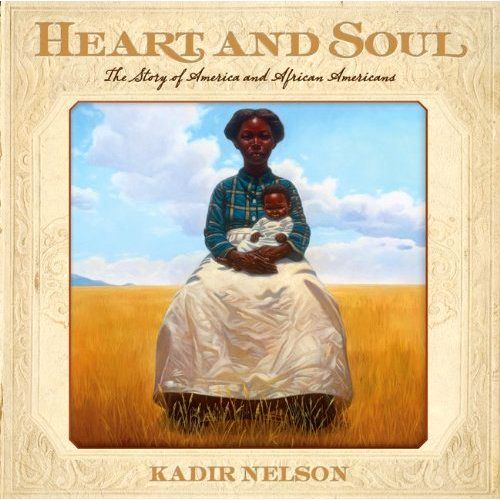
Nelson, Kadir (2011) Heart and Soul:  The Story of America and African Americans  New York: HarperCollins

Henkes, Kevin (2012) Penny and her Doll  New York:  HarperCollins

Children’s picture books are amazing in their range.  I recently read two picture books, one after the other, liked both of them, and was struck by how bizarrely different they were.

Let’s start with Kardir Nelson’s Heart and Soul.  Here is the cover:

Image

I could stare at Kadir Nelson’s illustrations all day.  I used to assign my Children’s Lit students to buy Nelson’s We are the Ship which isn’t even really a kids’ book (though it is a beautiful picture book about the Negro Baseball Leagues — you should buy it from an independent bookstore immediately — or get it out from your library). His paintings always seem to smell like summer to me. I wish I could walk into them (and talk to the people he paints, their faces seem to have so many stories etched into them).  Just look at that illustration above for a minute.  Isn’t it gorgeous?  Hold on, let me show you another one:

How does he make the slaves exposed on the deck of a ship making the middle passage from Africa look so beautiful?  The stiuation is, of course, utterly horrible, but Nelson bringes out the deep dignity and beauty of each person he depicts.

Anyway, where was I?  Oh, yeah, so Heart and Soul is this amazing overview of the story of African-Americans in America from the Revolutionary War to the election of President Obama.  And if I wasn’t jealous enough of Nelson’s artistic ability, he is an excellent writer as well.  The text takes the form of a narrative from an older family member to a younger one (or maybe a group of kids) about their history.  The voice is strong and interesting.  Here are the opening lines of the book:

“Ever visit the capital in Washington, DC?  It’s a beautiful white building made of sandstone, and it has a big iron dome that rises over the city like a full moon.  It was built by slaves and freemen to be a symbol of the liberty Americans had won from England in the American Revolution.  Inside the rotunda there are large paintings and sculptures of famous Americans.  Big ol’ statues of Abraham Lincoln and George Washington.  The paintings tell the story of how America came to be.  Strange, though… nary a black face in all of those pretty pictures.  There’s plenty of white folks and a few Indians here and there, but none of us.  It’s as if we never existed — stricken from the record, like Moses from the walls of Egypt.  Of course, those fancy paintings ain’t telling the whole truth.”

Bottom line:  Heart and Soul is a beautiful books that more students ought to be exposed to — from pre-K grade through graduate school (though the little ones might enjoy it more if you show them the pictures and talk through it — they might have to be in first grad before the text really makes sense to them. )  It is serious at time, but also full of sunlight and hope throughout. Buy it.

So how can I talk about a book called Penny and her Doll after describing a book that covers almost the entire sweep of American history?  How could Kevin Henkes ever hope to achieve that level of gravitas? 

Well, that’s an easy question — he can’t, he doesn’t, and he isn’t trying to.  Penny and Her Doll is about a girl (actually a mouse-girl — this is Kevin Henkes after all) who is trying to think of a name for her new ragdoll sent from Grandma.  Penny struggles with finding the right name for a while, and finally she does.  That’s it. Nothing profound, just the story of a little kids solving a real problem by working at it for a while.   Henkes’s style is nothing like Nelson’s.

Image

This book is covered, inside and outside with flowers.  There is a lot of pink going on here.  The mouse is presentational rather than representational.  So why would I like this book?  I mean, doesn’t it seem a little bit shallow?

Maybe, but look at the cover once.  The focus of the whole cover is on a young mouse showering a little doll with affection.  Look at the way she holds the doll.  This little mouse really cares.  And the story is a simple one with simple words — but it is also very reassuring.  Penny is seriously worried, the way little kids can be sometimes, that she will not be able to find a name for her doll.  The grownups in her life reassure her that she will come up with something.  And eventually, after thinking it over for a few days, she does.  Nothing dramatic here, but yet there is something very important being communicated.

Reassurance.  Listen, maybe you have a rosy picture of childhood as a time when each day stretched out before you without any commitments, and life was carefree and without worry.  If that is your memory, it is false.  Children worry about a lot of things.  Many of the things they worry about are not, of course, reasonable, but they don’t know that.  One of the things picture books can do is remind them that things are going to be okay.  This book (and the other Penny books with it; Henkes has several out) is reassuring.

Wait a minute, you say.  So the first story was very honest — so much so that it sounds like it might be a little unsettling.  The second book frankly seems a little unrealistic — but it is reassuring.  so which is it?  Which kind of book does a little kid need to read.

My friends, children desperately need both. 

Stead, Phillip C.  (2012)  A Home for Bird  New York:  Roaring Brook Press.

Image

Vernon the frog stumbles upon a knick-knack craft scultpurey thing of a bird.  He introduces his new friend bird to his friends, skunk and porcupine, explaining that bird is very shy.  The three friends (and some others besides) decide that bird is unhappy and they set out to find a good home for bird. 

The story is engaging (even for adults) the illustrations are delightful — a bit cartoony (see illustrations above) but also really quite beautiful.  This is a good book.

Smith, Lane  (2012)  Abe Lincoln’s Dream  New York:  Roaring Brook Press

Image

Anything Lane Smith writes always strikes me as being just a single degree or two off from the normal world we live in.  It isn’t a big enough shift that you can pinpoint what makes it seem so odd — but clearly it is something. 

In this story, the ghost of Abe Lincoln confides in a little African-American girl about his recurring nightmare that he keeps having.  She shows him around the world of the 21st century and together they conclude that although this world is far from perfect, some of the things Lincoln put in motion have borne fruit. 

This illustrations are oddly wonderful (not sure if a little kid would like them) and the storyline mores along quickly.  Not many words per page, which might make it good for new readers and restless readers alike.  Good stuff.

Allen Say (2011) Drawing from Memory New York:  Scholastic.

Image

You probably know someone who is still young and who loves drawing or who wants to be an art teacher someday.  Don’t finish reading this review.  It will only waste time.  Instead, go order this book for them.  You may want to order a copy for yourself too — even if you don’t fancy becoming an artist some day, if you are interested in history, memoir, Japan, art, education, a well-told story, or beautiful books.

This is the story of children’s illustrator Allen Say.  It is a beautiful combination of black and white photographs, drawings from memory, and drawings that Say made when he was just learning how to draw.  it describes his early development as an artist, his disagreements with his father over whether art was a respectable profession, the teachers that nurtured him, how he had to leave home to go to school, the glory of his first studio space, how he learned to combine karate and drawing, and best of all, how he managed to get himself apprenticed to the premier cartoonist in Japan.  I cannot decide whether I like the words best or the art.  I suspect the answer is both. 

I don’t know what to tell you about age level for this book.  I think first graders and younger would have a hard time with it.  Beyond that, all bets are off.  I think it would be excellent for middle school, high school, college, and regular grown-ups. 

This may be the best picture book I have read this year. It is so good that I kept it even when it was overdue (and I NEVER let books be overdue).

de la Pena, Matt; Nelson, Kadir  (2011)   A Nation’s Hope:  The Story of Boxing Legend Joe Louis.  New York:  Dial Books.

Image

So I’ll confess up front, I am not much of a boxing fan, but when I turned to the first page of this book and saw Kadir Nelson’s painting of a crowd outside of Yankee Stadium in 1939 in the setting sunlight, it took me by surprise, and it took my breath away (and I don’t even like the Yankees).  De la Pena frames this book as not only the fight between Joe Louis and Max Schmeling, but also as Joe Louis’s fight for respect in Jim Crow America.  And also maybe, as the way that Joe Louis gave America a hero when it really needed one.  He does a nice job.  The book is well written. but really, it doesn’t matter.  What makes this book is Nelson’s illustrations.  The light and dark in an image of a brightly lit boxing ring adrift in a sea of darkness; the image of Joe Louis as a dejected kid, dreaming of a better life; the image of a black family huddled around the radio:  all these draw you far deeper than you would ever think images could.  I am used to getting lost in the words of a book.   This experience, getting lost in the images, was somewhat new to me.

Look, you’ll just have to see it yourself. 

I am actually quite a fan of winter (I love shoveling snow, no joke) but I recognize that not everyone shares my enthusiasm for snow and cold.  So here are some picture books that will make you think of other seasons. 

Fogliano, Julie; Stead, Erin E. (2012) and then it’s spring.  New York:  Roaring Brook Press.

Image

This is a remarkably simple book about a little kid who plants some seeds when everything is brown.  He waters it and worries about it and mostly he waits in his little red wagon until finally one day everything is green.  The illustrations are simple but realistic (my favorite one is a cutaway that shows the ants and mice underground as they wait for spring too) and detailed enough that little kids can spend a long time looking at them.  No deep themes here, but the words are well chosen/  I also love that the little guy wears glasses. 

Woodson, Jacquline; Lewis, E.B.  (2012)  Each Kindness.  New York:  Nancy Paulsen Books.

Image

Okay, the bright sunny pictures manage to keep this book from being too gloomy — but actually the story is about a girl named Maya who joins an elementary classroom part way into the semester, after all the friendships have been chosen.  Despite her teacher’s attempts to find a friend for Maya, the other kids shut her out.  Then one day Maya isn’t there any more and Chloe wishes she had made the decision to be kind to her.  Although we might wish for a happy ending, we don’t really get one with this book — and actually I think that is okay.  It is good for little kids (and big kids too) to recognize that unkindness hurts, and we don’t always get another chance.  Though you might not want to buy this for your child, it would be helpful for kindergarten through second (or maybe through adulthood, now that I think about it) to hear this in class and think about how they can make the world better.
     To be honest, though, it really doesn’t matter what the subject is, E.B. Lewis’s art makes me think of summer.

Buzzeo, Toni;  Small, David (2012) One Cool Friend.  New York: Dial Books

Image
Image

This is a silly book.  Elliot wants a penguin and his father, thinking he wants a plush penguin, agrees.  Then Elliot apparently kidnaps a penguin and his apparently oblivious father apparently doesn’t notice.  His oblivious father also apparently doesn’t notice when Elliot uses the air conditioner in his room to freeze a wading pool of water so he and the penguin can ice skate.  His oblivious father also apparently doesn’t notice Elliot’s penguin in the freezer when he goes for ice cream.  Turns out, though in the surprise ending, that Elliot’s father is not as oblivious as you might think..The whole book is structured around one joke, — but its silliness is something kids will enjoy.  The art is a little overly cartoony for my taste, but it is well done. 
     And I know this one is about ice and snow — but you see it is warm outside, that is why Elliot needs to run the air conditioner.  Remember running the air conditioner?

Finally, there is nothing like thinking of the seashore when you are cold and miserable.  Although maybe you weren’t thinking of this sort of sea adventure”

Kimmel, Eric A.; Glass, Andrew (2012)  Moby Dick:  Chasing the Great White Whale.

Image

You  know the story already.  Ishmeal goes to sea on the Pequod with Queequeg, Starbuck, Stubb and, of course, Captain Ahab.  They do some whaling and eventually find the great white whale with Ahab hoping to get his revenge.  Instead the whale turns the tables.
     I actually love the novel and so it is a little hard for me to take the rhyming verses that summarize the story — but the paintings are beautiful and actually, this book is a good summary of the story (though I think it mistakenly makes reference to a character called Flash — I think they mean Flask — the butterless man).  This might be a good way for a high school teacher to summarize the novel before teaching it (though I would argue that no one should read Moby Dick until they are at least 25 and have lived a little.  The book is much funnier then.)

Swords, Freshmen, Periods, Valentines, and Guitars: Graphic Novels with Female Main Characters for Middle School and High School Students

Alfageeh, Sara; Shammas, Nadia (2022) Squire.  New York: Harper Alley.

Image

Opening Lines:  Aiza!  Don’t forget to take the apricots! // I know, Mama, I know! / Good luck today! ?? You again?  You know, I don’t have to give you anything.  You’re not even my dog!

Other Interesting Quote:  “We’re in a war of our own.  The war for truth!”  p. 245

Genre and Format:  Graphic novel traditional fantasy

What academic subject does this book connect to:  English language arts, social studies

Short Summary:  Aiza is a member of the Ornu tribe which is now part of the Byat-Sajji Empire.  As such, she is the lowest of the low.  Her whole life, she has dreamed f becoming a Knight of the Empire.  When she joins the army as a squire, she feels like her dream is coming true.  However, she finds that the army is not what she hoped for. She is still treated as an outsider, General Hende’s training is incredibly hard, and the competition makes it difficult to find friends.  As the empire moves toward war again, she starts to realize that the honor and justices that she always connected with he knights may, in fact, be a veneer disguising prejudice, injustice and lies.  Can Aiza give up the position of knighthood if it means she has a chance to be the honorable protector of the truth she thought knighthood meant?

Why should I read this?  It is an exceillent story with interesting characters and an intriguing story.  The art is beautiful and the authros have a remarkable grasp of how to use the graphic novel form to tell a story.  This is a story of what a real hero is and that theme connects with others including the nature of war and the adolescent struggle to define oneself.  This is an enjoyable and thoughtful book.

Who is this book best for?  This book would be ideal for fifth or sixth grade and older.  It would be an excellent choice for classroom and school libraries, but would also be a good choice for literature circles or for any English Language Arts unit that touches on questions of war and truth and identity.  It might also work as a supplemental text in connection with a social studies unit on war and truth and propaganda. 

Is this book likely to be challenged?  I don’t think so.

Mai, Sarah (2024) Freshman Year.  New York:  Little Brown and Company.

Image

Opening Lines:  Wisconsin, (redacted) High School Gymnasium, Early June. // Sarah 18 Graduating. // Sarah, graduated. // Sarah, the rest of life. / That was it? / Knock knock.

Other interesting quote:  “I’m just going to close my eyes for a minute.  Feeling a little nauseous.”  p. 29

Genre and Format:  Graphic novel memoir

What academic subject does this book connect to:  English language arts

Short SummaryAfter graduation and a summer of parties and hopefulness, Sarah leaves Wisconsin to go to school in Minnesota.  It starts out well, but soon Sarah feels like she cannot be anywhere near as good of a student as her roommate, her back-home summer boyfriend begins pulling away, and she finds herself overwhelmed by freedom, responsibility, loneliness, crowds, and more.  She slowly finds her way toward being closer at least to wellness.

Why should I read this?  It is clever, relatable, earnest and truthful.  Anyone who has ever been to college, or who anticipates going to college will find this helpful, real, and hopeful.  The images carry a lot of emotion, and Mai does a good job of using the graphic novel effectively to tell the story.

Who is this book best for?  High school students or freshman in college would connect to this best.  I would recommend it especially for seniors.  It would be a great text to use for a meoir unit or a college-readiness unit.  It would also be a great choice for any high school classroom library or school library.

Is this book likely to be challenged? There are references to drinking, though Sarah does not glorify partying at all.  Some vulgar language as well. 

Yang, Gene Luen; Pham, Leuyen (2024) Lunar Year Love Story: New York: First Second.

Image

Opening lines:  He gave me until nest Valentine’s Day.  One year.  And I’ve already messed it up.

Other Interesting Quote:  “I told you, when you’re standing over the fryer, don’t inhale, no matter how good you think it smells.”

Genre and Format:  Graphic novel fiction

What academic subject does this book connect to:  English language arts

Short Summary:  When Val was a little girl, Valentines Day was her favorite day of the year.  She would make personalized uplifting valentines for everyone of her classmates, and one for her dad who was grieving for her mom.  That valentine would be a special one, with words that Val imagined her mom might say to him.  She keeps up the practice until high school, when hre Dad told her to stop and a kid in one of her classes was upset by one of the cards.  Then Val finds out that her Mom didn’t die, she left.  Val figures that love isn’t real and isn’t for her.  But then she gets involved in a cultural group to learn about her cultural heritage and begins to learn lion dancing.  And discovers that one of her fellow lion dancers is the kid who was so upset by her card years ago.  There is more to the story, of course, including an imaginary friend who looked like a little cupid, then evolved into a dour and horrible St. Valentine, trying to claim her heart, but in the end it all works out in a way that will make readers happy.

Why should I read this?  First of all, anything Gene Yang writes is wonderful.  Secondly, while there is romance in this book, it isn’t a romance.  It is a story about two hurting people who come together because of an activity they both do and slowly find that they care for each other.  No love-at-first-sight here, and no purely physical love.  This is a story that seems to me to be more true to the way love really hap[pens, and hwo sometimes the obstacles that love faces are huge and real.  It is a very good book.

Who is this book best for?  This book would be ideal for high school students.  It would work well as a part of a classroom library or a school library.  It could also work as a choice for literature circles.  There is some thematic material here, but it probably couldn’t sustain whole class study.

Is this book likely to be challenged?  Perhaps, but I don’t think so.  There are some ghost/supernatural lements, but I think for high school students this won’t be an issue. 

Williams, Lily; Schneeman, Karen (2020) Go with the Flow. New York: First Second.

Image

Opening Lines:  Wakey ,wakey, eggs…and bakey! / Who’s ready for her first day of sophomore year?

Other interesting quote:  “The trolls!  The trolls have come for me!  I’m not ready for the trolls.”  p. 283

Genre and Format:  Graphic novel fiction

What academic subject does this book connect to:  English language arts

Short Summary:  When Sasha unexpectedly gets her period at school and doesn’t know it, Abby, Britt, and Christine guide her away from the snickering girls into a bathroom so she isn’t too embarrassed.  The coin dispenser in the bathroom, however, is out of tampons and pads.  Abby is able to give her the emergency pad she carries with her, but together the grils realize that if Sasha didn’t have a kind person nearby, the empty dispenser would have been nof no help.  And what if she didn’t have any change.  Together they decide they are going to advocate for change.  Their campaign isn’t easy, though, they are met with indifference from an administration that prioritizes football uniforms over hygiene.  They stage some demonstrations which, though well designed, don’t always have the desired effect.  And when one of the friends decides to make a move without consulting the others, both their mission and their friendship is imperiled.  Will they be able to reconcile in time to force the changes they believe in?

Why should I read this?  This is a story of activism and students seeking justice and equity, but it is also a story of friendship.  Both stories are worth rooting for.  The artwork is particularly good at conveying emotion.  The lettering is typeset, which limits its effectiveness for conveying tone and emphasis, but that isn’t a dealbreaker.  All in all, it is a satisfying read.

Who is this book best for?  With the right teacher and context, this could be a good book for middle school, but I suspect it will land better for high school. It would work well with any teaxt set about friendship or changing the world – also literature circles.  It would also be a great choice for a classroom or school library.   

Is this book likely to be challenged?  Yes, though not for any really good reason. I suspect the challenges to this book will be beased on the idea that talking about menstruation is somehow gross or obscene.  I could also imagine objections on the basis that males would not be able to handle it.  But I would respond that only by talking about such important things in the light can males and females become more better informed and more compassionate toward others.

Larsen, Hope (2021) All My Friends.  New York: Farrar, Straus, and Giroux.

Image

Opening Lines:  Echo pPrk, Los Angeles.  Saturday. / Da da da da da da  dum dum dum // Braaang // Bina, 24  Lora, 14, Kesi, 15 / Nok nok // Turn it down, Kasi! / Mom! You’re home early!

Other Interesting Quote:  “Don’t beat yourself up.  Just, like, take some responsibility.

Genre and Format:  Graphic novel fiction

What academic subject does this book connect to:  English language arts, Music

Short Summary:  Bina and her friends have formed a rock band, Fancy Pink.  When their new song is featured on Bina’s favorite TV show, they start to make a name for themselves.  And then, amazingly, they have a shot at a record deal.  The band is geeked.  Their parents are not.  Bina is also trying to figure out her romantic life.  When her parents forbid her from playing what might be their most important gig ever, Bina has a choice to make.

Why should I read this?  Hope Larsen has written some of my favorite graphic novels ever and this one joins them.  The layout and images are nearly perfect and Bina is an incredibly easy character to root for.  The story also captures many universal truths of growing up, in cluding following your dream, the way that exciting opportunities are also terrifying, the many ways that life can go completely wrong, and the amazement when things go exactly right for once.

Who is this book best for?    This would be an excellent choice for classroom and school libraries form about fifth grade through high school .I think it is more fun than deeply thematic and isn’t really suited for classroom study – but it is the kind of book that I would want my students to discover on their own and enjoy the heck out of.

Is this book likely to be challenged?  I don’t think so.  The main characters do act independently and do disobey their parents in a fairly major way, but they also face the consequences of that action.

Classic Review: just call her ‘Ella

Haddix, Margaret Peterson  (1999) Just Ella  New York: Aladdin

Image

Okay, so the original story of Cinderella has been told and retold in pretty much any setting and variation you can think of.  And even though Margaret Peterson Haddix (author of Running out of Time and about a hundred other good books) starts her novel at the end of the story and presents a Princess Ella who has to choose between life as the royal wife of Prince Charming and a more ordinary life with a tutor who wants to help refugees of the most recent war the kingdom has had with its neighbors — it still sounds like a familiar love triangle thing (Twilight anyone).  But don’t dismiss this novel quite so quickly. 

What makes it good is a combination of Ella’s interesting voice and her interesting personality.  Ella has just been handed her dream — a life of phenomenal luxury after more than her share of abuse and poverty– but she starts to realize that a life of wealth has its own constraints.  She finds she is not really free to do what she wants, but rather that the expectations upon her as princess and upon the noble women of her culture in general leave her very little choice in things.  When her pompous and rotund tutor has a heart attack and is replaced by his idealistic son, she starts to wonder what her life is for.  And that is what makes this book great.  It isn’t about a helpless and confused girl choosing between two hunky suitors — it is the story of a thoughtful and reflective girl making a deliberate choice about her life. it’s good.

This is a good one for girls from fifth grade on up.  It fits best with a literature class — although it gives a stereotypical picture of medieval life, it clearly is not intended to offer any historical insights.  Boys might like it if they read it, but the cover might make it a pretty hard sell.     

Graphic Novels about Philosophy? Really?

Krimstein, Ken (2018) The Three Escapes of Hannah Arendt: A Tyranny of Truth. New York: Bloomsbury

Image

Opening Limes:       

All Too Human

An Introduction to a Life. 

Too soon.  Too angry.

Too smart. Too stupid.

Too honest.  Too snobbish.

Too Jewish. Not Jewish enough. 

Too loving. Too Hateful.

Too manlike.  Not manlike enough. 

Other interesting quote:  “As fire lives on oxygen, the oxygen of totalitarianism is untruth..”  Hannah Arndt.  p. 165

Genre and Format:  Graphic novel non-fiction

What academic subject does this book connect to:  English language arts, social studies, philosophy.

Short SummaryThis is a graphic novel about the life, political philosophy, and writings of Hannah Arendt.  It particularly focuses on what is perhaps her best known book, The Origins of Totalitarianism (1951).  Arndt live an amazing and difficult life.  She was persecuted by the Nazis, fled multiple countries, wrote about the nature of fascism, and was in love with Martin Heidegger, who was also a philosopher, but one who sympathized with the Nazis. The book is a quirky blend of her life, her philosophy, and her wisdom.

Why should I read this book?  This is as good of a beginners introduction to Arnst as you will find.  And Arendt has never been more relevant as she is right now.  With President Trump in the US and other fascist thugs in Germany and Israel, Arendt’s wrds speak to what is going on in the world.  Consider the two quotes at the beginning of this review.

Who is this book best for?  The book was written as an introduction for adults, not high school students.  So while it might work for high school seniors, it would really be more ideal for college students.

Is it likely to be challenged?  Possibly.  There is a lot of smoking, frank mentions of sex, and minor frontal nudity. 

Robertson, Donald J.; Fraga, Ze Nuno (2022) Verissimus: The Stoic Philosophy of Marcus Aurelius  New York: St. Martins

Image

Opening lines:  The year is AD 180.  The Emperor Marcu Aurelius lies dying of plague in the legionary camp at Vindobona in the Roman province of Pannonia

Other interesting quote:  “Nothing good and admirable can ever belong to humans without effort on their part.”  n.p.

Genre and Format:  Graphic novel non-fiction

What academic subject does this book connect to:  English language arts, social studies, philosophy.

Short Summary:  Marcus Aurelius was emperor of the Roman Empire.  As such, he was, at that time, arguably the most powerful person in the world with political power over a vast region touching four continents and with a military whose power was unmatched.  Marcus Aurelius was also a remarkably insightful stoic philosopher.  His father died when we was young and Aurelius turned to the study of wisdom for solace.  His reign was marked by war with invaders and a struggle with a plague that swept through his empire, but also infected him.  Throughout it all, he found comfort in his adherence to stoic philosophy.

Why should I read this?    This remarkable graphic novel is part history, part biography, and part an explanation of stoic philosophy.  The narrative of Aurelius’s life keeps the reader’s attention and Robertson masterfully weaves in explanation of the ideas behind stoic philosophy.  The reader learns it along with young Aurelius.  The artwork is clear and realistic, but also rendered in a way that is dramatic and pulls the reader into the story. 

Who is this book best for?  This book is, without question, the most exciting philosophy-based graphic novel that I have ever read.  It would work well as a companion book to a college course studying ancient philosophy.   It would also fit with an ancient civilization course in high school.   Finally, it could be an option in a biography unit in high school English.  It would be a great choice for a high school classroom library or a high school library.  Not every student will gravitate toward this book, but it is a great choice for readers filled with curiosity or who like a challenge. 

It this book likely to be challenged?  In our current political climate it is getting harder and harder for me to answer this questions with any degree of certainty.  But I don’t think it would be, no.

Nott, Dan (2023) Hidden Systems: Water, Electricity, the Internet, and the Secrets Behind the Systems We Use Every Day.  New York: RH Graphic.

Image

Opening lines:  Sometimes I am very surprised by how little I know about everyday things. // How is there enough water for everyone at the same time? //  And what’s really powering this light?  What even is electricity? // Usually I just move on.  / Oh well.

Other Interesting Quote:  “I began drawing about hidden systems because comics seem to have this superpower-like ability to compare how we think about something to how it works concretely, to view small pieces in the context of larger systems.”  p. 6

Genre and Format:  Graphic novel non-fiction

What academic subject does this book connect to:  English Language Arts, Social Studies, philosophy, engineering

Short Summary:  Nott’s graphic novelsexplains how multiple systems work:  the internet, the power grid, our water systems, and systems in the future.  But what is more interesting to me is the way that Nott thinks deeply about each of these systems.  He leads the reader to think about how the systems came to be, why they are important. What their advantages and disadvantages are, and what they say about humans and humanity.

Why should I read this book?  When you walk down the street you are walking on top of pipes and tunnels, gas lines and electric line, and above you, electricity is flowing through lines, data is travelling invisibly through the air, and all of these systems are working in the context of natural systems like the water cycle and the ecological systems we depend on are woven though them.  Usually we don’t even notice or think about it.  Nott does a masterful job of unravelling each system while simultaneously taking great care to show us the interconnections as well.  This is an important book.

Who is this book best for?  Elementary, middle school, and high school libraries, classroom libraries in science, engineering, social studies, art, and English classrooms.  Also fourth through sixth grades in general.  Some of the concepts might be a little hard for younger kids, but with he images, they can get through it. This could be part of a sociology unit in high school social studies, and part of an engineering unit in high school science.

Is it likely to be challenged?  I don’t think so.

Harari, Yuval Noah; Vandermuelen, David; Casanave, Daniel (2020, 2021) Sapiens: A Graphic History, Volumes 1 and 2.

Image

Opening lines: About 14 billion years ago, matter, energy, time, and space came into being in what is known as the Big Bang. / The story of these fundamental reatures of our universe is called physics.

Other interesting quote:  “In modern times, just a small difference in skin color, dialect, or religion can prompt one group of sapiens to exterminate another.  Why should ancient sapiens be any different.”  p. 50

Genre and Format:  Graphic novel non-fiction

What academic subject does this book connect to:  English language arts, social studies, philosophy.

Short Summary:  It is admittedly difficult to summarize all of human history in a paragraph or two – and it is hard for Harari to summarize it in 500 or so pages over 2 volumes of graphic novel.  Harari is apply a scientific/physics lens to history.  Harari makes several interesting arguments which will certainly make the reader think, though they may not ultimately be convincing.  One of his arguments is that humans naturally settle into groups the size of small villages.  To get them to participate in groups larger than that requires stories.  Harari claims that it is only though stories that humans will commit to something like a nation, a po0litical system, a religious system, or an economic system.  Stories about democracy, Jesus, George Washington, pulling yourself up by your bootstraps, the security of banks, manifest destiny and so on allow humans to band together in larger groups.  (I personally believe this is a bit simplistic. Other factors like economic security and a sense of belonging (just to start) surely play a role in this as well.  In other places he argues that when humans transition from hunter-gatherers to a grain-based agrarian society, and from there to a meat-based diet, we were stepping for a balanced life of happiness to all of the ills of the modern world.  Here again, such an argument seems overly simplistic.  Harari puts for these arguments supported primarily with extreme confidence.  And he is very convincing.

Why should I read this book?  First of all, this is a monumental and impressive undertaking.  To try to present all of human history as a single narrative and argument is impressive. To read it does give one a different sense of perspective.

Second,. This book is certainly thought provoking.  I think in the context of a philosophy unit in high school or college, this could be a very useful tool for teaching students to ask questions about arguments.  Breaking through Harari’s extreme confidence to ask “How does he know this?”  “Are there alternate reasons or interpretations?”  “Are there alternate conclusions?” “Is his particular perspective – looking at history from a distance – likely to privaledge some interpretations and miss others?”  about his specific arguments could be a very important lesson. 

Who is this book best for?   This book would be ideal for high school students.  I could imagine a middle school student who is at a high reading level enjoying it, though I would be concerned that such a person might buy Harari’s arguments without questioning them.  These books would work great for a philosophy unit or a critical thinking unit in English or history classes.  I could imainge these books in classroom libraries and school librarires, though I think they are better in the context of good classroom teaching.

Are these books likely to be challenged?  It is quite possible, though it is perhaps unlikely that a parent would sit down and read the while thing.  Harari’s argument has little room wor God, is somewhat cynical, and certainly runs close to arrogant.

15 April 2025