-
-
AeroGreen

💡 Inspiration
Aviation contributes significantly to global emissions, yet route decisions are often based on limited real-time intelligence. During Hack New Haven (24-hour AI track), we asked: What if air traffic controllers had an AI co-pilot to optimize routes for fuel, cost, and sustainability in real time?
That idea became ATC Route Optimizer — a system that blends AI, aviation data, and sustainability into one intelligent assistant.
🛠️ How We Built It
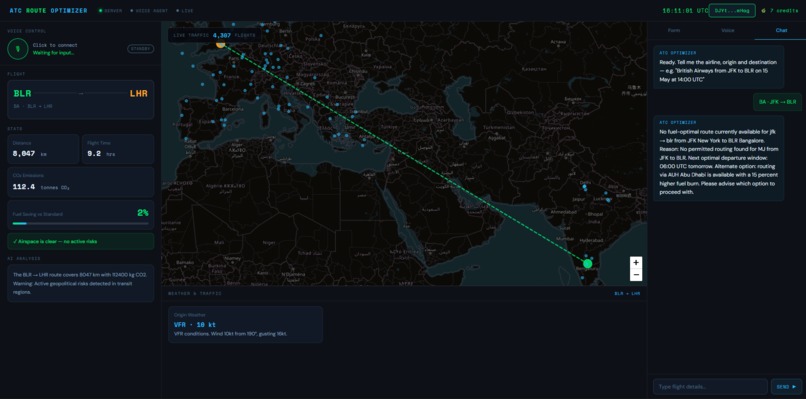
We designed a full-stack Node.js system that simulates a real ATC decision pipeline:
Frontend: Radar-style dashboard using Leaflet.js for live route visualization Backend: Express.js server with WebSockets for real-time updates AI Layer: Voice interaction via ElevenLabs Route explanations via Google Gemini Data Sources: OpenFlights (routes graph) OpenSky (live traffic) CheckWX (weather / METAR) NewsAPI (geopolitical risks) Blockchain: Solana devnet to mint carbon credit tokens
At the core, we used BFS pathfinding over airline routes to explore possible paths and rank them by efficiency.
We modeled fuel and emissions using:
Fuel (kg)
Distance (km) × 4.5 Fuel (kg)=Distance (km)×4.5
CO₂ (kg)
Fuel × 3.16 CO₂ (kg)=Fuel×3.16
We also adjusted for wind:
Effective Distance
𝑑 × ( 1 − 0.08 ⋅ tailwind factor ) Effective Distance=d×(1−0.08⋅tailwind factor) 📚 What We Learned
This project pushed us across multiple domains simultaneously:
How graph algorithms (BFS) apply to real-world logistics Integrating multiple real-time APIs into one coherent pipeline Designing voice-first AI interfaces for technical systems Understanding aviation constraints like wind, traffic, and routing Using blockchain beyond hype — as a measurable incentive system
Most importantly, we learned how to build fast under pressure without losing system design clarity.
⚡ Challenges We Faced
Data Integration Chaos Each API had different formats, latency, and reliability. Normalizing everything into a single pipeline was tough.
Real-Time Performance Running BFS + weather + traffic + AI explanations in a 24-hour build required careful optimization and async handling.
Voice → Structured Intent Parsing natural speech into:
{ airline, origin, destination, time }
was surprisingly tricky — accents, phrasing, and ambiguity made this a real challenge.
Meaningful Optimization It wasn’t enough to find any route — we needed a better route. Balancing distance, wind, and traffic required thoughtful scoring logic.
Blockchain Integration Connecting real-world savings to carbon credit minting on Solana added complexity, especially under hackathon time constraints.
🏆 Accomplishments That We’re Proud Of Built a fully functional end-to-end system in 24 hours integrating AI, real-time aviation data, and blockchain Successfully implemented BFS-based route optimization on real-world airline datasets Integrated live weather, traffic, and geopolitical risk data into a single decision pipeline Enabled voice-controlled ATC interaction, making the system intuitive and futuristic Designed a real-time radar-style dashboard with WebSocket updates Created a carbon credit system on Solana, linking optimization directly to sustainability impact 🚀 What It Does
AeroGreen (ATC Route Optimizer) is an AI-powered system that helps air traffic controllers and airlines choose the most fuel-efficient and eco-friendly flight routes in real time.
Analyzes multiple route options using graph algorithms Incorporates live weather (tailwinds), air traffic, and global risks Calculates fuel consumption and CO₂ emissions for each route Recommends the optimal path with AI-generated explanations Supports voice, chat, and form-based inputs Rewards emission savings with blockchain-based carbon credits
In short, it turns complex aviation data into actionable, sustainable routing decisions.
🔮 What’s Next for AeroGreen Machine Learning Models to predict optimal routes based on historical trends (beyond rule-based BFS) Integration with real airline/ATC systems for live deployment Advanced optimization algorithms (A*, reinforcement learning) for better scalability Global weather forecasting models for more accurate long-haul predictions Carbon marketplace integration to trade earned credits in real ecosystems Mobile & cockpit-ready UI for pilots and operators Scalability improvements using cloud-native architecture (AWS/GCP)
Our long-term vision is to make AeroGreen a standard intelligence layer for sustainable aviation worldwide.
🚀 Final Thoughts
What started as a hackathon idea became a mini ecosystem combining AI, aviation, and sustainability.
This project showed us that optimization isn’t just about algorithms — it’s about impact. Even small efficiency gains at scale can mean massive reductions in fuel usage and emissions.
And honestly… building something this ambitious in 24 hours taught us one thing: constraints don’t limit innovation — they accelerate it.
Built With
- express.js
- many-more-no-time
- node.js
- solana


Log in or sign up for Devpost to join the conversation.