-
-
Amati

Inspiration
130 million students in Latin America attend public schools with no access to a private tutor. When they get stuck on a math problem at 9pm, there is no one to call. They turn to ChatGPT. ChatGPT gives them the answer. They copy it. They learn nothing.
We asked: what if the AI was structurally incapable of giving the answer?
What it does
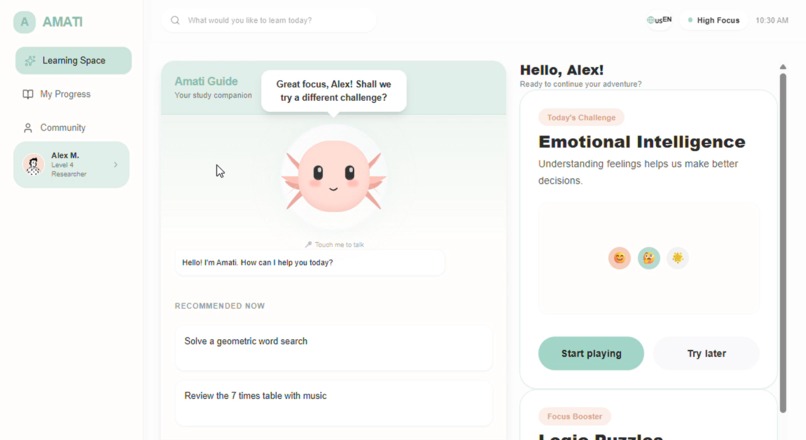
Amati is a 24/7 Socratic AI tutor accessible through a React web application. The backend is also architected to support WhatsApp (Meta Cloud API) and a native Flutter mobile app — both in active development.
The core mechanic: a two-stage post-inference Anti-Cheat validator runs on every response before it reaches the student. Stage 1 is a regex filter (<5ms). Stage 2 uses Amazon Nova 2 Lite as a semantic judge — reading the response the way a teacher would. If the answer can be extracted, even indirectly, the response is discarded and regenerated.
The result: an AI that is architecturally incapable of giving a direct answer. Not by guidelines. By code.
5-Level Socratic Engine (Bloom's Taxonomy):
- Level 1 — Activate prior knowledge
- Level 2 — Cultural analogy
- Level 3 — CPA Scaffolding (Concrete → Pictorial → Abstract)
- Level 4 — Directed hint + student hypothesis
- Level 5 — Model an analogous problem, then transfer
Emotional Circuit Breaker: Detects frustration from text patterns (repeated questions, expressions of defeat). When triggered, the system resets to Level 1 and responds with empathy before logic.
Adaptive design system grounded in cognitive load theory: font, touch target size, animation density, and axolotl mascot behavior all adapt to the student's grade level (1–12).
Roadmap — Next development phase:
- Voice pipeline via Amazon Nova 2 Sonic (STT→Socratic→TTS on WhatsApp; S2S via WebRTC on PWA) — pending credit access
- Indigenous language support — Nahuatl and Yucatec Maya with region-specific cultural analogies (milpa, cenotes, Aztec calendar)
- WhatsApp channel — full Socratic engine on any basic phone, no app install required
- Flutter mobile app — teacher & parent dashboard with BKT knowledge maps
How we built it
- Amazon Nova 2 Lite — Socratic engine (5 levels) and Anti-Cheat semantic judge via
api.nova.amazon.com/v1(OpenAI-compatible SDK) - Amazon Nova Act — Curriculum orchestrator: decides Socratic level, selects cultural analogies, generates Magic Links
- Amazon Titan Multimodal Embeddings — Homework photo → 1024-dim vector → pgvector HNSW concept search (collective learning: successful scaffolding paths are reused across students)
- Amazon Nova 2 Sonic — Voice pipeline architecture is fully designed and built; activation pending credit access
- FastAPI + PostgreSQL + pgvector — async backend with Bayesian Knowledge Tracing (BKT) and Spaced Repetition System (SM-2)
- React + Vite — current demo interface with age-adaptive design system
- Flutter 3.22 — mobile and PWA app in development
- Meta Cloud API — WhatsApp channel backend ready
Challenges we ran into
The hardest challenge was the semantic Anti-Cheat. Regex alone catches explicit phrases like "the answer is 42." It cannot catch "if you multiply the two numbers you have, you'll get the result." We needed a model that understood indirect disclosure — and Nova 2 Lite, tuned to a 10-token judgment call at temperature 0.0, proved faster and more accurate than expected.
Designing for cognitive load at every grade. A first-grader and a tenth-grader cannot share the same interface. We built an age-adaptive design system where font family, font size, button size, animation density, and mascot prominence all derive from the student's grade — grounded in Piaget's developmental stages and Sweller's cognitive load theory.
Credit constraints shaped the roadmap. Amazon Nova 2 Sonic requires Bedrock access that exceeded our current credits. Rather than simulate the feature, we built the full voice pipeline architecture in the backend (sonic_pipeline.py, webrtc_handler.py) and documented it clearly — ready to activate in the next phase.
Accomplishments that we're proud of
- Zero direct answers — guaranteed by architecture, verified by a pytest suite that must pass at 100% before any code merge
- A design system grounded in peer-reviewed cognitive load theory (Jalil et al.) — every color chosen for a reason
- Collective learning via pgvector: when a student photographs their homework, the system finds similar exercises solved by previous students and reuses the successful scaffolding path
- The axolotl mascot has 8 emotional states driven entirely by live backend data (
frustration_score,streak_days,mastery_achieved,circuit_breaker_triggered) - Full backend architecture for WhatsApp, voice, and mobile — ready for the next deployment phase
What we learned
Nova Act's real value is in the agentic loop — deciding when to advance the Socratic level, which analogy to select, when to generate a Magic Link — not in generating the language itself. Separating orchestration (Nova Act) from generation (Nova 2 Lite) made the system more reliable and significantly cheaper per turn.
Post-inference validation changes everything. The only way to guarantee Socratic behavior at scale is to validate every response before it is sent.
What's next for Amati
Activate the Amazon Nova 2 Sonic voice pipeline (pending credit access), launch Nahuatl and Yucatec Maya support, open the WhatsApp channel publicly, and ship the Flutter mobile app. Then: pilot with schools in Oaxaca, Mexico, and partnership with SEP (Mexico's Ministry of Education) to expand the curriculum to all 16 subjects for grades 1–12.
"Quality education shouldn't depend on your zip code."
Built With
- amazon-bedrock
- amazon-ecs-fargate
- amazon-nova-2-lite
- amazon-nova-2-sonic
- amazon-nova-act
- amazon-rds-relational-database-service
- amazon-titan-multimodal-embeddings
- amazon-web-services
- celery
- docker
- fastapi
- flutter
- pgvector
- postgresql
- python
- react
- redis
- webrtc
- whatsapp-business-api


Log in or sign up for Devpost to join the conversation.