-
-
Problem at Hand
-
Overview


Summary
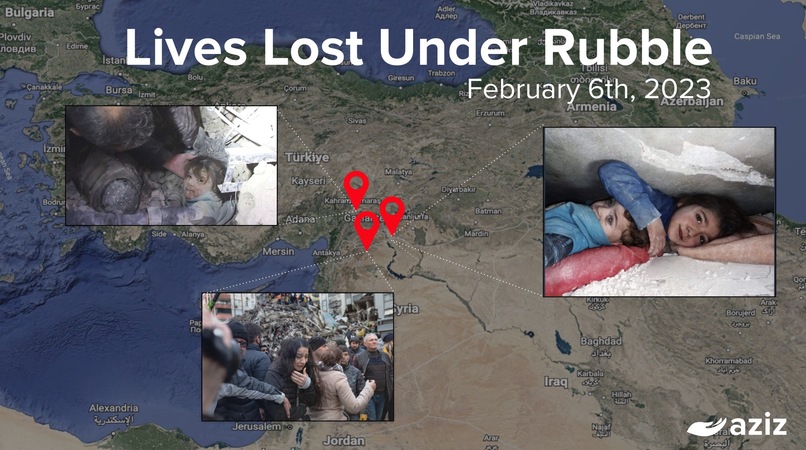
Just two weeks ago, two devastating earthquakes struck Turkey and Syria, leaving 46,000 dead and many more lost under the remains of buildings.
Emergency response efforts were significantly impeded by inefficient recovery protocols to screen the large area of land affected, depleting the chances of survival for those still trapped under buildings.
This urgent crisis demands an effective solution. We present Aziz, a technological device that screens for humans still trapped under debris, empowers rescue workers on their mission to save lives, and revolutionizes our preparedness for future crises.
Inspiration
On February 6th, 2023, two 7.8 and 7.5 magnitude Earthquakes struck Turkey and Syria, causing the collapse of over 6,000 buildings. Given that these earthquakes took place in the middle of the night, very few had time to escape, trapping many underground without a route to safety.
Since that night, many rescue workers have been mobilized to dig through the rubble in search of remaining victims. However, these rescue efforts have been extremely time-consuming and labor-intensive, which have compounded the consequences for those still trapped underground, waiting with waning hope and praying that someone will hear their feeble voices.
One of our team members has lost both family and friends living in Adana, Turkey, to these earthquakes. Those who have survived from her home city have been forced to evacuate to other parts of the country, causing a prosperous region to convert to what resembled a waste zone overnight. Our solution Aziz was motivated by the devastating state that Turkey and Syria are now in and aims to respond to the harsh lessons learned from this incident.
One of the major factors that impeded an effective response to earthquake recovery was the inefficient and demanding process that was needed in order to identify bodies amongst the rubble. With over 6,000 buildings collapsed and each one requiring either an overwhelming number of hours or highly advanced construction equipment to dig through, there was no feasible method to rescue victims in time. As a result, groups of volunteers resorted to waiting in silence, listening for a voice to emerge from under the rubble, and upon hearing a voice digging with construction tools, pieces of debris, or in some cases, just their hands. This process was repeatedly followed until potential victims could be recovered, alive or not.
As rescue workers persisted day and night with this labor-intensive process, victims still trapped under buildings were forced to wait in agony as they lost strength and hope that someone would come to the rescue. Even at the present moment, rescue workers continue to dig through remnants of buildings, with many bodies discovered daily. This crisis has blatantly exposed many technological and ethical limitations that pushed this situation to be even worse than it already was.
Aziz seeks to provide the technological capacity needed for rescue workers to answer the hopes and prayers of trapped victims wishing to see sunlight once again. The name “Aziz'' itself is a Turkish word that means “dear,” representing the care that unites communities in times of emergency. Our platform complements the care that is shared between communities by equipping them with robust technology to respond to times of crisis and to identify humans still trapped underground.
Still, the devastating situation in Turkey is not a one-time event. Natural disasters and international crises are bound to occur yet again, each time testing our preparedness and capacity to respond. Through Aziz, we lay a technological foundation to redefine how crises are dealt with and bring equity, security, and safety as we let our endearing care unite us closer, especially during emergencies.
What Aziz does
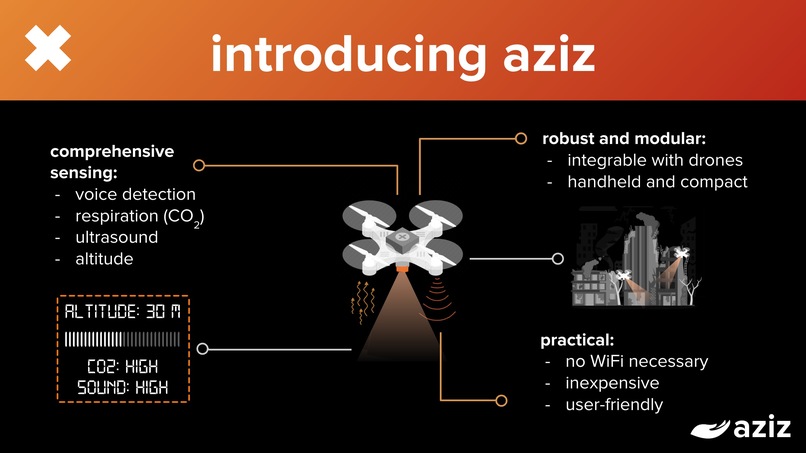
Aziz is an all-in-one, comprehensive monitoring system that integrates various metrics to assess signs of human life from beneath rubble, allowing rescue workers to find victims trapped underground. First, our sensing technology contains a sensitive voice detection system to identify voices originating from under the rubble that may be difficult for the human ear to hear. Furthermore, our system contains a carbon dioxide monitor, of which elevated levels measured through ppm-range changes in atmospheric CO2 composition indicate respiration. Our platform also integrates an altitude sensor for gauging the depth of potential victims with respect to sea level to a high degree of accuracy. Finally, our system harnesses user-controlled ultrasonic sensors that scan across areas and provides real-time information on the 3D landscape of a rescue worker’s surroundings, even in complete darkness. Ultimately, these four capabilities work in complement with one another to support rescue teams as they try to identify signs of life amongst difficult terrain and in dangerous environments.
While Aziz provides the technological foundation for a robust sensing system with responsive and live data on metrics including audio, respiration levels, altitude, and surrounding landscape, this sensor system also carries societal implications that can be realized during rescue missions. Most simply, Aziz can be used as a compact and portable device that can be attached to and controlled by rescue workers digging through rubble. For example, if a rescue worker comes across a small opening too small for them to fit through while crawling through tunnels under rubble, they may use this device to survey the area that they are not able to reach and decide whether to initiate efforts in that direction. Alternatively, Aziz, which is lightweight and small in size, can be integrated with drones for rapid scanning over large areas. Aziz could be assembled onto drones and first used to scan over buildings and then survey inside buildings using an additional LED to light up its surroundings and provide stability in its flying movement. Finally, Aziz could be coupled with small robots that can be fished inside small openings and retrieved from deep underground. While the possibilities for implementation of Aziz are broad and well-defined, even on its own, this technology is a powerful and impactful device critical to rescue missions.
However, beyond just the technological level, Aziz works on a societal level to provide an effective solution that empowers communities under crisis, especially those with low access to advanced technology or financial flexibility. Aziz is particularly impactful in developing or underprivileged regions as it has low-resource and low-cost capabilities. We designed this platform to operate without WiFi, which alleviates a significant burden in developing areas and immensely widens its potential for impact. Moreover, Aziz is very inexpensive as it is composed of standard, low-cost parts assembled onto a 3D printed scaffold, all of which sum to a small price that will ensure that all have access to this critical tool. With its technologically robust and societally impactful capabilities, Aziz provides an effective solution to disaster preparedness, which is a significant concern that carries consequences beyond the situation in Turkey and that will continue to impact future generations.
How we built Aziz
Aziz was built using an Arduino microcontroller and complementary modules. The main part of the circuit is the Arduino MKR WiFi 1010, which is connected with an Arduino MKR IoT equipped with several built-in sensors, such as temperature, humidity, barometric pressure, gas (air quality, VOC), ambient light, and gyroscope. This combination provides the device with sufficient computational power and access to many useful sensors all while maintaining a compact build. Initially, the team planned to implement the preliminary detection via drone using the RCWL-0516 microwave radar module for Arduino; however, the hardware limitation made us use Ultrasonic Sensor HC-SR04 as a complementary device that can serve as a temporary alternative. The 3D printed scaffold holds all the components together by the attached SG90 Servo Motor for holding and directing Ultrasonic Sensor HC-SR04 from one side and the joystick from another side. The electrical circuit was soldered to the common board and connected to the computer to upload code and test using the Arduino IDE on C++.
Challenges we ran into
Technological limitations: The first challenge we faced was the limited variety of sensors and other hardware that could be used to generate inputs for screening for signs of life. After reading into the literature, we decided that RCWL-0516 microwave radar, which can sense heartbeat and heart rate through walls, would be most suited to our needs, but were unable to obtain this. Hence, we chose the next best alternative, an ultrasonic sensor, which still provided similar insight into spatial organization in the dark. Nonetheless, in the future, it would be possible to implement alternatives like RCWL-0516 microwave radars at any point without dramatic impact on the weight of the device.
Processing external metrics for detecting the likelihood of life: While we were able to employ various data-collecting sensors to gather external information on abiotic factors, the process of converting these abiotic metrics to biotic predictions was challenging. We particularly struggled while trying to determine a threshold for carbon dioxide ppm concentration that was indicative of respiration. We had to do extensive reading of scientific literature to understand carbon dioxide levels across various terrains before deciding upon a threshold value that separated carbon dioxide levels in outdoors places without human inhabitants from carbon dioxide levels of indoor and outdoor human-inhabited places.
Practical limitations: In order to keep our solution low-cost, low-resource, and hence widely accessible, we placed additional constraints on ourselves during the design process to ensure the final product would meet these visions. For example, in order to ensure that our system could work without a WiFi connection, we decided to take a hardware approach where all code could be loaded onto a microcontroller and used without compromised impact in remote regions, rather than developing a WiFi-reliant website.
Accomplishments that we're proud of
An interdisciplinary approach to designing a technological solution: In order to develop our final product, we drew from software coding skills in C++, 3D modeling skills in Fusion 360, societal knowledge of the state of Turkey and Syria’s crisis, and more. We are happy to see how we were able to draw from different skill sets to develop a cohesive solution that is a product of interdisciplinary collaboration. Our multidisciplinary approach allowed us to come up with a more comprehensive solution that embeds essential knowledge from different fields, and we’re happy to see how these all came together in the end to support a more robust final product.
Going from strangers to a tightly knit team: Prior to coming to TreeHacks, none of us had met in person and we were barely familiar with one another. However, after 36 hours of hacking together, we have formed a closely knit, collaborative team and feel very close with one another. Without knowing whether we’d get along, we were open to each others’ ideas and willing to take risks, allowing us to foster effective collaboration both when our ideas agreed and when our ideas differed.
Integrating interests and strengths: We are proud that our final product is a mosaic of everyone’s interests and strengths. While we integrated Sam’s strengths in 3D modeling and Dilnaz’s interests developing biomedical models from abiotic data, we coupled these with Selin’s interest in designing tools for identifying earthquake victims trapped under rubble. When we look at our final design, we see a reflection of our own ideas and visions as well as those of our teammates’, each time being able to pinpoint how ideas were proposed and how they developed through collaboration to become a part of this final mosaic.
What we learned
Throughout this weekend, we learned how to overcome challenges by optimizing our product design path. As we faced technological limitations, we creatively brainstormed suitable alternatives that would allow us to preserve the initial project vision but reach that vision through an alternate path, whether it be replacing radio wave sensors with an ultrasound sensor to establish a proof-of-concept model or 3D-printing a scaffold to hold the various electronic components together rather than leave them connected by flimsy wires. Additionally, even when we achieved our general vision, we still performed iterations of testing to find alternate approaches that potentially worked even better. For example, as we were implementing our ultrasonic sensor to detect distances and outline the surrounding landscape, we initially implemented auditory signals whose frequency increased as the sensor approached the nearest object. Even though this achieved our fundamental vision of providing a readout in response to distance from objects, we realized that the mix of auditory signals with visual signals displayed on the user interface created too many senses for the user to focus on, so we decided to just represent distance readouts using the visual user interface.
Additionally, given that we were under an extreme time constraint this weekend, we learned the importance of fully thinking through ideas early on before diving headfirst into the build phase. We learned that 5 minutes of early brainstorming can save 5 hours down the road and that fully fleshing out ideas gives a stronger team vision and paves a clearer development path. We particularly experienced this when deciding on how to implement our product; we realized we could either pursue a drone add-on or a system connected to robotic platforms that would be used like a fish hook in small cracks. Uncertainty on how to approach this decision as we were constructing created some hesitation and we realized that the best course of action at that time was to thoroughly address the decision before moving forward with a half-clear idea in mind. Once we discussed and came to a conclusion, we felt much more confident in development and were able to resume at a quicker pace than before, achieving a more cohesive vision at the end.
What's next for Aziz
We plan to implement thermal infrared sensors to replace our ultrasonic sensors, which were unable to be obtained due to technological limitations. Infrared imaging will enable us to capture body heat signatures, drawing more precise conclusions on the presence and location of humans. In addition, adding a variety of inputs that will be able to detect the person breathing in a close distance will increase the overall accuracy of prediction. The possible variants are acetone, ammonia, and isoprene that detect metabolic tracers emitted by human breath and skin, all of which have a literary precedent as being used as a metric for the presence of humans.
Another next important step is creating real-world impacts through implementation. We see the future of the project as a device that can be put into rubble underneath from a drone that has its own microwave/thermal IR sensors to detect the possible life signals within an area. Rescuers can use drones for delivering Aziz deep inside the rubble to places where humans can’t reach. This could be achieved by pairing our sensor system with a spherical robot, specifically the polyhex edge skeleton, which has adjustable sides/legs capable of manuevering these electronic components across obstacles inside buildings. The adjustable system of the polyhex design will make sure that Aziz can move inside the rubble and transform into different shapes depending on the environment. The shapes would be determined through pressure on the legs and would allow thorough screening of building remnants prior to rescue worker labor-intensive efforts.
Ethics
The situation in Turkey and Syria was a very large demonstration of an ethical crisis in that those who lived in more remote regions were unable to receive the life-saving support they needed—including heavy duty construction equipment, search and rescue teams, and medical attention. As a result, depending on the regions in which they lived, certain groups of people were more likely to be rescued in a quick enough time to still be found alive, as opposed to others who were less fortunate.
This ethical crisis creates a need for more equitable emergency recovery protocols that not only provide equal treatment depending on location and status, but that also provide equal chances of being saved instead of equal chances of not being found. Through technological innovation, we can remedy these ethical dilemmas and move toward a more equitable future, although development of these fair technologies will also require more ethical considerations. Our proposed life sensing system has both positive and negative ethical implications, each of which must be thoroughly considered to ensure that the platform reaches its intended goal rather than amplify any unintended consequences.
Ethical implications of Aziz:
- At the highest level, Aziz is playing a foundational role in determining whether or not lives are saved. If not advertised or implemented properly, this aspect could create major repercussions for Aziz, especially in the situation where Aziz fails to detect humans and causes search and rescue teams to overlook those victims (type II error). To carefully navigate this ethical concern, we will first be very deliberate during marketing efforts to clearly state that we are purely a data collecting platform and that we make no ardent statements on our ability to save the lives of those trapped under rubble, as this could lead us into consequences where we receive blame for overlooking humans in need of saving. Second, to address this ethical challenge, we will develop our platform to be as objective as possible; we will give explicit data values when possible instead of making any human-influenced subjective statements and will ensure that every indication has a quantitative basis.
- Moreover, our platform needs to be carefully reviewed to prevent biases in function and output, which favors the survival of some victims over others. Although we have a CO2 sensor that is read out as either too high or too low, the question becomes what is this CO2 threshold with respect to? What part of the globe? How applicable is it to other parts? Given that these thresholds will vary from region to region, we need to ensure that we either use thresholds that are inherently bias-free or remove these thresholds and purely reflect quantitative values. One particularly successful way in which our system avoids preferential search and rescue is due to the fact that Aziz doesn’t rely on WiFi. Because WiFi access can be highly variable in remote parts of the world, we’ve specifically designed our system to operate WiFi-free and in a wireless manner, ensuring that WiFi availability does not create an ethical issue of unequal accessibility.
- Another ethical risk to consider are the political implications of this device, given tensions in cross-national relationships. Since this product has been designed and developed in the US, when it is implemented abroad, it may imply messages about the US political system or create resentment toward the country. For example, if the device were to miss a person trapped under rubble, this could deflect blame onto the US and heighten political tensions between other countries. Likewise, depending on where this product is implemented, this could also suggest political inclinations of the US and create tension between nations. If this technology were to reach Syria in support of efforts to save the lives of those trapped under rubble, an initiative which happens to currently be spearheaded in rebel regions by the White Helmets, the Syrian government could see this as a threat and further expand its resentment toward the US.
- Because our platform collects data from its surroundings, there could be data privacy concerns and cases of the unintentional collection of sensitive data. The microphone on our system detects audio signals to determine if voices are present, but this could pick up on voices of people who do not consent to it. Since surveying everyone in the region to verify consent of the use of this technology conflicts with the purpose of uncovering hidden victims, we may need to remove certain functionalities due to this or use our platform solely for real-time data monitoring without involving any data storage.
Discussing these ethical considerations has been one of our early steps in ensuring that we do not create unintended ethical implications. The next steps in addressing ethical concerns will involve two aspects: product design and marketing. With respect to product design, although we already have features implemented to bolster the ethical side of our device, there are further revisions we can make. For example, we could replace the carbon dioxide sensor output from “high” or “low” levels to be a spectrum of values or to provide simply the quantitative value of carbon dioxide content in the atmosphere. Second, when it comes to marketing our platform, we need to cleverly develop a marketing strategy that doesn’t overpromise its benefits to users. Rather than having the slogan of rescuing the lives of those trapped under collapsed buildings, we will focus on objective data collection-oriented capabilities of this comprehensive and widely accessible technology.
Ultimately, through Aziz, we hope to provide fair and equitable technological solutions that promote wellbeing rather than compound ethical consequences. Aziz has a powerful potential to embolden underrepresented populations and provide critical technologies that will be widely accessible during emergencies. Achieving this vision will require careful planning, clever design, and strategic marketing at each step of the way to ensure that this platform can reach its full potential for impact.
Bibliography
[1] https://www.technology.org/2018/04/23/portable-device-to-aid-rescue-workers-in-searching-for-humans-trapped-under-rubble/ [2] https://spinoff.nasa.gov/FINDER-Finds-Its-Way-into-Rescuers-Toolkits [3] https://www.jpl.nasa.gov/videos/finder-radar-for-locating-disaster-victims [4] https://www.ncbi.nlm.nih.gov/pmc/articles/PMC1455483/ [5] https://www.mdpi.com/2218-6581/1/1/3


Log in or sign up for Devpost to join the conversation.