-
-
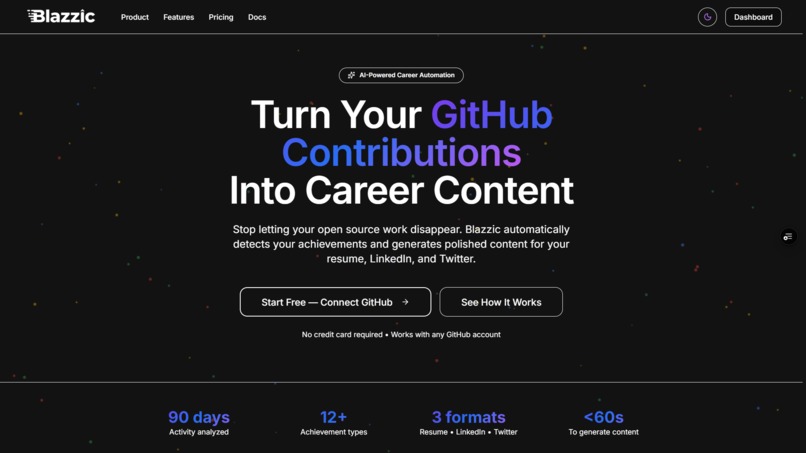
Work → Content → Visibility. Zero effort.

Blazzic
Inspiration
Every developer ships meaningful work daily — merged PRs, bug fixes, open-source contributions, feature launches — but almost none of it gets the visibility it deserves. We noticed a massive gap: developers are great at building, but terrible at self-promotion. Tweets never get written, LinkedIn stays stale, and resumes remain vague.
We asked ourselves: what if your GitHub activity could speak for itself?
That question became Blazzic — a platform that turns the work you're already doing into the visibility you're not getting.
What it does
Blazzic connects to your GitHub account, automatically detects meaningful achievements (PRs merged, repos created, impactful commits), and uses AI to generate platform-optimized content — Twitter posts, LinkedIn updates, and quantified resume bullets — all from real activity.
But it doesn't stop at generation. Blazzic publishes for you. Users can post immediately or schedule content for later. A database-backed async job queue processes scheduled posts reliably with retry logic and exponential backoff.
Key features:
- GitHub Sync — Detects achievements from commits, PRs, and repos with an intelligent scoring system
- AI Content Generation — Uses Google Gemini to craft platform-specific posts with proper character limits and tone
- One-Click Publishing — Post directly to Twitter via OAuth 1.0a integration
- Scheduling Engine — BullMQ-powered async job queue for reliable scheduled posting
- Dashboard — Real-time stats, activity stream, usage tracking, and achievement management
- Portfolio — Public-facing page showcasing your achievements and published content
- Freemium Model — Usage tracking with free/pro tiers and Stripe-ready billing
How we built it
Frontend & Backend: Next.js 16 with App Router, TypeScript, and Tailwind CSS. The entire app is a single full-stack deployment on Vercel with server components and API routes.
Database: PostgreSQL (via Neon/Supabase) with Prisma ORM. The schema covers 12 models spanning auth, achievements, content lifecycle, scheduling, social connections, usage tracking, subscriptions, and sync history.
AI Engine: Google Gemini 2.5 Flash powers the content generation pipeline. A custom AIAgent class handles the full workflow — analyzing GitHub data for shareability, scoring activities, and generating platform-specific posts with character limit validation.
Auth: NextAuth.js v5 with GitHub OAuth for login and Twitter OAuth 1.0a for social posting. Separate SocialConnection model stores platform tokens independently from auth accounts.
Job Queue: BullMQ with Redis (via ioredis) for reliable async post scheduling. Jobs include priority levels, retry logic with exponential backoff, and full status tracking (pending → queued → processing → published/failed).
UI Components: Radix UI primitives with custom styling — progress bars, popovers, selects, radio groups — all wrapped in a polished, dark-mode-first design with glassmorphism effects and gradient animations.
Challenges we ran into
Twitter OAuth Migration — We initially built with OAuth 2.0 PKCE but had to migrate to OAuth 1.0a mid-development due to API access tier limitations. This required restructuring token storage and the entire posting flow.
AI Rate Limiting — Gemini's free tier has strict rate limits (5 requests/minute). We had to implement 13-second delays between API calls and carefully batch multi-platform generation to avoid hitting limits.
Content Character Limits — Each social platform has different limits (Twitter: 280, LinkedIn: 3000, Instagram: 2200). Getting the AI to consistently respect these while maintaining quality required iterative prompt engineering and fallback truncation logic.
Job Queue Reliability — Building a durable scheduling system that handles failures gracefully, supports retry with backoff, and maintains idempotent execution was a significant engineering challenge.
GitHub Data Normalization — GitHub's API returns data in varied formats across commits, PRs, issues, and repos. Normalizing this into a consistent achievement model with meaningful scoring required careful schema design.
Accomplishments that we're proud of
- End-to-end automation — From GitHub activity detection to published tweet, the entire pipeline works without manual intervention.
- Production-grade job queue — BullMQ-powered scheduling with priority, retry, backoff, and full observability. Not a toy cron — a real async processing system.
- Intelligent achievement scoring — The AI doesn't just dump all activity. It analyzes, scores, and surfaces only the most impactful work worth sharing.
- Clean, premium UI — Glassmorphism, gradient animations, dark mode, and responsive design. The dashboard feels like a polished SaaS product, not a hackathon prototype.
- Freemium architecture — Usage tracking, subscription tiers, and Stripe-ready billing built into the data model from day one.
What we learned
- OAuth is deceptively complex — Especially when migrating between auth flows mid-project. Token management, scopes, and refresh logic differ wildly between providers.
- AI prompt engineering is iteration-heavy — Getting consistently formatted, platform-appropriate output from LLMs requires extensive prompt tuning and validation layers.
- Full-stack TypeScript is powerful — Sharing types between Prisma models, API routes, and React components eliminated entire categories of bugs.
- Job queues need more than just scheduling — Idempotency, observability, graceful failure handling, and backoff strategies are what separate a reliable system from a fragile one.
- Developer branding matters — Building this product reinforced just how much career-impacting work goes undocumented. The problem is real.
What's next for Blazzic
- LinkedIn Posting — Extend the publishing engine to support LinkedIn's API for professional content distribution
- Analytics Dashboard — Track post performance, engagement metrics, and growth trends across platforms
- Smart Scheduling — AI-powered optimal posting times based on audience engagement patterns
- Team Support — Allow engineering teams to collectively showcase their work and achievements
- Notifications — Email and in-app alerts for new achievements detected and post performance updates
- Portfolio Enhancements — Custom themes, domain mapping, and embeddable achievement widgets
- More Platforms — Instagram, Dev.to, Hashnode, and Medium integration for maximum developer reach
Built With
- automations
- nextjs
- react
- saas
- typescript


Log in or sign up for Devpost to join the conversation.