-
-
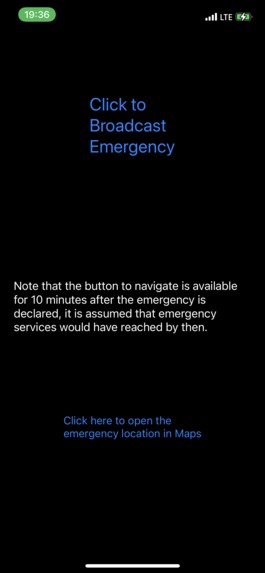
Basic UI of the app
-
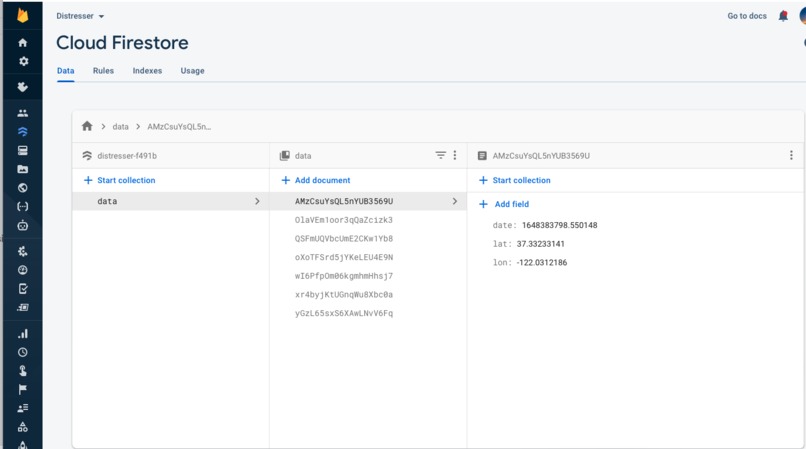
Data pushed to the firebase Firestone database
-
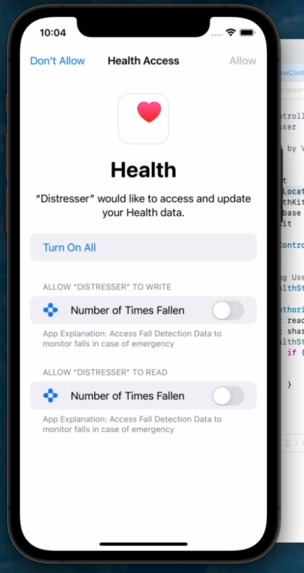
Requesting permission to access Health Data (Fall count)
-
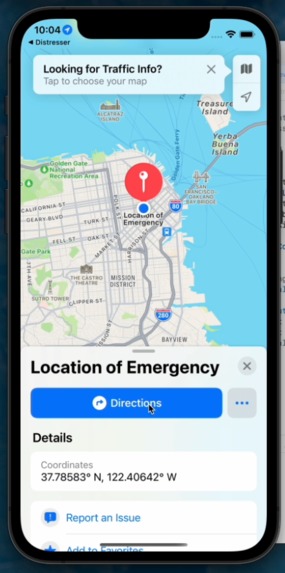
Navigating to the location of emergency


Inspiration
While brainstorming for ideas, we discovered that there’s an ample amount of data that our smartphones and watches collect. Being a strong believer in humanity, we believe a lot of the emergencies can be attended to faster if the people in the vicinity are notified. Medical professionals refer to golden hour as the period immediately after traumatic injury or emergency, the chances of survival are maximum. We believe that our application will make it easier and faster for volunteers to attend to the emergency. There are a wide array of other uses of this application. Suppose a group of people are camping out in the wild. If one of the person is in emergency, immediately their friends will be notified and their location will be shared, not only with the people close by, but also with the first responders, enabling that person to get help as soon as possible. There is no scaled up app available in India.
What it does
Our application, which was made in the last 2 days, has a broadcast emergency button where the location and time of the emergency is pushed to the backend servers (we’re using firebase). The responder can simply see that emergency was declared and navigate to the exact spot using Apple Maps, natively. There’s a 10 minute response time, after which we assume the emergency is taken care of. This is done so that other responders’ time and effort is directed towards other newer emergencies. We are also working on the feature which will notify the responders’ who are only within a 5 kilometer radius.
How we built it
We started by creating an iOS app project in XCode and connecting it to a backend project using Firebase. We made use the Apple HealthKit APIs to produce the number of times the iPhone user has fallen. We’ve included a detailed reason as to why we had to choose this approach. We also used Apple’s CoreLocation module’s APIs in order to fetch the precise location, accurate to a meter of the user. We uploaded this data -- in the form of latitude & longitude and data & time -- to Firebase using their APIs. This allowed us to share this crucial information at very low latency with the first responders who can navigate to the location with the help of Apple Maps. To implement this, we used Apple’s MapKit APIs to navigate to the location, natively.
Challenges we ran into
Our initial plan was to build this product wifi independent ie., using Bluetooth. Unfortunately, due to learning curves and time constraint, we were unable to do so. We also planned to make a separate responders’ app which sent push notifications, however, we were unable to do so since that requires an entitlement from Apple, which is only available to those who are enrolled in Apple Developer Program (costing around USD $100 per year). For the same reason, we weren’t able to make a separate apple watch app (as we planned earlier) to make use of CMFallDetectorManager as it requires the same aforementioned entitlement.
Accomplishments that we're proud of
We were quite frankly surprised with our ability to churn out such an app, albeit a crude one. The challenges aforementioned were supposed to be the backbone of our app, but thanks to a couple of amazing sessions of brainstorming, we were able to overcome some of the challenges. Although our team does have some experience in building an iOS app, this was the first time we made use of the UIKit and new APIs. This gave us a lot of insight into how one app is integrated with other apple services and how a full-fledged application is built. This is our first hackathon and we put all our efforts over this weekend into it and glad we got such an opportunity from the University of Windsor and MLH.
What we learned
We learned how to work in a team, efficiently and voicing our concerns whenever necessary and realized the importance of brainstorming sessions. We gained a lot of exposure about using not only 3rd party APIs, but also Apple’s services as we made use of CoreLocation and HealthKit. We saw a glimpse of iOS app development and loved every bit of it.
What's next for Distresser
One of the first things to do is to work on the challenges, which requires learning about the Bluetooth’s environment and Apple’s API for the same. When we are confident, we will enroll in the Apple’s Development program to implement the changes and share our idea with the world. Once that’s done, we’ll roll out this app as an alpha and then beta release to test it, before publishing it in the App Store.


Log in or sign up for Devpost to join the conversation.