-
-
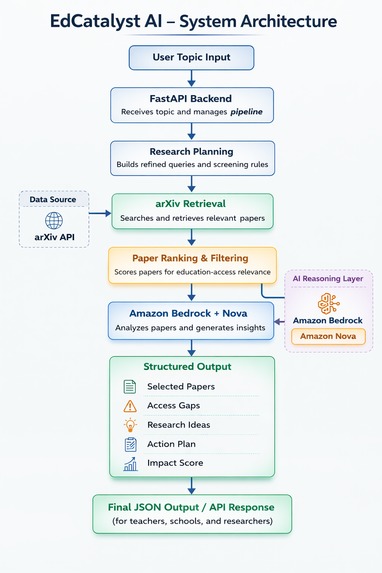
EdCatalyst AI System Architecture
-
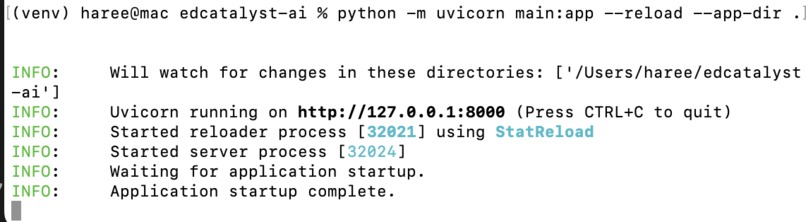
Running the FastAPI backend for EdCatalyst AI
-
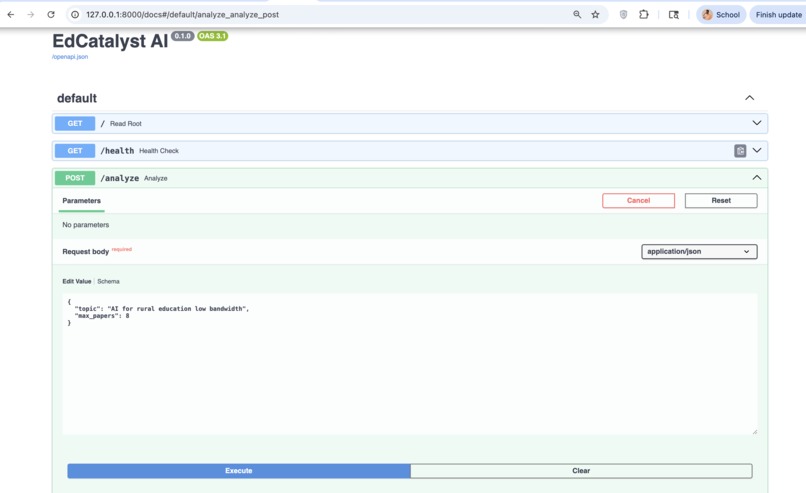
API interface for analysing education research topics
-
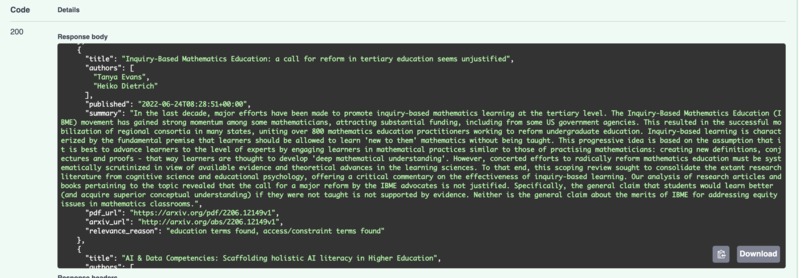
EdCatalyst AI automatically retrieves and filters relevant research papers related to the topic.
-
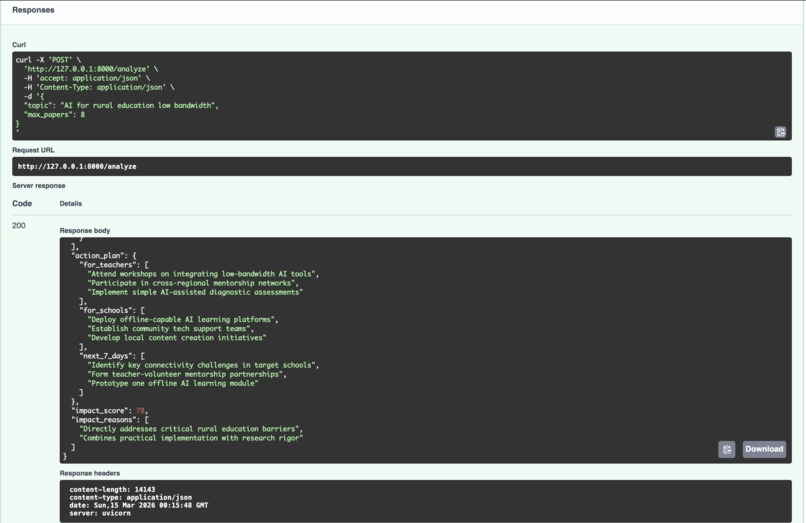
AI-generated educational insights and action plan


Inspiration
The inspiration for EdCatalyst AI came from conversations with my mom, who has been working in the education system for more than 35 years and currently serves as the principal of a government school in India.
While discussing how technology is changing education, she mentioned that although AI tools exist, they are rarely used in her school for actual teaching purposes. Many students are also not very tech-savvy, and teachers often rely on traditional teaching materials. Another challenge is the difference in resources between private and government schools. Private schools often have access to better tools, infrastructure, and training, while government schools have far fewer resources.
This made me think about how AI could actually help teachers in these environments instead of adding complexity. I wanted to build something that could take the knowledge from AI research and translate it into practical insights that teachers can apply in their classrooms, especially in schools with limited resources.
EdCatalyst AI was created with the idea of making AI-driven educational insights more accessible and useful for educators in government schools.
What it does
EdCatalyst AI analyses research papers related to AI and education and converts them into practical insights that teachers and schools can use.
The system retrieves relevant research papers, analyses them using AI, and produces: -Key access gaps in education systems -Research ideas that could improve learning outcomes -Actionable strategies for teachers -Recommendations for schools -A potential impact score for the proposed solutions
Instead of expecting teachers to read complex research papers, EdCatalyst AI summarises and translates research into practical guidance that educators can apply in real classroom environments.
How we built it
EdCatalyst AI was built using a combination of research retrieval and AI reasoning.
The backend was developed using Python and FastAPI, which handles the main API endpoint for analysing education topics.
The system retrieves research papers from arXiv based on a given topic and filters them for relevance. These papers are then processed using Amazon Bedrock, specifically Amazon Nova, to analyse the research and generate structured outputs such as access gaps, research opportunities, and action plans.
The pipeline includes: -Query generation for research retrieval -Paper ranking and relevance scoring -AI-driven analysis of research content -Structured JSON outputs that generate actionable insights
This architecture allows the system to automatically turn research papers into practical educational recommendations.
Challenges we ran into
One of the biggest challenges during development was debugging the pipeline and managing the integration between different components.
Working with AWS services and AI models required careful configuration of credentials, model access, and inference settings. At several points, issues like expired tokens, model invocation errors, and formatting problems in AI responses caused the system to break.
Another challenge was maintaining momentum during development. Each time I resumed working on the project, I had to restart the environment and trace issues through multiple layers of the pipeline.
Despite these challenges, solving these problems helped improve the reliability of the system and provided valuable experience in working with AI infrastructure.
Accomplishments that we're proud of
One of the accomplishments I’m most proud of is successfully building a working pipeline that can retrieve academic research and convert it into actionable educational insights.
Integrating Amazon Nova through AWS Bedrock and generating structured outputs from research papers was a major milestone for the project. Seeing the system finally produce meaningful analysis and recommendations from real research papers was extremely rewarding.
Completing this project within the time constraints of a hackathon while building the full analysis pipeline was also a significant achievement.
What we learned
Through this project, I learned several important concepts related to building AI-powered systems.
I gained hands-on experience working with large language models and structured outputs, as well as integrating AI models through AWS Bedrock. I also learned how to build a research retrieval pipeline using APIs and process academic content programmatically.
Most importantly, this project showed me how AI can be applied not just for building new tools, but for translating complex knowledge into something practical and useful for real-world users.
What's next for EdCatalyst AI
The next step for EdCatalyst AI is to expand its usability for real educators.
Future improvements include: -Deploying the system so teachers can access it easily online -Adding multilingual support so educators in different regions can use the platform -Improving the analysis pipeline to generate more context-aware recommendations -Exploring ways to integrate the system with existing school workflows
The long-term vision is to create a tool that helps bridge the gap between educational research and classroom implementation, making AI insights accessible to educators everywhere.


Log in or sign up for Devpost to join the conversation.