-
-
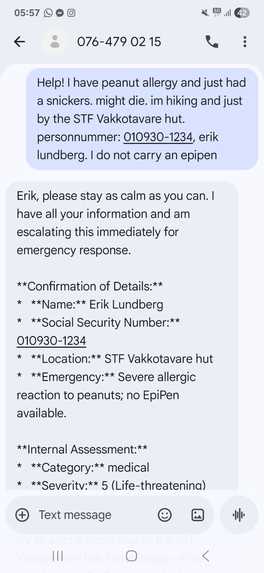
You eat a snickers but realize you're allergic to snickers and that you'reabout to die
-
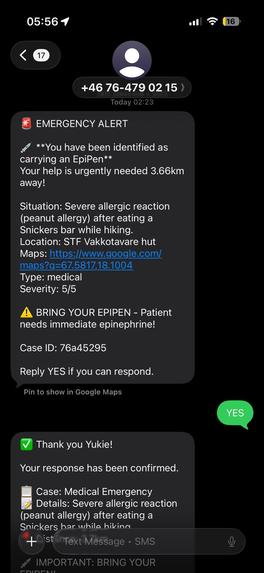
Good samaritan carrying an Epipen responds to a request
-
-
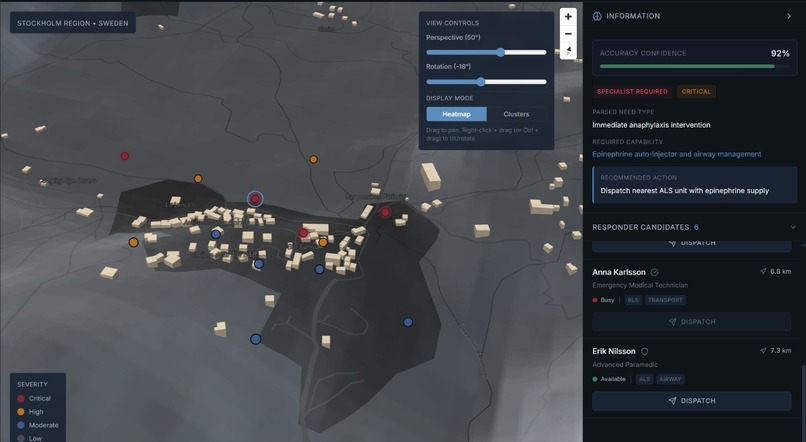


Note our team is called "Skynet" in the hackeurope dashboard
HermesOS: AI powered Operating System for Disaster Response
In the wake of natural and manmade disasters blizzards, tsunamis, or wildfires critical infrastructure is often the first thing to fail. When the internet goes dark, communities are left isolated. While traditional emergency services (911/112) exist, they are frequently overwhelmed or physically unable to reach victims, leaving a massive gap in immediate, life-saving resource distribution.
In crises and remote parts of the world internet data is often not available, with SMS and Voice call being the only available, reliable options, our platform uses Ethical AI agents to orchestrate a peer-to-peer support network, autonomously matching urgent requests for medicine, fuel, or shelter with people who can help and resources. Note that this is not a complement to emergency services, but an extension: it provides professional operators with real-time ground-truth insights and heatmaps of community needs, allows them to send hyper-local emergency notifications, and enables them to manually override AI assignments to prioritize life-critical cases. By resolving low-level logistical needs through community-led aid, the OS clears the "noise" for official responders, ensuring that professional resources are reserved for the most dire emergencies while the community sustains itself through intelligent, AI-guided coordination.
How We Built It
- AI Agent: LangChain + Gemini API. Handles peer-to-peer case creation, assignment, and arbitrary workflow handling.
- Backend: FastAPI (Python) with Twilio for inbound/outbound SMS, signature validation, and a workflow bridge that forwards normalized events to an AI agent endpoint.
- Database: Supabase (PostgreSQL) for managing cases, events, messages, resources, specialties, and users. Vector embeddings (1536-dim) power semantic search over events.
- Frontend: React + Vite, Tailwind CSS, and shadcn/ui, featuring type-safe API client generation via OpenAPI (Orval).
- Infrastructure: Docker, AWS ECR, and CloudFront for deployment. Utilizes migrations and environment-based configurations for local and cloud parity.
Note: The AI agent is intentionally decoupled; classification and broadcast logic sit behind a simple JSON webhook contract, allowing the core platform to remain stable while the AI evolves.
Challenges We Ran Into
Integrating Twilio, Elevenlabs, Gemini, Langchain, Python packaging, Twilio text, Twilio audio, AWS, Terraform, Supabase
Accomplishments We're Proud Of
AI agents is saving lives!!
What We Learned
- Twilio is doesn't work with UK numbers and is VERY expensive 1. Erik bought a Swedish burner sim card for Tom and 2. we have poured 50 USD into the API credits .
What's Next for HermesOS
- Advanced AI Logic: Fully implement classification, peer-matching, and broadcast logic behind the existing bridge.
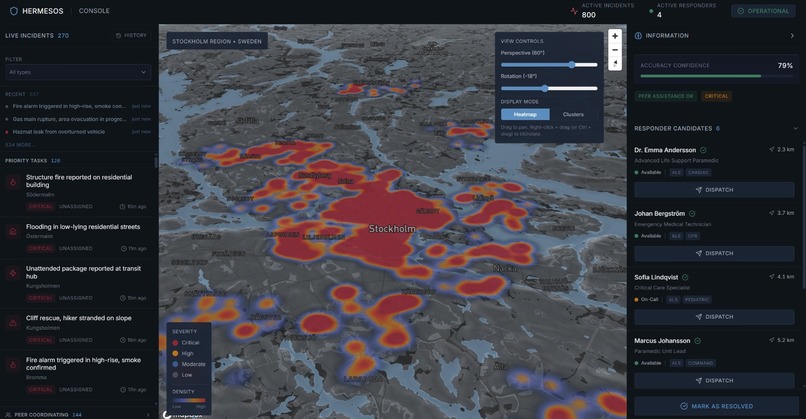
- Command Dashboard: A map-based UI featuring message locations, problem heatmaps, and active case management.
- Voice Integration: Expanding the Twilio stack to include voice-to-text support for landline users.
- Geo-fenced Notifications: Operator-triggered broadcasts targeting specific geographic coordinates.
- Human-in-the-Loop UI: A manual override interface for emergency operators to prioritize cases when AI suggestions require human judgment.
Built With
- amazon-web-services
- elevenlabs
- gcp
- twilio


Log in or sign up for Devpost to join the conversation.