-
-
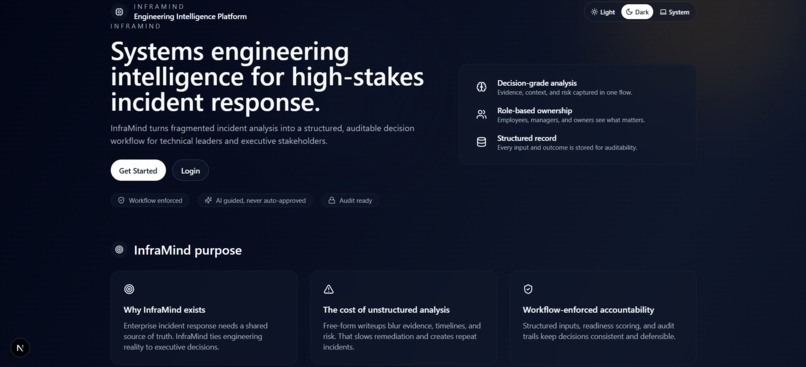
Home Page
-
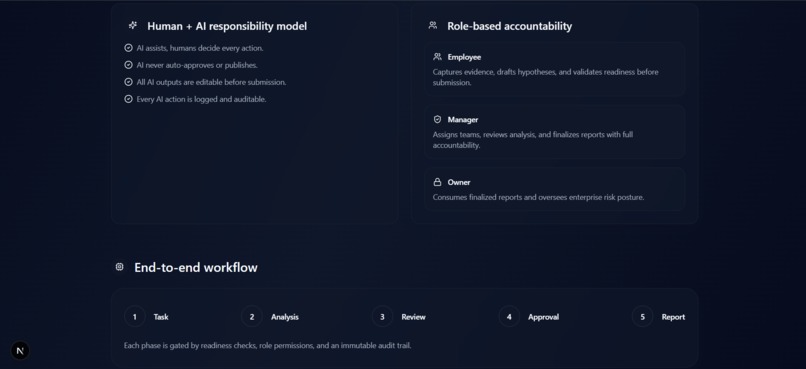
Landing Page Information about InfraMind
-
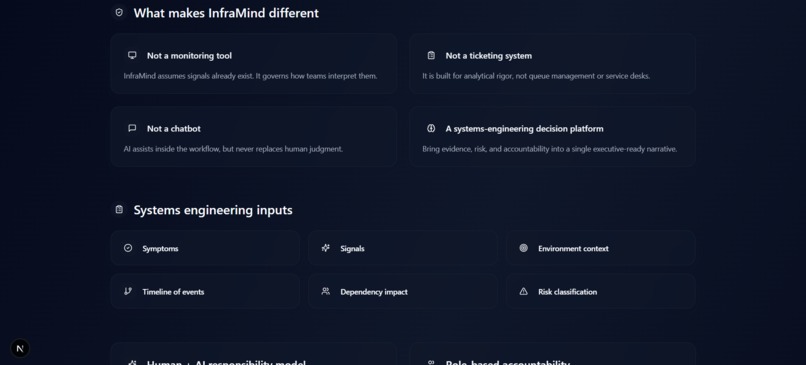
Landing Page Information about InfraMind
-
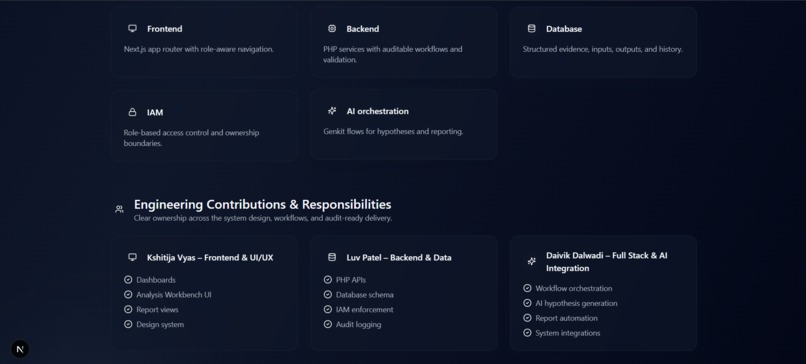
Landing Page Information about InfraMind
-
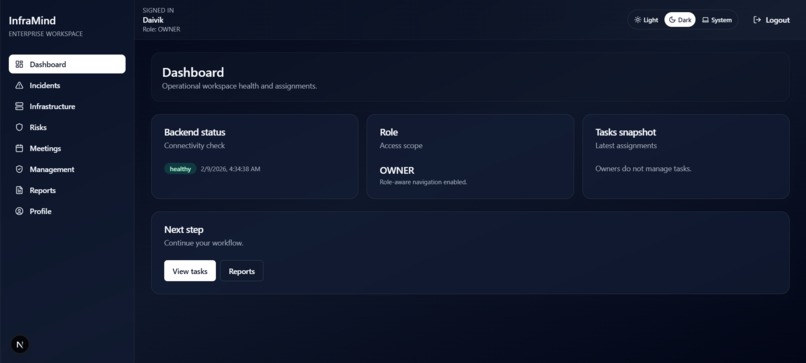
Owner's Dashboard
-
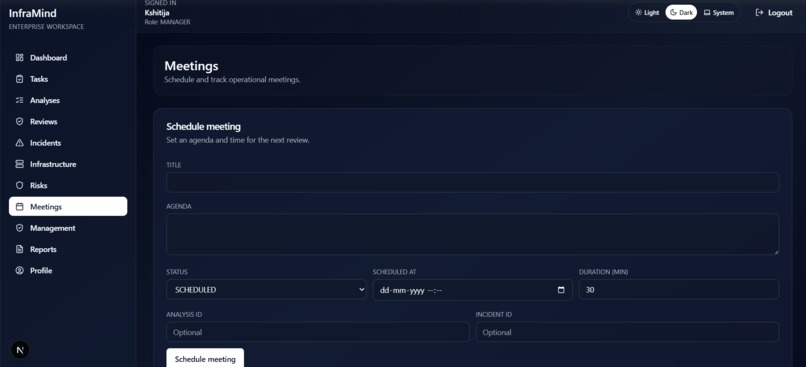
Schedule Meeting
-
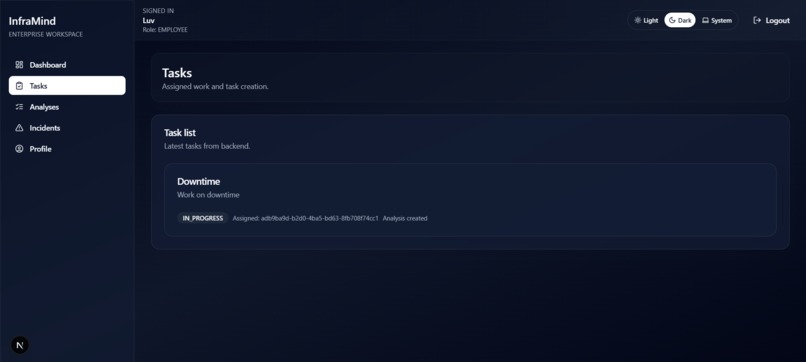
List of Task
-
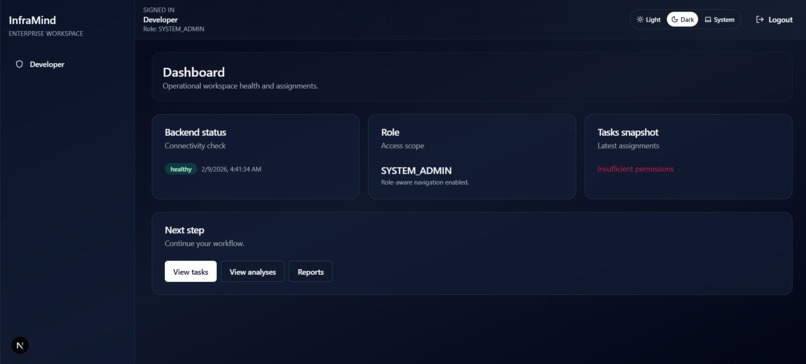
Developer Dashboard
-
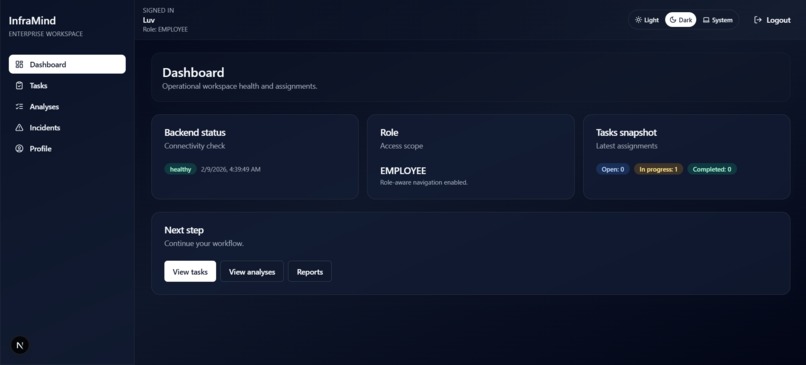
Employee Dashboard
-
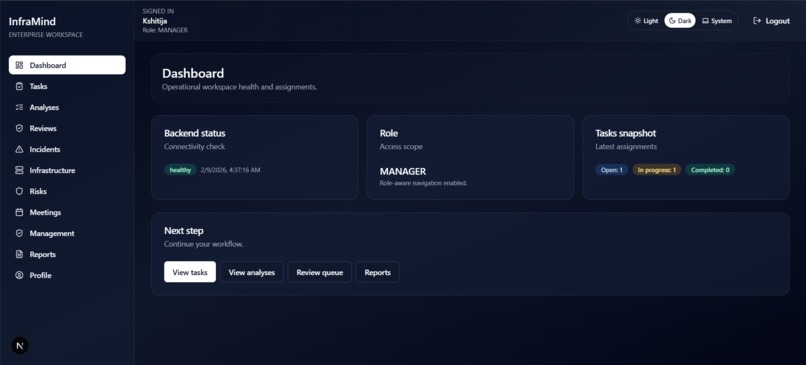
Manager's Portal
-
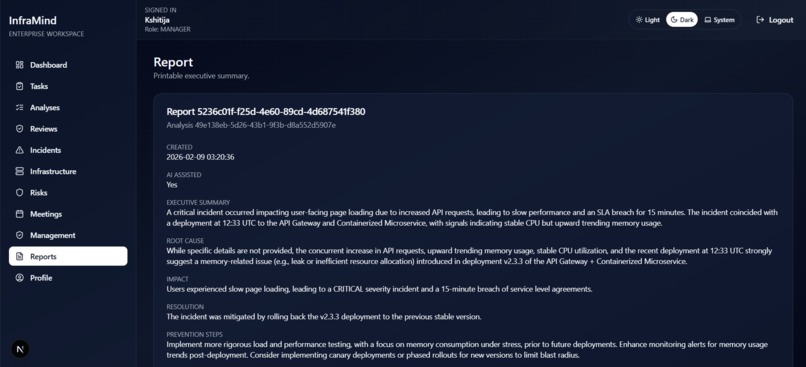
View Generated Report
-
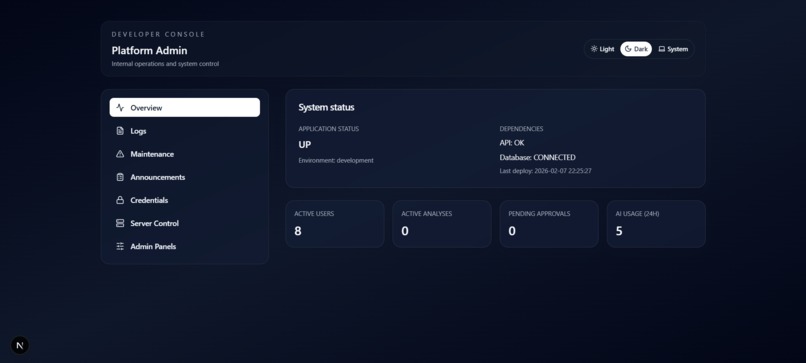
Developer Console/Admin Panel


Inspiration
Modern engineering teams handle incidents and system failures under immense pressure, yet the analysis process itself is often unstructured, inconsistent, and difficult to audit. Root cause analyses frequently depend on individual experience rather than a shared, disciplined framework, and the final reports rarely capture the full reasoning that led to decisions.
At the same time, generative AI is increasingly being applied to operational workflows — but often in ways that remove human accountability instead of reinforcing it.
InfraMind was inspired by a simple question: What if AI could assist systems engineers without replacing judgment, and workflows could enforce engineering discipline instead of bypassing it?
We wanted to build a platform that feels like a real internal tool used by SREs, managers, and technical leadership — not just a demo.
What it does
InfraMind is an AI-assisted systems engineering and incident analysis platform designed around real-world workflows and accountability.
It enables teams to:
- Create and assign incident analysis tasks.
- Perform structured investigations using systems-engineering inputs (symptoms, signals, timelines, dependencies, risk).
- Generate AI-assisted hypotheses and analysis summaries without auto-decisions.
- Enforce a strict review and approval workflow.
- Produce executive-ready reports for leadership.
- Maintain full auditability of every action and state transition.
The platform supports multiple roles:
- Employees perform analyses.
- Managers review, approve, and generate reports.
- Owners view finalized executive reports only.
- Developers/System Admins manage platform operations through an internal console. ## How we built it InfraMind uses a production-style, layered architecture:
Frontend
- Next.js 16 (App Router) with TypeScript.
- Server Actions for all state transitions.
- Tailwind CSS + shadcn/ui with glassmorphism design.
- Role-aware UI with dark/light/system theme support.
Backend
- PHP 8.2 MVC REST API.
- JWT-based authentication and RBAC enforced server-side.
- SQLite by default (MySQL/Postgres supported).
- Explicit services, repositories, and controllers.
AI
- Genkit orchestrating calls to Google Gemini (gemini-2.5-flash).
- AI runs server-side only.
- All AI outputs are strict JSON, schema-validated, and human-reviewed.
- AI assists analysis but never submits or approves work.
Core Design Principles
- Backend is the source of truth.
- All workflow state changes are auditable.
- AI assists, humans decide.
- No critical logic runs on the client. ## Challenges we ran into One of the biggest challenges was balancing AI capability with accountability. It was tempting to let AI auto-generate conclusions, but that would undermine trust and realism. We instead designed AI as a constrained assistant that works only on structured inputs and never bypasses human review.
Another major challenge was enforcing strict role-based access control across a multi-stage workflow while keeping the UI intuitive. Owners, for example, must never see raw analysis data — only finalized reports — which required careful backend enforcement.
Finally, migrating from rapid prototyping to a fully integrated, production-style system required discipline: cleaning unused code, enforcing canonical types, validating every API path, and ensuring frontend and backend stayed perfectly in sync.
Accomplishments that we're proud of
- Building a realistic incident analysis workflow that mirrors how professional SRE teams work.
- Designing responsible AI integration that enhances, rather than replaces, engineering judgment.
- Implementing strict RBAC and audit trails across all actions.
- Delivering a developer/admin console with maintenance mode, announcements, and system controls.
- Achieving a clean separation of concerns between frontend, backend, database, and AI layers. ## What we learned We learned that:
- AI is most powerful when it is constrained and contextual.
- Workflow design is just as important as model quality.
- Enterprise credibility comes from rules, logs, and enforcement, not flashy features.
- Treating a hackathon project like production software leads to better technical decisions.
Clear ownership and role separation dramatically improve system clarity.
What's next for Infra-Mind
Future improvements include:
Deeper AI reasoning over historical incidents.
Integration with real observability tools (logs, metrics, traces).
Advanced risk scoring and trend analysis.
Policy-driven compliance reporting.
Multi-organization support with stronger isolation. InfraMind is designed to grow into a full decision-support platform for systems engineering, not just an incident tracker.
Built With
- composer
- css
- environment-based-configuration
- eslint
- gemini
- genkit
- google-cloud
- immutable-audit-logs
- json-based-api-contract
- jwt-authentication
- mysql
- next.js
- node.js
- npm
- phpmyadmin
- phpstan
- phpunit
- radix
- react
- restful-api-design
- role-based-access-control
- server-side-ai-execution-only
- server-side-authorization-enforcement
- shadcn/ui
- sql
- sqlite
- tailwind
- typescript
- visual-studio


Log in or sign up for Devpost to join the conversation.