-
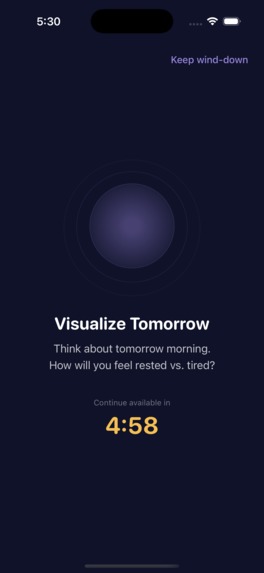
Mindfulness Minutes- If you're thinking of disabling the application, you'll be directed to wait and make sure your decision is aligned
-
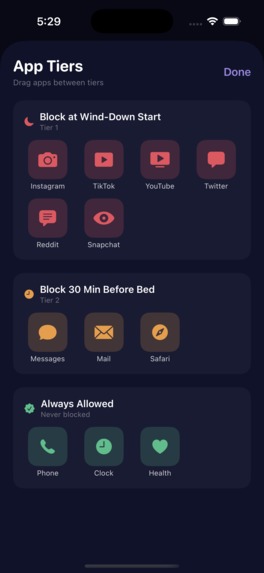
App Tiers - Some apps are more distracting than others so apps disabling works in waves from most to least
-
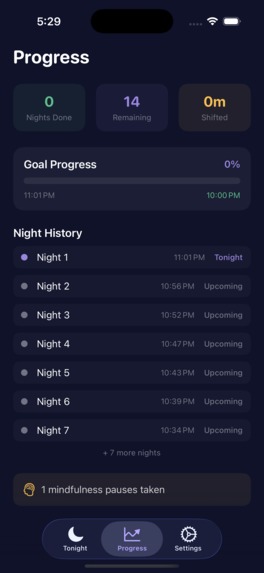
Progress Tracking - Keep track of how your sleep is improving over the days
-
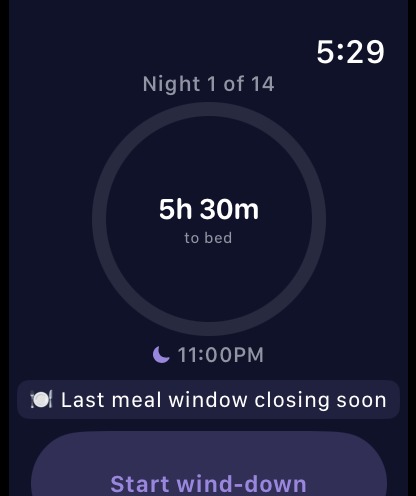
Apple Watch Connectivity - Keeping you in Check on the Go!


Inspiration
If you're anything like me, you've probably told yourself "just one more scroll" at midnight, only to wake up groggy, reach for your phone, and repeat the cycle the next night. I've known for years that my sleep was broken — I just never had a system that made fixing it feel achievable. Most sleep apps tell you how badly you slept. MoreSleep asks a different question: what if your phone actively helped you sleep earlier, one night at a time? The insight was simple: your bedtime doesn't move by an hour overnight. It moves in 15-minute increments, compounding over a week. MoreSleep is built around that rhythm — a gradual, science-backed wind-down system that works with your device instead of fighting it.
What it does
MoreSleep shifts your bedtime forward by 15 minutes each night until you hit your goal. You set your target — say, moving from midnight to 10:30 PM over 7 days — and the app takes it from there. Every evening, a precision notification timeline fires working backwards from your target bedtime: a meal cutoff reminder at 3 hours out, a hydration cutoff at 2.5 hours, a lighting switch prompt at 2 hours, a screens-off alert at 1 hour, and a final wind-down cue 15 minutes before bed. Every single notification is anchored to peer-reviewed research — users can tap "Why?" on any alert to read the science behind it, including cited studies from journals like PNAS, Nutrients, and the Journal of Clinical Sleep Medicine. The Tonight screen shows a live countdown to your target bedtime alongside a wind-down checklist. If life gets in the way, a single "Snooze wind-down 30 mins" button is right there — no guilt, no friction. Deep links guide you through enabling Night Shift and Sleep Focus directly from the app, so the setup that usually stops people never gets the chance to
How we built it
MoreSleep is a native Swift app built around three coordinated layers. The scheduling engine lives in AppStore.swift, which holds your bedtime goal and calculates each night's target using 15-minute rewind math. From that single source of truth, NotificationManager.swift pre-schedules an entire week's worth of notifications in one pass using UNUserNotificationCenter — eleven distinct alerts per night, each with a dynamically computed fire time relative to that evening's target bedtime. The onboarding flow in OnboardingView.swift keeps permission requests contextual and trust-building: notification access is requested only after explaining exactly what it's for, and Night Shift and Sleep Focus setup is handled through deep links rather than asking users to dig through Settings themselves. TonightView.swift drives the main loop — countdown timer, checklist state, and the snooze mechanism — while MoreSleepApp.swift ties notification permissions to app launch so nothing is deferred. The science layer was built in parallel: each notification carries a research payload linking its advice to specific studies, surfaced through a modal "Why?" sheet that cites authors, journals, and DOIs without overwhelming the user.
Challenges we ran into
The hardest problem was notification timing math. Scheduling eleven alerts per night across seven nights — each anchored to a different target bedtime — meant that a single calculation error would silently misfire for the rest of the week. We had to build the rewind logic carefully: compute tonight's target, derive every offset from it, and batch-schedule all 77 notifications atomically so there were no gaps or duplicates. The other tension was between science and usability. The research is genuinely compelling — late eating shifts your circadian clock by up to 1.5 hours, blue light suppresses melatonin by up to 85% — but burying users in citations on a phone screen at 9 PM defeats the purpose. Getting the "Why?" modal right required several iterations to land on something credible without being clinical.
Accomplishments that we're proud of
We're proud that every notification in MoreSleep is defensible. It isn't a generic "time to sleep!" push — it's a timestamped, study-backed intervention tied to a specific physiological mechanism. When the 8 PM alert fires, there's a reason it's 8 PM and not 8:30. We're also proud of how the gradual shift model feels in practice. Asking someone to move their bedtime by 15 minutes tonight is a completely different psychological proposition than asking them to fix their sleep. That reframe — small, compounding, achievable — is the real product.
What We Learned Building MoreSleep reinforced how much UX work goes into making correct behavior feel natural. The notification schedule is technically straightforward, but surfacing it in a way that feels supportive rather than nagging required rethinking every label, every timing, and every piece of copy. We also learned how much trust matters in health apps. Every "Why?" tap is a user asking: should I actually do this? Having a real answer — a named researcher, a journal, a year — makes the whole system more credible, and that credibility is what keeps users from dismissing the reminders after night two. The hackathon build is the core loop. The roadmap goes much deeper. HealthKit integration will replace the current goal-based model with real sleep data — actual sleep stages, HRV trends, resting heart rate, and blood oxygen — feeding a genuine sleep debt calculation instead of a projected one. Sleep Focus scheduling will move from a deep-link prompt to a programmatic activation, so the app sets tonight's Focus window automatically without any user action. Longer term, the Screen Time API unlocks app-blocking tierlists: users drag their installed apps into categories — block first, block 30 minutes before bed, always allowed — and MoreSleep enforces the schedule without requiring willpower. An Apple Watch companion would bring sleep debt and the bedtime countdown to the wrist, with gentle haptic alerts at wind-down start replacing the phone notifications entirely. The north star is a system where your devices have already begun winding down before you've consciously decided to. MoreSleep should be the infrastructure for that — invisible when things are going well, and a gentle nudge when they're not.


Log in or sign up for Devpost to join the conversation.