-
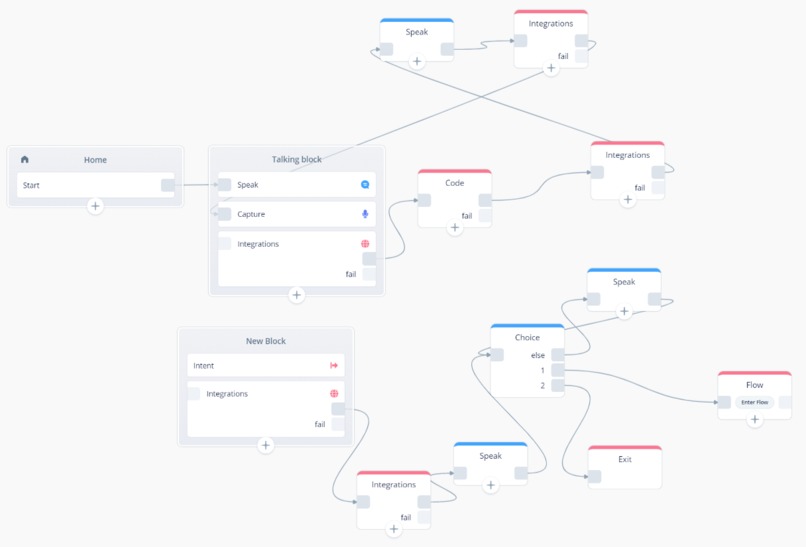
Voiceflow_Flow

Inspiration
There are millions of people in the world who struggle every single day with mental health issues. They are either too shy to talk to a therapist, cannot afford it or don't have the time for the same. Many of these people also struggle with making friends, and end up having no-one to talk to.
What it does
Ms. Rogers is a proactive listening bot aimed towards mental health. This bot is not designed to replace your therapist. It acts like a friend, and can listen to you when you need to talk to someone.
How we built it
Our aim was to reach out to as many consumers as possible. For this, we established 3 mediums of communications for our bot: 1) Google Home Devices 2) Amazon Alexa Devices 3) SMS messaging service (no data required) The bot operates via Voiceflow API that interacts with our Flask API Back-end. Our back-end performs Sentiment Analysis on the input data via IBM's Watson Tone Analyzer API, and then uses Machine Learning to provide appropriate responses to that input.
Challenges we ran into
The first challenge the team faced was the integration of multiple services into our back-end while still keeping the response times fast. This was solved by maintaining an external database that caches frequent responses and reduces the API calls made.
The second challenge we faced was to train our bot to act as a friend and not as a psychiatrist while still being able to carry on human-like conversations. This was resolved by using the IBM's Watson NLP API that gave us not only the sentiment scores but sentiment categories as well, which the bot then uses to decide the responses. However the bot is still unable to hold a conversation as it gets very toxic, needs a very large dataset of conversations, and needs plenty of learning. We are still far from passing the turing test.
Accomplishments that we're proud of
We were able to set up both SMS and voice controlled commands. We used ML and learned how to use IBM Watson. We have a working project!
What we learned
We learned that making a human chatbot that responds perfectly every single time (without a robust training model) is nearly impossible. It takes a lot of resources to make what we were trying to achieve, but at the end, we did come close to our desired target, and learned that working together as a team in harmony can solve a lot of unprecedented challenges!
What's next for Ms. Rogers
Ms. Rogers has a lot of potential as it can perform better than ever as it is trained more and more. Our next step would be to train Ms Rogers on full conversational datasets and then improve the quality of the responses.



Log in or sign up for Devpost to join the conversation.