-
-
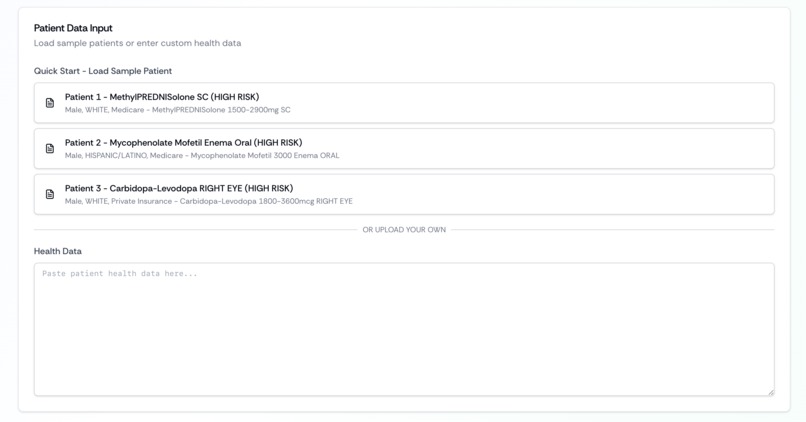
Patient Data Input
-
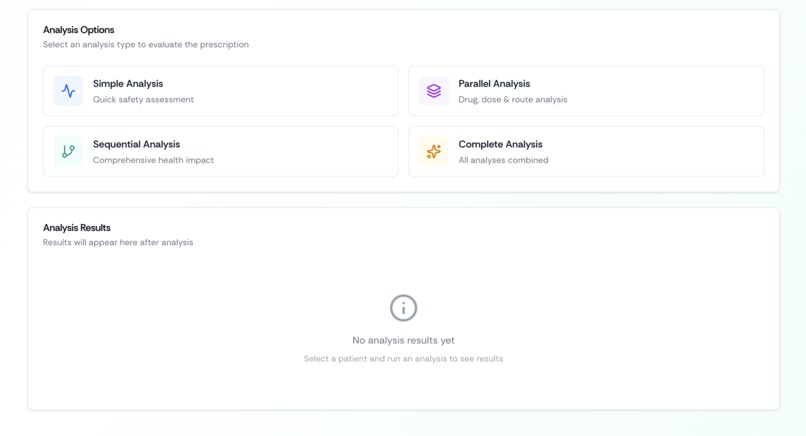
Analysis Options
-
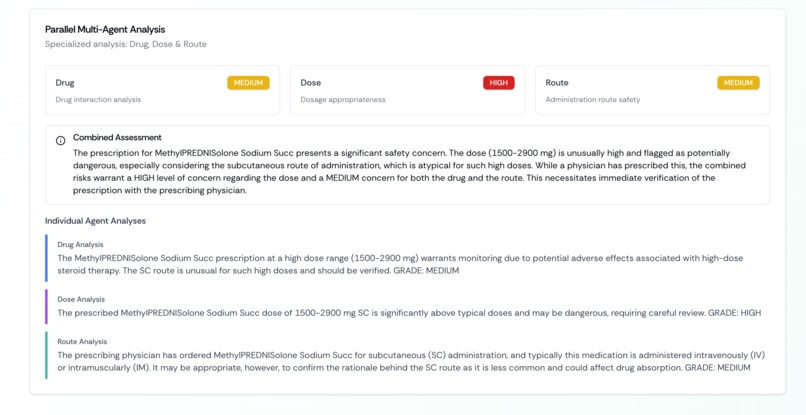
Analysis Results
-
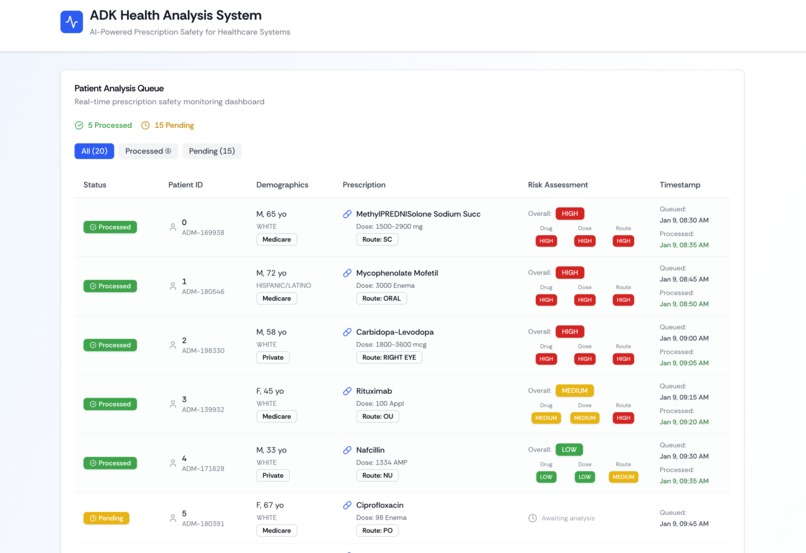
Dashboard
-
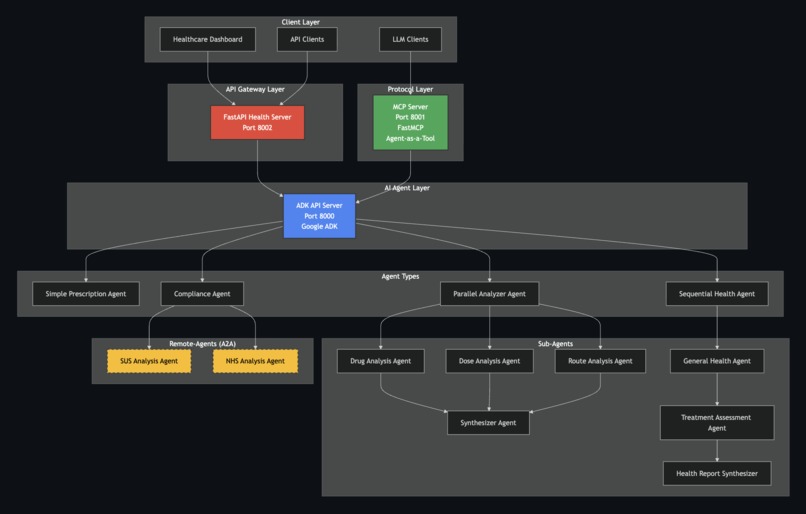
Architecture


Inspiration
In Brazil's public healthcare system, 1 in 8 patients receive dangerous drug combinations that could kill them. With 24.7 million Brazilians using programs like Farmácia Popular, we're talking about millions at risk. Healthcare professionals are overwhelmed, and the safety net that should catch these errors simply doesn't exist at scale. We built our ADK Health Analysis System to be that safety net - an AI-powered virtual pharmacist using Google ADK and Cloud Run that can analyze prescriptions in real-time and save lives.
What it does
Our system analyzes medical prescriptions in under 10 seconds using 5 specialized Google ADK agents. It detects dangerous drug interactions, validates dosing, checks administration routes, and ensures compliance with Brazilian SUS guidelines. When a prescription could harm a patient, healthcare professionals get instant alerts with specific recommendations. The system integrates with existing healthcare infrastructure through REST APIs and can scale to serve all 200+ million Brazilians.
| Agent | Type | Analysis Focus | Output |
|---|---|---|---|
| Simple Prescription | Single Agent | Overall safety assessment | overall_criticality (low/medium/high) |
| Parallel Analyzer | Parallel Multi-Agent | Drug interactions, dosing, routes | drug_criticality, dose_criticality, route_criticality |
| Sequential Health | Sequential Multi-Agent | Comprehensive health impact | Treatment duration, compliance risk, lifestyle impact, monitoring frequency |
| SUS Compliance | A2A Remote Agent | Brazilian public health compliance | overall_compliance, severity, issues, recommendations |
| NHS Compliance | A2A Remote Agent | UK NHS guidelines compliance | overall_compliance, severity, issues, recommendations |
How we built it
We created a microservices architecture on Google Cloud Run with 4 containers: ADK API Server for agent orchestration, MCP Server for protocol communication, FastAPI for REST endpoints, and A2A Server for remote compliance agents. Using Python 3.10 and Google ADK, we developed specialized agents for simple triage, parallel drug analysis, sequential health assessment, and SUS/NHS compliance validation. We validated the system using real medical data from the MIMIC-III dataset and Brazilian EHR data.
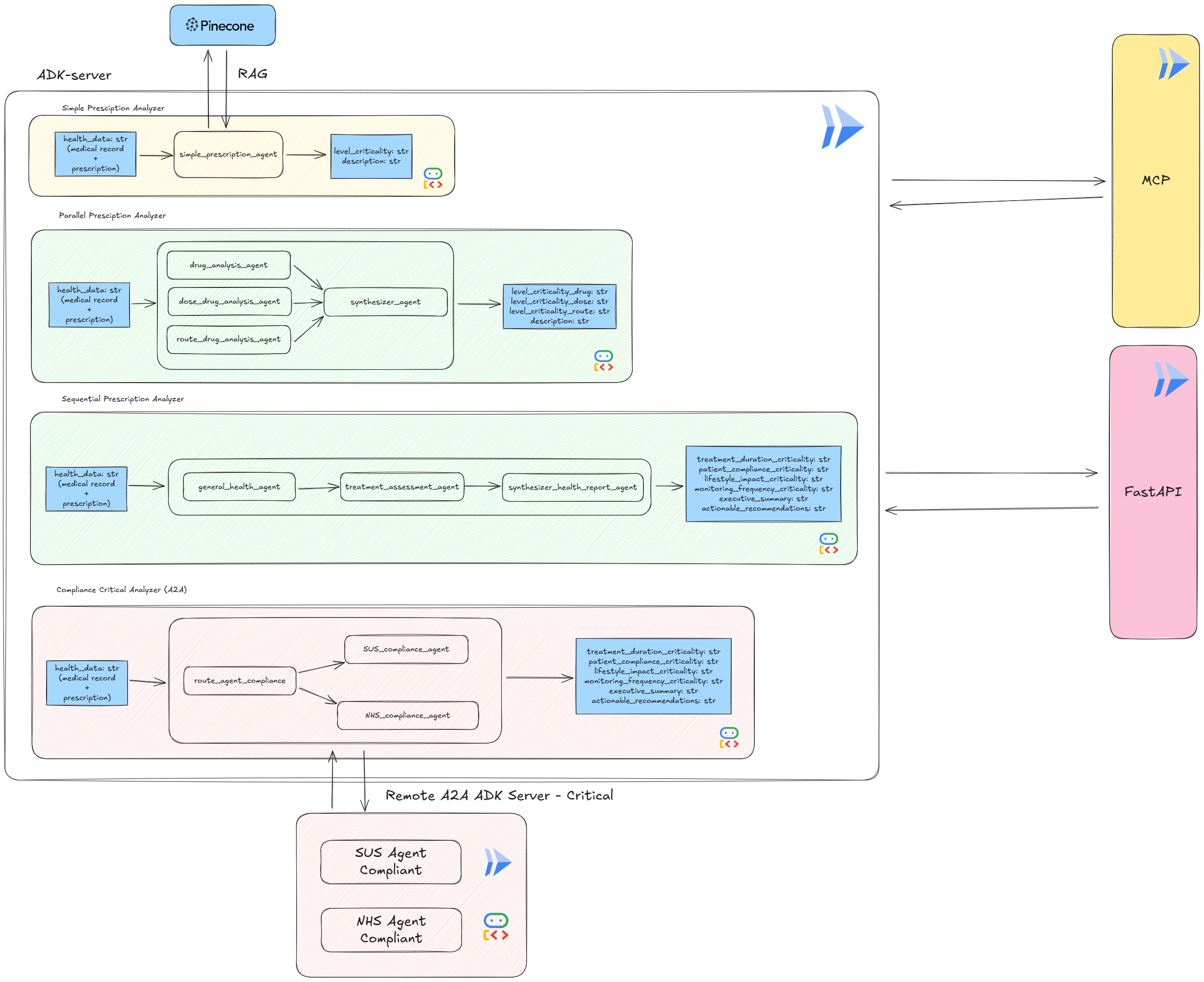 Complete system architecture showing the four Cloud Run services with specialized AI agents for prescription safety analysis
Challenges we ran into
The biggest challenge was understanding medical complexity - drug interactions, dosing calculations, and Brazilian healthcare regulations required extensive research. Coordinating 5 AI agents while maintaining sub-10 second response times was technically demanding. Implementing Agent-to-Agent communication for compliance validation was innovative but complex. Ensuring the system could handle national scale while maintaining clinical accuracy required careful architecture decisions and extensive testing.
Another major challenge was enabling all agents to serve any LLM client through the Model Context Protocol (MCP). This is a powerful capability because it allows us to centralize all the complex logic and medical knowledge base on our side (freeing clients from having to implement or maintain any of it themselves).
By building a unified “Health Agent Hub”, we created a scalable and interoperable layer that any user can access, whether through ChatGPT, Claude, or programmatically via Google’s ADK or LangChain. This means that developers, hospitals, or even patients can interact with our intelligent health agents without needing to implement any of the underlying healthcare logic or compliance mechanisms themselves.
Accomplishments that we're proud of
We built a production-ready system that can save millions Brazilian lives annually and prevent adverse drug events. Our Agent-to-Agent architecture for healthcare compliance is genuinely innovative. The system processes prescriptions in under 10 seconds, integrates with real medical data (MIMIC-lll, just for demonstration), and is already deployed on Google Cloud Run. We created comprehensive documentation and validated the platform with actual medical datasets, making it ready for immediate SUS deployment.
What we learned
Healthcare AI demands deep domain expertise, every technical decision carries life-or-death implications. Google’s Agent Development Kit (ADK) unlocked sophisticated multi-agent coordination that simply wasn’t possible before, while Cloud Run’s auto-scaling proved ideal for healthcare workloads with unpredictable demand.
We also learned how to design, orchestrate, and deploy intelligent agents at scale through the Model Context Protocol (MCP), making them instantly accessible to any LLM client (whether via ChatGPT, Claude, LangChain, or custom ADK integrations) without requiring complex healthcare logic on the client side.
Finally, working with real medical data reminded us how messy and nuanced it can be, demanding careful parsing, validation, and ethical handling. Above all, we confirmed that when applied thoughtfully, technology can truly save lives and drive systemic impact in public health.
What's next for NeroHelpSUS
We’re now ready to open NeroHelpSUS to the community, keeping the project active and evolving as an open, collaborative initiative. Our next steps focus on strengthening reliability, scalability, and security by increasingly leveraging Google Cloud’s infrastructure and services, ensuring that the platform can safely operate at national and eventually global scale.
In parallel, we plan to integrate classical machine learning layers (such as decision trees and supervised learning models) to complement our LLM-based agents. These models will serve as specialized analytical tools, enhancing precision in drug interaction detection, dosage validation, and patient risk prediction.
Our vision is to create a robust hybrid intelligence system (combining the interpretability of classical models with the reasoning power of large language models) to make prescription safety accessible, explainable, and reliable for healthcare systems everywhere.
Built With
- a2a
- adk
- cloud-run
- docker
- fastapi
- google-adk
- google-ai
- google-play
- langchain
- mcp
- mimic-3
- python


Log in or sign up for Devpost to join the conversation.