-

Hero page
-
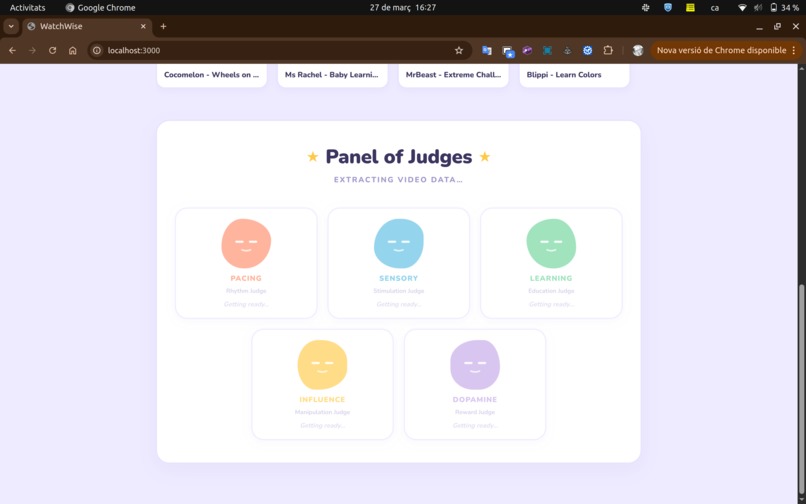
Judges thinking...
-
Logo
-
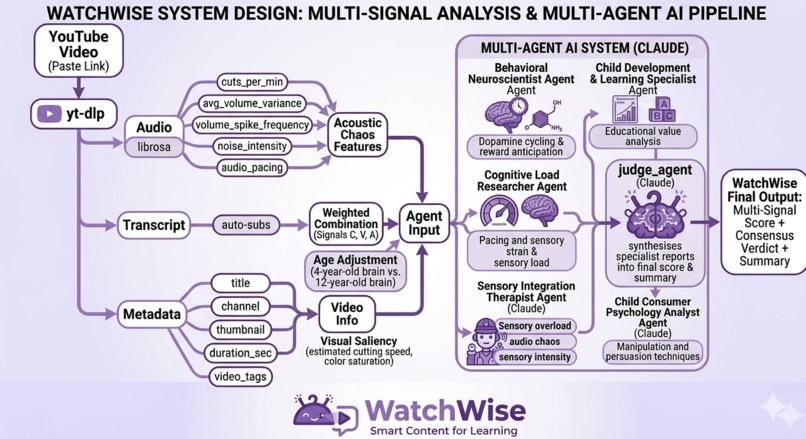
System Design
-
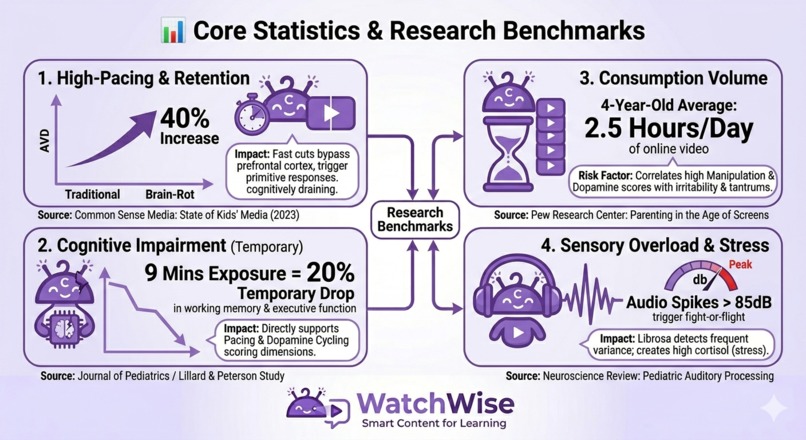
Stats


About the Project
Do you find yourself watching hours of fast-paced, sharply edited videos on social media that feel like “brain rot”? You’re not alone. Oxford’s Word of the Year 2024: “brain rot” shows that this is now a mainstream concern, and research confirms it: excessive media use can contribute to cognitive declines, make it harder to concentrate, and leave viewers feeling overloaded.
Our tool lets parents paste a video link and instantly see how cognitively demanding that content really is for their child’s developing brain. Unlike traditional age ratings, we focus on the signals that matter:
- Cutting speed and pacing: how rapidly scenes change
- Audio chaos and sensory intensity: the noise, volume, and sensory load
- Manipulative reward tactics: tricks creators use to keep kids hooked
Scores are adjusted for age, because a 4-year-old’s brain and a 12-year-old’s brain process the same content very differently. Behind the scenes, our system downloads the video and runs it through a multi-signal analysis pipeline, weighting each signal and combining them into a single cognitive load score. That score is then age-adjusted and passed into our multi-agent AI system, which includes five specialist agents and one judge agent:
- Behavioral Neuroscientist: Dopamine cycling & reward anticipation
- Child Development & Learning Specialist: Potential educational deficits
- Child Consumer Psychology Analyst: Manipulation and persuasion
- Cognitive Load Researcher: Pacing and cognitive strain
- Sensory Integration Therapist: Sensory overload
The judge agent synthesises their analyses into a single, age-adjusted cognitive load score, giving parents a clear, nuanced view of how the content affects developing brains.
Our approach is grounded in research:
Dopamine cycling & variable reward schedules – Montague et al. (1996) showed dopamine neurons fire not just on reward delivery but on reward prediction, meaning the anticipation of the next cut or stimulus is itself neurologically activating. Schultz (1998) formalized the reward prediction error model: unpredictable rewards cause larger dopamine spikes than predictable ones, explaining why chaotic, fast-cut content is more engaging than steady content.
Developing brains & vulnerability – Casey et al. (2008) found that the prefrontal cortex, responsible for impulse control, is not fully developed until the mid-20s, leaving children and teens with immature inhibitory control over dopamine-driven urges. Spear (2000) found adolescent brains show heightened dopaminergic activity with weaker top-down regulation, making teens especially susceptible to reward-maximizing media.
Screen media & dopamine – Christakis et al. (2004) reported that every additional hour of TV per day at ages 1–3 increased attentional problems at age 7, with rapid scene changes proposed as the mechanism. Anderson & Pempek (2005) coined the “overstimulation hypothesis”: fast-paced media conditions developing brains to expect high stimulus density, making normal cognitive tasks feel unrewarding. Dong & Potenza (2014) found problematic media use shares neural substrates with substance use disorders, including reduced prefrontal control and sensitized dopamine pathways.
Social media & engineered reward cycles – Sherman et al. (2016) confirmed that viewing liked content on Instagram activated the nucleus accumbens in adolescents, showing that social media triggers the same dopamine circuits as primary rewards.
By quantifying cognitive load instead of relying solely on age ratings, our tool gives parents actionable, science-backed insights to protect developing brains from “brain rot.”


Log in or sign up for Devpost to join the conversation.