-

Front page
-
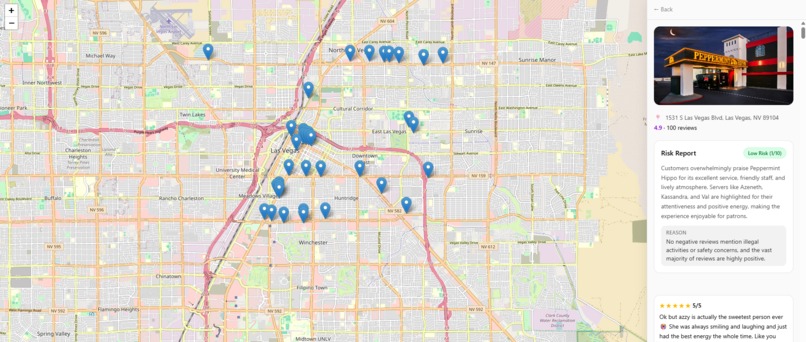
Interactive Map w/ Risk Assessment


Inspiration
SinMaps devs know firsthand what it is like to grow up in Las Vegas, without being able to live the Las Vegas lifestyle. Our devs believe partying has no age restriction in the entertainment capital of the world.
What it does
SinMaps utilizes user input and existing reviews to predict the likelihood of being ID'd at any nightlife venues, assigning a risk score to all club, liquor store, smoke shop, and bar locations readily available on an interactive map.
How we built it
Backend: We used a curl script to call an API to search for certain keywords to look for stores. Then we use the provided store names to scrape reviews and run them through an ML model to evaluate the stores and assign a "risk score."
Frontend: We built a dynamic, interactive web app using [Insert your framework, e.g., React.js / HTML & vanilla JS]. We integrated a map API [e.g., Google Maps / Mapbox API] to visually plot the stores. The frontend pulls the analyzed risk data from our database and displays color-coded markers (e.g., red for high risk, green for safe), allowing users to click on a location to read a summary of the red flags.
Challenges we ran into
As most of our team members had no experience with web development, our biggest challenge was creating the U/I, primarily the map. Figuring out the architecture to connect our frontend to a backend database, and successfully rendering useful APIs like interactive maps without breaking the UI, involved a steep learning curve and a lot of debugging.
Accomplishments that we're proud of
Building a Full-Stack App: Despite our lack of web dev experience, we successfully built a working pipeline that connects an interactive map to a live database.
Data Pipeline: We are incredibly proud of the automated script that scrapes messy, real-world review data and passes it through an AI model to extract meaningful, actionable safety insights.
Real-World Impact: We built a tool that solves a genuine problem. It's highly scalable and could legitimately protect tourists from getting scammed or ending up in unsafe situations.
What we learned
Full-Stack Integration: We learned how to stitch together multiple technologies, from web scrapers and AI models to frontend map APIs and databases.
Data Parsing: We learned how noisy raw review data can be, and how to effectively prompt and utilize an ML model to distinguish between a regular bad review ("the drinks were expensive") and a genuine safety risk ("they overcharged my card and the bouncers were aggressive").
Team Perseverance: We learned how to divide tasks effectively, rely on documentation, and push through the "tutorial hell" to build a working product under a tight deadline.
What's next for Sin Maps Expanding Categories: We want to track other high-risk venues, such as casinos (because everyone should be able to gamble).
Crowdsourced Real-Time Reporting: Implementing a feature that allows users to drop a pin and report a sketchy location, so users could take advantage.
City Expansion: Once the model is perfected for Las Vegas, we plan to scale it to other party cities like Miami, Los Angeles, and New York.
Built With
- beautiful-soup
- docker
- fastapi
- featherless
- html
- leaflet.js
- python
- selenium
- sql
- superbase
- typescript


Log in or sign up for Devpost to join the conversation.