-
-
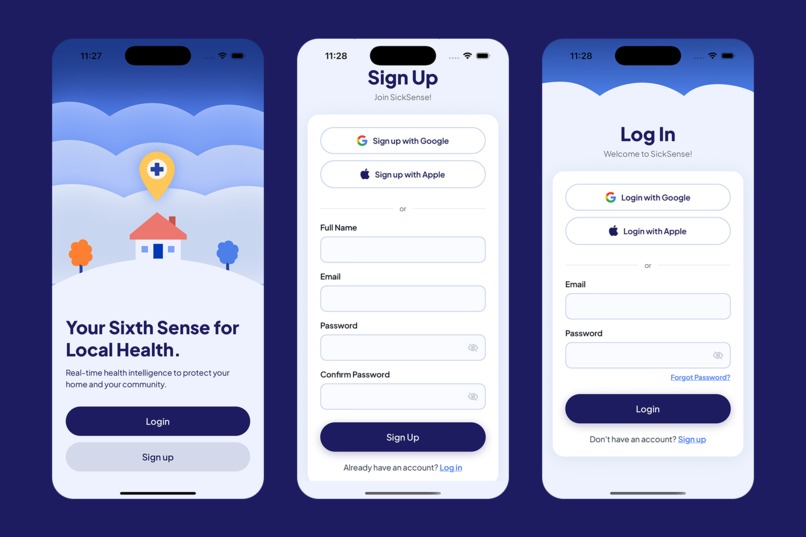
Landing, Signup
-
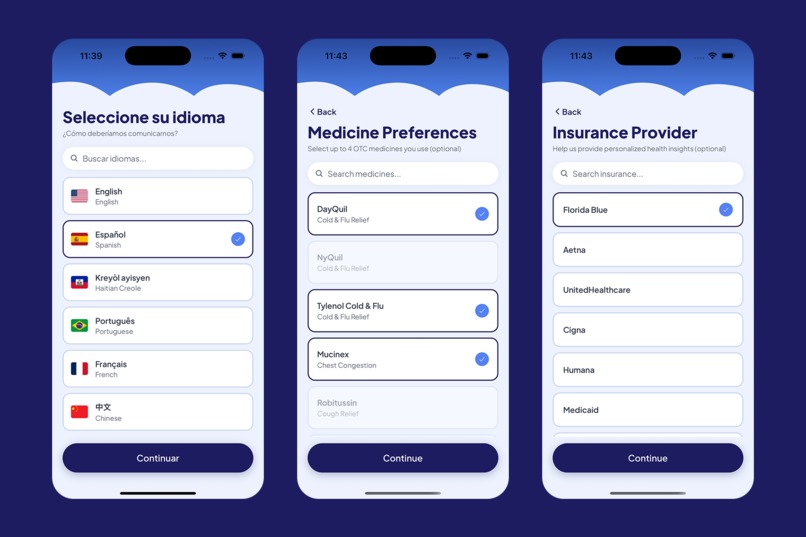
Languages, Preferred Over The Counter Medicine, Insurance
-
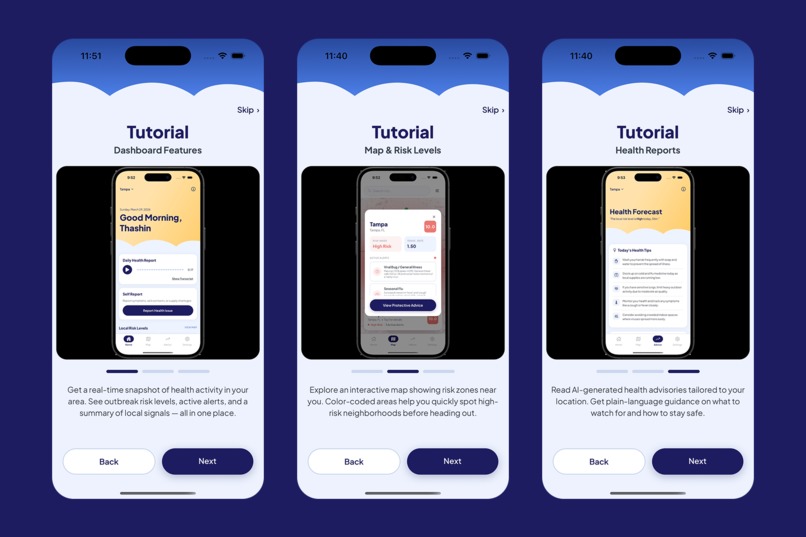
Onboarding Tutorial
-
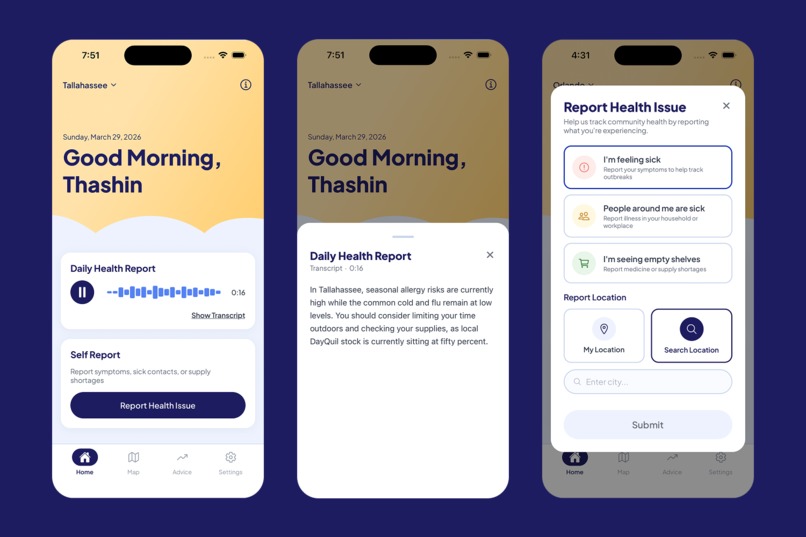
Dashboard, Daily Report, Transcript, Self Report
-
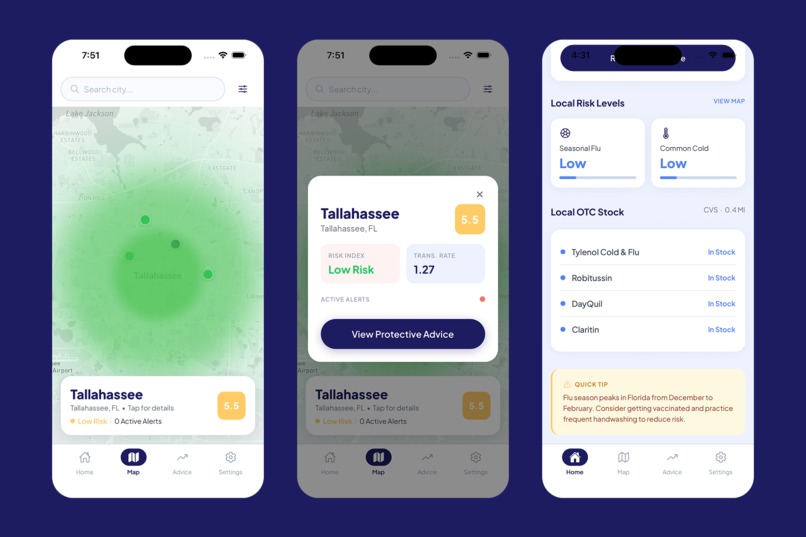
Heatmap, More information, Preferred OTC Stock
-
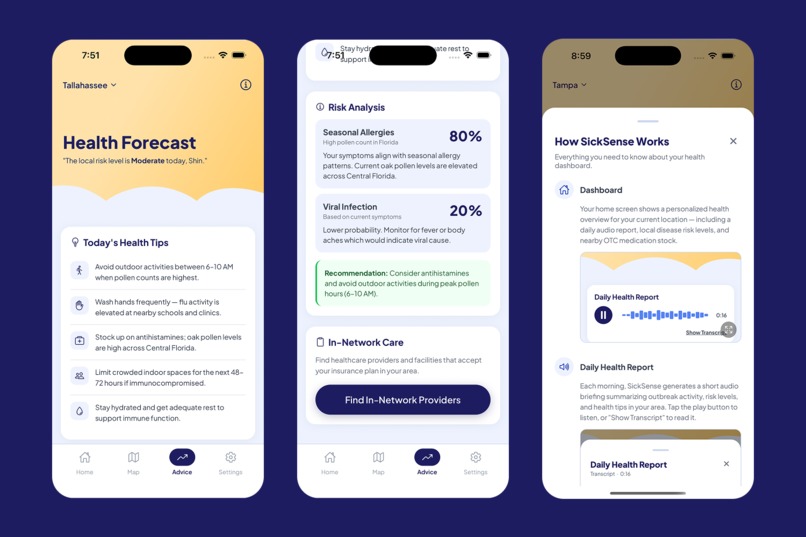
Advice screen, Risk Analysis, Help/Info Modal
-
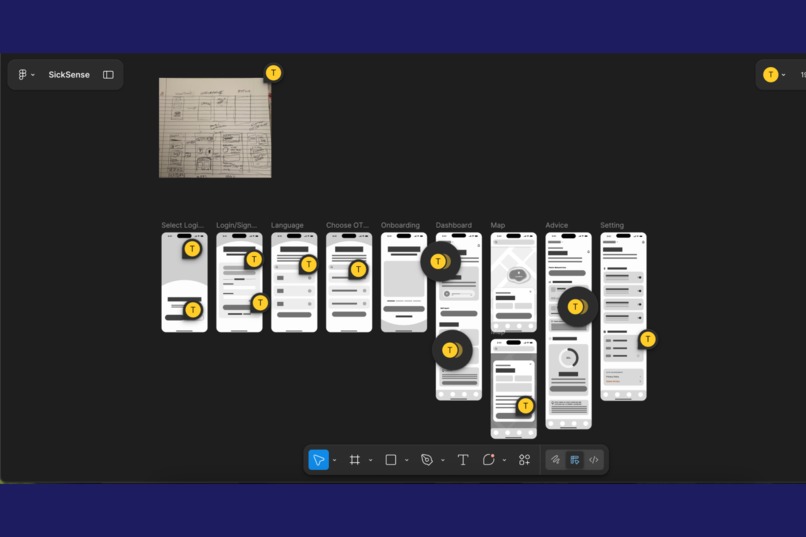
Low-Fi
-
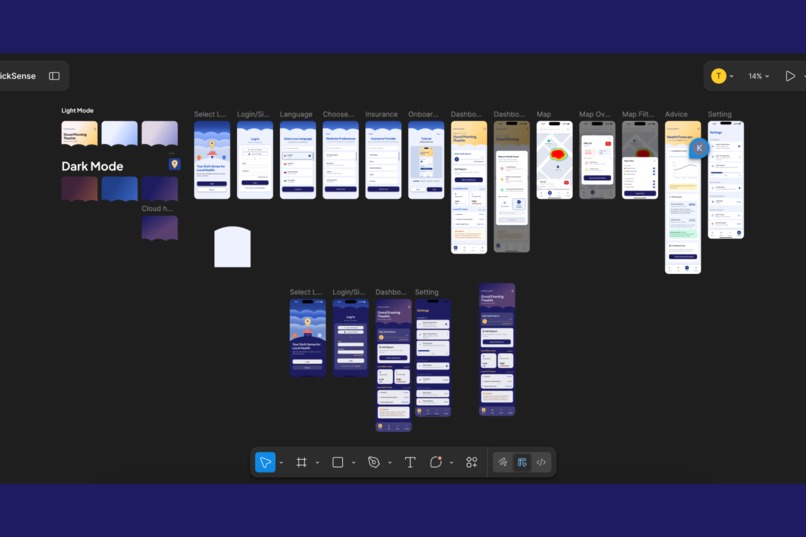
Hi-Fi + Dark Mode


Inspiration
Throughout this flu season alone, nearly 19 million Americans have contracted the flu and around 10,000 have tragically died. To reduce this number, we sought to provide people with as much information about outbreaks of illnesses and how to stay safe as possible through autonomous data collection.
Public health crises often move too fast for traditional reporting and hit the most vulnerable populations the hardest. We were inspired by the gap between raw data and real-world protection. Too often, a parent only finds out about a local flu spike after their child is already sick, or an elderly neighbor misses a critical health bulletin due to a language or accessibility barrier.
We built SickSense to bridge this gap. We wanted to create an autonomous persistent guardian that doesn't just "chat" about health, but actively monitors the digital pulse of a city—EMS logs, pharmacy stock, search trends, and more. This data aggregation pipeline identifies anomalies before they become headlines. Our goal is to empower every individual with the intelligence they need to stay safe, healthy, and informed.
What it does
SickSense is a mobile app that acts as an autonomous public health guardian. It sources and stores real-time data about illnesses from the web and cross-references it using an anomaly detection pipeline to determine if an outbreak of an illness is happening in real-time.
If an anomaly is detected, we provide users with actionable intelligence on how to stay safe. Using our localized heatmap, we show the user exactly where illnesses have been spotted most frequently nearby. Finally, SickSense provides a daily health report to keep users up-to-date on potential outbreaks as well as the quantity of over-the-counter (OTC) medication available at local pharmacies.
How we built it
We utilized the Google ADK (Agent Development Kit) to create a robust multi-agent ecosystem that orchestrates the entire process of scraping, comparing, and storing data from the web into a Firebase database.
On the frontend, we designed our UI/UX in Figma and implemented it using React Native (managed via Expo) to deliver a seamless mobile experience. The backend, including the agent control plane and our data collectors, was built in Python, sourcing intelligence directly from an array of real-world APIs.
ADK Architecture
Our architecture relies on three specialist agents operating in parallel and looping workflows:
- Scout Agent: Continuously monitors the web, gathering early indicators of potential illnesses and anomalies.
- Analyst Agent: Receives the data from the Scout and cross-references it against historical data using anomaly detection pipelines to verify the outbreak's validity.
- Advisor Agent: Takes verified intelligence from the Analyst and turns it into a proactive daily health report. It provides a comprehensive rundown of potential outbreaks in the user's vicinity and generates site-specific, actionable safety recommendations—delivered directly through the app's clean UI and enhanced with an accessible Text-to-Speech (TTS) feature.
Through A2A Interoperability (the "Handshake"), these agents talk to each other to fill gaps in knowledge. Rather than rely on static datasets, we developed custom Python collectors to run parallel retrieval streams. We integrate 9 distinct real-time data streams without interrupting the ecosystem workflow:
- Pharmacy Inventories: Extracting real-time OTC (Over-the-Counter) medicine availability from CVS and Walgreens.
- Urgent Care Busyness: Live traffic and wait-time approximations from Google Maps for local hospitals and clinics.
- EMS Dispatch Logs: Monitoring local Emergency Medical Service dispatch trends for spikes in health-related calls.
- CDC & Public Health Bulletins: Parsing official regional anomaly reports and historical outbreak data.
- Social Media Sentinels: Analyzing localized discussions from Reddit and Nextdoor boards for early-warning symptom reporting.
- Search Trends: Capturing localized health-related search patterns (Google Trends).
- Air Quality Indexes: Real-time environmental triggers for respiratory tracking.
- Pollen Counts: Monitoring local allergen data to distinguish seasonal allergies from viral outbreaks.
- User Self-Reports: Crowdsourced, localized symptom logging directly from the SickSense user base.
Challenges we ran into
- Environment & Simulation Hurdles: Half of our team was unable to simulate the mobile app effectively because they were using Windows 10. We also discovered that Expo Go has out-of-date restrictions on certain iOS versions, making it much more difficult to test the mobile app on an actual physical device.
- Data Unification: Validating parsed web data and ensuring that all information displayed consistently across our UI heatmap and our Python Database instances became difficult to marshal efficiently.
Accomplishments that we're proud of
- Engineering our AI Agents architecture so that it ethically sources complex real-world data for localized illness patterns without hallucinating medical information.
- Inclusive Accessibility: Engineered the app with a "design for all" mindset, implementing high-contrast UI modes and Text-to-Speech (TTS) functionality to ensure the app is fully navigable for users with visual or auditory impairments.
- Breaking Language Barriers: Successfully implemented multi-language translation support, making critical health and outbreak data accessible to non-English speaking populations.
What we learned
- How to successfully bootstrap, style, and deploy a mobile app using React Native.
- How to construct AI Agents via Google ADK to continuously search, reason, and act upon live intelligence.
- Building resilient backend pipelines to generate automated, daily Text-To-Speech (TTS) reports detailing illness outbreaks while keeping our Firebase database properly synced.
What's next for SickSense
- Advanced Voice Modeling: Integrating the ElevenLabs API into the Text-To-Speech pipeline to improve the emotional resonance and sound quality of the daily recorded health report.
- Global Accessibility: Streamlining the localization process for our app into even more languages, giving more communities access to the protection of SickSense.
- Global Outbreak Monitoring: Expanding our real-time sickness detection and anomaly identification pipelines to a global scale. While our MVP effectively focused on Florida-specific intelligence, we plan to integrate international health data streams to provide early-warning protections and safety advisories to communities worldwide.
Built With
- fast-api
- figma
- firebase
- gemini3
- google-adk
- mapbox-gl
- python
- react-native




Log in or sign up for Devpost to join the conversation.