-
-
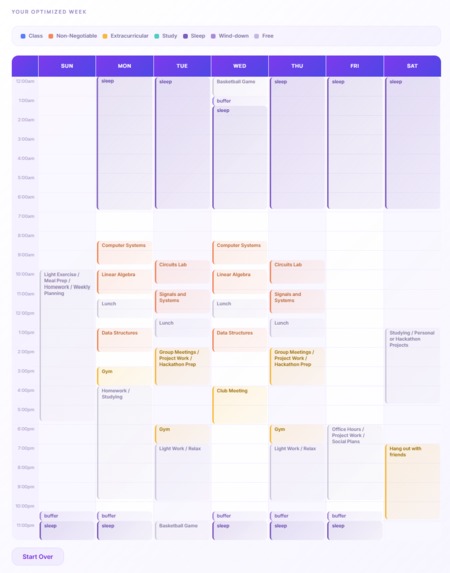
optimized schedule
-
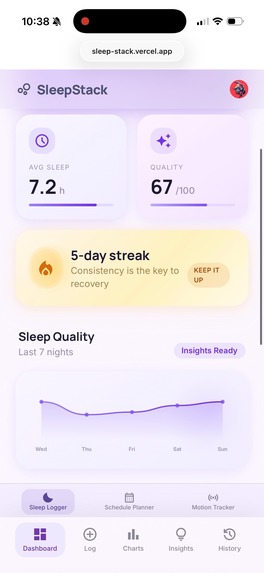
dashboard on mobile
-
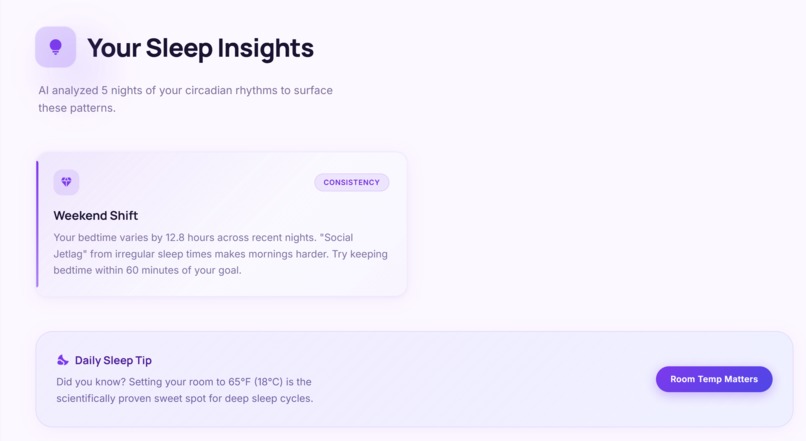
our a.i insights


❤️ Inspiration
Built for real life — not perfect routines.
As college students, we realized that optimizing sleep isn’t as simple as “go to bed at the same time every night.”
Schedules change daily — classes, late nights, events, and spontaneity make consistency difficult. We wanted to build something that adapts to real student life, helping users understand when to prioritize sleep and when they can afford flexibility.
🧠 What it does
SleepStack is a smart sleep optimization platform that helps users balance their schedule with better rest.
It allows users to:
- Track sleep using Apple Watch, phone-based detection, or manual input
- Log lifestyle factors like caffeine and exercise
- Input weekly schedules and events
- Classify events as negotiable or non-negotiable
Using this data, SleepStack:
- Generates an optimized weekly schedule
- Recommends when to attend or skip events
- Provides a sleep score and actionable insights
- Visualizes trends through graphs and analytics
Rather than forcing perfect habits, SleepStack helps users make better decisions within imperfect schedules.
🛠 How we built it
We built SleepStack using:
- React, JavaScript, HTML, CSS for the frontend
- Node.js for backend logic
- Supabase for data storage
- Clerk for authentication
- Vercel for deployment
For intelligence and automation:
- GPT-5.4 mini (via LAVA API) to generate personalized sleep insights
- LLM-based parsing to structure and interpret user schedules
We also leveraged Claude Code to accelerate development and iterate quickly on key features.
⚠️ Challenges we ran into
One major challenge was working within the iOS ecosystem, which requires:
- macOS-based development
- navigating strict tooling and permissions
Additionally, structuring messy real-world schedules into usable data was non-trivial. We used LLMs to help parse and organize this information effectively.
Balancing flexibility with meaningful optimization was another key challenge — ensuring recommendations were both realistic and useful.
🏆 Accomplishments that we're proud of
- Building a working system that meaningfully optimizes sleep around real schedules
- Integrating multiple data sources (Apple Watch, phone sensing, manual input)
- Creating a flexible framework that adapts to unpredictable routines
📚 What we learned
We developed skills across:
- Full-stack development and deployment
- Working with iOS integrations and constraints
- Designing systems that handle messy, real-world data
We also learned how to combine LLMs with structured data to generate useful, personalized insights.
🔮 What's next for SleepStack
Next steps include:
- Expanding support for Android devices
- Seamless integration with third-party calendar apps
- Improving data collection and accuracy
- Enhancing recommendation algorithms
Our goal is to make SleepStack a daily tool for anyone trying to balance productivity with better sleep.
Built With
- clerk
- concurrently
- css
- dotenv
- eslint
- express.js
- html
- javascript
- lava-api
- node.js
- react
- react-router-dom
- recharts
- supabase
- tailwind-css
- typescript
- vercel
- vite


Log in or sign up for Devpost to join the conversation.