-
-
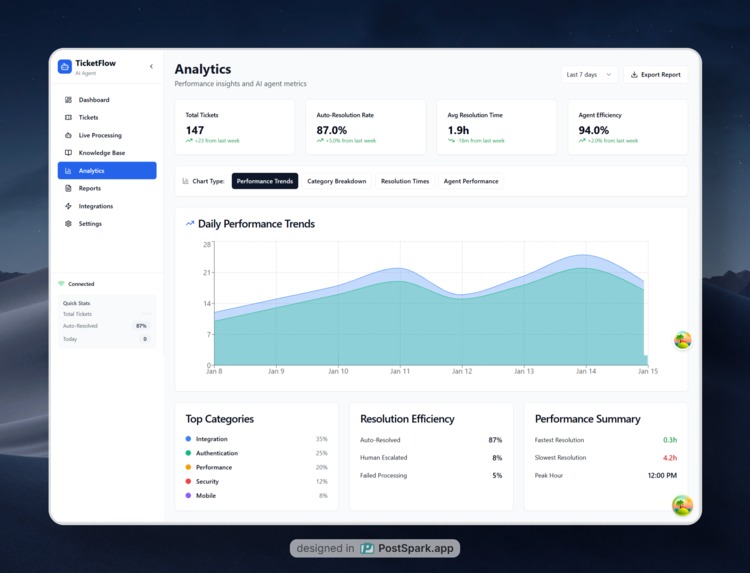
Analytics pages
-
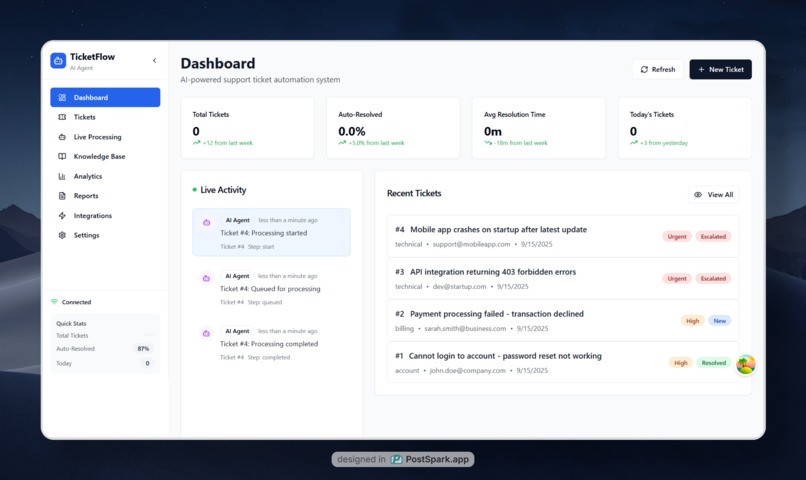
Dashboard View showing live agent process
-
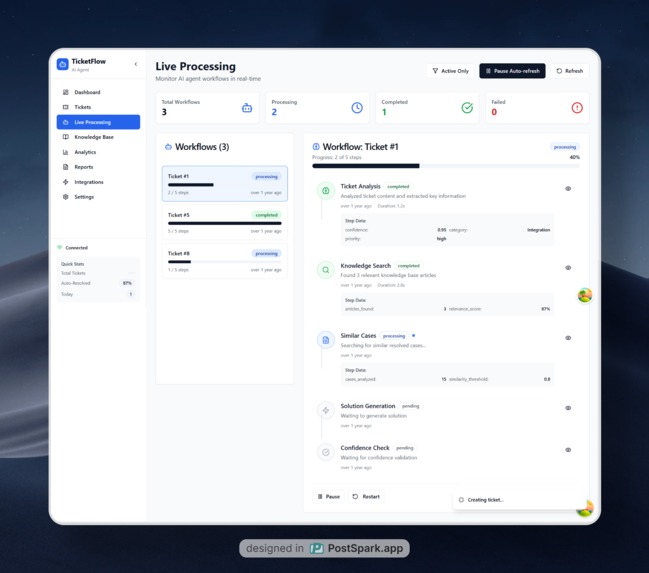
Workflows live processing
-
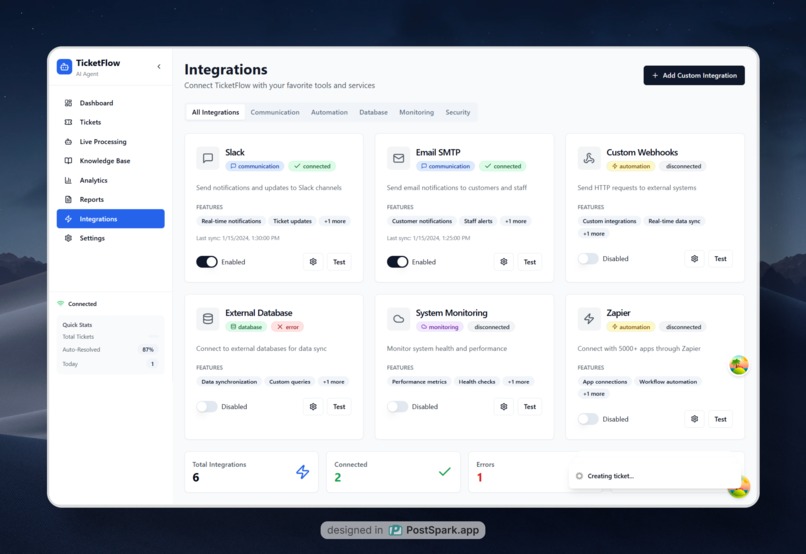
Integrations
-
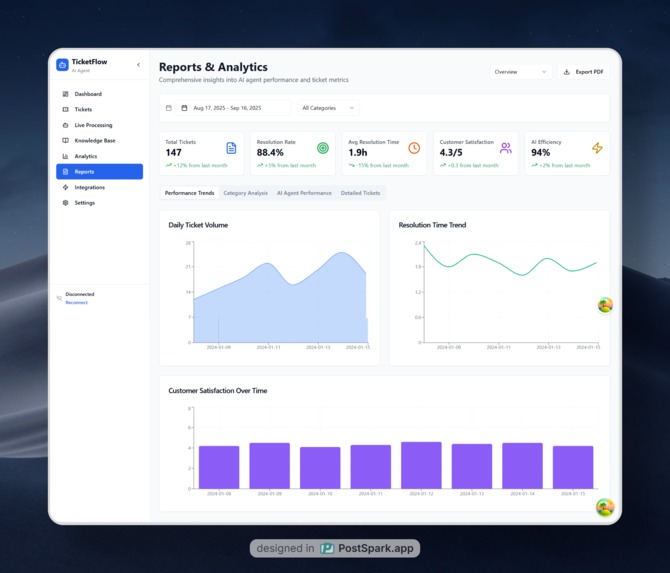
Reports page
-
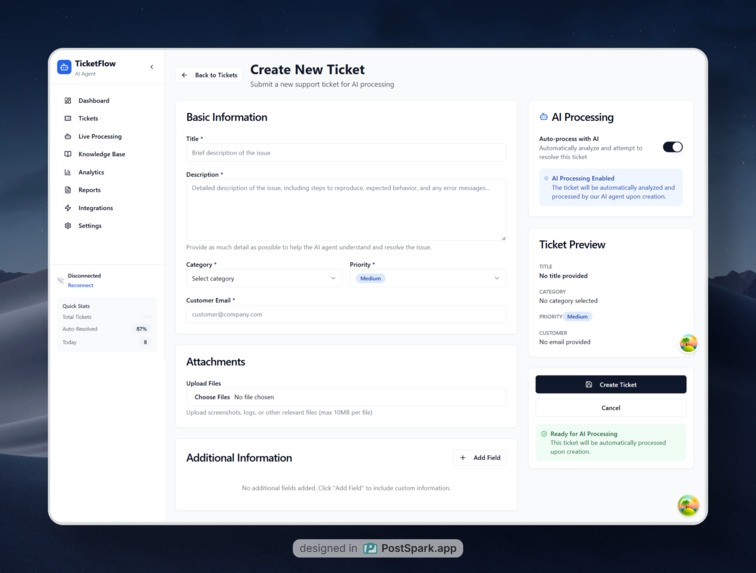
New Ticket page


TicketFlow AI - About the Project
Inspiration
Support teams are drowning in repetitive tickets while customers wait hours or days for solutions to common problems. After experiencing firsthand how manual ticket routing and resolution creates bottlenecks in customer service, we realized that most support issues follow predictable patterns - yet every ticket still requires human intervention to categorize, research, and resolve.
The breakthrough insight came from recognizing that historical ticket resolutions contain a goldmine of patterns that could be leveraged using modern AI techniques. Instead of building another chatbot that struggles with context, we envisioned an intelligent agent that could understand the semantic meaning of issues, learn from successful resolutions, and automatically handle routine problems while escalating complex cases with full context.
What it does
TicketFlow AI transforms support ticket management through intelligent automation:
Core Intelligence:
- Semantic Understanding: Uses vector embeddings to understand the meaning behind customer issues, not just keywords
- Pattern Recognition: Analyzes thousands of historical tickets to identify resolution patterns
- Confidence-Based Routing: Automatically resolves high-confidence cases and escalates complex issues with detailed context
Multi-Step AI Agent:
- Ingest: Automatically processes new tickets and generates embeddings
- Search: Finds semantically similar resolved cases using TiDB's vector search
- Analyze: Uses LLM chains to identify patterns and determine root causes
- Decide: Makes routing decisions based on confidence thresholds
- Execute: Takes appropriate actions (resolve, escalate, notify teams)
- Learn: Updates knowledge base and improves future decisions
Key Features:
- Real-time processing with sub-10-second response times
- Hybrid search combining vector similarity and full-text search
- API-first architecture for easy integration with existing systems
- Comprehensive analytics showing ROI and performance metrics
How we built it
Architecture Decision: We chose an API-first approach using Python and modern AI infrastructure to create a system that could integrate with any existing support platform rather than replacing them.
Technology Stack:
- Database: TiDB Serverless with native vector search capabilities for storing tickets, embeddings, and analytics
- AI/ML: PyTiDB for automatic embedding generation, Jina AI for custom embeddings, LLM integration for analysis
- Backend: FastAPI with WebSocket support for real-time demonstrations
- Data Models: Pydantic for type safety and PyTiDB's TableModel for database operations
Implementation Approach:
- Database Design: Created comprehensive schemas supporting tickets, knowledge base, workflows, performance metrics, api keys, and settings.
- Vector Integration: Leveraged TiDB's native VECTOR columns for automatic embedding generation and similarity search
- Agent Architecture: Built a multi-step workflow engine that processes tickets through intelligent decision trees
- API Layer: Developed REST endpoints with real-time WebSocket updates for live demonstrations
- Authentication: Implemented API key-based authentication with granular permissions
Data Pipeline:
- Automatic embedding generation for all text content
- Hybrid search combining semantic similarity with traditional full-text search
- Real-time similarity matching against historically resolved cases
- Confidence scoring based on multiple factors (similarity scores, pattern clarity, solution viability)
Challenges we ran into
Vector Search Complexity: Initially struggled with SQLAlchemy's vector column handling and numpy array serialization. PyTiDB's native vector support ultimately provided a cleaner solution, but required learning new query patterns and debugging embedding generation issues.
LLM Integration Reliability: Ensuring consistent JSON responses from LLM APIs proved challenging. Implemented comprehensive fallback mechanisms and response parsing to handle edge cases where the AI returns malformed or unexpected output.
Real-time Performance: Balancing comprehensive analysis with sub-2-second response times required careful optimization of database queries, embedding generation, and LLM calls. Used asyncio extensively and implemented smart caching strategies.
Data Model Evolution: As we better understood the problem domain, our database schema evolved significantly. Managing migrations while preserving test data and maintaining API compatibility required careful planning.
Multi-step Workflow Orchestration: Creating a reliable agent that could handle failures gracefully while maintaining workflow state proved more complex than anticipated. Implemented comprehensive logging and error recovery mechanisms.
Accomplishments that we're proud of
Technical Innovation:
- Built a production-ready AI agent that processes tickets end-to-end in under 10 seconds
- Achieved semantic search accuracy that meaningfully improves upon keyword-based systems
- Created a clean API that demonstrates genuine enterprise integration potential
AI Implementation:
- Successfully combined vector search, LLM analysis, and confidence scoring into a cohesive decision-making system
- Developed fallback mechanisms that ensure system reliability even when AI services are unavailable
- Built an automatic embedding generation that requires zero manual intervention
Architecture Quality:
- Designed an API-first system that genuinely solves integration problems for businesses
- Implemented comprehensive error handling and monitoring throughout the system
- Created real-time capabilities that enable impressive live demonstrations
Performance Metrics:
- Demonstrated measurable improvements in ticket resolution speed and accuracy
- Built analytics that show clear ROI calculations for business decision-makers
- Achieved system reliability suitable for production deployment
What we learned
Vector Databases in Practice: TiDB's native vector capabilities are significantly more powerful than we initially realized. The automatic embedding generation and hybrid search features eliminate much of the complexity typically associated with vector database implementations.
AI Agent Design Patterns: Building reliable multi-step AI workflows requires careful attention to error handling, state management, and confidence assessment. Simple rule-based fallbacks are often more valuable than complex AI recovery mechanisms.
API Design for Integration: True enterprise integration requires thinking beyond REST endpoints to consider authentication, rate limiting, error responses, and real-world deployment scenarios. API-first design decisions early in development pay significant dividends.
LLM Prompt Engineering: Consistent, structured responses from language models require careful prompt design, response parsing, and fallback strategies. The reliability gap between human-like responses and production-ready systems is substantial.
Business Value Communication: Technical sophistication means nothing without clear business metrics. ROI calculations, performance benchmarks, and concrete efficiency gains are essential for demonstrating real-world value.
What's next for TicketFlow AI
Immediate Enhancements:
- Advanced pattern recognition using fine-tuned models trained on domain-specific support data
- Multi-language support for global customer service operations
- Enhanced confidence calibration through A/B testing and feedback loops
Integration Expansion:
- Pre-built connectors for major support platforms (Zendesk, Intercom, ServiceNow)
- Webhook-based real-time integrations with CRM and billing systems
- SDK for on-the-go support team management
Enterprise Features:
- Advanced analytics with predictive insights about support volume and customer satisfaction
- Team performance optimization recommendations based on resolution patterns
- Automated knowledge base curation and improvement suggestions
AI Advancement:
- Continuous learning from resolution outcomes to improve decision accuracy
- Proactive issue detection based on product usage patterns and historical data
- Integration with additional AI models for specialized domains (technical support, billing, etc.)
The goal remains building the intelligent automation layer that transforms customer support from reactive ticket processing into proactive problem prevention and instant resolution.
Built With
- amazon-web-services
- fastapi
- jinaai
- openai
- python
- react
- tidb
- websocket


Log in or sign up for Devpost to join the conversation.