-
-
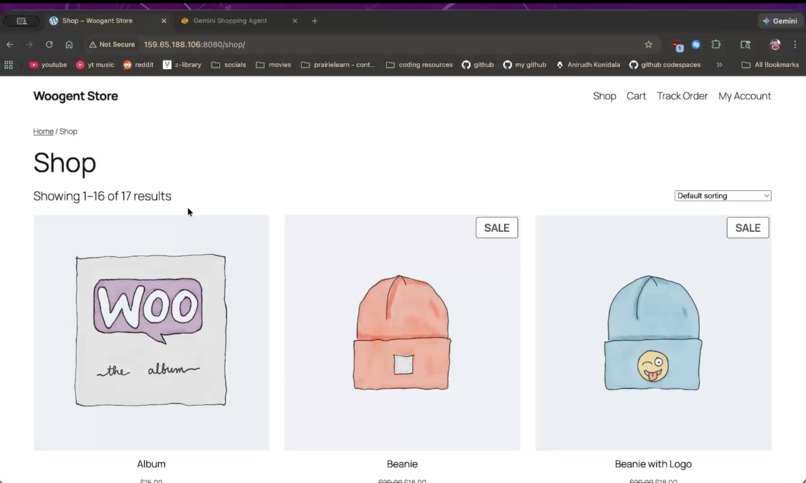
WooCommerce demo store / catalog
-
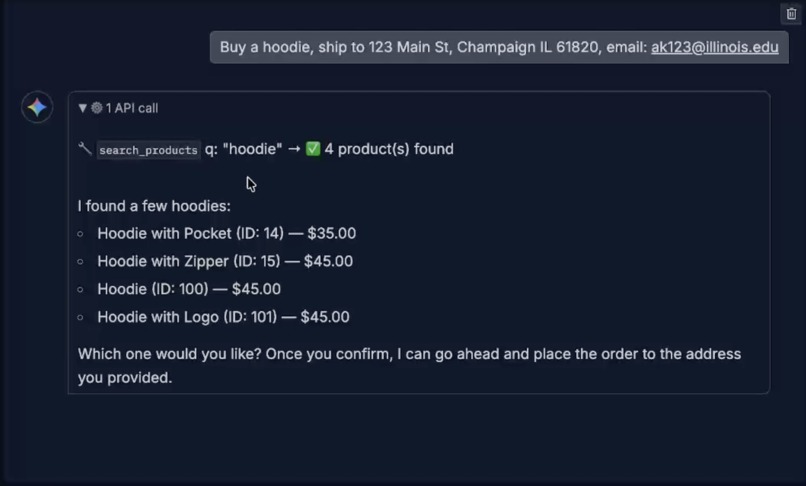
Google Gemini Shopping Agent calls my Woogent API to find the available products that are hoodies from the WooCommerce demo store
-
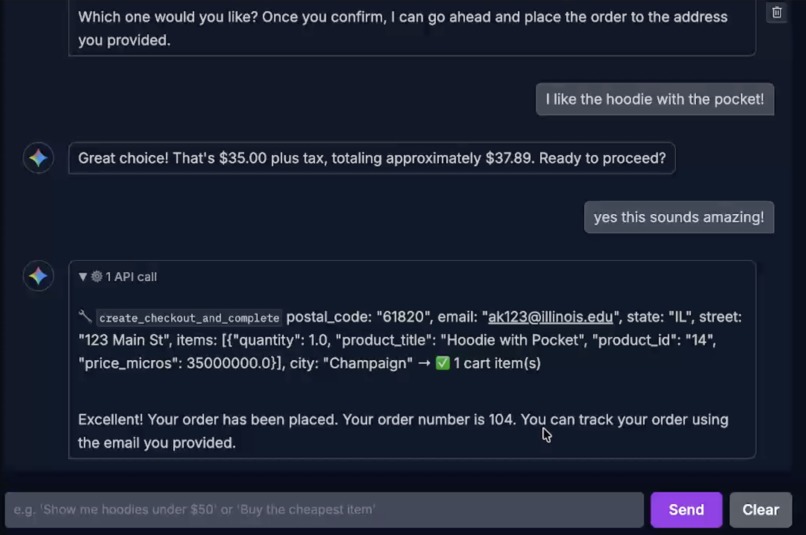
The agent adds the Hoodie I want to my cart and completes a checkout session, which will give me an order number I can use to track my order
-
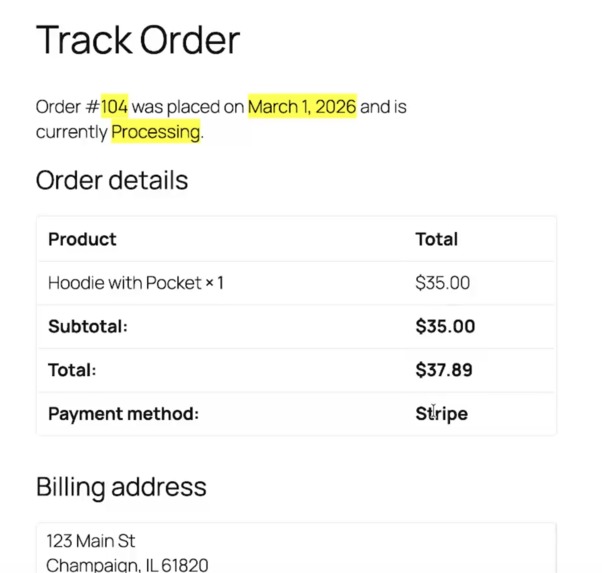
The WooCommerce demo store will let me track my order using the orders's order number and billing email!


Woogent








For HackIllinois 2026, I built Woogent, an API that lets AI agents shop on online stores: built and catered towards small businesses using Google's Universal Commerce Protocol (UCP) on top of a WooCommerce MySQL database that ships with a Gemini-powered AI shopping demo and a Woogent Demo Store backed via WooCommerce
At a high level:
- Backend API: FastAPI service that exposes a UCP-compliant REST API backed by a WooCommerce database.
- WordPress + WooCommerce: Standard WordPress stack with WooCommerce and sample data, running in Docker.
- Gemini demo: Gradio UI that lets Gemini act as an AI shopping assistant using function calling against the UCP API.
Live Demo
| Service | URL |
|---|---|
| Gemini AI Shopping Demo | http://159.65.188.106:7860 |
| UCP API (publicly accessible) | http://159.65.188.106:8000 |
| API Docs (Swagger UI) | http://159.65.188.106:8000/docs |
| UCP Manifest | http://159.65.188.106:8000/.well-known/ucp |
| WooCommerce Store | http://159.65.188.106:8080 |
The problem
Retail isn’t one market: it’s three
| Segment | Who they are | How they sell online |
|---|---|---|
| Large enterprises | Amazon, Walmart, Target | Their own platforms, huge engineering teams, and custom agentic commerce |
| Medium retailers | Brands on Shopify, Wix, Etsy | Marketplaces with APIs; vendors are adding AI/agent support |
| Small retailers | ~4 million stores | WooCommerce, Magento: free and open source with no AI agent integration |
The first two are getting AI storefronts, voice shopping, and agent integrations. However, the third is stuck. They don’t have the budget for a custom API, the headcount to integrate with every new AI product, or the time to migrate off the stack that already works for them.
So when we talk about agentic commerce, we're really talking about a split, where stores with a path to AI are not the same as stores without one
Roughly 4 million small retailers sit on the wrong side of that line. That’s what inspired Woogent to bring a standards-based agent API backed by UCP to the stack these small retailers already use, WooCommerce, so that they don’t have to rebuild or pay for a new platform.
Why Woogent?
Woogent turns an existing WooCommerce store into an AI-native commerce backend, without asking merchants to migrate platforms.
- Built for a real integration gap: WooCommerce storefronts are mature, but they are not directly consumable by LLM shopping agents. WooGent adds a standards-oriented UCP layer so AI clients can discover, browse, and transact against live merchant data.
- An API at its Core: Woogent is still an API at its core. The Google Gemini Shopping Agent is a live demonstration of how an AI Agent can use my Woogent API. Other use cases include server-to-server integrations and function-calling AI clients. Because Woogent is an API at its core, it can still be tested independently via cURL and Postman!
- Commerce flows modeled explicitly: Checkout sessions and orders are separate resources with clear lifecycle transitions, idempotent mutations, and predictable error behavior.
- Developer-ready experience: OAuth/JWT auth, machine-readable discovery, structured error responses, and a Docker-first setup make it fast to evaluate and integrate!
- Future-facing but practical: It enables AI-assisted shopping today while staying compatible with existing WooCommerce operations and data models
What I learned
Universal Commerce Protocol (UCP)
I went deep on the UCP spec: discovery at/.well-known/ucp, REST semantics for products and checkout sessions, and the state machine (e.g.incomplete → pending_payment → completed). Learning how Google and others expect agents to discover and call commerce APIs shaped the whole design.WooCommerce under the hood
WooCommerce is WordPress + a lot of meta and custom tables. Products live inwp_posts+wp_postmeta; orders moved to HPOS (wc_orders,wc_order_addresses, etc.), notwp_posts. I learned to read the schema, write raw SQL for products and orders, and avoid assuming “everything is a post.”OAuth 2.0 + JWTs for agents
Agents need a token to act on behalf of a user. I implemented the Authorization Code grant, HTTP Basic at the token endpoint, and RS256 JWTs so the API can verify callers without storing sessions. The public key lives at/.well-known/jwks.jsonso any client can validate tokens.Gemini function calling
I modeled the demo as “Gemini + a set of tools that map to UCP endpoints.” Designing the tool schemas so Gemini could reliably choose the right call (e.g. search products vs. create session vs. complete) took iteration; clear names and parameter descriptions mattered a lot.Stripe PaymentIntents
I wired checkout to Stripe’s API (create PaymentIntent, confirm with a test token) so the flow is real end-to-end, and stored the transaction ID on the WooCommerce order for traceability.
How I built it
API-first
I started with the UCP surface: discovery, products, checkout sessions, orders. FastAPI + Pydantic gave me OpenAPI docs and validation; every route returns UCP-shaped JSON and UCP-style errors.WooCommerce as the source of truth
No duplicate product or order store. The API reads and writes the same MySQL DB that WordPress uses. That keeps the demo honest: “this is what a small merchant would run.”Layered services
Routes stay thin; business logic lives inucp_adapter(session lifecycle, order creation, shipping options). Auth is inauth(OAuth, JWT, key generation). DB access is inwoo_queries(raw SQL). That made it easier to test and to reason about each piece.Demo as a client
The Gradio + Gemini app is just one client of the API. It discovers the store, searches products, and drives checkout by calling the same endpoints that cURL or Postman would. That keeps the API the product and the demo a proof.Docker Compose for one-command run
MySQL, WordPress (with WooCommerce + sample data), the API, and the demo all start withdocker compose up -d. Awpclijob handles WooCommerce setup and sample import so judges (or you) can run it locally without touching WordPress manually.
Challenges I faced
WooCommerce’s dual world
Products are inwp_posts; orders are in HPOS tables. I had to map UCP concepts (line items, totals, addresses) onto both schemas and handle the fact that order IDs are no longer post IDs. A lot of debugging was “is this coming fromwp_postmetaorwc_order_addresses?”Idempotency and headers
UCP expectsIdempotency-Key,Request-Id, andUCP-Agenton state-changing calls. Implementing and testing idempotent create/update/complete so the same key doesn’t double-create orders took care; I used an in-memory store for the hackathon and would move to Redis or DB for production.Gemini doing the right thing at the right time
The model had to discover the store first, then search, then create a session, then set address, then complete. Sometimes it tried to complete before setting shipping or used the wrong product ID. I improved this by tightening the tool descriptions and by including minimal “next step” hints in the system prompt so the flow stays on track.Production parity
Getting the same stack running on a VPS (WordPress URL, OAuth redirects, Stripe webhooks, product images) meant fixingWP_SITEURL, CORS, and asset paths. I added a “refresh products” path so prod could re-import sample data and descriptions without wiping the server.Time box
In a weekend you can’t do everything. I focused on: UCP compliance, a working checkout with Stripe, and a Gemini demo that could run end-to-end. Things like webhook signing, retries, and a full order-history UI stayed as “next steps.”
Why did I build Woogent?
Woogent doesn’t ask small retailers to leave WooCommerce or to hire an eng team (both of which come with real risk and cost). Instead, it acts as a bridge: a UCP-backed API that allows any agent or integration to call it so that the same stores that already run on WordPress and WooCommerce can show up in the next wave of AI shopping, joining Amazon and Shopify!


Log in or sign up for Devpost to join the conversation.