
NASA is going back to the Moon! We’ll follow the crew of Artemis II every step of the way.
Continue reading “Following Artemis II’s Journey Around The Moon”
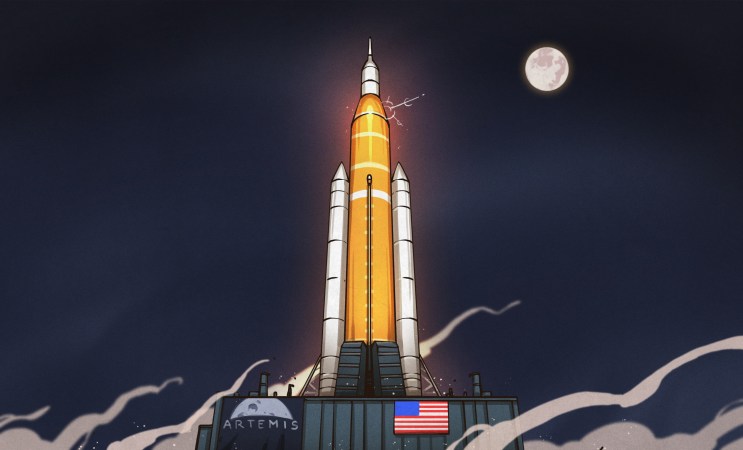
NASA is going back to the Moon! We’ll follow the crew of Artemis II every step of the way.
Continue reading “Following Artemis II’s Journey Around The Moon”

A few years back a company had an ad campaign with a discouraged caveman who was angry because the company claimed their website was “so easy, even a caveman could do it.” Maybe that inspired [JuliusBrussee] to create caveman, a tool for reducing costs when using Claude Code.
The trick is that Claude, like other LLMs, operates on tokens. Tokens aren’t quite words, but they are essentially words or word fragments. Most LLM plans also charge you by the token. So fewer tokens means lower costs. However, LLMs can be quite verbose, unless you make them talk like a caveman.
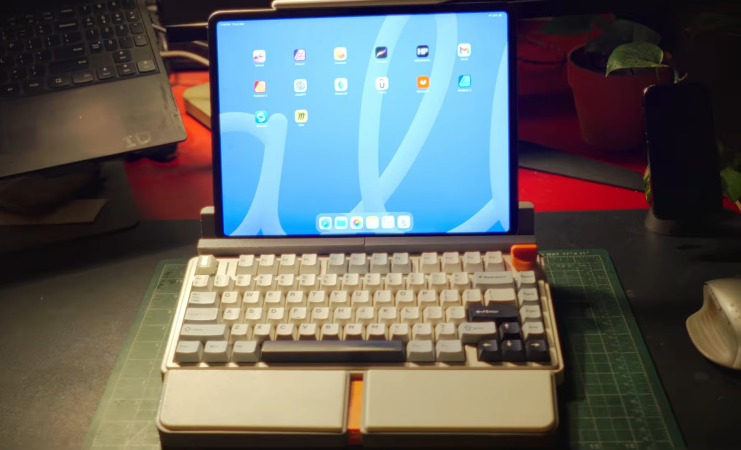
3D printing is a staple of the hacker community. From decorative items to rugged functional parts, almost anything you can think of, can be printed. [anurag.id] shows us some classic 3D printing hacks by converting his keyboard into a compact workstation.
Like any hacker project, the initial idea is small: he decides the knob on his mechanical keyboard is boring, so he designs some alternatives. First, one “retro style” knob. Then, like any good project, the scope creep begins. He makes another knob, and another… by the end he has 6 different designs! But don’t worry, the scope can get even bigger. He decides his ipad needs a good stand on his desk–and what better place to put it than on the keyboard? Now it’s starting to look like a real little workstation. Finally, as a finishing touch, he adds some magnetically-attached wrist rests for a compact, ergonomic workstation.
Video after the break.
Continue reading “Modular Mechanical Keyboard Transformed Into A Compact Workstation”
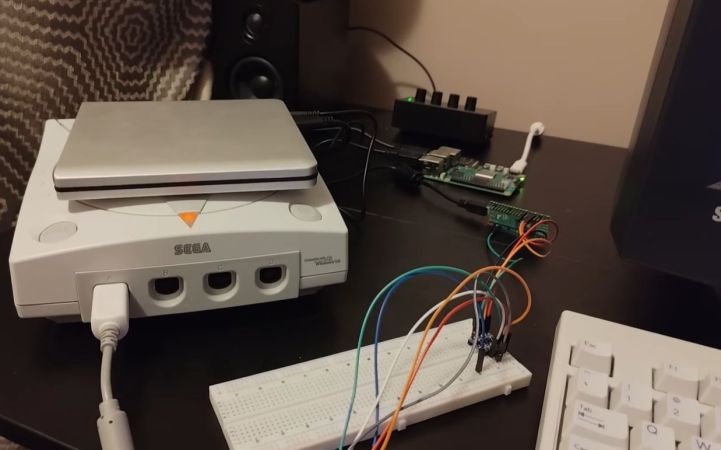
Although the Sega Dreamcast had many good qualities that made it beloved by the thousands of people who bought the console, one glaring omission was the lack of DVD video capabilities. Despite its optical drive being theoretically capable of such a feat, Sega had opted to use the GD-ROM disc format to not have to cough up DVD licensing fees, while the PlayStation 2 could play DVD movies. Fortunately it’s possible to hack DVD capability into the Dreamcast if you aren’t too fussy about the details, as [Throaty Mumbo] recently demonstrated.
For the Tl;dw folk among us, there’s a GitHub repository that contains the basic summary and all needed files. Suffice it to say that it is a bit of a kludge, but on the bright side it does not require one to modify the Dreamcast. Instead it uses a Pico 2 board that emulates a Sega DreamEye camera on the Dreamcast’s Maple bus via the controller port. The Dreamcast then requests image data as if from said camera.
On the DVD side of things there’s a Raspberry Pi 5 that connects to an external USB DVD drive and which encodes the video for transmission via USB to the Pico 2 board. Although somewhat sketchy, it totally serves to get DVDs playing on the Dreamcast. If only Sega had not skimped on those license fees, perhaps.
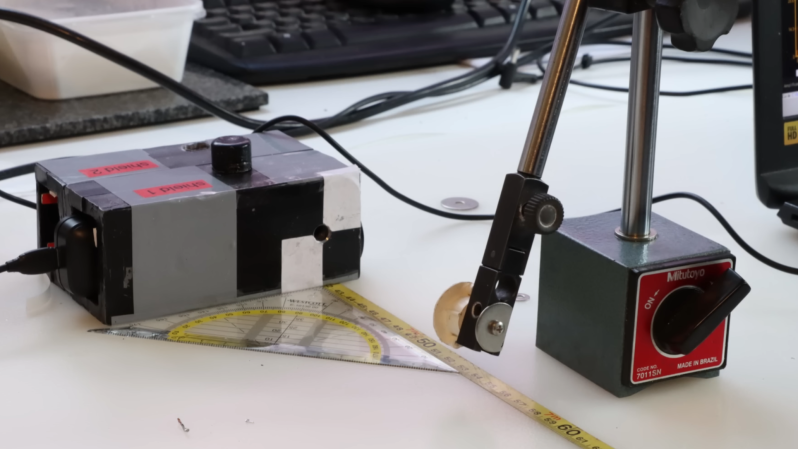
Everything on the electromagnetic spectrum has some properties of both waves and particles, but it’s difficult to imagine a radio wave, for example, behaving like a particle. The main evidence for a particle-like nature is quantization, the bundling of electromagnetic energy into discrete packets. One way around this is to theorize that quantization is due to the specific interaction between the electromagnetic field and matter, not intrinsic to the field itself. To investigate this theory, [Huygens Optics] conducted several experiments with gamma rays, including Compton scattering.
For these experiments, he used a Radiacode 110 X-ray and gamma ray detector, which uses a photodetector to detect radiation’s passage through a scintillation crystal. By summing the energy contained in the light emitted by one ray, it can measure the ray’s energy and, over time, create an energy spectrum. [Huygens Optics] used the americium capsule from an old smoke detector as a radiation source, and cast a lead enclosure to shield the Radiacode from most background radiation, with a small opening for measurements.
Continue reading “Testing The Wave-Particle Duality With Gamma Rays”

The news is full of reports from the moon-bound Integrity, otherwise known as Artemis II. Mostly, the news is good, but there has been one “Houston, we have a problem…” moment. The space toilet, otherwise known as the Universal Waste Management System or UWMS is making a burning smell while in use. While we would love to be astronauts, we really don’t want to go ten days without using the can, and it made us wonder how, exactly, the astronauts answered the call of nature.
Back in the Apollo-era, going to the bathroom was a messy business. The capsule wasn’t that big, and there were no women on board. So you simply strapped an adhesive-rimmed bag or tube to yourself and answered nature’s call with your two closest coworkers right there.

The system was far from perfect. Apollo 8 and Apollo 10 both had to do some housekeeping due to leaky bags.
Astronaut Ken Mattingly reportedly said, “Man, one of the feats of my existence the other day was, in 42 minutes, I strapped on a bag, went out of both ends, and ate lunch…. I used to want to be the first man to Mars. This has convinced me that, if we got to go on Apollo, I ain’t interested.”
Still, it was better than the first Mercury launch, where Alan Shepard famously relieved himself in his spacesuit while sitting on the pad for over eight hours. Later missions used hoses.
Things got slightly better with Skylab, where there was more room. The Shuttle also had a toilet. You got a curtain for privacy, but you couldn’t go #1 and #2 at the same time. Also, apparently, the contraptions were not easily workable for females.
Continue reading “In Space (Probably) Everyone Can Hear You.. Well, You Know”

The topic of micro- and nanoplastics (MNPs) has become increasingly prevalent over the past years, as amidst dismissal and panic, researchers attempt to distinguish just how much of a problem MNPs truly are. The most essential problem here is that we are still developing the tools to accurately measure the levels of MNP contamination. Recently, [Madeline E. Clough] et al. demonstrated in an article published in Analytical Methods how gloves worn in laboratory settings can create false positive MNP signals.
As we covered previously, detecting MNPs is tough due to the detection methods used, many of which rely on interpreting signals from methods like pyrolysis-gas chromatography-mass spectrometry (Py-GC-MS), with protocols for this and other methods still being worked on, particularly on how to filter out false positives.
The article by [Clough] demonstrates how dry contact of lab gloves on samples can deposit stearate salts – left over from their production, which are subsequently misidentified as being MNPs, specifically polyethylene (PE). These false positives occur with µ-Fourier transform infrared (µ-FTIR) spectroscopy and µ-Raman spectroscopy, but can occur with Py-GC-MS as well, as has been determined previously. Substances like the fatty lipids that are commonly found in the human body, and in particular the brain, will closely match the PE signature.
With these very common stearate salts now also a likely source of contamination with MNP measurements, it just becomes more obvious that it’s incredibly hard to make accurate assessments about any hazards of MNPs until we can determine their presence with any level of reliability.
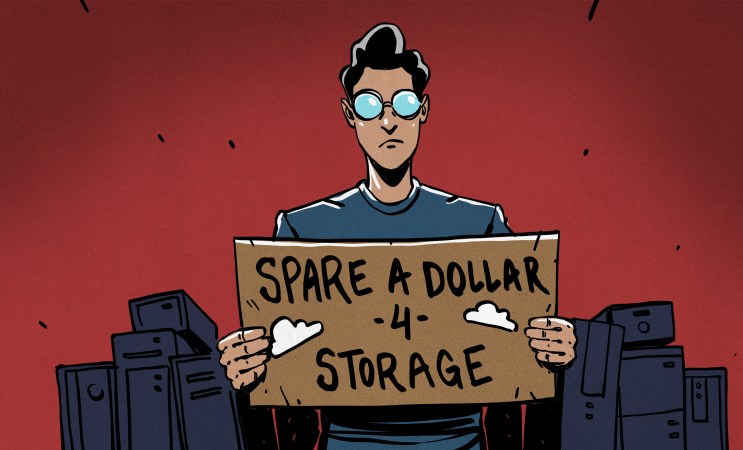
These days our appetite for more data storage is larger than ever, with video files larger, photo resolutions higher, and project files easily zipping past a few hundred MB. At the same time our options for data storage are becoming more and more limited. For the longest time we could count on there always being a newer, roomier, faster, and cheaper form of storage to come along, but those days would seem to be over.
We can look back and laugh at low capacity USB Flash drives of the early 2000s, yet the first storage drive to hit 1 TB capacity did so in 2007, with a Hitachi Deskstar 7k100, only for that level of capacity in PCs to not really be exceeded nineteen years later.
We also had Blu-ray discs (BD) promise to cram the equivalent of dozens of DVDs onto a single BD, with two- and even four-layer BDs storing up to a one-hundred-and-twenty-eight GB. Yet today optical media is dying a slow death as the sole remaining cheap storage option. NAND Flash storage has only increased in price, and the options for those of us who have large cold storage requirements would seem to be decreasing every day.
So what is the economical solution here? Invest in LTO tapes using commercial left-overs, or give up and sign up for Cloud Storage™ for the low-low price of a monthly recurring fee?
Continue reading “With Affordable Storage Options Dwindling, Where To Store Our Data?”










