macro photo slider

Tiny Moves, Big Depth: An Open-Source Macro Focus Slider

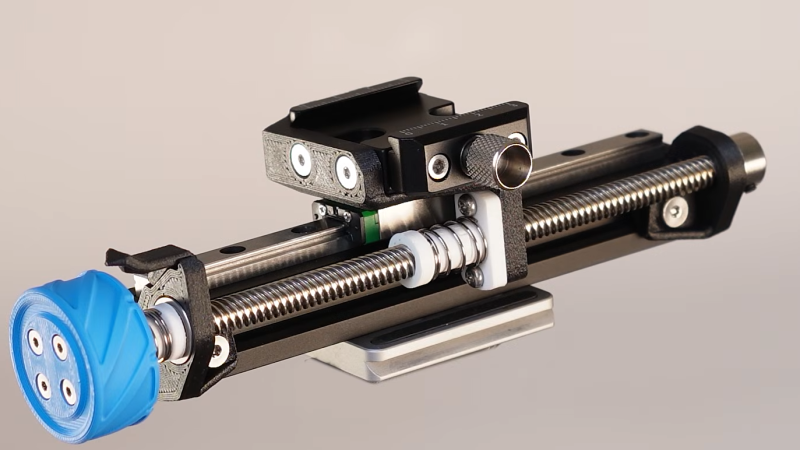
When taking macro photographs, you often need just a tiny bit of controlled motion — so little that it’s tough to pull off by hand. To address this, [Salveo] designed a small open-source macro photography slider featuring an anti-backlash handle.

Macro photography gives you an extremely shallow field of view, sometimes under 1 mm of depth, in which subjects stay in focus. To combat this, it’s common to capture multiple images while sliding the camera forward or backward, then combine them for a much larger depth of field than a single shot provides. [Salveo]’s slider gives fine control over this focus-stacking process, with the knob even marked to show every 1 mm of linear travel.

The slider is built around a 150 mm linear rail, though it could easily be lengthened or shortened to suit your needs. A T8 leadscrew, paired with anti-backlash nuts, translates the knob’s rotation into smooth linear motion. The knob itself uses a custom-designed anti-backlash mechanism to ensure the slider works cleanly in either direction.

You can grab all the 3D-printable files as well as the full bill of materials from the project page. Be sure to check out [Salveo]’s build video below. Thanks [Tim L.] for sending in this awesome open-source slider. Be sure to check out some of the other macro photography projects we’ve covered, too.

Continue reading “Tiny Moves, Big Depth: An Open-Source Macro Focus Slider”
Image

The Threadless Ball Screw Never Took Off, But Don’t Write It Off

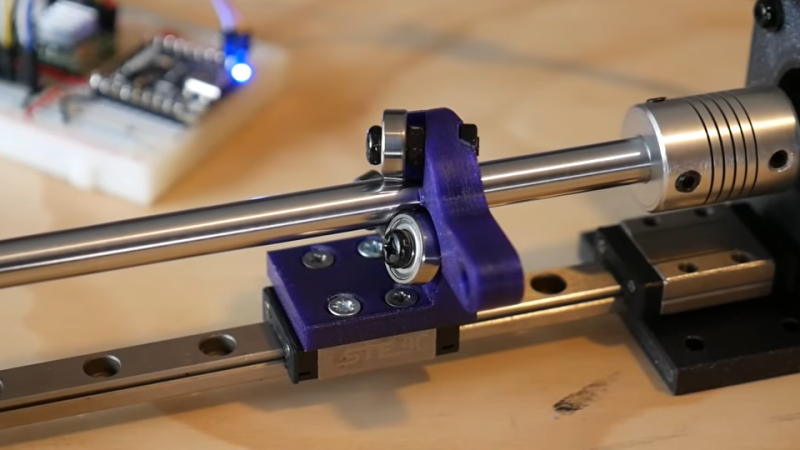
If you’ve never heard of the threadless ball screw, which was invented over sixty years ago, [Angus] of Maker’s Muse has a video demonstrating the whole thing, covering its history and showcasing both its strengths and weaknesses. If you like seeing mechanical assemblies in action, give it a watch.

The device — consisting of little more than a smooth rod and three angled ball bearings — is a way to turn rotational motion into linear motion. Not a single belt, thread, or complex mechanical assembly in sight. While a simple nut on a threaded rod can turn rotation into linear motion, those come with their own issues. The threadless ball screw was one effort at finding a better way.

Image
While it lacks precision, the threadless ball screw nevertheless offers quiet and smooth motion with adjustable tension in a very DIY-friendly design.

Threadless ball screws never really took off, although they were given some consideration for use in 3D printers back in the RepRap days. Today one can purchase quality CNC components without leaving one’s web browser, but back in the early 2000s things like lead screws and ball screws were rather more specialized, less accessible, and more expensive than they are today. RepRap folks had to make their own solutions. But while the threadless ball screw is a very DIY-friendly design, it was ultimately lacking in performance.

The main problem is they’re just not precise enough for anything like CNC work. [Angus] does some back-and-forth tests with a 3D printed unit that shows serious drift after only a few minutes. Now, he knows perfectly well that his 3D-printed test unit is far from ideal, but the rapidity at which it drifted was still a surprise. Making a carriage with two threadless ball screws — one at each end — performed a lot better, but was ultimately still flawed.

It’s not all bad. There’s zero backlash. They are mechanically simple, remarkably smooth, and utterly quiet. Also, [Angus] discovered that the maximum force this setup can be made to apply is surprisingly significant, and is directly related to the tension on the bearings. That means one can trivially adjust how easily the carriage slips  (or doesn’t) just by tightening or loosening the screw holding each bearing.

Sure, they’re not precise. But maybe you don’t need precision. Maybe you just need to move something back and forth in a strong & silent sort of way that can still slip gracefully (and quietly) if something goes awry, like bottoming out an axis. 3D printing makes it pretty easy to whip one up, so maybe there’s still a place for the threadless ball screw.

Continue reading “The Threadless Ball Screw Never Took Off, But Don’t Write It Off”

Dotterboard smt counter

Tame The Tape: Open-Source Dotterboard For Bulk SMT Parts

One of the great things about building electronics today is how affordable SMT components have become — sometimes just fractions of a cent each. That low price often means ordering far more than you need so you’ll have spares on hand the next time a project calls for them. Keeping track of exactly how many of each part you actually have, though, is rarely easy. To solve that problem, [John] built the Dotterboard, an open-source SMT tape counter.

While working on some of his other projects, [John] found himself managing thousands of tiny SMT parts and decided it was time to automate the counting. The Dotterboard takes inspiration from the BeanCounter — a compact, portable SMT tape counter — but expands the design to handle larger components beyond the 8 mm tapes the BeanCounter targets.

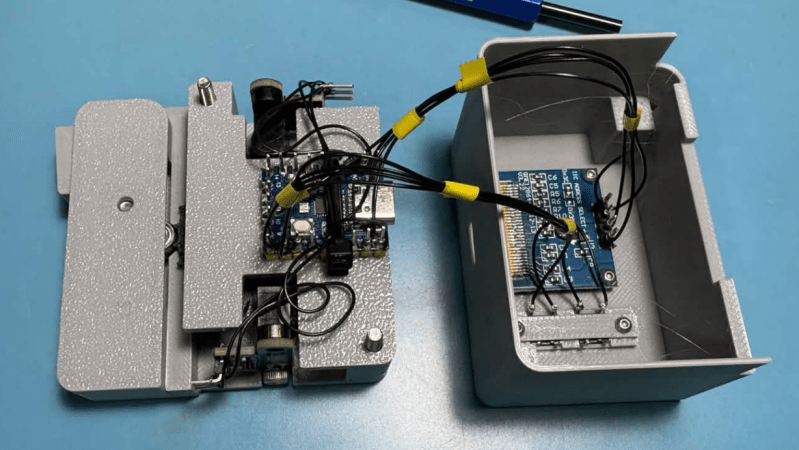
The Dotterboard is mostly 3D-printed and uses just a few common hardware parts such as springs and ball bearings. An OLED displays the current count, which comes from an encoder tracking movement and multiplying by the number of components per hole. At the heart sits an RP2040 Zero that needs nothing more than a single USB-C cable for power, unlike the bulky industrial SMT counters that demand AC outlets and desk space.

Be sure to check out all the details of the build on [John]’s website, and grab the files from his GitHub if you want to make your own. Let us know what are some projects you’ve done to save you the headache of doing the same task by hand for hours on end.

Continue reading “Tame The Tape: Open-Source Dotterboard For Bulk SMT Parts”

Image

Use A Gap-Cap To Embed Hardware In Your Next 3D Print

Embedding fasteners or other hardware into 3D prints is a useful technique, but it can bring challenges when applied to large or non-flat objects. The solution? Use a gap-cap.

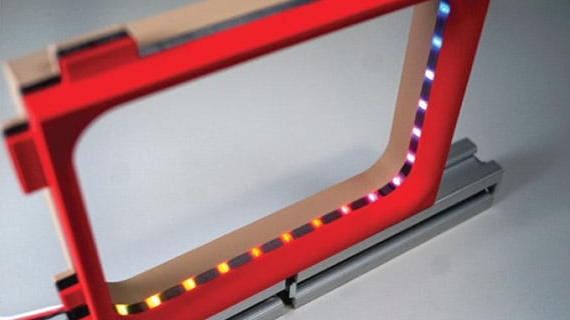
ImageThe gap-cap technique is essentially a 3D printed lid. One pauses a print, inserts hardware, then covers it with a lid before resuming the print. The lid — or gap-cap — does three things. It seals in the part, it fills in empty space left above the component, and it provides a nice flat surface for subsequent layers which makes the whole process much cleaner and more reliable.

This whole technique is a bit reminiscent of the idea of manual supports, except that the inserted piece is intended to be sealed into the print along with the embedded hardware under it.

If you have never inserted anything larger than a nut or small magnet into a 3D print, you may wonder why one needs to bother with a gap-cap at all. The short version is that what works for printing over small bits doesn’t reliably carry over to big, odd-shaped bits.

For one thing, filament generally doesn’t like to stick to embedded hardware. As the size of the inserted object increases, especially if it isn’t flat, it increasingly complicates the printer’s ability to seal it in cleanly. Because most nuts are small, even if the printer gets a little messy it probably doesn’t matter much. But what works for small nuts won’t work for something like an LED strip mounted on its side, as shown here.

Image
Cross-section of a print with an embedded LED strip. The print pauses (A), LED strip is inserted and capped with a gap-cap (B, C), then printing resumes and completes (D).

In cases like these a gap-cap is ideal. By pre-printing a form-fitting cap that covers the inserted hardware, one provides a smooth and flat surface that both seals the component in snugly while providing an ideal surface upon which to resume printing.

If needed, a bit of glue can help ensure a gap-cap doesn’t shift and cause trouble when printing resumes, but we can’t help but recall the pause-and-attach technique of embedding printed elements with the help of a LEGO-like connection. Perhaps a gap-cap designed in such a way would avoid needing any kind of adhesive at all.

Image

Take A Ride On Wrongbaud’s Hardware Hacking Highway

Regular Hackaday readers will no doubt be familiar with the work of Matthew Alt, AKA [wrongbaud]. His deep-dive blog posts break down hardware hacking and reverse engineering concepts in an engaging way, with practical examples that make even the most complex of topics approachable.

ImageBut one of the problems with having a back catalog of written articles is making sure they remain accessible as time goes on. (Ask us how we know.) Without some “algorithm” at play that’s going to kick out the appropriate article when it sees you’re interested in sniffing SPI, there needs to be a way to filter through the posts and find what’s relevant. Which is why the new “Roadmap” feature that [wrongbaud] has implemented on his site is so handy.

At the top of the page you’ll find [wrongbaud]’s recommended path for new players: it starts with getting your hardware and software together, and moves through working with protocols of varying complexity until it ends up at proper techno wizardry like fault injection.

Clicking any one of these milestones calls up the relevant articles — beginners can step through the whole process, while those with more experience can jump on wherever they feel comfortable. There’s also buttons that let you filter articles by topic, so for example you can pull up anything related to I2C or SPI.

Further down the page, there’s a helpful “Common Questions” section that gives you a brief overview of how to accomplish various goals, such as identify an unknown UART baud rate, or extract the contents of an SPI flash chip.

Based on the number and quality of the articles, [wrongbaud]’s site has always been on our shortlist of must-see content for anyone looking to get started with hardware hacking, and we think this new interface is going to make it even more useful for beginners who appreciate a structured approach to learning.

Image

Prevent Your Denon Receiver Turning On From Rogue Nvidia Shield CEC Requests

In theory HDMI’s CEC feature is great, as it gives HDMI devices the ability to do useful things such as turning on multiple HDMI devices with a single remote control. Of course, such a feature will inevitably feature bugs. A case in point is the Nvidia Shield which has often been reported to turn on other HDMI devices that should stay off. After getting ticked off by such issues one time too many, [Matt] decided to implement a network firewall project to prevent his receiver from getting messed with by the Shield.

The project is a Python-based network service that listens for the responsible rogue HDMI-CEC Zone 2 requests and talks with a Denon/Marantz receiver to prevent it from turning on unnecessarily. Of course, when you want these Zone 2 requests to do their thing you need to disable the script.

That said, HDMI-CEC is such a PITA that people keep running into issues like these over and over again, to the point where people are simply disabling the feature altogether. That said, Nvidia did recently release a Shield update that’s claimed to fix CEC issues, so maybe this is one CEC bug down already.

Image

Building A Hackerspace Entry System

A hackerspace is a place that generally needs to be accessed by a wide group of people, often at weird and unusual hours. Handing around keys and making sure everything is properly locked up can be messy, too. To make it easy for hackers to get in to [Peter]’s local hackerspace, a simple electronic system was whipped up to grant access.

Image
The combined use of QR code & PIN adds a layer of security.

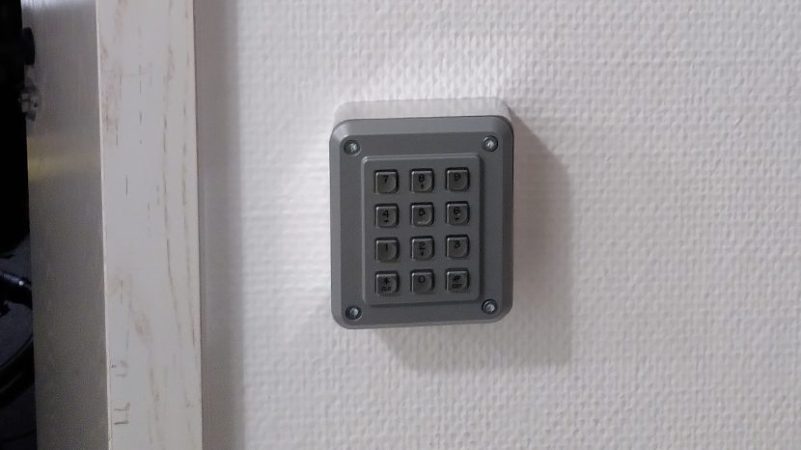
The basic components of the system are a keypad, a QR code and barcode scanner, a stepper motor, an Arduino Nano, and a Raspberry Pi. The keypad is read by an Arduino Nano, which is also responsible for talking to a stepper motor driver to actuate the lock cylinder. A secondary Arduino mounted inside the building is used to control the stepper motor, which actuates the lock cylinder once authentication is complete.

The system works on the basis of two-factor authentication. Regular users authenticate to enter by presenting a QR code or barcode, and entering a matching PIN number. The system can also be set up for PIN-only entry on a temporary basis.

For example, if the hackerspace is running an event, a simple four-digit pin can allow relatively free access for the duration without compromising long-term security. Actual authentication is handled by the Raspberry Pi, which takes in the scanned barcode and/or PIN, hashes it, and checks it against a backend database which determines if the credentials are valid for entry. If so,they command the second Arduino to unlock the door.

While it’s not technically necessary for a project like this — in fact, you could argue it’s preposterously overkill — we have to take particular note of the machined aluminum enclosure for the keypad. Mere mortals could just run it off on their 3D printers, but if you’ve got access to a CNC router and a suitably chunky piece of aluminum, why not show off a bit?

Continue reading “Building A Hackerspace Entry System”