Image

DC In The Data Center For A More Efficient Future

If you own a computer that’s not mobile, it’s almost certain that it will receive its power in some form from a mains wall outlet. Whether it’s 230 V at 50 Hz or 120 V at 60 Hz, where once there might have been a transformer and a rectifier there’s now a switch-mode power supply that delivers low voltage DC to your machine. It’s a system that’s efficient and works well on the desktop, but in the data center even its efficiency is starting to be insufficient. IEEE Spectrum has a look at newer data centers that are moving towards DC power distribution, raising some interesting points which bear a closer look.

A traditional data center has many computers which in power terms aren’t much different from your machine at home. They get their mains power at distribution voltage — probably 33 KV AC where this is being written — they bring it down to a more normal mains voltage with a transformer just like the one on your street, and then they feed a battery-backed uninterruptible Power Supply (UPS) that converts from AC to DC, and then back again to AC. The AC then snakes around the data center from rack to rack, and inside each computer there’s another rectifier and switch-mode power supply to make the low voltage DC the computer uses.

The increasing demands of data centers full of GPUs for AI processing have raised power consumption to the extent that all these conversion steps now cost a significant amount of wasted power. The new idea is to convert once to DC (at a rather scary 800 volts) and distribute it direct to the cabinet where the computer uses a more efficient switch mode converter to reach the voltages it needs.

It’s an attractive idea not just for the data center. We’ve mused on similar ideas in the past and even celebrated a solution at the local level. But given the potential ecological impact of these data centers, it’s a little hard to get excited about the idea in this context. The fourth of our rules for the responsible use of a new technology comes in to play. Fortunately we think that both an inevitable cooling of the current AI hype and a Moore’s Law driven move towards locally-run LLMs may go some way towards solving that problem on its own.


header image: Christopher Bowns, CC BY-SA 2.0.

Image

Comparing The Power Usage Of 12 VDC And 240 VAC Kettles

If you have a 12 VDC power system, like the battery of a PV solar system or car, would it be more efficient to boil water for that cup of tea with that 12V straight from the battery, or use a 240 VAC mains kettle via a ~90% efficient inverter instead? That’s the question that [Cahn] decided to answer experimentally, using a bulky 3 kW inverter and a collection of electric kettles.

Although the used amount of 500 mL of water is boiled much faster in the 2,200 Watt mains kettle than in the 150 and 350 Watt low-voltage kettles, this obvious difference is somewhat irrelevant if you’re only concerned with efficiency. To measure the power used a Victron smart shunt was used with each run, keeping in mind that a perfect efficiency for heating 500 mL from room temperature to boiling is around 43-44 Wh.

With two runs per kettle, the 240 VAC kettle used 65-70 Wh. The first ‘150 Watt’ kettle pulled nearly 200 Watt to boil the water after about 20 minutes, using 62-64 Wh. The second ‘150 Watt’ kettle pulled around 180 Watt, took 23-25 minutes and used 68-74 Wh. Finally, the ‘350 Watt’ kettle drew over 420 Watt and used 50-56  Wh in just over 8 minutes.

Continue reading “Comparing The Power Usage Of 12 VDC And 240 VAC Kettles”

Image

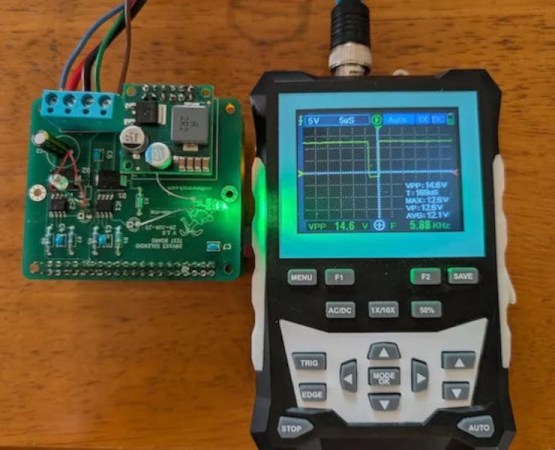
Converting A Sprinkler System To DC

Famously, Nikola Tesla won the War of the Currents in the early days of electrification because his AC system could use transformers to minimize losses for long distance circuits. That was well before the invention of the transistor, though, and there are a lot of systems that still use AC now as a result of electricity’s history that we might otherwise want to run on DC in our modern world. Sprinkler systems are one of these things, commonly using a 24V AC system, but [Vinthewrench] has done some work to convert over to a more flexible 24 VDC system instead.

The main components of these systems that are set up for AC are solenoids which activate various sets of sprinklers. But these solenoids can take DC and still work, so no major hardware changes are needed. It’s not quite as simple as changing power supplies, though. The solenoids will overheat if they’re fully powered on a DC circuit, so [Vinthewrench] did a significant amount of testing to figure out exactly how much power they need to stay engaged. Once the math was done, he uses a DRV103 to send PWM signals to the solenoids, which is set up to allow more current to pull in the solenoids and then a lower holding current once they are activated.

With a DC power supply like this, it makes it much easier to have his sprinkler system run on a solar powered system as well as use a battery backup without needing something like an inverter. And thanks to the DRV103 the conversion is not physically difficult; ensuring that the solenoids don’t overheat is the major concern here. Another great reason to convert to a DIY sprinkler controller is removing your lawn care routine from an unnecessary cloud-based service.

Image

Running Power And Data Over Just Two Wires

When you’re hooking up equipment across a vehicle, you’re often stuck sending power and data to and from things like sensors or actuators. The more wires you have to run, the more hassle, so it’s desirable to get this number as low as possible. That’s an especially big deal in the world of cycling electronics, where every additional gram is considered a drawback. To this end, companies have developed two-wire methods of sending power and data together, and now, [Keith Wakeham] has devised his own way of doing so.

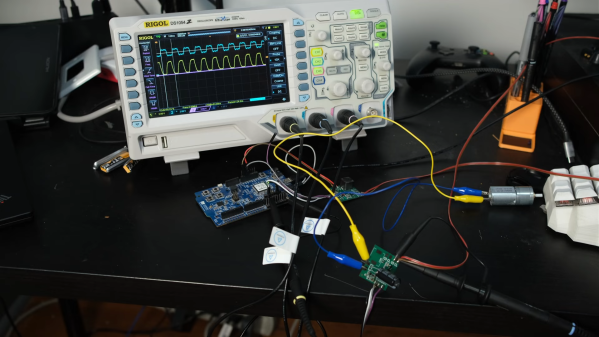
[Keith] was inspired by Shimano’s E-Tube system which is fairly fancy in its encoding schemes, but he went his own way. His concept relied on old-school On-Off Keying methods to take a signal and capacitively couple a signal into power lines. He explains the theory behind the method, and shares schematics that can be used to actually communicate over power lines. Then, he shows off the real hardware that he built to test the concept for himself.

The results? Good! [Keith] was able to maintain speeds of 57,600 bits/second even with an electrically-noisy gear motor operating on the lines. That’s more then enough for all kinds of applications.

If you’ve got your own data-over-powerline hacks, don’t hesitate to let us know. Continue reading “Running Power And Data Over Just Two Wires”

Image

Open Source DC UPS Keeps The Low-Voltage Gear Going

We all like to keep our network gear running during a power outage — trouble is, your standard consumer-grade uninterruptible power supply (UPS) tends to be overkill for routers and such. Their outlet strips built quickly get crowded with wall-warts, and why bother converting from DC to AC only to convert back again?

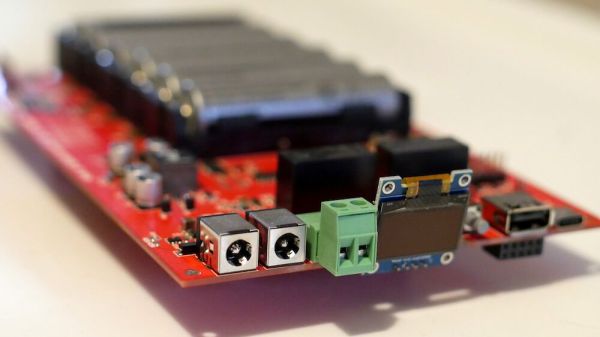
This common conundrum is the inspiration for [Walker]’s DC UPS design, which has some interesting features. First off, the design is open source, which of course invites tinkering and repurposing. The UPS is built for a 12 volt supply and load, but that obviously can be changed to suit your needs. The battery bank is a 4S3P design using 18650 cells, and that could be customized as well. There’s an ideal diode controller that prevents DC from back-feeding into the supply when the lights go out, and a really interesting synchronous buck-boost converter in place of the power management chip you’d normally see in a UPS. The converter chip takes a PWM signal from an RP2040; there’s also an ESP32 onboard for web server and UI duties as well as an STM32 to run the BMS. The video below discusses the design and shows a little of the build.

We’ve seen a spate of DC UPS designs lately, some more elaborate than others. This one has quite a few interesting chips that most of us don’t normally deal with, and it’s nice to see how they’re used in a practical design.

Continue reading “Open Source DC UPS Keeps The Low-Voltage Gear Going”

Image

Buck Converter Takes 8V To 100V

For those living before the invention of the transistor, the modern world must appear almost magical. Computers are everywhere now and are much more reliable, but there are other less obvious changes as well. Someone from that time would have needed a huge clunky machine like a motor-generator set to convert DC voltages, but we can do it with ease using a few integrated circuits. This one can take a huge range of input voltages to output a constant 5V.

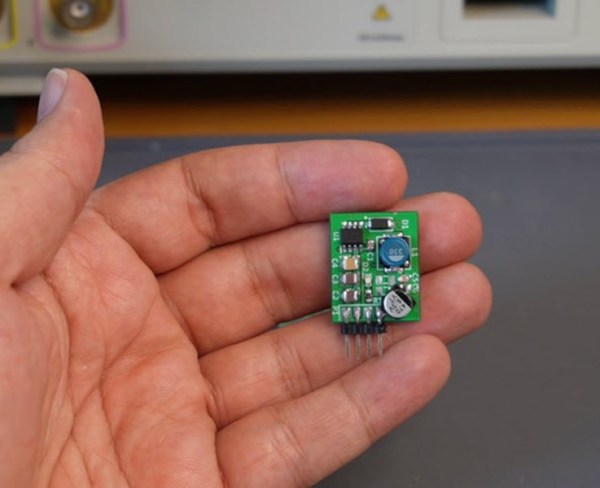
The buck converter was designed by [hesam.moshiri] using a MP9486 chip. While it is possible to use a multipurpose microcontroller like something from Atmel to perform the switching operation needed for DC-DC converters, using a purpose-built chip saves a lot of headache. The circuit was modified a little bit to support the higher input voltage ranges and improve its stability and reliability. The board is assembled in an incredibly tiny package with inputs and outputs readily accessible, so it would be fairly simple to add one into a project rather than designing it from scratch.

Even though buck converters, and other DC converters like boost and the mysterious buck-boost converter, seem like magic even to us, there is some interesting electrical theory going on if you’re willing to dive into the inner workings of high-frequency switching. Take a look at this explanation we featured a while back to see more about how buck converters, the more easily understood among them, work.

Image

High Voltage Power Supply From USB

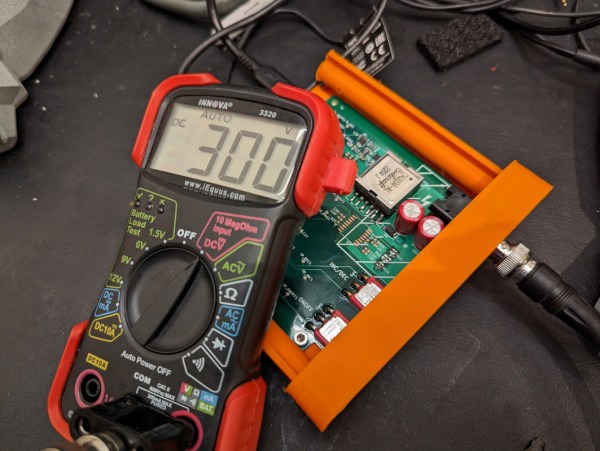
Those who work in different spaces may have different definitions of the term “high voltage”. For someone working on the GPIO pins of a Raspberry Pi it might be as little as 5 volts, someone working on a Tesla coil might consider that to be around 20 kV, and an electrical line worker might not reference something as HV until 115 kV. What we could perhaps all agree on, though, is that getting 300 volts out of a USB power supply is certainly a “high voltage” we wouldn’t normally expect to see in that kind of context, but [Aylo6061] needed just such a power supply and was eventually able to create one.

In this case, the high voltages will eventually be used for electrophoresis or electrowetting. But before getting there, [Aylo6061] has built one of the safest looking circuits we’ve seen in recent memory. Every high voltage part is hidden behind double insulation, and there is complete isolation between the high and low voltage sides thanks to a flyback converter. This has the benefit of a floating ground which reduces the risk of accidental shock. This does cause some challenges though, as voltage sensing on the high side is difficult while maintaining isolation, so some clever tricks were implemented to maintain the correct target output voltage.

The control circuitry is based around an RP2040 chip and is impressive in its own right, with USB isolation for the data lines as well. Additionally the project code can be found at its GitHub page. Thanks to a part shortage, [Aylo6061] dedicated an entire core of the microprocessor to decoding digital data from the high voltage sensor circuitry. For something with a little less refinement, less safety, and a much higher voltage output, though, take a look at this power supply which tops its output voltage around 30 kV.