Art of 3D printer in the middle of printing a Hackaday Jolly Wrencher logo

The Joys Of 3D Printing

Al and I were talking on the podcast today about a sweet 3D printed wide-format camera build, and we got to musing on why we 3D-print.

For Al, it’s an opportunity to experiment with 3D printing itself: tweaking his machines to get the best performance out of them. Other people make small, functional objects that they need in their daily life, like bag clips or spare parts for broken appliances. Some folks go for the ornamental or the aesthetic. The kids in my son’s class all seem obsessed with sci-fi props and fidget toys. The initial RepRap ideal was to replace all commercial fabrication with machines owned by the individual, rather than by companies – it was going to be Marxist revolutionary.

But there’s another group of 3D printer enthusiasts that I think doesn’t get enough coverage, and I’m going to call them the hobbyist industrial designers. These are the people who design a custom dog-poop-bag holder that exactly fits their extra-wide dog leash, not because they couldn’t find one that fit in the pet store, but because it’s simply fun to design and fabricate things. (OK, that’s literally me.)

It’s fun to learn CAD tools, to learn about how things are designed, how they work, and how to manufacture them at least in quantity one. Dreaming, designing, fabricating, failing, and repeating until you get it right is a great joy. And then you get to use the poop-bag holder every day for a few years, until you decide to refine the design and incorporate the lessons learned on the tough streets of practical use.

Of course none of this is exclusive to 3D printing. There were always people who designed-and-built things in the metal machine shop, or made their creations out of wood. In that sense, the 3D printer is just another tool, and the real fun isn’t in using the 3D printer, but rather in the process of bringing things out of your mind and into the world. So maybe there is nothing new here, but the latitude that 3D printing affords the hobby designer is amazing, and that makes it all the more fun, and challenging.

So do you 3D print for necessity, to stick it to the man, to pimp your printer, for the mini-figs, or simply for the joy of the process of making things? It’s all good. 3D printing is a big tent.
Image

An Introduction To Analog Filtering

One of the major difficulties in studying electricity, especially when compared to many other physical phenomena, is that it cannot be observed directly by human senses. We can manipulate it to perform various tasks and see its effects indirectly, like the ionized channels formed during lightning strikes or the resistive heating of objects, but its underlying behavior is largely hidden from view. Even mathematical descriptions can quickly become complex and counter-intuitive, obscured behind layers of math and theory. Still, [lcamtuf] has made some strides in demystifying aspects of electricity in this introduction to analog filters.

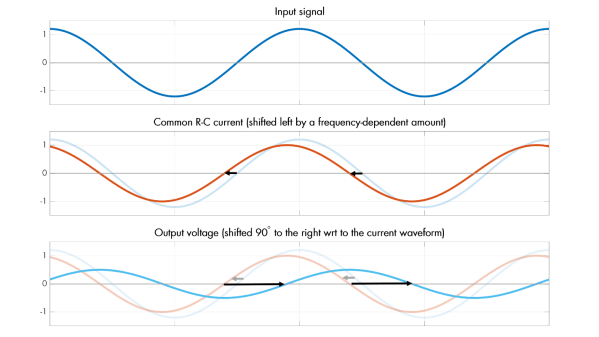
ImageThe discussion on analog filters looks at a few straightforward examples first. Starting with an resistor-capacitor (RC) filter, [lcamtuf] explains it by breaking its behavior down into steps of how the circuit behaves over time. Starting with a DC source and no load, and then removing the resistor to show just the behavior of a capacitor, shows the basics of this circuit from various perspectives. From there it moves into how it behaves when exposed to a sine wave instead of a DC source, which is key to understanding its behavior in arbitrary analog environments such as those involved in audio applications.

There’s some math underlying all of these explanations, of course, but it’s not overwhelming like a third-year electrical engineering course might be. For anyone looking to get into signal processing or even just building a really nice set of speakers for their home theater, this is an excellent primer. We’ve seen some other demonstrations of filtering data as well, like this one which demonstrates basic filtering using a microcontroller.

Image

The Subtle Art Of Letterform Design

Typeface (such as Times New Roman) refers to the design that gives a set of letters, numbers, and symbols their signature “look”. Font, on the other hand, is a specific implementation of a typeface, for example, Times New Roman Italic 12 pt.

Image
‘Q’ is a counterpoint to the idea that typography is just one fussy detail after another.

Right about this point, some of you are nodding along and perhaps thinking “oh, that’s interesting,” while the rest of you are already hovering over your browser’s Back button. If you’re one of the former, you may be interested in checking out the (sort of) interactive tour of typography design elements by the Ohno Type School, a small group that loves design.

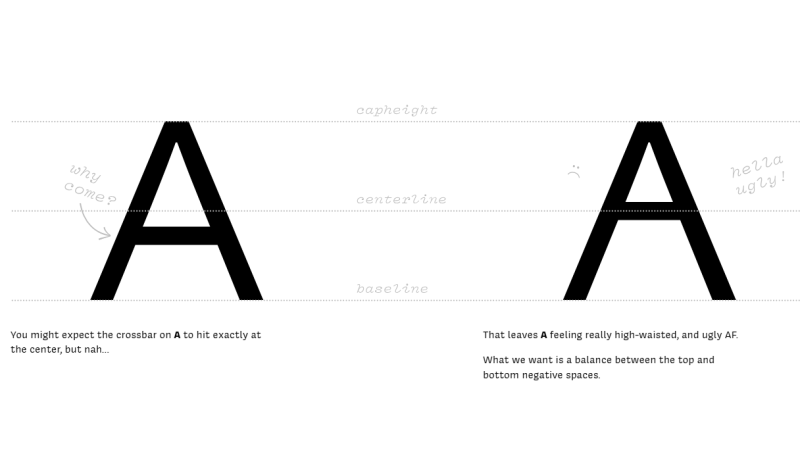
On one hand, letters are simple and readily recognizable symbols. But at the same time, their simplicity puts a lot of weight on seemingly minor elements. Small changes can have a big visual impact. The tour lays bare answers to questions such as: What is the optimal parting of the cheeks of a capital ‘B’? At what height should the crossbar on an ‘A’ sit, and why does it look so weird if done incorrectly? And yet, the tail of a ‘Q’ can be just about anything? How and why does an ‘H’ define the spacing of the entire typeface? All these (and more) are laid bare.

Continue reading “The Subtle Art Of Letterform Design”

Image

Personalization, Industrial Design, And Hacked Devices

[Maya Posch] wrote up an insightful, and maybe a bit controversial, piece on the state of consumer goods design: The Death Of Industrial Design And The Era Of Dull Electronics. Her basic thesis is that the “form follows function” aesthetic has gone too far, and all of the functionally equivalent devices in our life now all look exactly the same. Take the cellphone, for example. They are all slabs of screen, with a tiny bezel if any. They are non-objects, meant to disappear, instead of showcases for cool industrial design.

Of course this is an extreme example, and the comments section went wild on this one. Why? Because we all want the things we build to be beautiful and functional, and that has always been in conflict. So even if you agree with [Maya] on the suppression of designed form in consumer goods, you have to admit that it’s not universal. For instance, none of our houses look alike, even though the purpose is exactly the same. (Ironically, architecture is the source of the form follows function fetish.) Cars are somewhere in between, and maybe the cellphone is the other end of the spectrum from architecture. There is plenty of room for form and function in this world.

But consider the smartphone case – the thing you’ve got around your phone right now. In a world where people have the ultimate homogeneous device in their pocket, one for which slimness is a prime selling point, nearly everyone has added a few millimeters of thickness to theirs, aftermarket, in the form of a decorative case. It’s ironically this horrendous sameness of every cell phone that makes us want to ornament them, even if that means sacrificing on the thickness specs.

ImageIs this the same impetus that gave us the cyberdeck movement? The custom mechanical keyboard? All kinds of sweet hacks on consumer goods? The need to make things your own and personal is pretty much universal, and maybe even a better example of what we want out of nice design: a device that speaks to you directly because it represents your work.

Granted, buying a phone case isn’t necessarily creative in the same way as hacking a phone is, but it at least lets you exercise a bit of your own design impulse. And it frees the designers from having to make a super-personal choice like this for you. How about a “nothing” design that affords easy personalized ornamentation? Has the slab smartphone solved the form-versus-function fight after all?

Image

Learn 15 Print-in-Place Mechanisms In 15 Minutes

3D printed in-place mechanisms and flexures, such as living hinges, are really neat when you can get them to print correctly. But how do you actually do that? YouTuber [Slant 3D] is here with a helpful video demonstrating the different kinds of springs and hinges (Video, embedded below) that can be printed reliably, and discusses some common pitfalls and areas to concentrate upon.

Living hinges are everywhere and have been used at least as long as humans have been around. The principle is simple enough; join two sections to move with a thinned section of material that, in small sections, is flexible enough to distort a few times without breaking off. The key section is “a few times”, as all materials will eventually fail due to overworking. However, if this thing is just a cheap plastic case around a low-cost product, that may not be a huge concern. The video shows a few ways to extend flexibility, such as spreading the bending load across multiple flexure elements to reduce the wear of individual parts, but that comes at the cost of compactness.

Continue reading “Learn 15 Print-in-Place Mechanisms In 15 Minutes”

Image

Back To Reality With The Time Brick

There are a lot of distractions in daily life, especially with all the different forms of technology and their accompanying algorithms vying for our attention in the modern world. [mar1ash] makes the same observation about our shared experiences fighting to stay sane with all these push notifications and alerts, and wanted something a little simpler that can just tell time and perhaps a few other things. Enter the time brick.

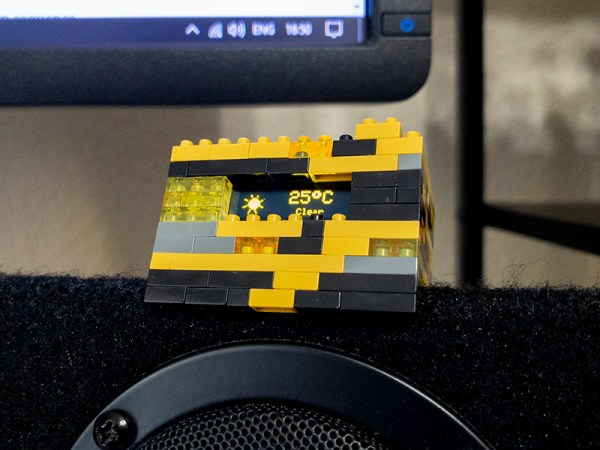
The time brick is a simple way of keeping track of the most basic of things in the real world: time and weather. The device has no buttons and only a small OLED display. Based on an ESP-01 module and housed in a LEGO-like enclosure, the USB-powered clock sits quietly by a bed or computer with no need for any user interaction at all. It gets its information over a Wi-Fi connection configured in the code running on the device, and cycles through not only time, date, and weather but also a series of pre-programmed quotes of a surreal nature, since part of [mar1ash]’s goals for this project was to do something just a little bit outside the norm.

There are a few other quirks in this tiny device as well, including animations for the weather display, a “night mode” that’s automatically activated to account for low-light conditions, and the ability to easily handle WiFi drops and other errors without crashing. All of the project’s code is also available on its GitHub page. As far as design goes, it’s an excellent demonstration that successful projects have to avoid feature creep, and that doing one thing well is often a better design philosophy than adding needless complications.

Image

Have Li-ion Batteries Gone Too Far?

The proliferation of affordable lithium batteries has made modern life convenient in a way we could only imagine in the 80s when everything was powered by squadrons of AAs, or has it? [Ian Bogost] ponders whether sticking a lithium in every new device is really the best idea.

There’s no doubt, that for some applications, lithium-based chemistries are a critically-enabling technology. NiMH-based EVs of the 1990s suffered short range and slow recharge times which made them only useful as commuter cars, but is a flashlight really better with lithium than with a replaceable cell? When household electronics are treated as disposable, and Right to Repair is only a glimmer in the eye of some legislators, a worn-out cell in a rarely-used device might destine it to the trash bin, especially for the less technically inclined.

[Bogost] decries “the misconception that rechargeables are always better,” although we wonder why his article completely fails to mention the existence of rechargeable NiMH AAs and AAAs which are loads better than their forebears in the 90s. Perhaps even more relevantly, standardized pouch and cylindrical lithium cells are available like the venerable 18650 which we know many makers prefer due to their easy-to-obtain nature. Regardless, we can certainly agree with the author that easy to source and replace batteries are few and far between in many consumer electronics these days. Perhaps new EU regulations will help?

Once you’ve selected a battery for your project, don’t forget to manage it if it’s a Li-ion cell. With great power density, comes great responsibility.