Image

Burning Wood To Brew Wood To Preserve Wood : Pine Tar

Before there was pressure-treated wood, before modern paints, there was pine tar. Everything from tool handles to wagons to ships were made of wood preserved with pine tar, once upon a time, and [woodbrew] wants to show you how to make it, how to use it, and why you might put it on your skin.

It starts with, you guessed it, pine! In the first part of the video, [woodbrew] creates a skin salve with pine resin and food-safe oil. The pine resin–which is the sticky goop that dries around wounds on evergreen trees–is highly antiseptic and has been used in wound salves since the stone age. The process is easy: melt it in a double boiler, then mix with equal parts oil. [woodbrew] also adds a touch of beeswax to firm it up, an a little eucalyptus extract for extra germ-killing power, and a nice smell to boot.

That’ll preserve your hands, but what about preserving wood?  That starts at about 9 minutes in, and for that you’re going to need a lot more resin, so picking it off wounded trees like he does at the start of the video won’t work. [woodbrew] suggests starting with dead-or-dying pines, and harvesting the crooks of their branches for “fatwood” — wood with the highest resin content. He also suggests the center of stumps, again of trees that died or were severely injured before being cut down. Then it’s a matter of cooking those fine organic molecules out. This is where we burn the wood to save the wood. Well, to save other wood. Wood we didn’t burn, obviously.

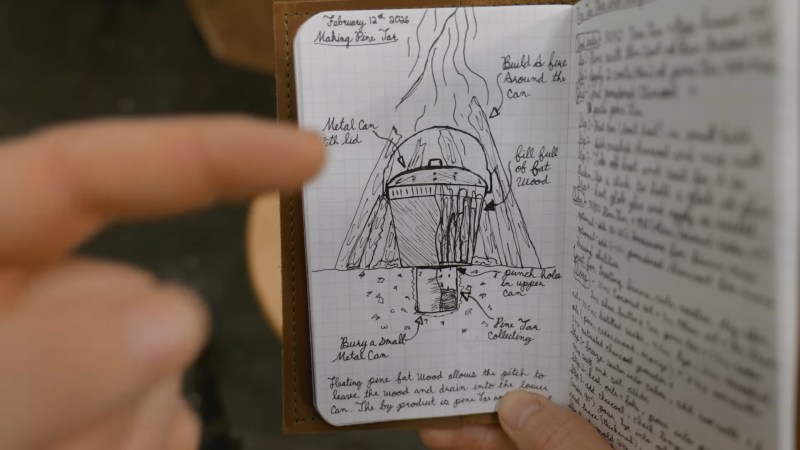
The distillation process [woodbrew] uses it fairly traditional, and consists of a couple of buckets. One bucket is buried and collects the pine tar; the other, with holes in the bottom to allow the tar to drip out, is filled with fatwood and covered tightly before being surrounded by firewood which is set alight. You could use an alternate source of heat here, but if you just cut down a pine tree for its fatwood, well, you’d have the rest of the tree to work with. Inside the fatwood bucket, the heat of the fire cooks off the volatile compounds that make pine tar, while the lack of oxygen from being closed up keeps it from burning. Burying the collection bucket keeps it from getting so hot the volatiles all boil off.

If this sounds like the process for making charcoal or woodgas, that’s because it is! He’s letting the gas fraction flare off here, but you could probably capture it– though a true gasifier brakes the tar down into gaseous compounds as well. The charcoal of course stays in the bucket as a bonus.

To make it usable as a wood finish, [woodbrew] mixes his homemade pine tar 50:50 with linseed oil, thining it to a spreadable consistency that helps it penetrate deep into the wood. By filling the voids in the wood, this mixture will help keep moisture out, and the antiseptic properties of the organic soup that is pine tar will help keep fungi at bay for potentially decades to come.

Thanks to [Keith Olson] for the tip!

Continue reading “Burning Wood To Brew Wood To Preserve Wood : Pine Tar”
Image

Off-Grid Electricity And Hot Water From Scrap Wood

Cooking with charcoal is a fairly common human activity, as much as others have come to prefer fuels like propane and propane accessories for their outdoor, summertime grilling. Although it’s made from wood, it has properties that make it much more useful for cooking — including burning at a higher temperature and with more consistent burn rates. It can also be used as a fuel for generating heat and electricity, but since it’s not typically found lying around in the forest it has to be produced, which [Greenhill Forge] has demonstrated his charcoal production system in one of his latest videos.

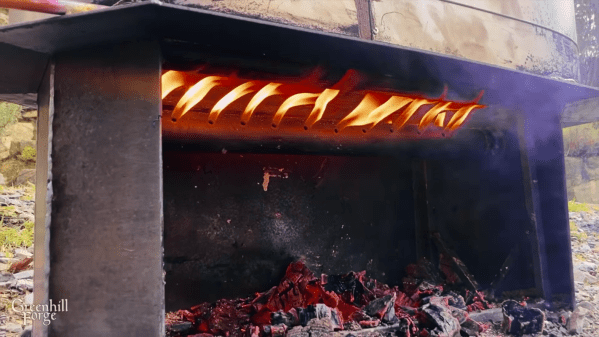
The process for creating charcoal is fairly simple. All that needs to happen is for wood to be heated beyond a certain temperature in the absence of oxygen. At this point it will off-gas the water stored in it as well as some of the volatile organic compounds, and what’s left behind is a flammable carbon residue. Those volatile organics are flammable as well, though, so [Greenhill Forge] uses them to heat the wood in a self-sustaining reaction. First, a metal retort is constructed from a metal ammo box, with a pipe extending from the side and then underneath the box. A few holes are drilled in this part, and the apparatus is mounted above a small fire on a metal stand. With the fire lit the wood begins heating, and as it heats these compounds exit the pipe and ignite, adding further fuel to the fire. Eventually the small fire will go out, allowing the retort to heat itself on the gasses released from the wood alone.

To generate the hot water, [Greenhill Forge] has taken an extra step and enclosed the retort in a double walled metal cylinder. Inside the cylinder is a copper tube packed in sand, which harvests the waste heat from the charcoal production for hot water. In his test runs, the water in a large drum was heated to the point that the tubing he used for the test began to melt, so it is certainly working better than he expected.

After the retort cools, [Greenhill Forge] uses the charcoal in another process that generates about a days’ worth of electricity and hot water. It’s part of a complete off-grid system that’s fairly carbon neutral, since trees are an abundant renewable resource compared to fossil fuels. Heating with wood directly is still common in many cold areas around the world, with the one major downside being the labor required to keep the stove running. But we’ve seen at least one project which solves this problem as well.

Continue reading “Off-Grid Electricity And Hot Water From Scrap Wood”

Image

Lumafield Shows Why Your Cheap 18650 Cells Are Terrible

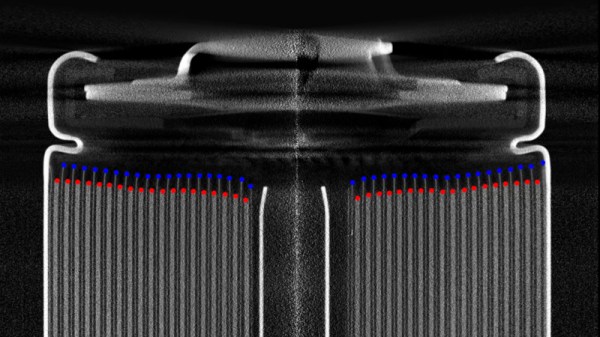
Lithium-ion cells deliver very high energy densities compared to many other battery technologies, but they bring with them a danger of fire or explosion if they are misused. We’re mostly aware of the battery conditioning requirements to ensure cells stay in a safe condition, but how much do we know about the construction of the cells as a factor? [Lumafield] is an industrial imaging company, and to demonstrate their expertise, they’ve subjected a large number of 18650 cells from different brands to a CT scan.

The construction of an 18650 sees the various layers of the cell rolled up in a spiral inside the metal tube that makes up the cell body. The construction of this “jellyroll” is key to the quality of the cell. [Lumafield’s] conclusions go into detail over the various inconsistencies in this spiral, which can result in cell failure. It’s important that the edges of the spiral be straight and that there is no electrode overhang. Perhaps unsurprisingly, they find that cheap no-name cells are poorly constructed and more likely to fail, but it’s also interesting to note that these low-quality cells also have fewer layers in their spiral.

We hope that none of you see more of the inside of a cell in real life than you have to, as they’re best left alone, but this report certainly sheds some light as to what’s going on inside a cell. Of course, even the best cells can still be dangerous without protection.

Image

South Korea Brought High-Rise Fire Escape Solutions To The Masses

When a fire breaks out in a high-rise building, conventional wisdom is that stairwells are the only way out. Lifts are verboten in such scenarios, while sheer height typically prevents any other viable route of egress from tall modern buildings. If the stairs are impassable, or you can’t reach them, you’re in dire peril.

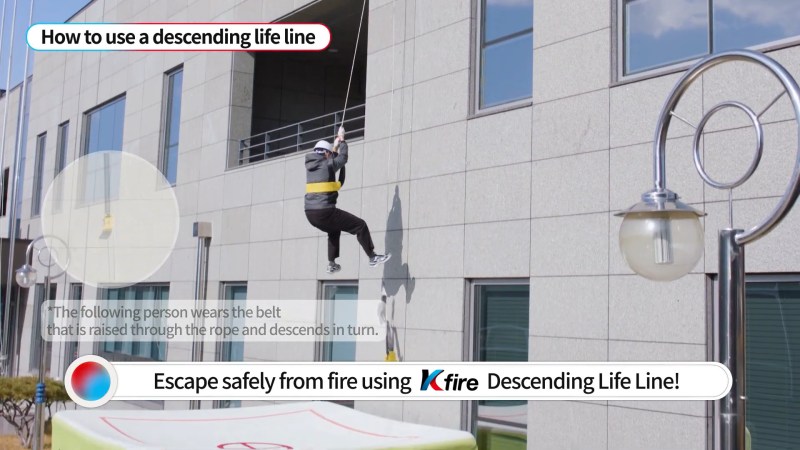
In South Korea, though, there’s another option for escape. The answer involves strapping on a harness and descending down ropes hanging off the side of the building, just like in an action movie. It might sound terrifying, but these descending lifeline devices have become a common part of fire safety infrastructure across the country.

Continue reading “South Korea Brought High-Rise Fire Escape Solutions To The Masses”

Image

Is Fire Conductive Enough To Power A Lamp?

Is fire conductive? As ridiculous that may sound at first glance, from a physics perspective the rapid oxidation process we call ‘fire’ produces a lot of substances that can reduce the electrical insulating (dielectric) properties of air. Is this change enough to allow for significant current to pass? To test this, [The Action Lab] on YouTube ran some experiments after being called out on this apparent fact in the comments to an earlier video.

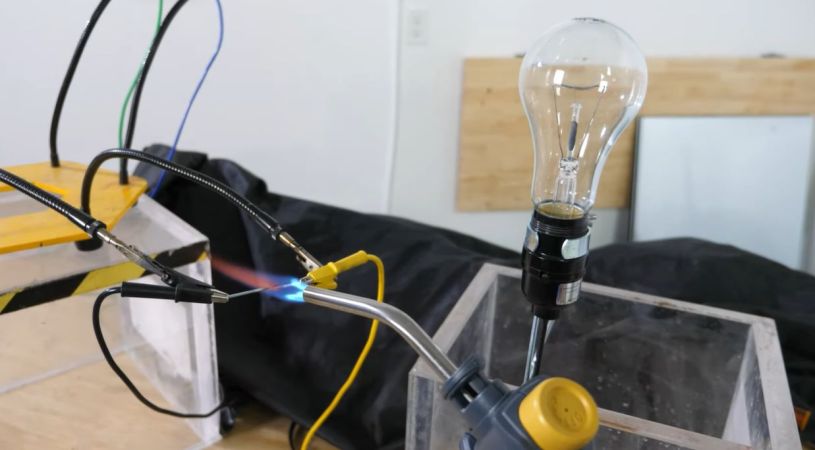
Ultimately what you need to make ‘fire’ conductive is to have an appreciable amount of plasma to reduce the dielectric constant, which means that you cannot just use any rapid oxidation process. In the demonstration with lights and what appears to be a (relatively clean-burning) butane torch, the current conducted is not enough to light up an incandescent or LED light bulb, but can light up a 5 mm LED. When using his arm as a de-facto sensor, it does not conduct enough current to be noticeable.

The more interesting experiment here demonstrates the difference in dielectric breakdown of air at different temperatures. As the dielectric constant for hot air is much lower than for room temperature air, even a clean burning torch is enough to register on a multimeter. Ultimately this seems to be the biggest hazard with fire around exposed (HV) electrical systems, as the ionic density of most types of fire just isn’t high enough.

To reliably strike a conductive plasma arc, you’d need something like explosive (copper) wire and a few thousand joules to pump through it.

Continue reading “Is Fire Conductive Enough To Power A Lamp?”

Hackaday Links Column Banner

Hackaday Links: January 12, 2025

The big news story of the week of course has been the wildfires in California, which as of Saturday have burned over 30,000 acres, destroyed 12,000 structures, caused 150,000 people to evacuate, and killed eleven people. Actually, calling them wildfires underplays the situation a bit because there are places where they’ve clearly become firestorms, burning intensely enough to create their own winds, consuming everything in their path in a horrific positive feedback loop. We’ve even seen fire tornados caught on video. We’ve got quite a few connections to the affected area, both personally and professionally, not least of which are all our Supplyframe colleagues in Pasadena, who are under immediate threat from the Eaton fire. We don’t know many details yet, but we’ve heard that some have lost homes. We’ve also got friends at the Jet Propulsion Labs, which closed a few days ago to all but emergency personnel. The fire doesn’t seem to have made it down the mountain yet, but it’s very close as of Saturday noon.

Continue reading “Hackaday Links: January 12, 2025”

Hackaday Links Column Banner

Hackaday Links: September 22, 2024

Thanks a lot, Elon. Or maybe not, depending on how this report that China used Starlink signals to detect low-observable targets pans out. There aren’t a lot of details, and we couldn’t find anything approximating a primary source, but it seems like the idea is based on forward scatter, which is when waves striking an object are deflected only a little bit. The test setup for this experiment was a ground-based receiver listening to the downlink signal from a Starlink satellite while a DJI Phantom 4 Pro drone was flown into the signal path. The drone was chosen because nobody had a spare F-22 or F-35 lying around, and its radar cross-section is about that of one of these stealth fighters. They claim that this passive detection method was able to make out details about the drone, but as with most reporting these days, this needs to be taken with an ample pinch of salt. Still, it’s an interesting development that may change things up in the stealth superiority field.

Continue reading “Hackaday Links: September 22, 2024”