Image

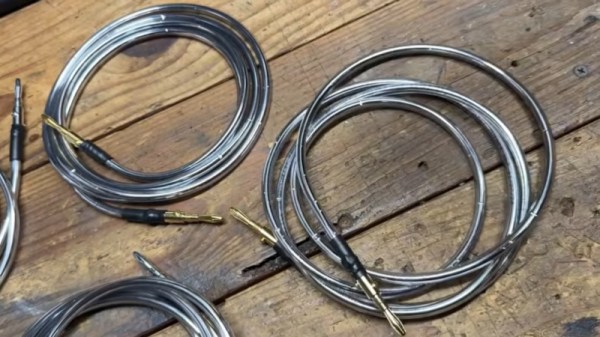
Mercury Audio Cables, So Nobody Else Has To Do It

We’ve seen our fair share of audiophile tomfoolery here at Hackaday, and we’ve even poked fun at a few of them over the years. Perhaps one of the most outrageously over the top that we’ve so far seen comes from [Pierogi Engineering] who, we’ll grant you not in a spirit of audiophile expectation, has made a set of speaker interconnects using liquid mercury.

In terms of construction they’re transparent tubes filled with mercury and capped off with 4 mm plugs as you might expect. We hear them compared with copper cables and from where we’re sitting we can’t tell any difference, but as we’ve said in the past, the only metrics that matter in this field come from an audio analyzer.

But that’s not what we take away from the video below the break. Being honest for a minute, there was a discussion among Hackaday editors as to whether or not we should feature this story. He’s handling significant quantities of mercury, and it’s probably not over reacting to express concerns about his procedures. We wouldn’t handle mercury like that, and we’d suggest that unless you want to turn your home into a Superfund site, you shouldn’t either. But now someone has, so at least there’s no need for anyone else to answer the question as to whether mercury makes a good interconnect.

Continue reading “Mercury Audio Cables, So Nobody Else Has To Do It”
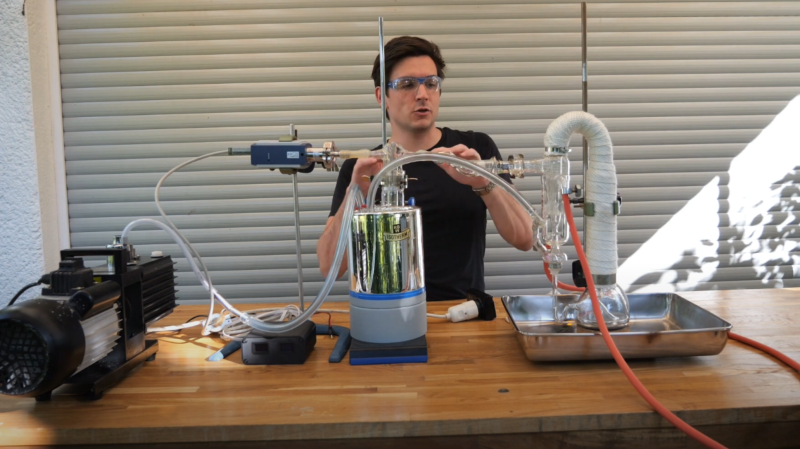
A man is shown behind a table, on which a glass apparatus like a distillation apparatus is set, with outlets leading into a large container in the center of the table, and from there to a pump.

Pulling A High Vacuum With Boiling Mercury

If you need to create a high vacuum, there are basically two options: turbomolecular pumps and diffusion pumps. Turbomolecular pumps require rotors spinning at many thousands of rotations per minute and must be carefully balanced to avoid a violent self-disassembly, but diffusion pumps aren’t without danger either, particularly if, like [Advanced Tinkering], you use mercury as your working fluid. Between the high vacuum, boiling mercury, and the previous two being contained in fragile glassware, this is a project that takes steady nerves to attempt – and could considerably unsteady those nerves if something were to go wrong.

Continue reading “Pulling A High Vacuum With Boiling Mercury”

Image

On The Nature Of Electricity: Recreating The Early Experiments

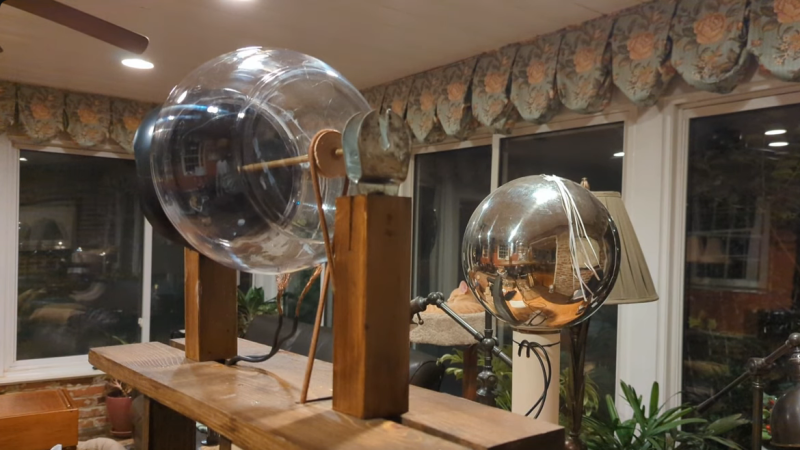
Bits of material levitating against gravity, a stream of water deflected by invisible means, sparks of light appearing out of thin air; with observations like those, it’s a wonder that the early experiments into the nature of electricity progressed beyond the catch-all explanation of magic. And yet they did, but not without a lot of lamb’s bladders and sulfur globes, and not a little hand waving in the process. And urine — lots and lots of urine.

Looking into these early electrical experiments and recreating them is the unlikely space [Sam Gallagher] has staked out with the “Experimental History of Electricity,” a growing playlist on his criminally undersubscribed YouTube channel. The video linked below is his latest, describing the apparatus one Francis Hauksbee used to generate static electric charges for his early 18th-century experiments. Hauksbee’s name is nowhere near as well-known as that of Otto von Guericke or William Gilbert, who in the two centuries before Hauksbee conducted their own experiments and who both make appearances in the series. But Hauksbee’s machine, a rotating glass globe charged by the lightest touch of a leather pad, which [Sam] does a fantastic job recreating as closely as possible using period-correct materials and methods, allowed him to explore the nature of electricity in much greater depth than his predecessors.

But what about the urine? As with many of the experiments at the time, alchemists used what they had to create the reagents they needed, and it turned out that urine was a dandy source of phosphorous, which gave off a brilliant light when sufficiently heated. The faint light given off by mercury when shaken in the vacuum within a barometer seemed similar enough that it became known as the “mercurial phosphor” that likely inspired Hauksbee’s electrical experiments, which when coupled with a vacuum apparatus nearly led to the invention of the mercury discharge lamp, nearly 200 years early. The more you know. Continue reading “On The Nature Of Electricity: Recreating The Early Experiments”

Image

Toxic Telescope Makes You Mad As A Hatter

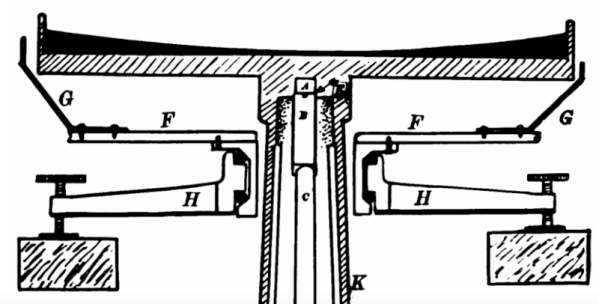
[Hank Green] posted an interesting video about the first liquid mirror telescope from back in the 1850s. At the time, scientists were not impressed. But, these days, people are revisiting the idea. The big problem with the early telescope is that it used mercury. Mercury is really bad for people and the environment.

The good thing about a liquid scope is that you can pretty easily make a large mirror. You just need a shallow pool of liquid and a way to spin it. However, there are downsides. You need to isolate the liquid from vibrations and dust. Another downside is that since gravity makes the shape of the mirror, these telescopes only go one way — straight up.

Continue reading “Toxic Telescope Makes You Mad As A Hatter”

Image

The Story Of The Quickening: Mercurial Metal

Of all known metals, mercury is probably one of the most famous, if only for its lustrous, liquid form at room temperature. Over the centuries, it has been commonly used in a wide variety of applications, including industrial chemical processes, in cosmetics, for telescope mirrors, thermometers, fluorescent lamps, dental fillings, bearings, batteries, switches and most recently in atomic clocks.

Though hardly free from the controversy often surrounding a toxic heavy metal, it’s hard to argue the myriad ways in which mercury has played a positive role in humanity’s technological progress and scientific discoveries. This article will focus both on its historical, current, and possible future uses, as well as the darker side of this fascinating metal.

Continue reading “The Story Of The Quickening: Mercurial Metal”

Image

Recreating Space Cameras

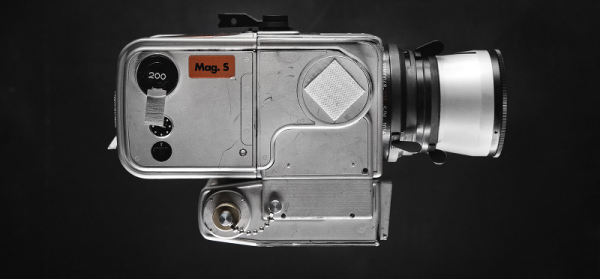
[Cole Price] describes himself as a photographer and a space nerd. We’ll give that to him since his web site clearly shows a love of cameras and a love of the NASA programs from the 1960s. [Cole] has painstakingly made replicas of cameras used in the space program including a Hasselblad 500C used on a Mercury flight and another Hasselblad used during Apollo 11. His work is on display in several venues — for example, the 500C is in the Carl Zeiss headquarters building.

[Cole’s] only made a detailed post about 500C and a teaser about the Apollo 11 camera. However, there’s a lot of detail about what NASA — and an RCA technician named [Red Williams] — did to get the camera space-ready.

Continue reading “Recreating Space Cameras”

Image

Travel To Mercury On Ion Power

Star Trek — as much as we love it — was guilty sometimes of a bit of hyperbole and more than its share of inconsistency. In some episodes, ion drives were advanced technology and in others they were obsolete. Make up your mind!

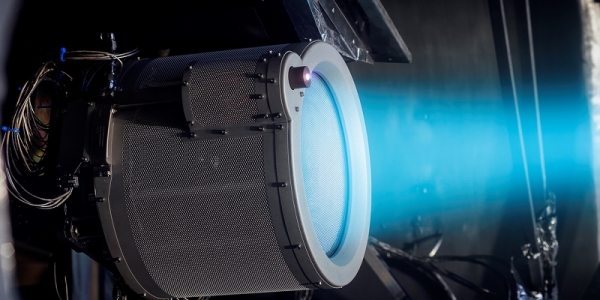
The ESA-JAXA BepiColombo probe is on its way to Mercury riding on four ion thrusters developed by a company called QinetiQ. But unlike the ion drive featured in the infamous “Spock’s Brain” episode, BepiColombo will take over seven years to get to Mercury. That’s because these ion drives are real.

The craft is actually two spacecraft in one with two different Mercury missions. The Mercury planetary orbiter will study the surface while the magnetosphere orbiter will study the little planet’s magnetic field. Check out a video about the mission, below. The second video shows [Neil Wallace] talking about how the ion propulsion — also known as solar electric engines — differ from traditional chemical thrusters.

Continue reading “Travel To Mercury On Ion Power”