
I’m an unusual Trek fan in that I just wasn’t into the series in the 80s and 90s. I checked out of TNG and Deep Space 9, which most Trek fans today consider classic Trek.
My history of Trek fandom goes TOS -> TAS -> movies -> Discovery, SNW and Starfleet Academy.
I have never clicked with the current animated Treks, though I did love the 70s animated series, which I rewatched with Julie sometime in the past 25 years or so and it was still pretty good.
I read “Soul of a New Machine,” by Tracy Kidder, who died last week, at about the time I switched from daily newspaper journalism to trade journalism in the technology industry, either just before making the career switch or just after. The book was published in 1981 and I made the career switch in 1989.
In my work, I wrote about Data General, the company that is the subject of “Soul of a New Machine.” I’m pretty sure I interviewed Tom West, the main character of the book, though I did not connect him with the book until after the interview, and the interview was straightforward and unmemorable, focused on company strategy or a new product or something like that.
“Soul of a New Machine” was a major contributor to the belief that a career in the technology industry could be more than just a career — it could be a calling, a life mission. And that was true for my career as well, as a trade journalist. I believed it.
With regard to trade journalism, I now believe that philosophy to be a myth, which of course benefits publishers, who profit from trade journalists’ commitment.
I now think of trade journalism as a trade, like plumbing or carpentry or electrical work. It’s a good job for people like me. It can be an important part of the foundation on which to build a good life. But it should not be your life purpose.
Jessamyn West, longtime Vermont librarian, technologist and one of the first generation of bloggers, remembers Tracy Kidder, author of “Soul of a New Machine,” who died recently. West’s father was the main character of the 1981 book and he and Kidder were friends.
“Tracy basically lived at our house on weekends while he was writing Soul of a New Machine. Sometimes he and my dad would go sailing, sometimes he’d just hang out at the house or go to work with my dad,” West writes.
While Tom West was legendary for his commitment to work, that meant he was an absentee father.
“My message to the men who told me how much the book meant to them when they were entering the world of technology (and it was always men even though I’m sure the book was useful for other genders of people in tech as well) was to find a more well-rounded life for themselves, to value being a good partner and parent as much as being good at their job,” writes Jessamyn West. “I work in technology now, but I’ve managed a balance that I’ve had to work for. Tech will take your life if you let it.”
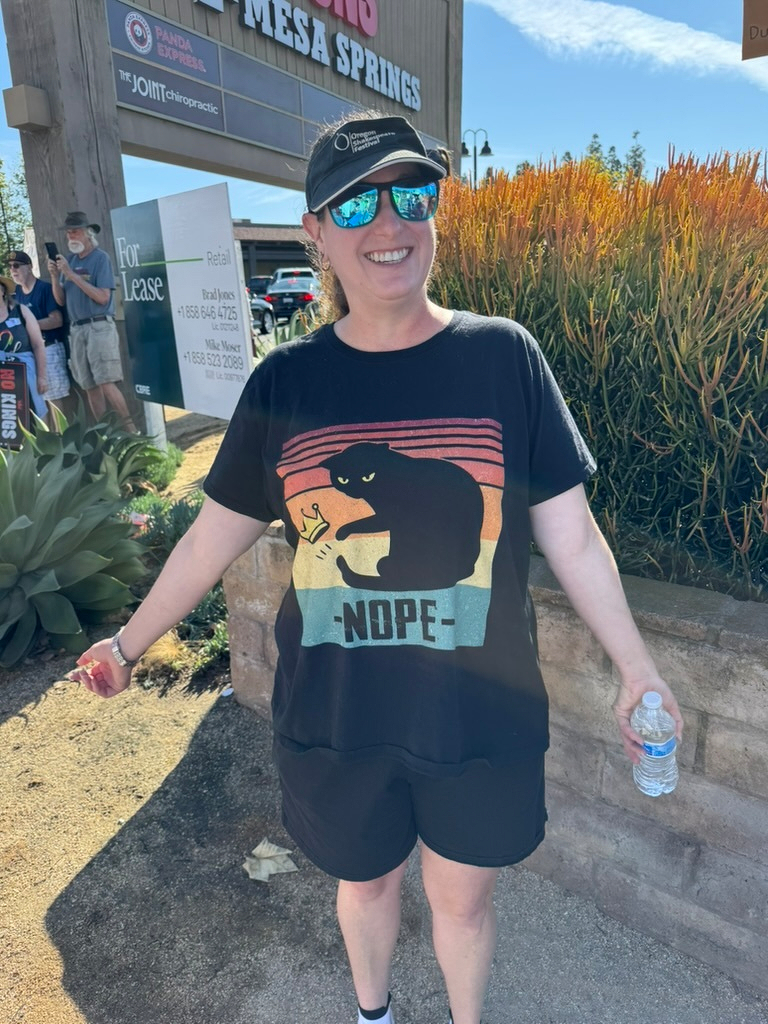
This was No Kings in La Mesa, California, a suburb of San Diego. We had about a thousand people by my guess, which is a lot, as the big San Diego event was nearby and easily accessible.





Donald J. Trump, America’s greatest President, interrupted a Cabinet meeting discussion of the Iran war, security lines at airports, rising oil prices and the skittish stock market to deliver a five minute rambling story about Sharpie pens.
I am catching up on expense reports. Why does “Fontainebleau” have so many vowels? How do they expect anybody to spell that?
The FCC’s new restrictions on foreign-produced consumer routers could gut the home Wi-Fi market, as most routers — even American-branded equipment — are manufactured overseas. By my colleague Monica Alleven on Fierce Network.
There’s no law requiring you to drink at the Nazi bar: A judge dismissed Elon Musk’s X Corp’s lawsuitclaiming an illegal boycott against X by the World Federation of Advertisers and companies including Mars, CVS Health and Colgate-Palmolive.
Rediscovering the iPad: Go commando
A few days ago, in an online conversation with a friend, I said:
I was a heavy, heavy iPad user through the 2010s to about three years ago. Now I barely use it. My MacBook Air is my desk computer, my travel computer and my secondary couch computer. My phone is my main couch computer. Indeed, the iPad lives right next to my couch, and usually I don’t bother picking it up — I just get out my phone instead.
I’ve made this point multiple times over the past few months, maybe years. I’ve gone from using the iPad daily, to rarely, to never. I’ve thought about donating it. I’m a little surprised people are buying them.
Last night I said to the same friend:
My iPad lives in a keyboard case. Tonight I glanced at it while sitting on the couch and reaching for my phone, and I said to myself, “Maybe if I took it out of the keyboard case I might like using it?” And I did and I do.
My Facebook Reels are showing me short videos of cats being dusted with flour and kneaded like bread, cats cooking and eating steak, a cat in a chef’s outfit cooking and serving mac and cheese. The videos are realistic but I think they may be AI-generated.
A Reddit discussion of how people organize their podcast playlists.
I use three playlists: One playlist, called “Queue,” is for timely podcasts that I want to listen to that day. These are generally news podcasts.
I have a playlist I call, imaginatively, “Playlist,” that is filled with episodes of podcasts that I know I want to listen to but they’re evergreen podcasts I can listen to any time over the next few weeks.
And there’s the “All” podcast, where new episodes come in.
When I’m going out to walk the dog, or do chores around the house, or driving somewhere, I check the “All” playlist to see what’s new. I move stuff to the Queue, to the Playlist, remove the episode from the “All” list but leave it on my iPhone if it’s slightly interesting, or I delete the episode entirely if it’s of no interest to me.
Starfleet Academy will be canceled after its second season. This is disappointing, but not surprising, given Paramount’s new MAGA ownership.
RIP Valerie Perrine. Hell of a career, hell of a life.
Understaffing as a form of enshittfification.By Cory Doctorow. Understaffing helps big business shift value from workers, patients and customers to investors. It annoys customers, immiserates employees and — in the case of healthcare — threatens lives.
Heather Cox Richardson: Just before he became vice president of the Confederate States of America in 1861, Alexander Stephens of Georgia made it clear what that country, and the upcoming Civil War, was about: Slavery, the supremacy of white men, and that “slavery subordination to the superior [white race is [the Black man’s natural and normal condition.” Stephens dreamed of spreading this ideology around the world.
Richardson:
On March 21, 1861, former U.S. senator Alexander Stephens of Georgia delivered what history has come to know as the Cornerstone Speech, explaining how the ideology and power of elite enslavers in the American South were about to usher in a new era in world history.
Speaking in Savannah, Georgia, just before he became the vice president of the Confederate States of America, Stephens set out to explain once and for all the difference between the United States and the Confederacy. That difference, he said, was human enslavement. The American Constitution had a crucial defect at its heart, he said: it based the government on the principle that humans were inherently equal. Confederate leaders had fixed that problem. They had constructed a perfect government because they had corrected the Founding Fathers’ error. The “cornerstone” on which the Confederate government rested was racial enslavement.
In contrast to the government the Founding Fathers had created, the Confederacy rested on the “great truth” that some people were better than others. Black Americans were “not equal to the white man; that slavery subordination to the superior race is his natural and normal condition. This, our new government, is the first, in the history of the world, based upon this great physical, philosophical, and moral truth.”
Stephens believed that the new doctrine of the Confederacy would spread around the world until southerners had the gratification of seeing “the ultimate universal acknowledgment of the truths upon which our system rests.” Stephens expected the old Union to dissolve and the Confederacy to be “the nucleus of a growing power which, if we are true to ourselves, our destiny, and high mission, will become the controlling power on this continent.”
And yet, when we remember the era that elite southern enslavers thought would see their ideology spreading around the globe and ushering in a new era in human history, we do not remember it as the “Stephens Era.” It is the Era of Lincoln, the man who came to represent those who stood against Stephens and his ilk.
How the Midwest Became the Place to Move. By Olga Khazan at The Atlantic. Julie and I have been talking about moving to Columbus, where she grew up, for nearly as long as we’ve been married. We’ve lived in San Francisco and currently San Diego for all that time.
RIP Metaverse, an $80 Billion Dumpster Fire Nobody Wanted
I was a Second Life enthusiast and I still believe something metaverse-ish might prove powerful. But Zuckerberg’s vision was dead wrong.
The complete and utter failure of the metaverse is a reminder not just of the fact that the future Silicon Valley is force feeding us is not inevitable, but that quite often these oligarchs quite simply cannot relate to real people, don’t know how or why people use their products, and very often have no idea what they’re doing.
A new stereotype about Jews dropped, and I can absolutely live with it, even though I am an example of its being utterly untrue.
How far back in time can you understand English? I got back to the 1300s or 1400s.
I’m now seeing this every time I go to my Facebook profile.
What next? Use AI to watch TV for me? To read science fiction? To pet the dog and cats? To drink coffee? To do any of the other things in life that I do only because I enjoy doing them?