

   __ __         __            ___
  / // /__ _____/ /__  ___ _  / _ \___ ___ __
 / _  / _ `/ __/  '_/ / _ `/ / // / _ `/ // /
/_//_/\_,_/\__/_/\_\  \_,_/ /____/\_,_/\_, /
retro edition                         /___/
Now optimized for embedded devices!!
| About | Successes | Retrocomputing guide | Email Hackaday |
Here’s a quick prototype from [Travis Goodspeed]. It’s a smart card built around an MSP430 microcontroller. We’ve used the MSP430 in the past because of its low power demands. He says this business card currently supports 1.8V to 3.3V, but a future design will have 5V as well. Technologies like Java Card exist for running applets on smart cards, but a familiar microcontroller like the MSP430 could certainly make development much faster. Knowing [Travis], there’s a reader somewhere about to go through some serious fuzzing.

While browsing the web for new and interesting hacks to show you guys, we run across all kinds of interesting stuff. Often, we would love to share them with you, and get your thoughts, but they just simply don’t have enough information or aren’t hacks at all. This is where HackaDay Links come in. Occasionally we’ll gather up some interesting stuff and post it all at once. These probably won’t be hacks, so if you’re not into seeing other interesting stuff, just wait for the next post.
We used to do these posts from time to time, and we’ve decided to start again. Without further adieu, here are the links:
1.Medgadget has a pretty cool crutch system which uses your upper leg for support instead of your arm. Seems like a better way of building support for digitigrade legs to us.
2.VR pods sure are looking funny now days. Seems like you could do this on your own pretty easy with some simple dome projection.
3.We were unaware of The Gadget Show, till we saw this post on DVICE. For those that don’t want to sit through it all, they do two projects. One is a wearable computer jacket with a projector built into the sleeve, the other is a set of iPod controls built into some horribly gaudy high heels. We shouldn’t judge the fashion though, they probably know fashion better than us.
4.These massive robotic arms have been all over the net for the past few weeks. The video is sort of neat, with cool cgi effects, but all he does is wave them around somewhat lethargically. We do hope to see something more soon.
5.Princess Leia, sunbathing. We had to share. Thank us later.
6.You could win [Ben Heck]‘s PS3 laptop. Unfortunately you have to spend a bunch of money at the score. Just in case you’re curious, they value it at $7500

[bongodrummer] wanted to use a lathe to make some gifts for his family. Instead of buying one, he decided to make one and recycle some parts in the process. More info after the break.
[bongodrummer] scavenged a motor from a washing machine which is a great choice because these motors are capable of generating plenty of torque. To control the speed of the lathe he developed his own pulse width modulation controller. All of the parts were then mounted to some heavy steel plates and an enclosure was built around the belt-driven assembly. In keeping with his recycling goals, the tool rest was fabricated from tubing reclaimed from a junked bicycle frame.
This lathe is not a CNC machine, but judging from the wooden bowl he turned out we’d say this project is a huge success.

How this one missed us, we’ll never know.
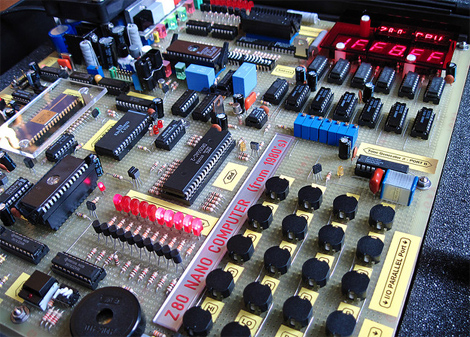
[GG] built himself a retro-styled Z80 nanocomputer over two years using all 1980′s tech. Laid out on one of the largest pieces of perfboard we’ve ever seen on a project, the computer uses a vintage Z80 CPU running at 2.5MHz, 8K ROM, 16K RAM, RS-232 and Parallel ports, an EPROM burner, and an AM95 math coprocessor for 32-bit floating point arithmetic.
We’ve seen a few homebrew computers before, including a Z80 laptop, but this blows them away. For his computer, [GG] created 8BASIC, A Basic interpreter that makes best use of the six 7-segment displays and eight 16-segment displays. The display isn’t really a limitation because [GG] also put together something in Visual Basic so his PC can communicate with his nanocomputer.
[GG] even went so far as to include error detection on the ROM and RAM, as well as an on-board power supply. If you can’t admire the dedication that went into this, at least admire the great wire porn. We’re just sad [GG] never did a proper write-up of his project. He could certainly teach us all something.
Video of [GG]‘s work after the jump.
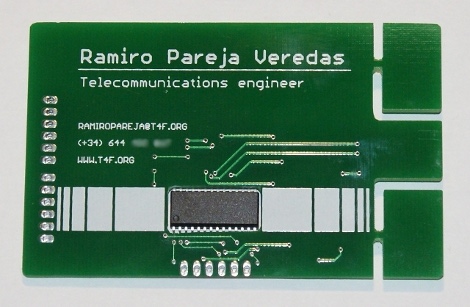
Just snap off the corners and this business card can be used as a mass storage device. Well sort of. The tab left over has four traces on the back to make it USB compatible. The PIC 24FJ64GB002 microcontroller on the card registers as a storage device and launches [Ramiro's] resume and a cover letter loaded as an HTML file. He’s made it as useful as possible by including access to the SPI and I2C bus connections but he’s also included some firmware to act as a data logger or an oscilloscope. At about 5 euros a piece you won’t be distributing these willy-nilly but it’s not too much more than handing out breakout boards with your name all over them.
