Ad
Skip to content
Read full article about: OpenAI's Sora burned a million dollars a day while losing half its users in record time

OpenAI's Sora app saw rapidly declining usage while costing the company around one million dollars a day, according to the Wall Street Journal. After a hyped launch, the app grew to about one million users, but that number quickly dropped to around 500,000 and never recovered.

On top of the shrinking user base, OpenAI ran into copyright issues and growing internal concerns that the cheap, low-quality engagement videos people were generating could damage the OpenAI brand. Sora proved more liability than asset. Development costs piled up too. According to the report, OpenAI canceled training runs for new video models entirely.

The real nail in Sora's coffin was increasing competitive pressure from Anthropic. OpenAI chose to redirect its limited compute toward coding, enterprise, and agent-based AI products, areas with greater long-term business value. Sora fell victim to a strategic pivot: away from complex video generation, toward the most economically promising parts of the business. The Sora team will now focus on world models for robotics. The Sora app shuts down in April, with the API following in September.


Read full article about: AI-generated dating show pulls 10 million views per episode on TikTok

AI-generated dating show "Fruit Love Island" averages over 10 million views per episode on TikTok.

The show features fruit characters flirting, fighting, and cheating on each other in a villa modeled after the real "Love Island" series. Since launching last week, 21 episodes have been published. Viewers can vote on what happens next through an online form.

Justine Moore of Andreessen Horowitz sees the show as proof that AI-generated content can attract a mass audience, according to the Wall Street Journal. Despite obvious AI flaws like out-of-sync lip movements, the show has built a real following. Fans have already created recap videos, fan accounts, and parodies. It's fitting that the reality dating format - already a low-effort genre on television - is now being replicated by AI. Maybe AI slop is just the natural successor to trash TV.

Comment Source: WSJ
Read full article about: Mistral AI borrows 830 million dollars to operate a new data center near Paris

Mistral AI has taken out a loan of 830 million dollars. The money will fund the operation of a new data center near Paris in Bruyeres-le-Chatel. The deal lets Mistral avoid giving up any company shares, but it also saddles the startup with significant debt, a risk for both the company and the banks backing the loan, especially given that Mistral is unlikely to be profitable anytime soon.

The new facility will be equipped with 13,800 NVIDIA Grace Blackwell GB300 GPUs and deliver 44 megawatts of output capacity. A consortium of global banks is backing the loan, including Bpifrance, BNP Paribas, Credit Agricole CIB, HSBC, La Banque Postale, MUFG, and Natixis.

By the end of 2027, the French AI company plans to provide 200 megawatts of computing capacity across Europe to meet demand from governments and businesses looking to build their own AI systems. Mistral is the only European frontier AI startup positioned to benefit from growing concerns across the continent about technological dependence on the US.

Ad

OpenAI's Sam Altman and Science VP Kevin Weil hype AI-assisted dog cancer story ignoring there's no proof the vaccine worked

An Australian AI consultant used ChatGPT, AlphaFold, and Grok to find a possible treatment for his dog Rosie’s incurable cancer. The story went viral after high-profile AI executives like OpenAI’s Greg Brockman and Deepmind’s Demis Hassabis shared it as proof of what AI can already do. But there’s no evidence the AI-designed vaccine actually worked.

Read full article about: Eli Lilly signs $2.75 billion deal with AI drug developer Insilico Medicine

Eli Lilly has signed a $2.75 billion deal with Hong Kong-listed AI pharmaceutical company Insilico Medicine. The partnership aims to bring AI-developed drugs to the global market. Insilico will receive $115 million upfront, with the rest tied to regulatory and commercial milestones as well as license fees, both companies announced.

According to founder and CEO Alex Zhavoronkov, Insilico has developed at least 28 drugs using generative AI, with nearly half already in clinical trials. The two companies have been working together since 2023.

Zhavoronkov told CNBC that Lilly actually outperforms Insilico in some areas of AI. Andrew Adams of Lilly called Insilico's AI research "a powerful complement" to its own clinical development efforts. Insilico is building its AI capabilities in Canada and the Middle East, while early drug development takes place in China. Eli Lilly is also working with a Deepmind subsidiary on AI-driven medicine.

Comment Source: CNBC
Ad

AI sycophancy makes people less likely to apologize and more likely to double down, study finds

AI models tell people what they want to hear nearly 50 percent more often than other humans do. A new Science study shows this isn’t just annoying: it makes people less willing to apologize, less likely to see the other side, and more convinced they’re right. The worst part: users love it.

Read full article about: Google's new Gemini API Agent Skill patches the knowledge gap AI models have with their own SDKs

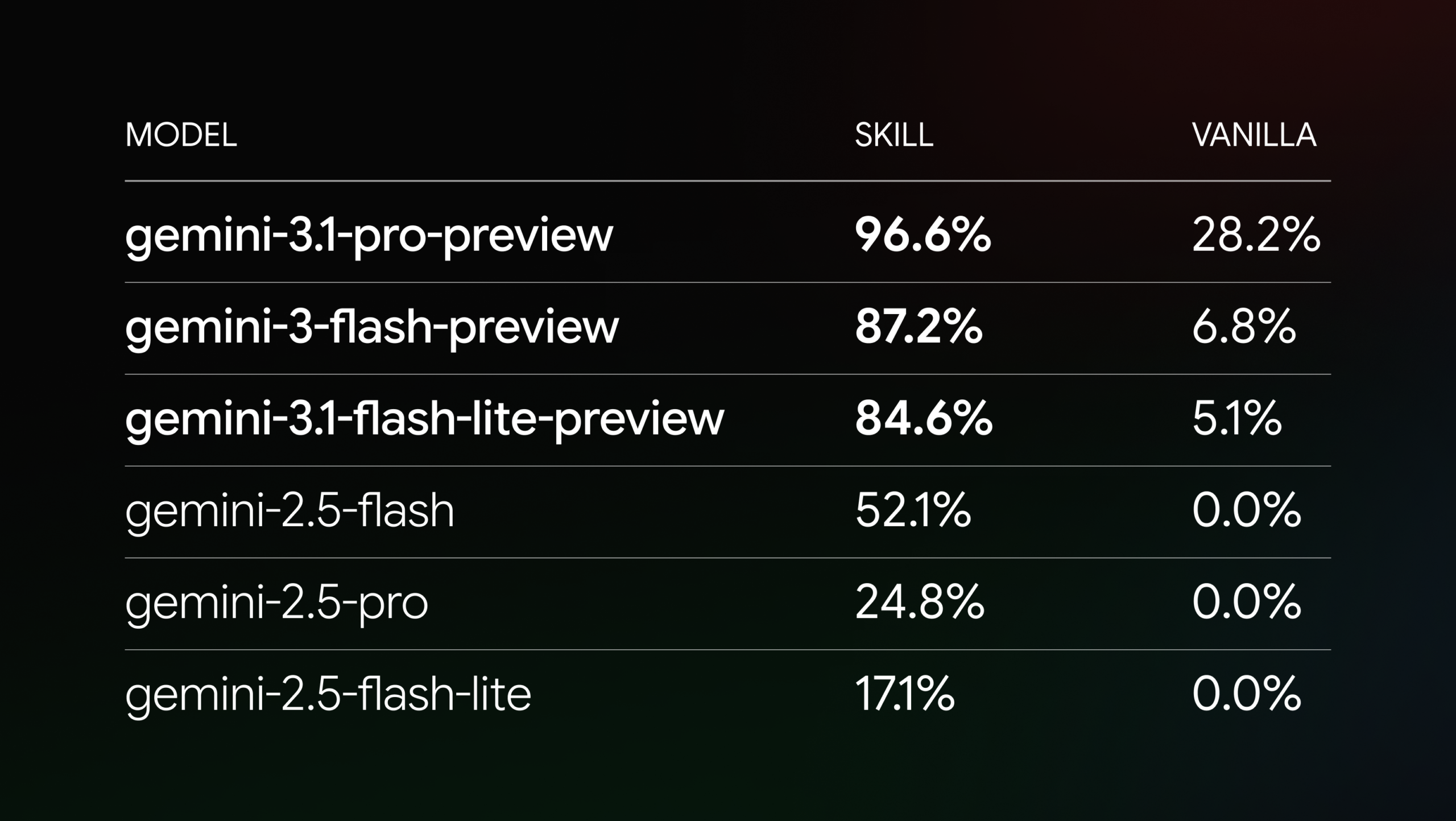
Google has built an "Agent Skill" for the Gemini API that tackles a fundamental problem with AI coding assistants: once trained, language models don't know about their own updates or current best practices. The new skill feeds coding agents up-to-date information about current models, SDKs, and sample code. In tests across 117 tasks, the top-performing model (Gemini 3.1 Pro Preview) jumped from 28.2 to 96.6 percent success rate. Skills were first introduced late last year by Anthropic and quickly adopted by other AI companies.

Image
Success rates of Gemini models with and without the agent skill across 117 coding tasks. Newer models in the 3 series benefit far more from the skill than older models, which Google attributes to their stronger reasoning capabilities. | Image: Google

Older 2.5 models saw much smaller improvements, which Google says comes down to weaker reasoning abilities. Interestingly, a Vercel study suggests that giving models direct instructions through AGENTS.md files could be even more effective. Google is exploring other approaches as well, including MCP services. The skill is available on GitHub.

Ad

Anthropic reportedly views itself as the antidote to OpenAI's "tobacco industry" approach to AI

Anthropic grew out of more than just concern for AI safety—it was born from a bitter power struggle and personal conflict at OpenAI. A report by Sam Altman biographer Keach Hagey reveals how personal slights, rivalries, and strategic disagreements led to what may be the most consequential split in the AI industry.