Quick Cafe Sketches
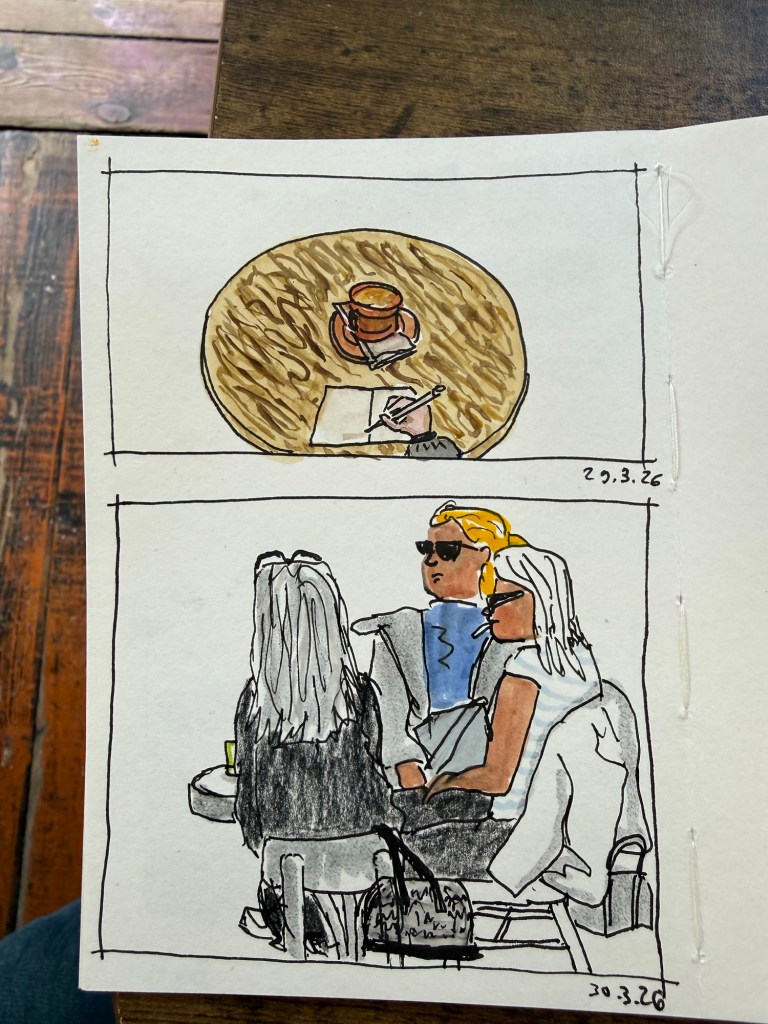
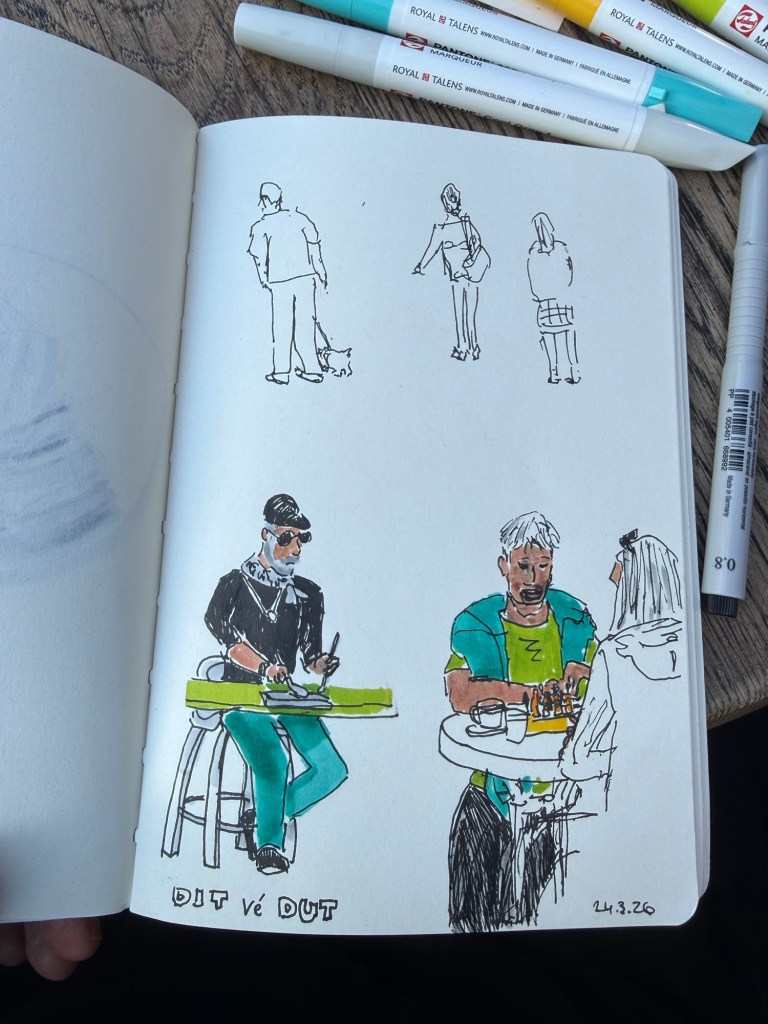
Quick cafe sketches done between the rocket alerts.
A blog about writing, sketching, running and other things
Quick cafe sketches done between the rocket alerts.
Once a year Schmincke, the German art supply company (makers of the best watercolours in the world) produce a limited edition colour out of the leftover pigments they have. The pigments come from their pastel production- which uses almost 100% pigment.
In 2024 the made an acrylic Random Grey. In 2023 the Random Grey was a pastel.
This year’s Random Grey is a watercolour. It’s a warm grey, granulating, and semi opaque. While I normally prefer cool or neutral grey’s, this colour looked interesting enough for me to give it a try.
The paint comes in a 15ml tube and though it’s a series 1 pigment it cost double the price of Schmincke’s usual series 1 watercolours (note: professional watercolours are usually priced differently by the kind of pigment they use. Blues tend to be more expensive than earth tones, for example. Schmincke’s series 1 are the cheapest and series 4 the most expensive). I’m not surprised as it’s a limited edition, but if you’re just looking for a warm grey Random Grey isn’t the most cost effective option.
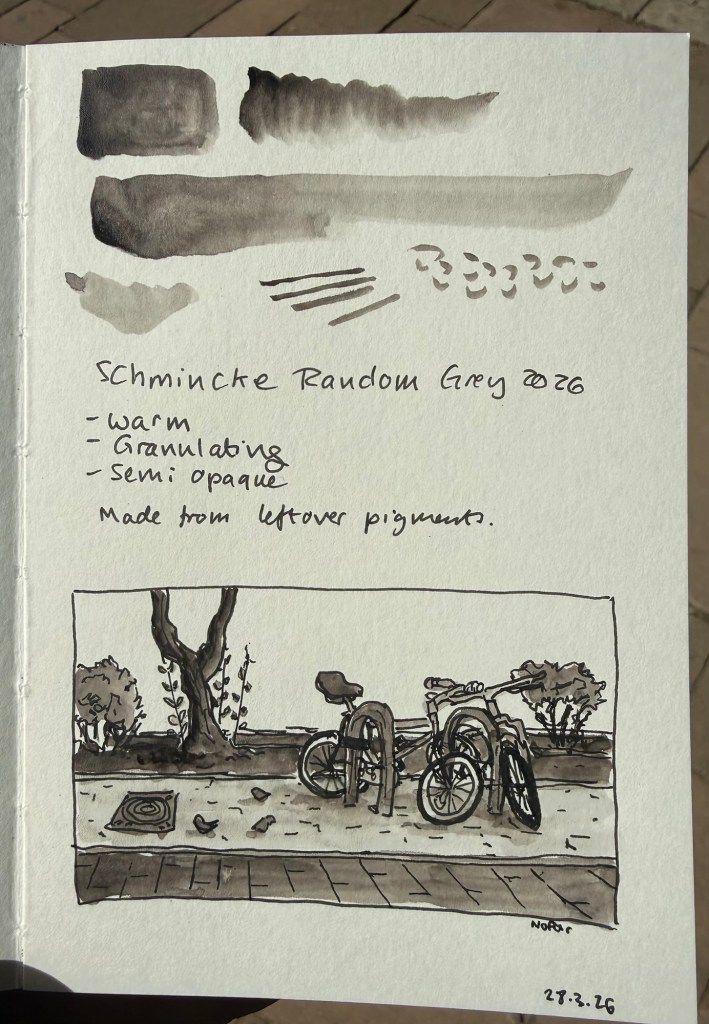
I filled three half pans with Random Grey (one for me and two to gift) and there was plenty more to go around, so if you’re interested in this watercolour but are price conscious you can try finding other artists in your area that would be willing to split the tube. Schmincke’s watercolours are superb and it’s very easy to fill a pan or half pan with paint, let it set for a day or two and then use it.
The shade really surprised me. Yes, it’s a warm grey, but it’s not too far away from a neutral grey to become unusable for all but certain lighting conditions. It does not have that yellowish brown tinge that makes warm grey’s so… atmospheric. I enjoyed using this pigment, its granulation and layering possibilities enough to add it (at least temporarily) to my watercolour palette.
Is this a bit of a gimmick? Yes. Is it also a fun and interesting grey to have around? Also yes. I look forward to mixing and combining it with some pinks and reds and seeing what comes out.
Note: I sketched this on Pith paper, which is not watercolour paper. On watercolour paper Random Grey’s granulating properties will be even more pronounced.
Queen Demon is the sequel to Witch King, and starts where Witch King ends. Like the previous novel, this epic fantasy has a double narrative structure: in the present Kai and his companions follow up on Dahin’s theory of the Hierarch’s Well and the origin of the Hierarchs themselves. In the past, Kai becomes the Witch King, a leader in Bashasa’s rebellion, and faces some very difficult personal choices.
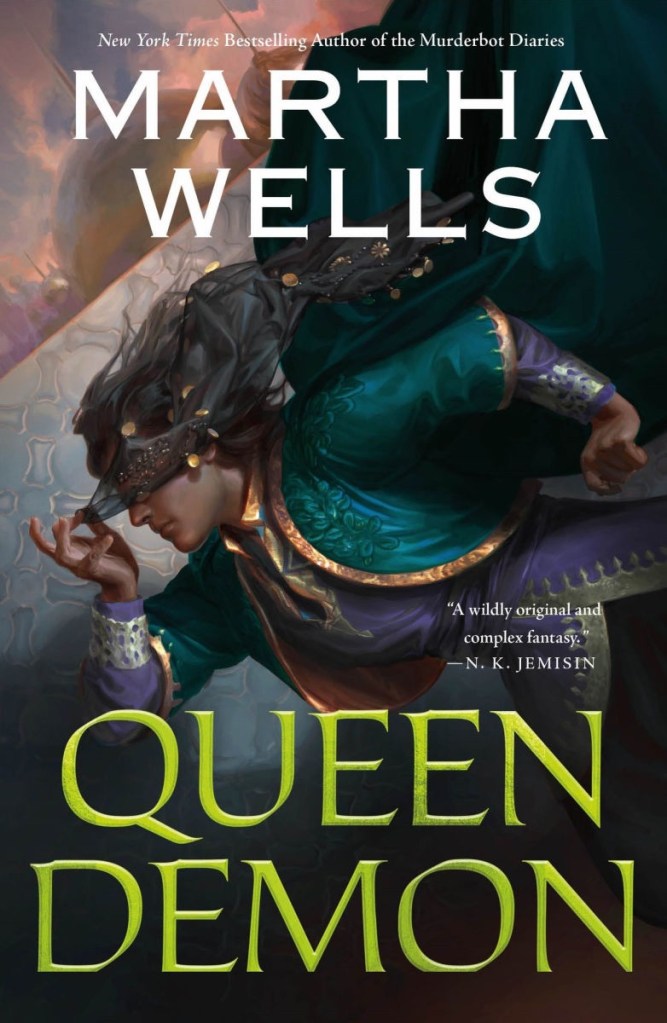
The pace is slower and more ponderous than in Witch King, because Wells spends more time developing her characters. We learn more about Dahin, Kai’s relationship with Bashasa, Bashasa’s role as a leader, witches, demons, hierarchs and expositors. We see less of Sanja, and I still feel like I want to know Zeide and Tahren more, but all in all Wells spends less time world-building and more time with the characters in that world. The scope of the tale may be heroic and epic, but we get a lot of small moments and individual choices.
Witch King was excellent. Queen Demon is very, very good. It’s not as punchy as its predecessor, but it’s still very well written, interesting and remarkable in the depth and complexity of character it manages to develop in such a relatively short time.
It does feel like a book that requires a sequel, unlike Witch King, but that’s not necessarily a bad thing. Wells has written a fantasy that is good enough to justify time away from her fabulous Murderbot books – and believe me, that’s high praise indeed.
I think that Michael Easter’s The Comfort Crisis is one the best self-help books around. I know that’s not saying much, as most self-help books aren’t worth the paper they’re printed on, but The Comfort Crisis got me to change several things about my life that made it measurably better.
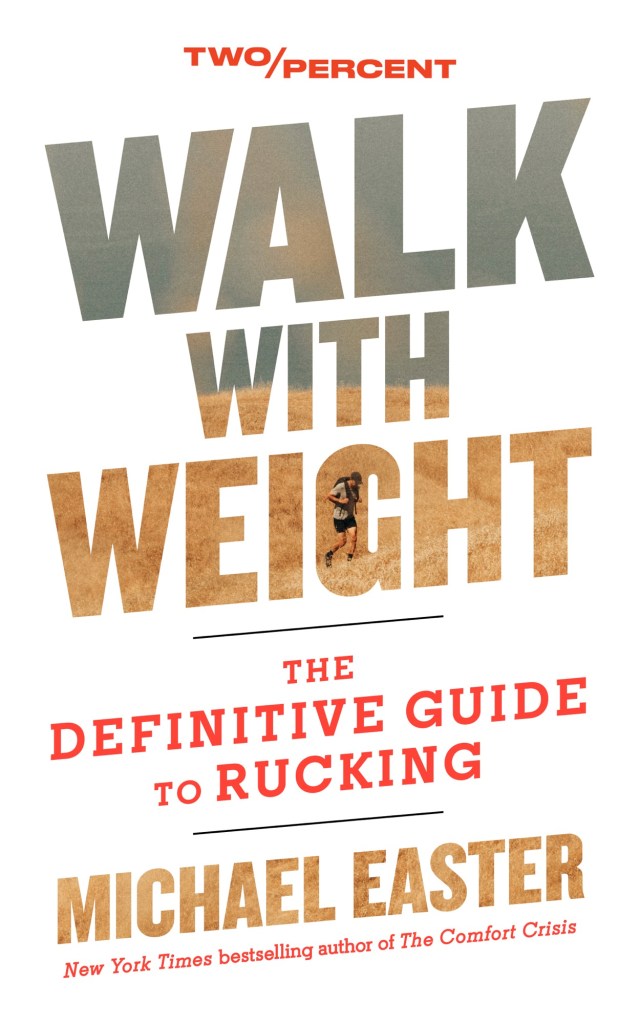
So when I saw that he’s published another book, this time about rucking (walking with weight, or yomping) I immediately bought and read it. I am interested in rucking as a form of cross-training for my running, and I think Easter is a capable writer, good at making scientific papers and ideas accessible to a general audience. My expectation was that this book would be a useful guide to getting more into the habit of rucking, and in a way I got what I wanted. The issue was that I also got a lot of what I didn’t.
I’ll explain.
If you know nothing at all about walking with weight, then this is a good book to get and read. However, if you have some familiarity with rucking, I think you will find this book a disappointment.
The issue is twofold:
So is this book a complete waste of time? No. There are still two or three blog posts worth of good content in it. There’s just also 100 extra pages of needless fluff – fluff that should have been replaced with an actual rucking experience Easter went through. As someone who regularly goes on long hikes in the wilderness, Easter just should have discussed his experiences if he needed to get to a certain page count. It would have been much more interesting.
If you’re completely new to rucking – this is likely worth the time and effort (it’s not a long book).
If you’ve started rucking or read about it a bit – you’d probably still get some use out of Walk with Weight. Just be prepared to skim most of the first part of it.
If you’re an experienced rucker, skip this book. There’s nothing new that Easter can teach you here.
Either way, carry on…
I haven’t had the time or headspace to post this until now, but here’s March spring themed currently inked fountain pens.
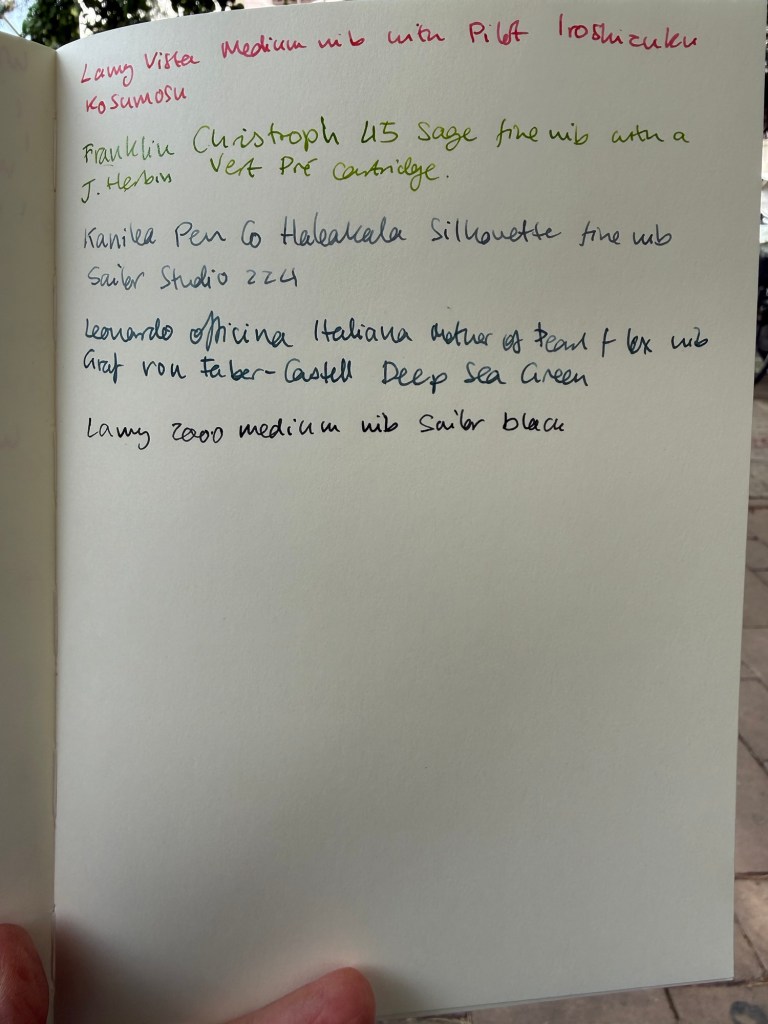
Lamy Vista medium nib with Pilot Iroshizuku Kosumosu ink. I wanted a pink ink in rotation and this is a new pen that I wanted to use. Kosumosu is a lighter pink so it benefits from wider nibs.
Franklin Christoph 45 Sage fine nib with a J. Herbin Vert Pré cartridge. Spring means grass green ink and Vert Pré fits the bill perfectly and works well with this pen. It was a little light at start but darkened with time.
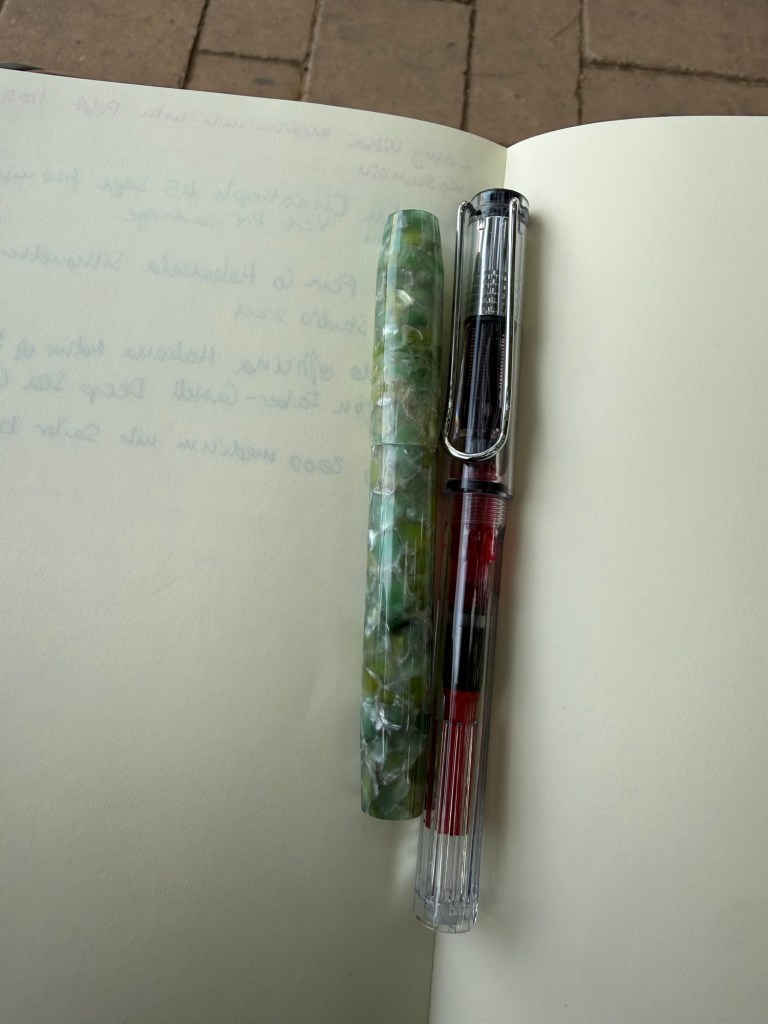
Kanilea Pen Co Haleakala Silhouette fine nib with Sailor Studio 224. I haven’t used this pen in a while and I like grey inks, which is why I almost always have one in rotation. Sailor 224 is one of my favourites.
Leonardo Officina Italiana Mother of Pearl fine flex nib with Graf von Faber-Castell Deep Sea Green. I love this pen and this nib and I haven’t used this grey green ink in a while.
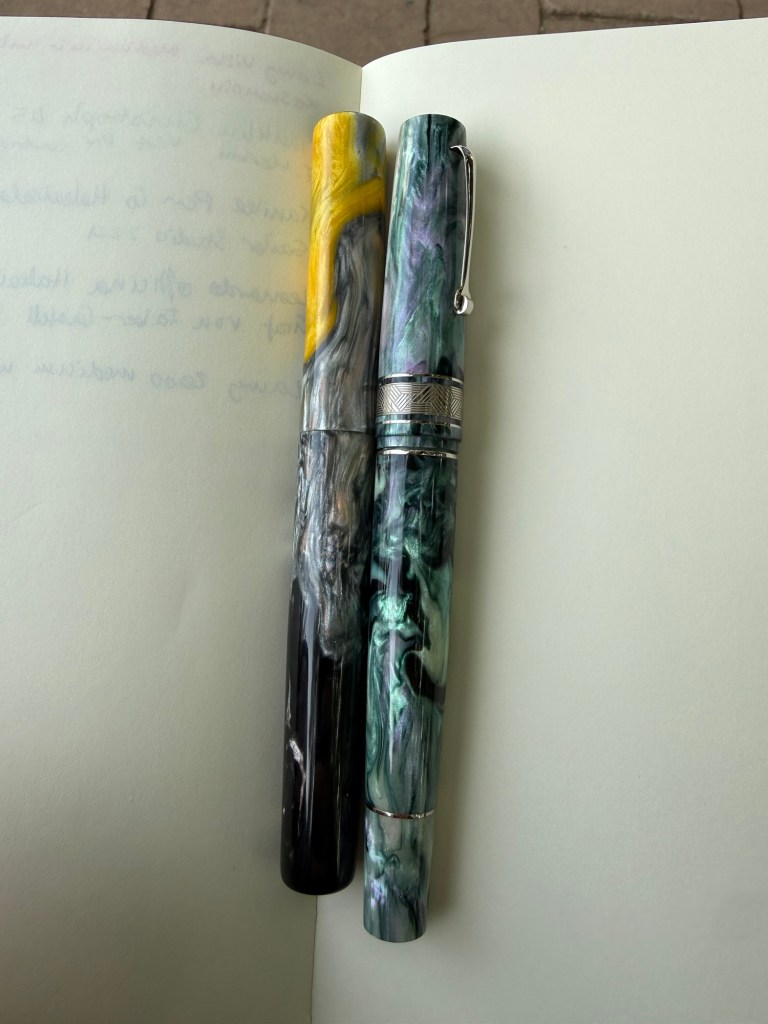
Lamy 2000 medium nib with Sailor Black. Workhorse pen with workhorse ink.
Aaronovitch is back in form with this 10th instalment of the “Rivers of London” series. The series has been muddled, mediocre and meandering since Aaronivitch finished the “faceless man” part of it (the first seven books of the series, most of them very good), but this one flows well and is a fun book to read.
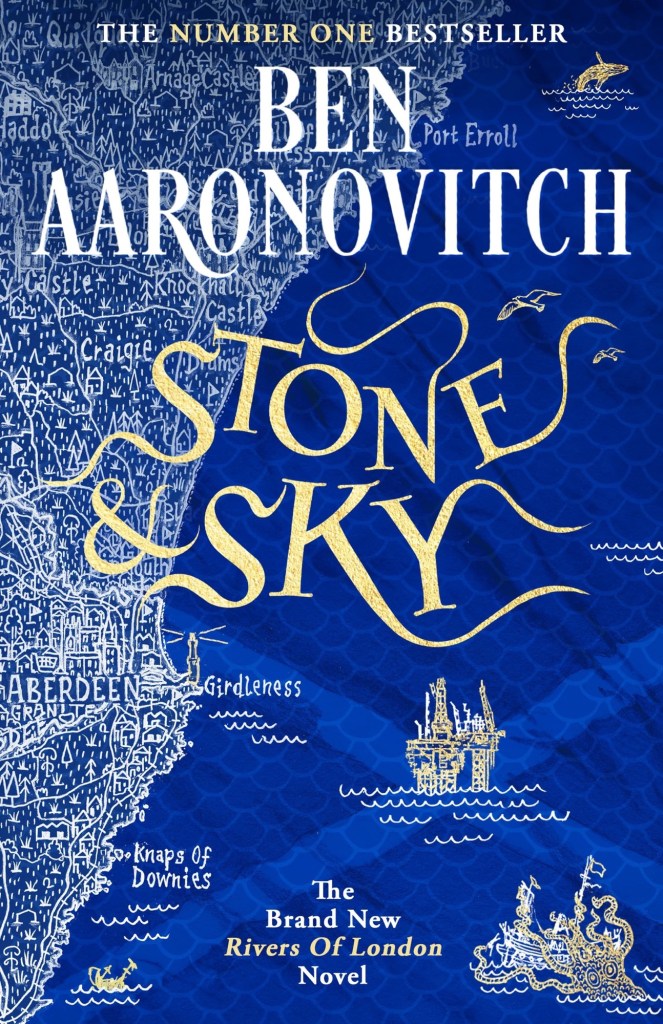
Peter Grant is in Scotland, with his whole extended family (Nightingale, his wife Beverly, his twins, his parents, his father’s jazz band and their manager, and his cousin Abigail) in a bit of a contrived mission to take a family holiday while looking into some strange cryptozoological incidents. There’s the familiar wry Peter Grant humour and Abigail sass (the narrative is split between the two), imaginative world-building (this time with mermaids and selkies) and a nice set of villains to catch.
The setting is interesting, the final battle is suitably epic, and I like Abigail’s new mermaid girlfriend. I think Aaronovitch is facing the issue where there are so many books in the series and so much history to it that it’s sometimes hard to follow who is who and what happened when, but he does a decent enough job of keeping the readers informed about the most crucial parts of the past. Abigail’s brother’s death lies heavy over this one, and Aaronovitch handles her grief with subtlety and heart.
If you’ve read the other books in the series you’re bound to love this one. It does still suffer from the “oh boy, big bad things are coming in the future, look at all these vague portents” issues that the past few books in the series have had. It’s clear that Aaronovitch want another villain in the calibre of the faceless-man but isn’t able to come up with one. It also has the usual overdose of architectural descriptions that you see with other books in the series.
Another peculiar thing about this book is the name. Stone and Sea or even Sea and Sky would have been better than Stone and Sky. You’l understand why once you read it.
A solid addition to a good urban fantasy series, well worth the read for series regulars – but if you’re just getting started, go to book one of the series, the excellent Rivers of London.
Martha Wells is a phenomenal world-builder, and she knows how to create brilliant characters that you just can’t help rooting for. She did it in the Murderbot series and she’s done it again in Witch King.
The titular character, Kai, a demon prince, is captured and entombed by unknown enemies. As he frees himself, his witch friend Ziede, and street urchin Sanja, the three go on a quest to find Tahren, Ziede’s wife, and figure out who was behind the conspiracy to capture them. The narrative splits early on, with the main thread following current events and the search for Tahren and her brother Dahin, and a secondary thread following the past – Kai’s origin story and the story of the Rising World Coalition.

Wells knows how to write a fast and intricate narrative, and the conspiracies of the present and rebellion of the past unfold independently and yet somehow also mirror and enmesh with each other. There’s a lot Wells says here about friendship, belonging, loyalty, and courage, but none of it feels obvious, didactic or forced. Relationships are earned here, as are your affections towards Kai, Ziede, Sanja, Dahin, Bashasa and others.
The world-building is rich and dense, with no “standard” human/clothing/culture/architecture. Wells walks us through it, but there’s no hand-holding here. You are meant to jump in and immerse yourself in her world, learning about it as the plot speeds you along. It’s disorienting for the first chapter or two, and then it just flows. You end up wanting to spend more time in this world, exploring it, really getting to know its people, cultures and geography.
The only minus in Witch King is that you don’t get enough time with certain characters. I want to know Tahren and Tenes more, I want to see the group in their home at Avagantum. This is why I immediately bought the second book in the series, Queen Demon, once I finished this one.
A superb fantasy book that is hard to put down and is well worth your time.
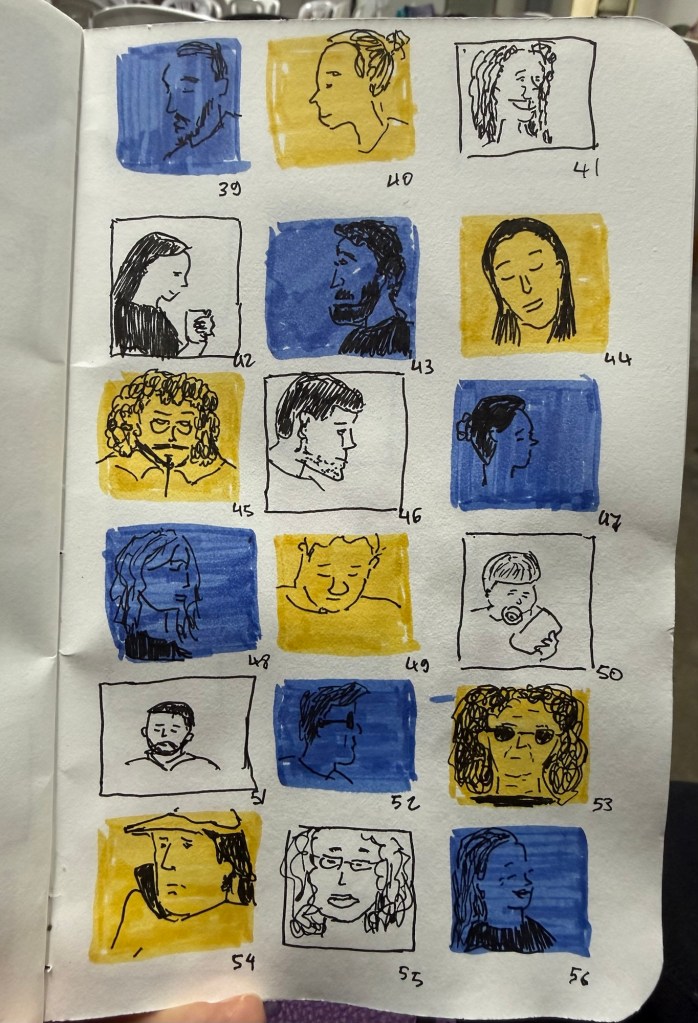
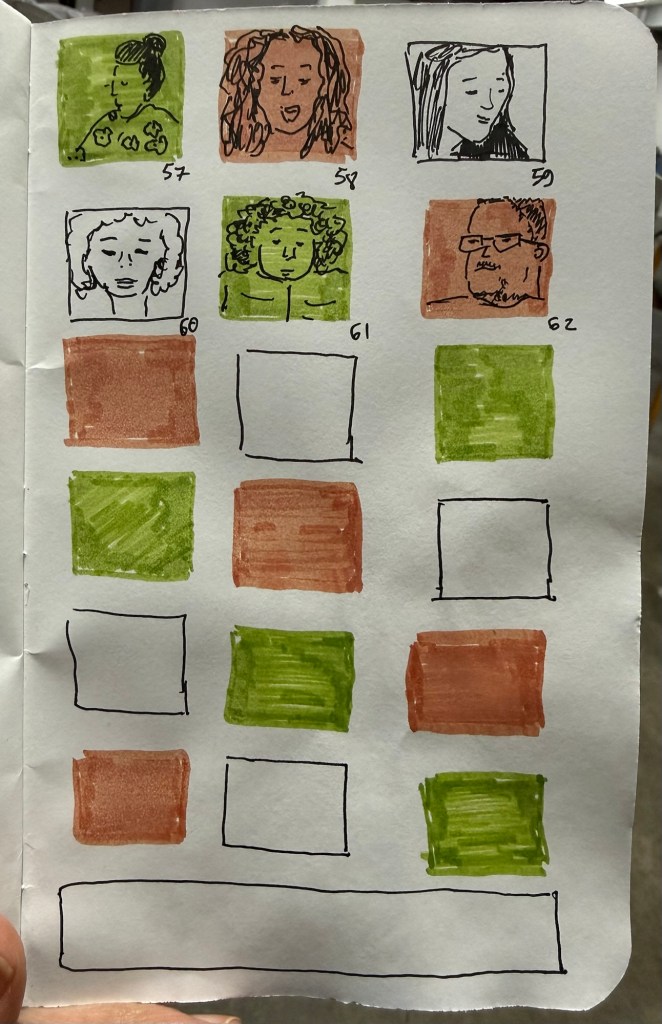
Last day of the challenge and I got all 100 (well, 101) people done. Today includes people in the streets near my house as well as people in the shelter.
Field Notes sketchbook and Faber Castell Pitt pens.
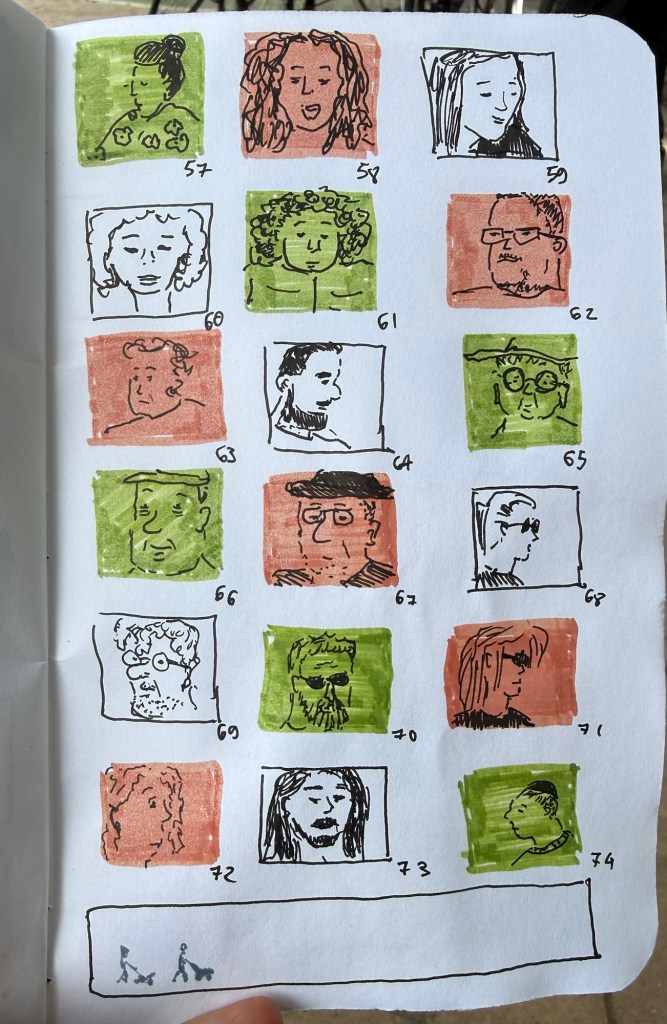
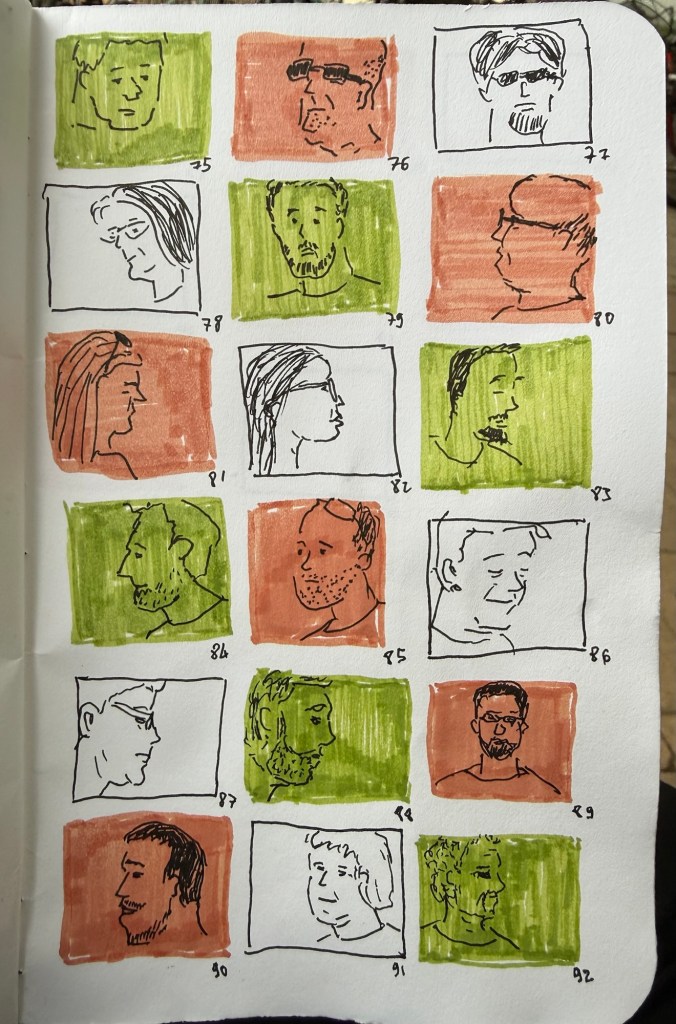
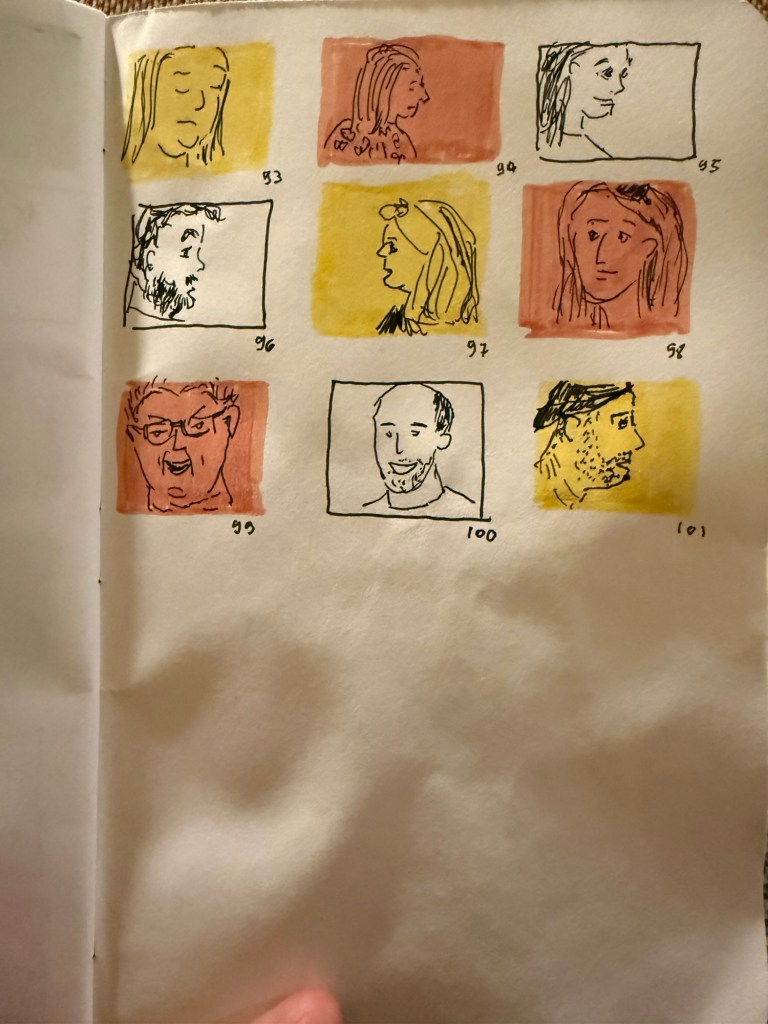
As usual this was a fun and challenging challenge to do, and I hope to get to do it again next year.
I picked up this book because I was supposed to go see the West End musical based on it and I wanted to know what to expect before I went.
The book is built to be a tear-jerking, moving affair, and it delivers on its promise. Joyce clearly knows the tropes that we expect, and cleverly weaves her narrative in and around them. The things that you are sure to happen to Harold on his way don’t happen, though the narrative is well aware of their possibility. What you’d expect his wife Maureen to do is also something Joyce enjoy subverting. There is something delicious about seeing a capable writer at work.

In any case, the basic plot is that Harold, a recently retired company man who lives in a village in southern England is stuck in his life. His wife Maureen lives in the same house with him, both of them recluses, and spends her days cleaning the house, finding fault with everything Harold says or does (the couple live in separate rooms and have been for years) and complaining about him to their son David. Maureen keeps expecting David to come visit, and Harold seems to have no friends, no hobbies, no prospects, no future.
This all changes when Harold gets a letter from his friend Queenie, a coworker that he hasn’t been in touch with for 20 years. She’s in a hospice, dying from cancer, and the letter is her farewell note to Harold. It moves him deeply, and he decides to write back to her. Instead of just posting the letter, he starts to aimlessly walk from one postbox to another, each time postponing sending the note – until a chance conversation with a woman at a gas station has him setting on an ill conceived pilgrimage to Queenie’s hospice, 450 miles away in the border between England and Scotland. As he meets people on the way he contemplates about his past, and we slowly piece together what happened that brought Harold, Maureen and Queenie to where they are today.
There are moving bits, frustrating bits, and one big, gut-wrenching revelation that makes you want to hug all three characters tightly. But mostly it’s a story about invisible people, people that seem dull but have huge tragedies and love stories and dreams in their lives, a story about connecting with others and about finding redemption through your feet.
Is this book perfect? No. It’s like Harold – a bit frumpy, sometimes dull, but it has a lot of heart in it, good intentions and it’s worth spending an afternoon with, preferably with some hot tea and biscuits.
Still lagging behind a bit since I’m still sick, but these are today’s batch. Hopefully tomorrow will be better.
Field Notes sketchbook and Faber Castell Pitt pens

 Writing at Large