Smart Partitioning with Apache Apex
Pramod Immaneni, Architect, PMC member
Thomas Weise, Architect & Co-founder, PMC member
May 19th 2016
Stream Processing
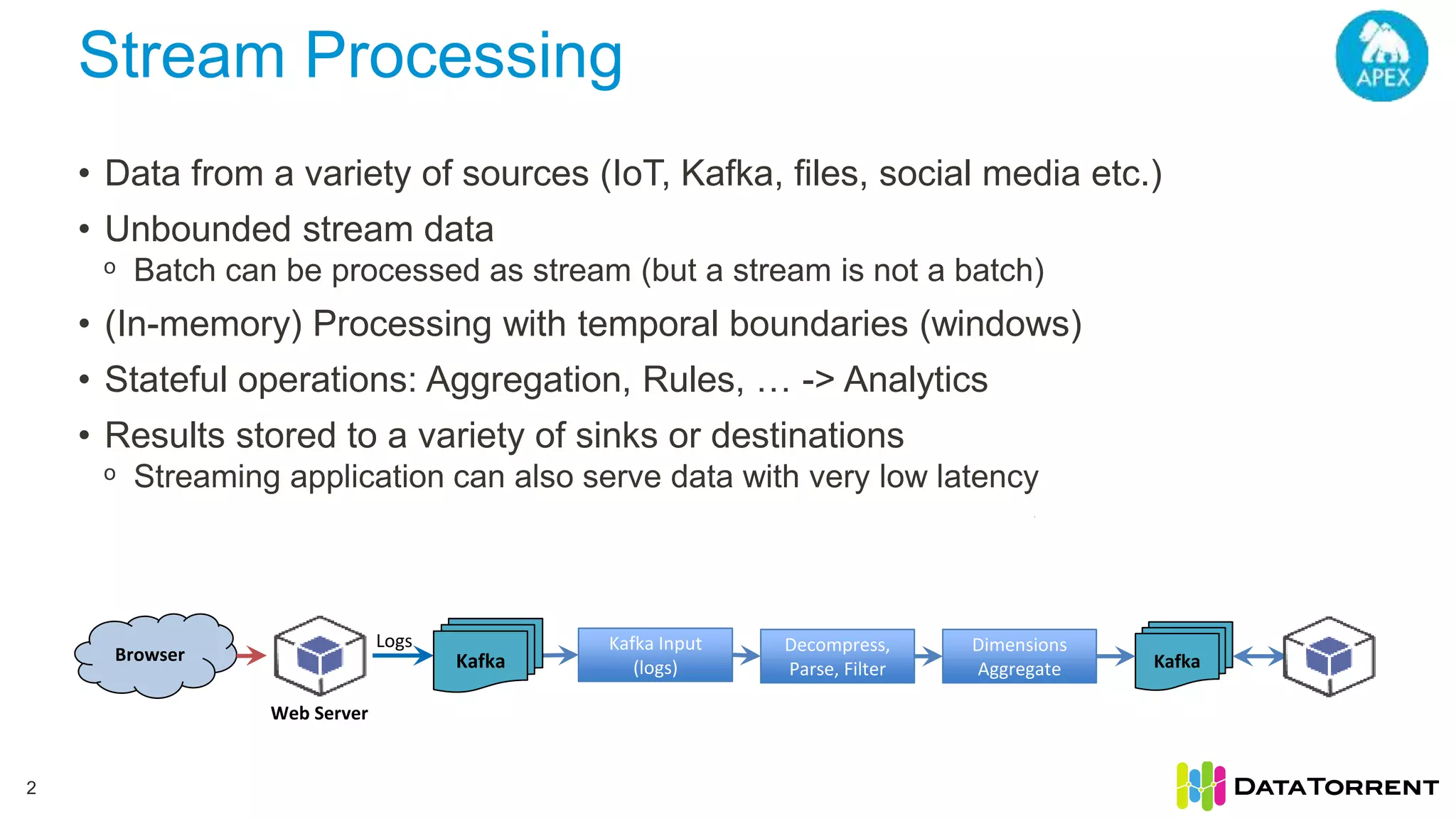
• Data from a variety of sources (IoT, Kafka, files, social media etc.)
• Unbounded stream data
ᵒ Batch can be processed as stream (but a stream is not a batch)
• (In-memory) Processing with temporal boundaries (windows)
• Stateful operations: Aggregation, Rules, … -> Analytics
• Results stored to a variety of sinks or destinations
ᵒ Streaming application can also serve data with very low latency
2
Browser
Web Server
Kafka Input
(logs)
Decompress,
Parse, Filter
Dimensions
Aggregate Kafka
Logs
Kafka
Apache Apex Features
• In-memory stream processing platform
ᵒ Developed since 2012, ASF TLP since 04/2016
• Unobtrusive Java API to express (custom) logic
• Scale out, distributed, parallel
• High throughput & low latency processing
• Windowing (temporal boundary)
• Reliability, fault tolerance, operability
• Hadoop native
• Compute locality, affinity
• Dynamic updates, elasticity
3
Big data processing & partitioning
• Large amount of data to process
• Data could be streaming in at high velocity
• Pipelining and partitioning to solve the problem
• Partitioning
ᵒ Run same logic in multiple processes or threads
ᵒ Each partition processes a subset of the data
• Apex supports partitioning out of the box
ᵒ Different partitioning schemes
ᵒ Unification
ᵒ Static & Dynamic Partitioning
ᵒ Separation of processing logic from scaling decisions
4
Apex Platform Overview
5
Native Hadoop Integration
6
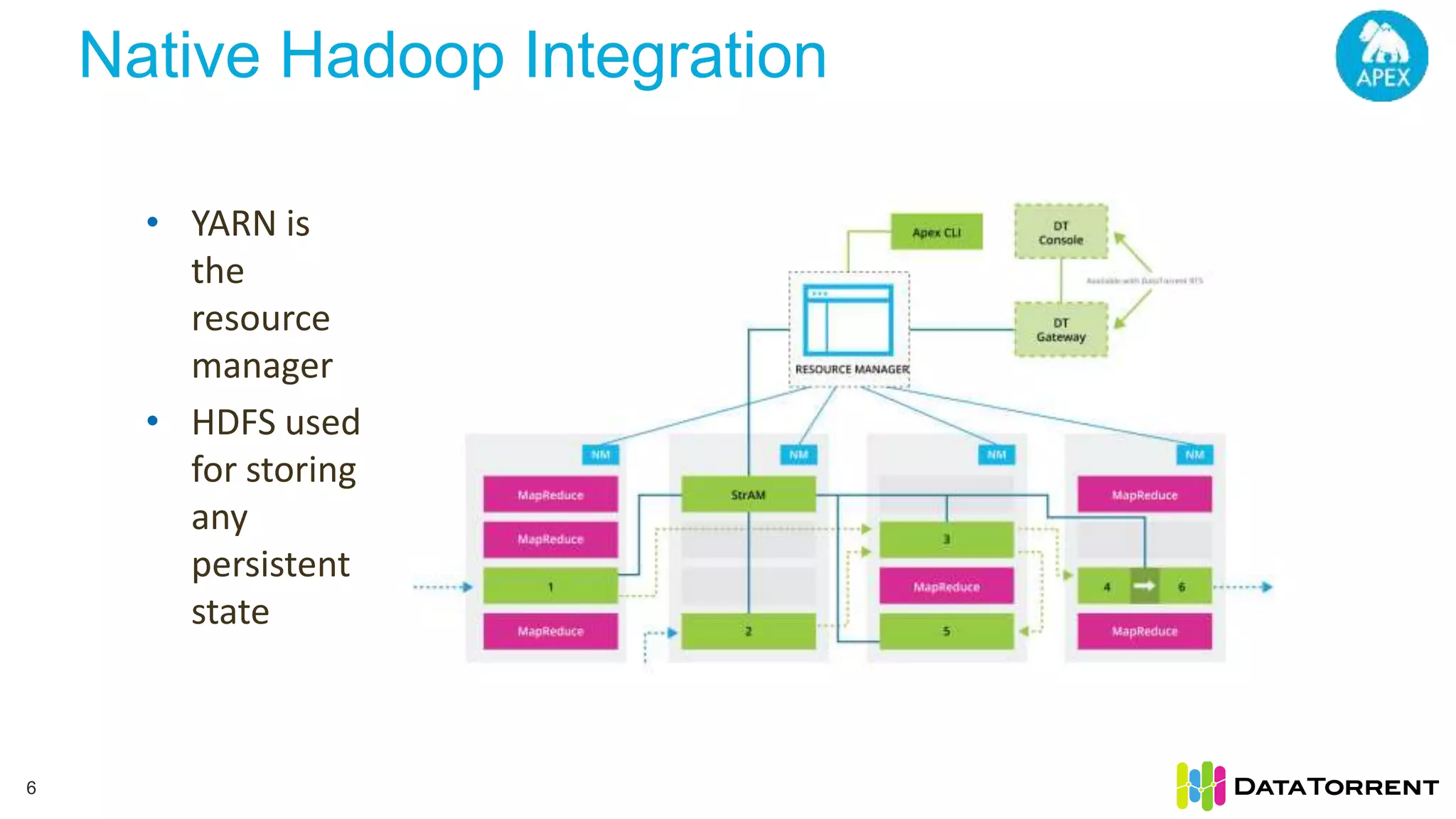
• YARN is
the
resource
manager
• HDFS used
for storing
any
persistent
state
Application Development Model
7
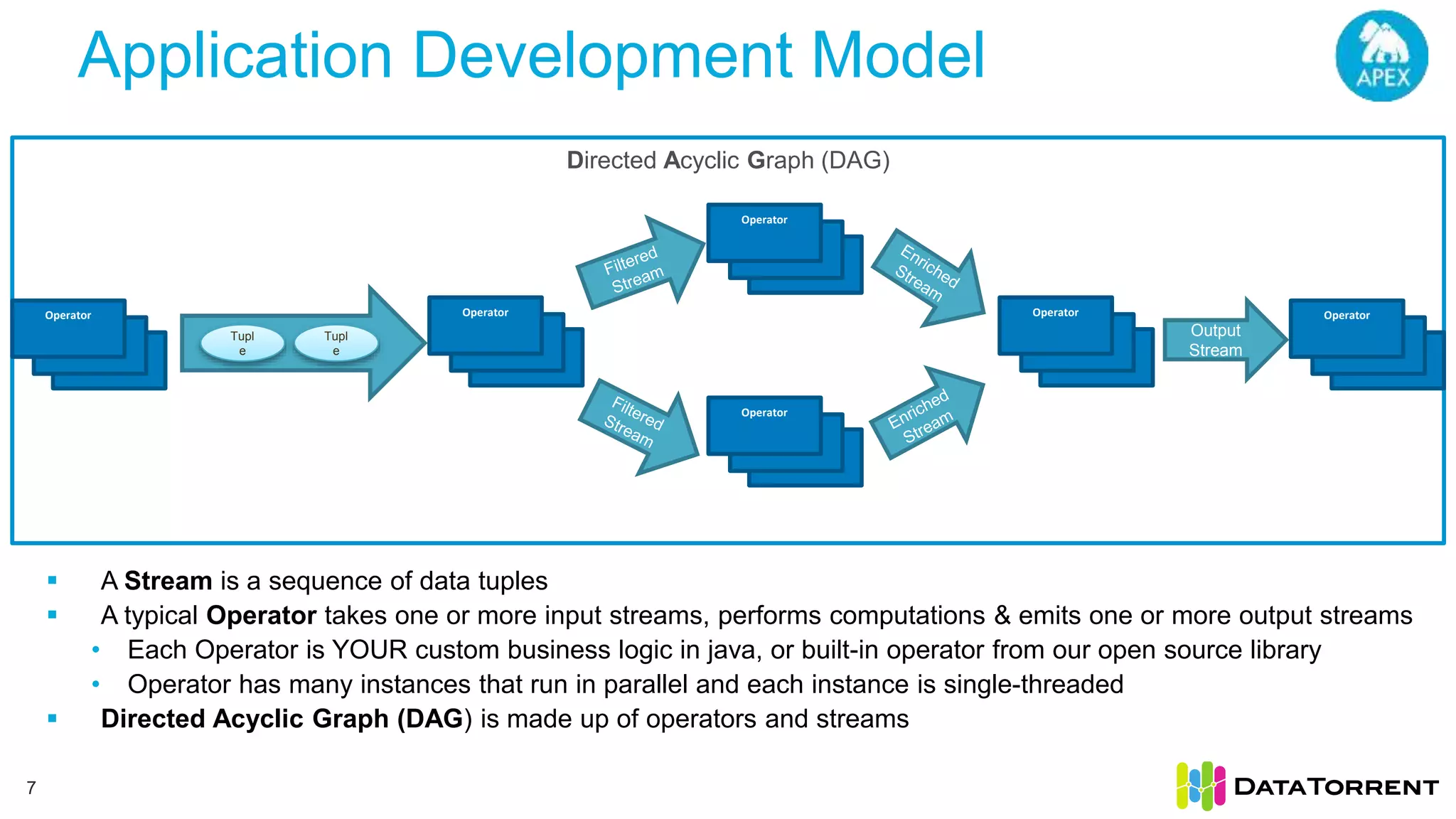
 A Stream is a sequence of data tuples
 A typical Operator takes one or more input streams, performs computations & emits one or more output streams
• Each Operator is YOUR custom business logic in java, or built-in operator from our open source library
• Operator has many instances that run in parallel and each instance is single-threaded
 Directed Acyclic Graph (DAG) is made up of operators and streams
Directed Acyclic Graph (DAG)
Output
Stream
Tupl
e
Tupl
e
er
Operator
er
Operator
er
Operator
er
Operator
er
Operator
er
Operator
Streaming Windows
8
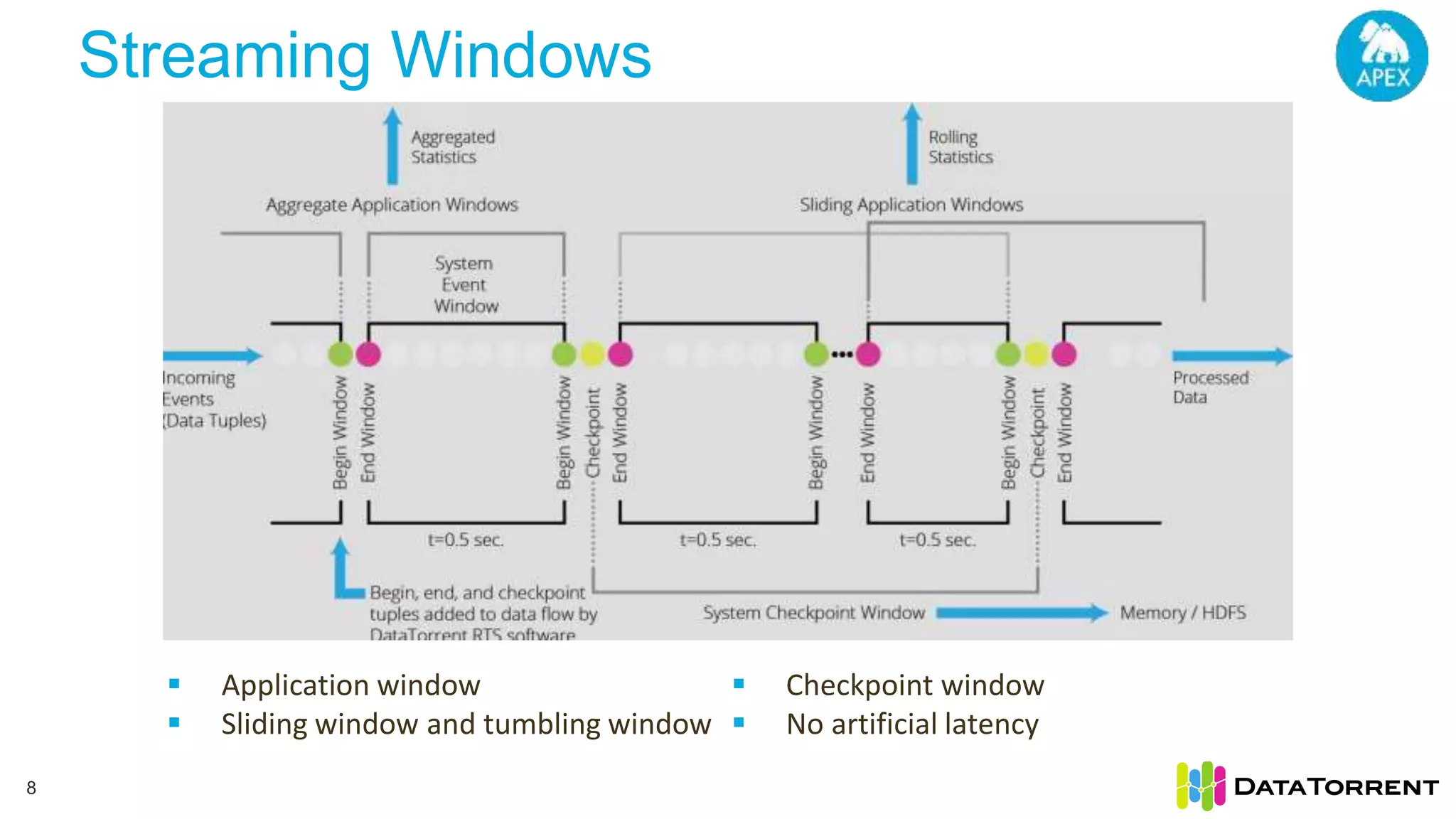
 Application window
 Sliding window and tumbling window
 Checkpoint window
 No artificial latency
Partitioning
9
NxM PartitionsUnifier
0 1 2 3
Logical DAG
0 1 2
1
1 Unifier
1
20
Logical Diagram
Physical Diagram with operator 1 with 3 partitions
0
Unifier
1a
1b
1c
2a
2b
Unifier 3
Physical DAG with (1a, 1b, 1c) and (2a, 2b): No bottleneck
Unifier
Unifier0
1a
1b
1c
2a
2b
Unifier 3
Physical DAG with (1a, 1b, 1c) and (2a, 2b): Bottleneck on intermediate Unifier
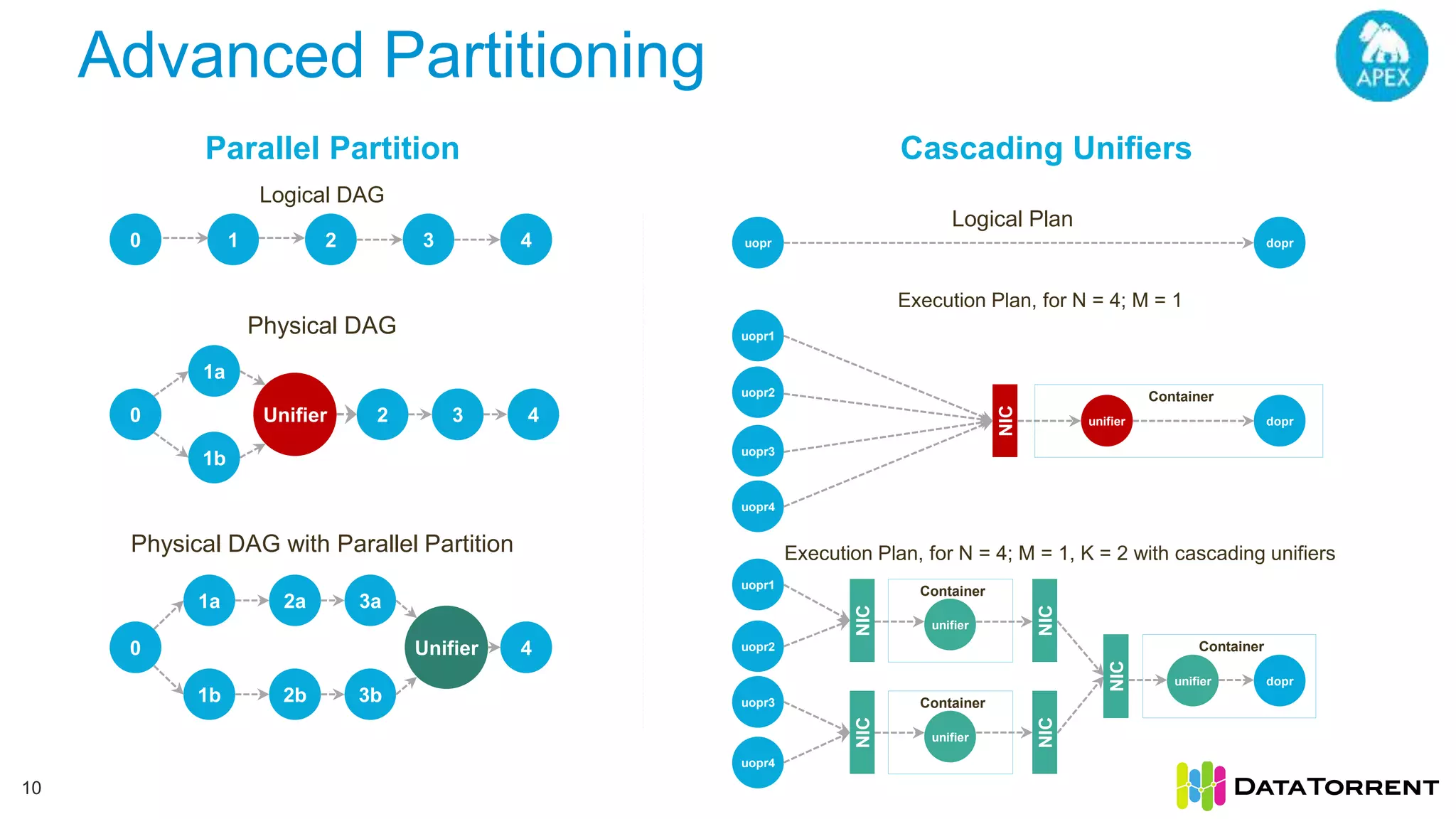
Advanced Partitioning
10
0
1a
1b
2 3 4Unifier
Physical DAG
0 4
3a2a1a
1b 2b 3b
Unifier
Physical DAG with Parallel Partition
Parallel Partition
Container
uopr
uopr1
uopr2
uopr3
uopr4
uopr1
uopr2
uopr3
uopr4
dopr
dopr
doprunifier
unifier
unifier
unifier
Container
Container
NICNIC
NICNIC
NIC
Container
NIC
Logical Plan
Execution Plan, for N = 4; M = 1
Execution Plan, for N = 4; M = 1, K = 2 with cascading unifiers
Cascading Unifiers
0 1 2 3 4
Logical DAG
Dynamic Partitioning
11
• Partitioning change while application is running
ᵒ Change number of partitions at runtime based on stats
ᵒ Determine initial number of partitions dynamically
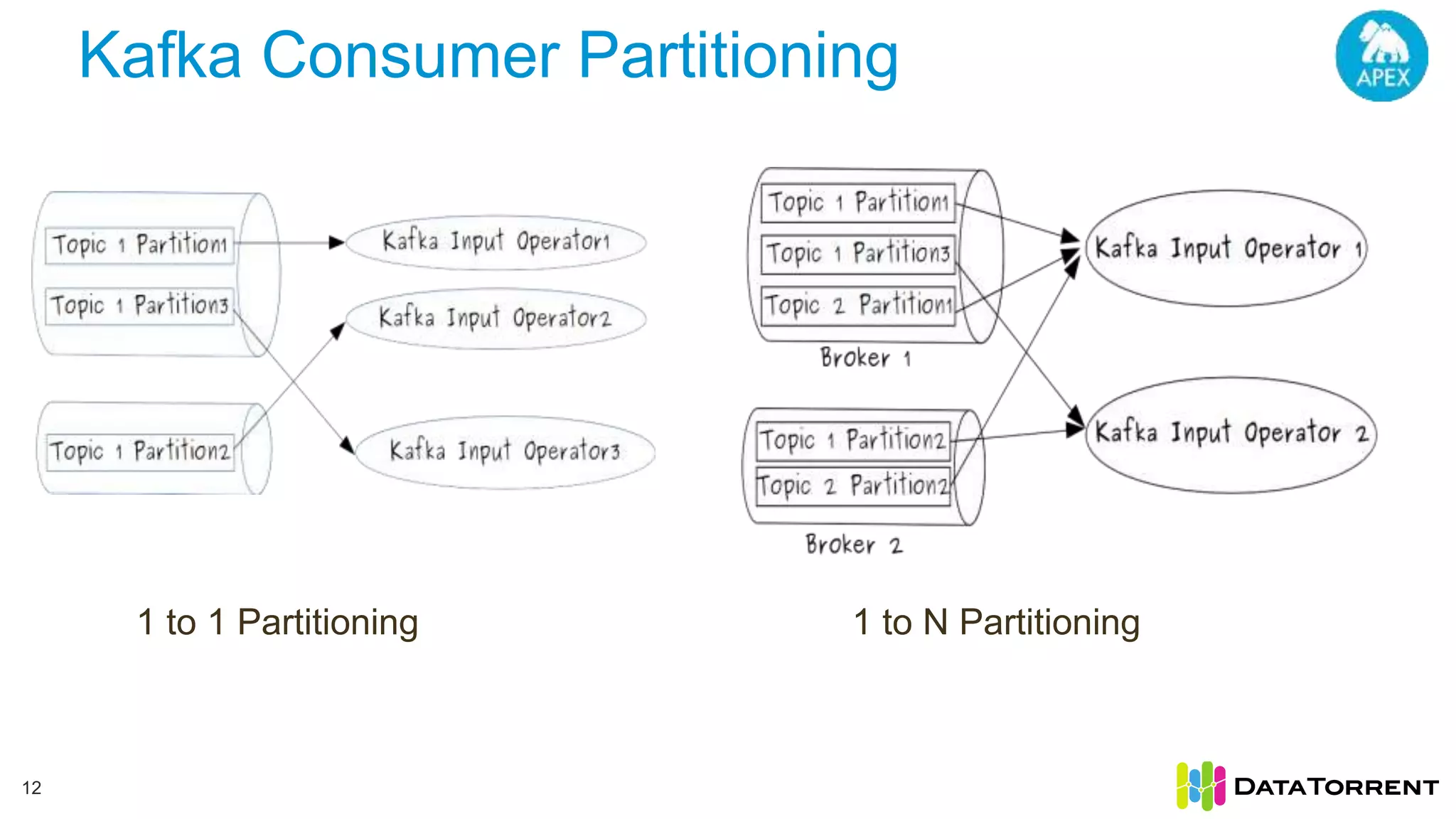
• Kafka operators scale according to number of kafka partitions
ᵒ Supports re-distribution of state when number of partitions change
ᵒ API for custom scaler or partitioner
2b
2c
3
2a
2d
1b
1a1a 2a
1b 2b
3
1a 2b
1b 2c 3b
2a
2d
3a
Unifiers not shown
Kafka Consumer Partitioning
12
1 to 1 Partitioning 1 to N Partitioning
File Reader Partitioning
13
File1
File2
File3
File4
File5
…
Filen
• User can specify number of partitions to
start with
• Partitions are created accordingly
• Files are distributed among the
partitions
• User can change the number of partitions
at runtime by setting a property
• New partitions will get created
automatically
• Remaining files will be balanced
among the new partition setc
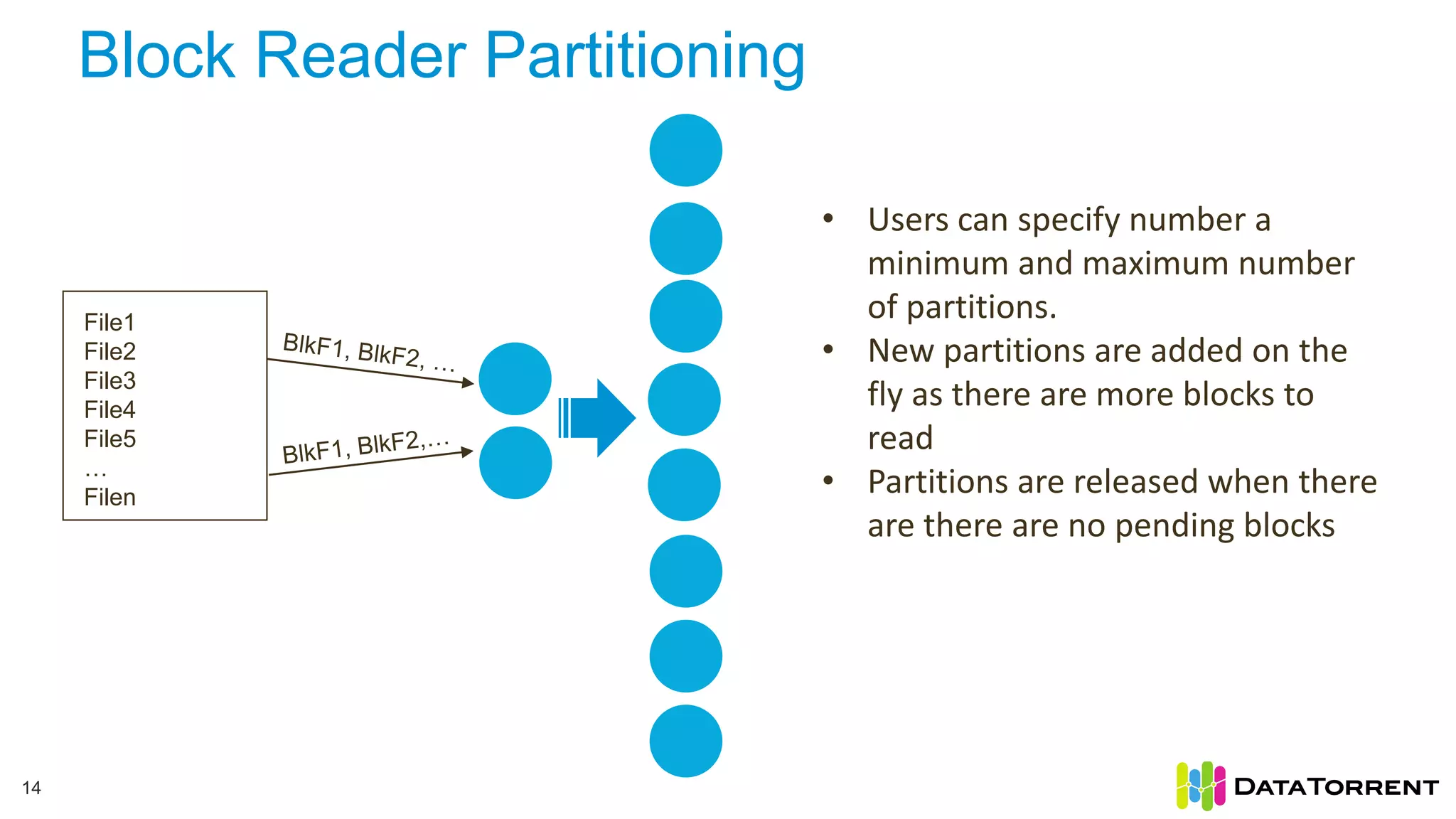
Block Reader Partitioning
14
File1
File2
File3
File4
File5
…
Filen
• Users can specify number a
minimum and maximum number
of partitions.
• New partitions are added on the
fly as there are more blocks to
read
• Partitions are released when there
are there are no pending blocks
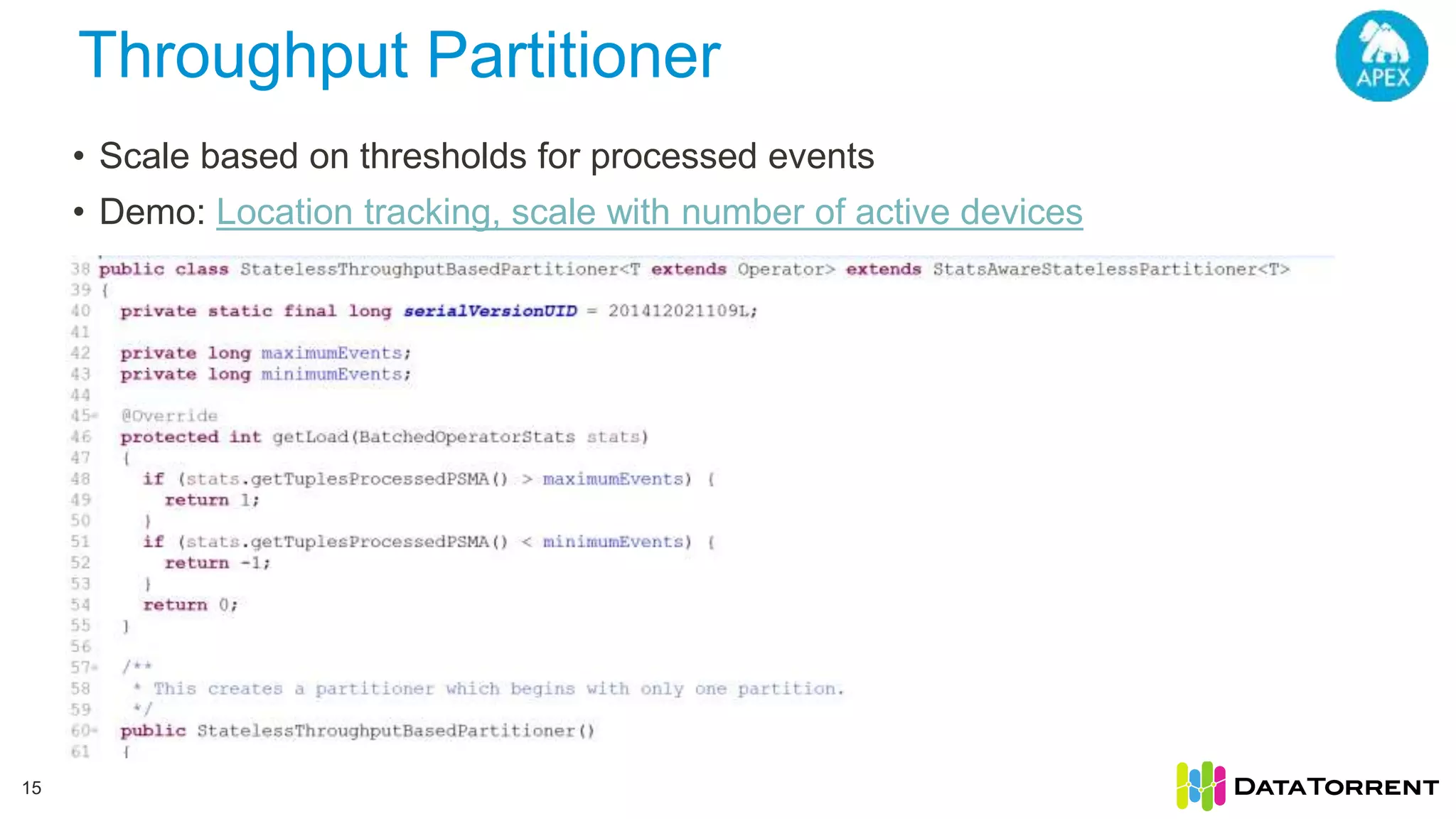
Throughput Partitioner
15
• Scale based on thresholds for processed events
• Demo: Location tracking, scale with number of active devices
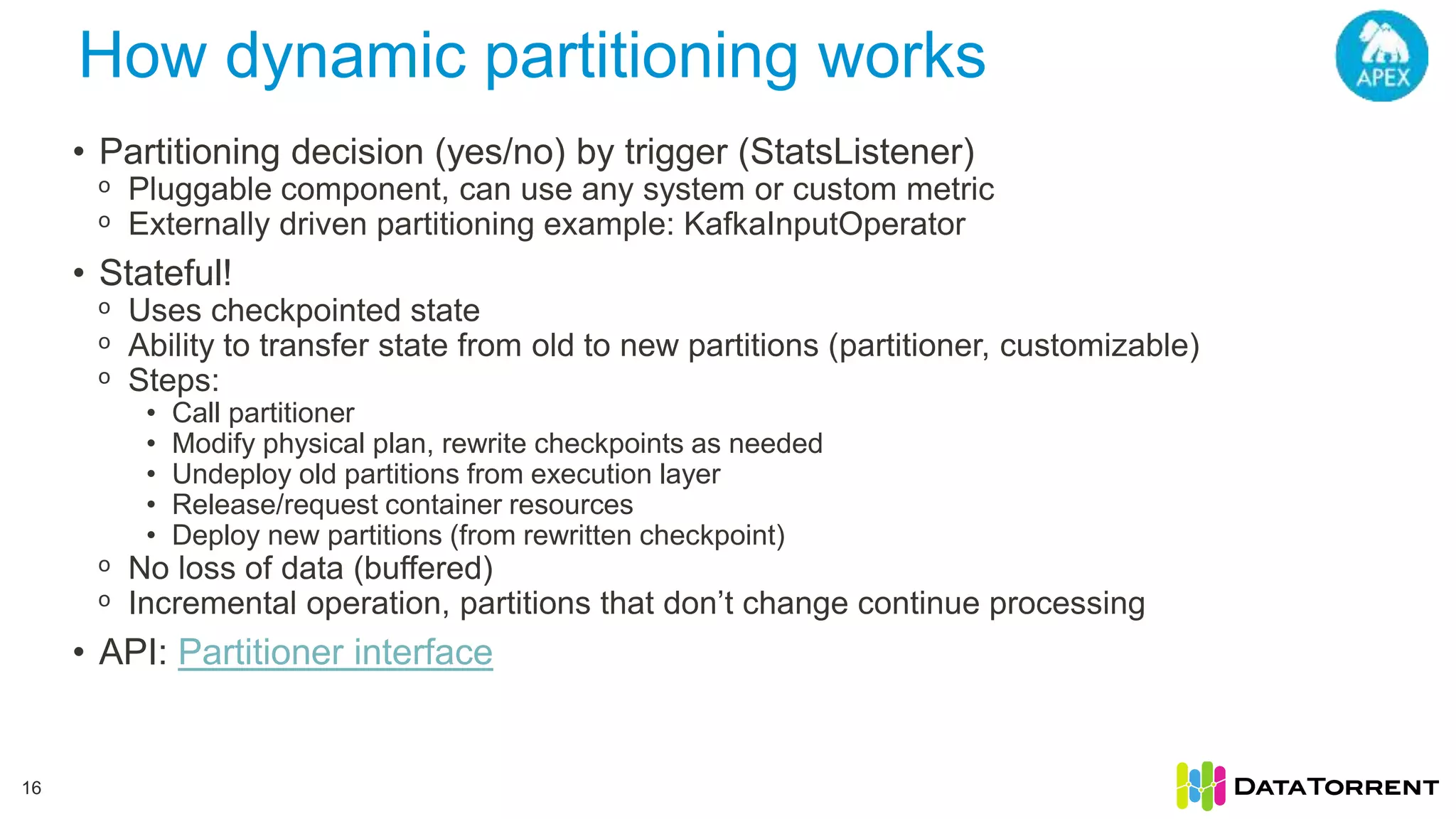
How dynamic partitioning works
16
• Partitioning decision (yes/no) by trigger (StatsListener)
ᵒ Pluggable component, can use any system or custom metric
ᵒ Externally driven partitioning example: KafkaInputOperator
• Stateful!
ᵒ Uses checkpointed state
ᵒ Ability to transfer state from old to new partitions (partitioner, customizable)
ᵒ Steps:
• Call partitioner
• Modify physical plan, rewrite checkpoints as needed
• Undeploy old partitions from execution layer
• Release/request container resources
• Deploy new partitions (from rewritten checkpoint)
ᵒ No loss of data (buffered)
ᵒ Incremental operation, partitions that don’t change continue processing
• API: Partitioner interface
Writing custom partitioner
17
• Partitioner accepts set of partitions as of last checkpoint (frozen state) and
returns set of new partitions
• Access to operator state
• Control partitioning for each input port
• Can implement any custom logic to derive new from old partitions
• StatsListener
• public Response processStats(BatchedOperatorStats stats)
• Throughput, latency, CPU, …
• Partitioner
• public Collection<Partition<T>> definePartitions(Collection<Partition<T>> partitions,
PartitioningContext context)
• Examples: https://github.com/apache/incubator-apex-
malhar/tree/master/library/src/main/java/com/datatorrent/lib/partitioner
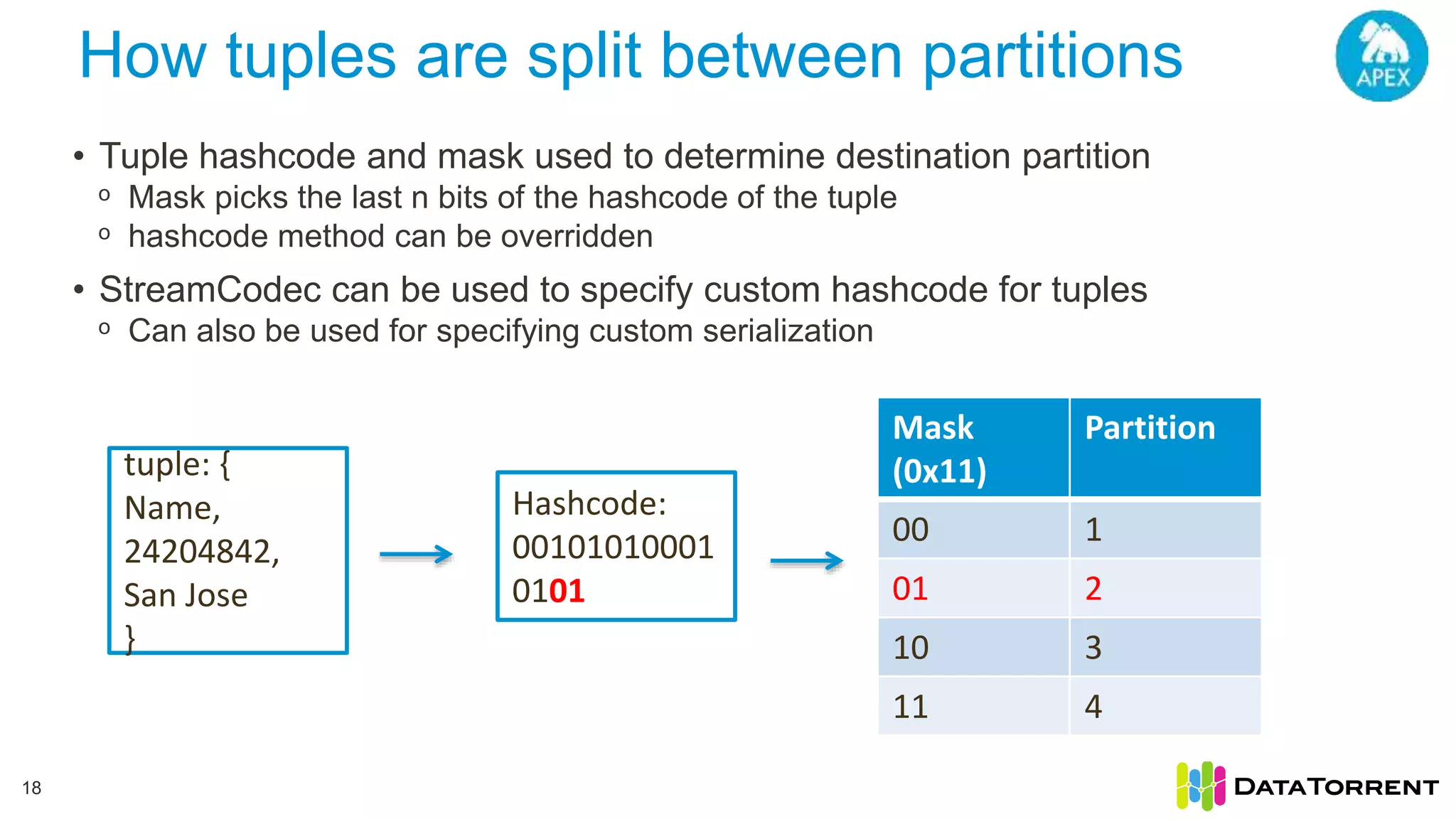
How tuples are split between partitions
18
• Tuple hashcode and mask used to determine destination partition
ᵒ Mask picks the last n bits of the hashcode of the tuple
ᵒ hashcode method can be overridden
• StreamCodec can be used to specify custom hashcode for tuples
ᵒ Can also be used for specifying custom serialization
tuple: {
Name,
24204842,
San Jose
}
Hashcode:
00101010001
0101
Mask
(0x11)
Partition
00 1
01 2
10 3
11 4
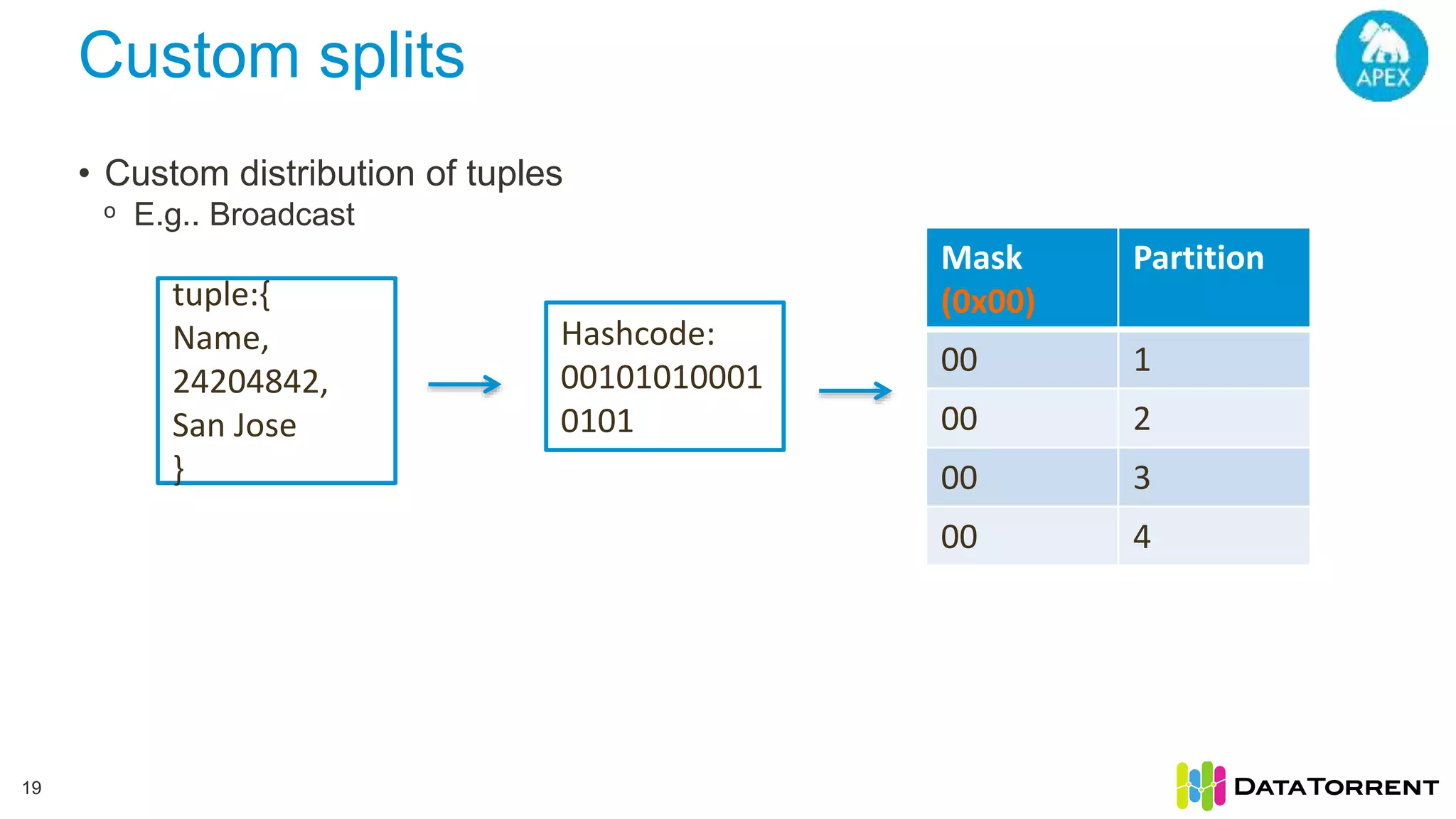
Custom splits
19
• Custom distribution of tuples
ᵒ E.g.. Broadcast
tuple:{
Name,
24204842,
San Jose
}
Hashcode:
00101010001
0101
Mask
(0x00)
Partition
00 1
00 2
00 3
00 4
Resources
20
• http://apex.apache.org/
• Learn more: http://apex.apache.org/docs.html
• Subscribe - http://apex.apache.org/community.html
• Download - http://apex.apache.org/downloads.html
• Follow @ApacheApex - https://twitter.com/apacheapex
• Meetups – http://www.meetup.com/pro/apacheapex/
• More examples: https://github.com/DataTorrent/examples
• Slideshare: http://www.slideshare.net/ApacheApex/presentations
• https://www.youtube.com/results?search_query=apache+apex
• Free Enterprise License for Startups -
https://www.datatorrent.com/product/startup-accelerator/
Q&A
21

Smart Partitioning with Apache Apex (Webinar)

  • 1.
    Smart Partitioning withApache Apex Pramod Immaneni, Architect, PMC member Thomas Weise, Architect & Co-founder, PMC member May 19th 2016
  • 2.
    Stream Processing • Datafrom a variety of sources (IoT, Kafka, files, social media etc.) • Unbounded stream data ᵒ Batch can be processed as stream (but a stream is not a batch) • (In-memory) Processing with temporal boundaries (windows) • Stateful operations: Aggregation, Rules, … -> Analytics • Results stored to a variety of sinks or destinations ᵒ Streaming application can also serve data with very low latency 2 Browser Web Server Kafka Input (logs) Decompress, Parse, Filter Dimensions Aggregate Kafka Logs Kafka
  • 3.
    Apache Apex Features •In-memory stream processing platform ᵒ Developed since 2012, ASF TLP since 04/2016 • Unobtrusive Java API to express (custom) logic • Scale out, distributed, parallel • High throughput & low latency processing • Windowing (temporal boundary) • Reliability, fault tolerance, operability • Hadoop native • Compute locality, affinity • Dynamic updates, elasticity 3
  • 4.
    Big data processing& partitioning • Large amount of data to process • Data could be streaming in at high velocity • Pipelining and partitioning to solve the problem • Partitioning ᵒ Run same logic in multiple processes or threads ᵒ Each partition processes a subset of the data • Apex supports partitioning out of the box ᵒ Different partitioning schemes ᵒ Unification ᵒ Static & Dynamic Partitioning ᵒ Separation of processing logic from scaling decisions 4
  • 5.
  • 6.
    Native Hadoop Integration 6 •YARN is the resource manager • HDFS used for storing any persistent state
  • 7.
    Application Development Model 7 A Stream is a sequence of data tuples  A typical Operator takes one or more input streams, performs computations & emits one or more output streams • Each Operator is YOUR custom business logic in java, or built-in operator from our open source library • Operator has many instances that run in parallel and each instance is single-threaded  Directed Acyclic Graph (DAG) is made up of operators and streams Directed Acyclic Graph (DAG) Output Stream Tupl e Tupl e er Operator er Operator er Operator er Operator er Operator er Operator
  • 8.
    Streaming Windows 8  Applicationwindow  Sliding window and tumbling window  Checkpoint window  No artificial latency
  • 9.
    Partitioning 9 NxM PartitionsUnifier 0 12 3 Logical DAG 0 1 2 1 1 Unifier 1 20 Logical Diagram Physical Diagram with operator 1 with 3 partitions 0 Unifier 1a 1b 1c 2a 2b Unifier 3 Physical DAG with (1a, 1b, 1c) and (2a, 2b): No bottleneck Unifier Unifier0 1a 1b 1c 2a 2b Unifier 3 Physical DAG with (1a, 1b, 1c) and (2a, 2b): Bottleneck on intermediate Unifier
  • 10.
    Advanced Partitioning 10 0 1a 1b 2 34Unifier Physical DAG 0 4 3a2a1a 1b 2b 3b Unifier Physical DAG with Parallel Partition Parallel Partition Container uopr uopr1 uopr2 uopr3 uopr4 uopr1 uopr2 uopr3 uopr4 dopr dopr doprunifier unifier unifier unifier Container Container NICNIC NICNIC NIC Container NIC Logical Plan Execution Plan, for N = 4; M = 1 Execution Plan, for N = 4; M = 1, K = 2 with cascading unifiers Cascading Unifiers 0 1 2 3 4 Logical DAG
  • 11.
    Dynamic Partitioning 11 • Partitioningchange while application is running ᵒ Change number of partitions at runtime based on stats ᵒ Determine initial number of partitions dynamically • Kafka operators scale according to number of kafka partitions ᵒ Supports re-distribution of state when number of partitions change ᵒ API for custom scaler or partitioner 2b 2c 3 2a 2d 1b 1a1a 2a 1b 2b 3 1a 2b 1b 2c 3b 2a 2d 3a Unifiers not shown
  • 12.
    Kafka Consumer Partitioning 12 1to 1 Partitioning 1 to N Partitioning
  • 13.
    File Reader Partitioning 13 File1 File2 File3 File4 File5 … Filen •User can specify number of partitions to start with • Partitions are created accordingly • Files are distributed among the partitions • User can change the number of partitions at runtime by setting a property • New partitions will get created automatically • Remaining files will be balanced among the new partition setc
  • 14.
    Block Reader Partitioning 14 File1 File2 File3 File4 File5 … Filen •Users can specify number a minimum and maximum number of partitions. • New partitions are added on the fly as there are more blocks to read • Partitions are released when there are there are no pending blocks
  • 15.
    Throughput Partitioner 15 • Scalebased on thresholds for processed events • Demo: Location tracking, scale with number of active devices
  • 16.
    How dynamic partitioningworks 16 • Partitioning decision (yes/no) by trigger (StatsListener) ᵒ Pluggable component, can use any system or custom metric ᵒ Externally driven partitioning example: KafkaInputOperator • Stateful! ᵒ Uses checkpointed state ᵒ Ability to transfer state from old to new partitions (partitioner, customizable) ᵒ Steps: • Call partitioner • Modify physical plan, rewrite checkpoints as needed • Undeploy old partitions from execution layer • Release/request container resources • Deploy new partitions (from rewritten checkpoint) ᵒ No loss of data (buffered) ᵒ Incremental operation, partitions that don’t change continue processing • API: Partitioner interface
  • 17.
    Writing custom partitioner 17 •Partitioner accepts set of partitions as of last checkpoint (frozen state) and returns set of new partitions • Access to operator state • Control partitioning for each input port • Can implement any custom logic to derive new from old partitions • StatsListener • public Response processStats(BatchedOperatorStats stats) • Throughput, latency, CPU, … • Partitioner • public Collection<Partition<T>> definePartitions(Collection<Partition<T>> partitions, PartitioningContext context) • Examples: https://github.com/apache/incubator-apex- malhar/tree/master/library/src/main/java/com/datatorrent/lib/partitioner
  • 18.
    How tuples aresplit between partitions 18 • Tuple hashcode and mask used to determine destination partition ᵒ Mask picks the last n bits of the hashcode of the tuple ᵒ hashcode method can be overridden • StreamCodec can be used to specify custom hashcode for tuples ᵒ Can also be used for specifying custom serialization tuple: { Name, 24204842, San Jose } Hashcode: 00101010001 0101 Mask (0x11) Partition 00 1 01 2 10 3 11 4
  • 19.
    Custom splits 19 • Customdistribution of tuples ᵒ E.g.. Broadcast tuple:{ Name, 24204842, San Jose } Hashcode: 00101010001 0101 Mask (0x00) Partition 00 1 00 2 00 3 00 4
  • 20.
    Resources 20 • http://apex.apache.org/ • Learnmore: http://apex.apache.org/docs.html • Subscribe - http://apex.apache.org/community.html • Download - http://apex.apache.org/downloads.html • Follow @ApacheApex - https://twitter.com/apacheapex • Meetups – http://www.meetup.com/pro/apacheapex/ • More examples: https://github.com/DataTorrent/examples • Slideshare: http://www.slideshare.net/ApacheApex/presentations • https://www.youtube.com/results?search_query=apache+apex • Free Enterprise License for Startups - https://www.datatorrent.com/product/startup-accelerator/
  • 21.

Editor's Notes

  • #3 Partitioning & Scaling built-in Operators can be dynamically scaled Throughput, latency or any custom logic Streams can be split in flexible ways Tuple hashcode, tuple field or custom logic Parallel partitioning for parallel pipelines MxN partitioning for generic pipelines Unifier concept for merging results from partitions Helps in handling skew imbalance Advanced Windowing support Application window configurable per operator Sliding window and tumbling window support Checkpoint window control for fault recovery Windowing does not introduce artificial latency Stateful fault tolerance out of the box Operators recover automatically from a precise point before failure At least once At most once Exactly once at window boundaries
  • #4 Partitioning & Scaling built-in Operators can be dynamically scaled Throughput, latency or any custom logic Streams can be split in flexible ways Tuple hashcode, tuple field or custom logic Parallel partitioning for parallel pipelines MxN partitioning for generic pipelines Unifier concept for merging results from partitions Helps in handling skew imbalance Advanced Windowing support Application window configurable per operator Sliding window and tumbling window support Checkpoint window control for fault recovery Windowing does not introduce artificial latency Stateful fault tolerance out of the box Operators recover automatically from a precise point before failure At least once At most once Exactly once at window boundaries
  • #5 Partitioning & Scaling built-in Operators can be dynamically scaled Throughput, latency or any custom logic Streams can be split in flexible ways Tuple hashcode, tuple field or custom logic Parallel partitioning for parallel pipelines MxN partitioning for generic pipelines Unifier concept for merging results from partitions Helps in handling skew imbalance Advanced Windowing support Application window configurable per operator Sliding window and tumbling window support Checkpoint window control for fault recovery Windowing does not introduce artificial latency Stateful fault tolerance out of the box Operators recover automatically from a precise point before failure At least once At most once Exactly once at window boundaries