
C Arithmetic operators are used to perform mathematical operations. There are five fundamental arithmetic operators supported by C language, which are addition(+), subtraction(-), multiplication(-), division(/) and modulus(%) of two numbers.
All arithmetic operators compute the result of specific arithmetic operation and returns its result.
| Operator | Description | Syntax | Example |
|---|---|---|---|
| + | Adds two numbers | a + b | 15 + 5 = 20 |
| – | Subtracts two numbers | a – b | 15 – 5 = 10 |
| * | Multiplies two numbers | a * b | 15 * 5 = 75 |
| / | Divides numerator by denominator | a / b | 15 / 5 = 3 |
| % | Returns remainder after an integer division | a % b | 15 % 5 = 0 |
C Program to perform Arithmetic Operations on Two Numbers
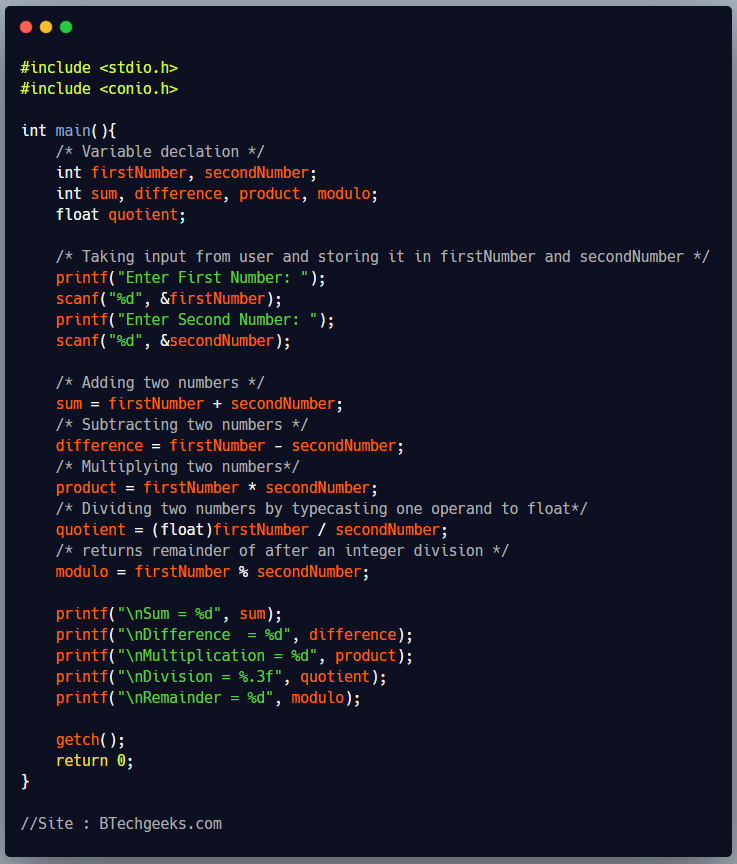
#include <stdio.h>
#include <conio.h>

int main(){
    /* Variable declation */
    int firstNumber, secondNumber;
    int sum, difference, product, modulo;
    float quotient;

    /* Taking input from user and storing it in firstNumber and secondNumber */
    printf("Enter First Number: ");
    scanf("%d", &firstNumber);
    printf("Enter Second Number: ");
    scanf("%d", &secondNumber);

    /* Adding two numbers */
    sum = firstNumber + secondNumber;
    /* Subtracting two numbers */
    difference = firstNumber - secondNumber;
    /* Multiplying two numbers*/
    product = firstNumber * secondNumber;
    /* Dividing two numbers by typecasting one operand to float*/
    quotient = (float)firstNumber / secondNumber;
    /* returns remainder of after an integer division */
    modulo = firstNumber % secondNumber;

    printf("\nSum = %d", sum);
    printf("\nDifference  = %d", difference);
    printf("\nMultiplication = %d", product);
    printf("\nDivision = %.3f", quotient);
    printf("\nRemainder = %d", modulo);

    getch();
    return 0;
}
Output
Enter First Number: 25
Enter Second Number: 4

Sum = 29
Difference  = 21
Multiplication = 100
Division = 6.250
Remainder = 1
