Scalable and Fair University Recruiting
CoderPad powers university recruiting with automated, realistic assessments and a unified interview experience—so you can screen thousands of early-career candidates quickly, fairly, and with stronger signal than puzzle-based tests.
Key Outcomes for University Recruiting
-
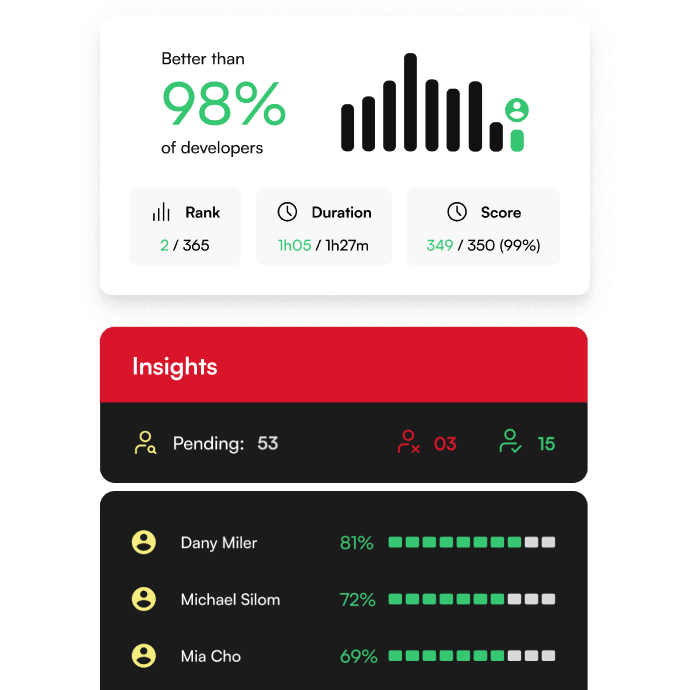
High-Volume, High-Signal Screening Auto-graded, job-relevant assessments (not LeetCode drills) filter large student cohorts while surfacing true potential across diverse backgrounds.
-
Fair, Consistent Evaluation Standardized rubrics, a familiar IDE, and optional localization reduce noise and bias across schools and geographies.
-
Industry-Leading Completion Our candidate-friendly experience drives 96%+ test completion, keeping more top students in your funnel.
-
Less Admin, More Offers Open-link assessments for events, automated scoring, and integrations cut manual work so teams can focus on closing top grads.
Solve your Top Challenges in University Recruiting
| Campus Hiring Challenges | CoderPad Solutions |
|---|---|
| Spikes in volume around career fairs and hackathons | Open-link assessments and massive concurrency handle walk-up traffic and bulk invites; everything is auto-graded. |
| Drop-off from test anxiety or irrelevant puzzles | Realistic, engaging projects and game-style exercises in a familiar IDE increase completion and showcase job-ready skills. |
| Integrity concerns with AI-savvy students | AI-aware, multi-file challenges plus similarity checks, IDE-exit tracking, suspicious-activity alerts, and optional webcam proctoring. |
| Inconsistent signals across schools and interviewers | One platform from screen to live interview; aligned signals and standardized scoring drive fair, repeatable decisions. |
Core Features for University Recruiting
- Open-Link & Event-Ready Share a single link at a booth, info session, or virtual fair; auto-grading and dashboards scale to thousands of simultaneous test takers.
- Early-Talent Templates & Real Projects Curated question sets and multi-file, job-relevant projects for SWE, data, and front-end roles measure real skills—not rote algorithms.
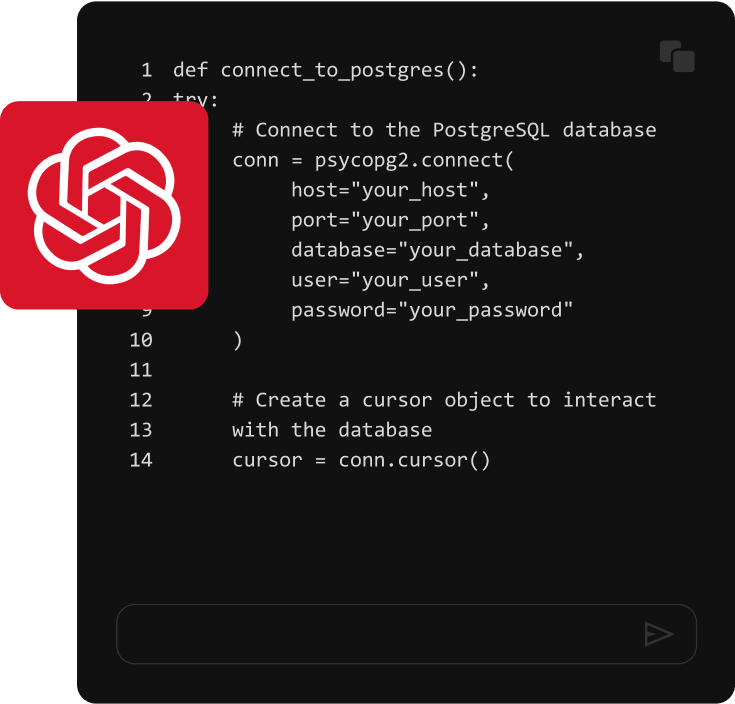
- AI-Aware & Cheat-Resistant by Design Projects intentionally require human reasoning and code understanding; layered integrity features help you trust the results.
- Seamless Workflow Send screens from your ATS or scheduler; standardize the live interview in the same IDE to probe the student’s project decisions. (Request new integrations if needed.)
- Simple, Scalable Pricing Unlimited users with usage-based pricing—enable every engineer to participate in campus season without license juggling.

How Others Approach Campus Hiring (and Where CoderPad Differs)
| What Competitors Emphasize | Common Trade-Offs Reported | CoderPad Advantage |
|---|---|---|
| Large MCQ banks, “events” modules | Lower completion, leaked questions, and seat-based licenses that bottleneck campus teams. | Higher completion, realistic tasks, unlimited users; usage-based pricing aligns to hiring peaks. |
| Long, take-home projects graded by vendor | Expensive per-role, slow feedback, and questionable signal-to-onsite alignment. | Auto-graded projects + live follow-up in one IDE; faster decisions with better context. |
| “Simulation” platforms with heavy hand-holding | Clunky setup, limited social proof, candidate-unfriendly constraints. | Self-serve, intuitive IDE students love; realistic constraints and optional guardrails. |
+96% assessment completion rate
4,000+ customers across 165 countries
Unified screen to interview workflow
FAQs
-
Use an open-link assessment to let any attendee start immediately; auto-grading and dashboards scale to thousands.
-
Standardized, job-relevant projects in a familiar IDE; optional question localization across 30+ languages.
-
Multi-file, context-rich tasks resist one-shot prompts; pair with similarity checks, IDE-exit tracking, suspicious-activity alerts, and optional webcam proctoring.
-
Yes, send screens and create interviews via integrations; if you don’t see yours, request it.
-
We consistently see high satisfaction and completion when interviews and screens reflect real work instead of puzzles.
